Sao (moon)
 Sao imaged by the Very Large Telescope on 3 September 2002 | |
| Discovery[a] | |
|---|---|
| Discovered by |
|
| Discovery site | Cerro Tololo Obs. |
| Discovery date | 14 August 2002 |
| Designations | |
Designation | Neptune XI |
| Pronunciation | /ˈseɪ.oʊ/ |
Named after | Σαώ (Saô)[4] |
| S/2002 N 2 | |
| Adjectives | Saonian /seɪˈoʊniən/[5] |
| Orbital characteristics (range)[b] | |
| Observation arc | 20.13 years (7,352 d)[7] |
| Earliest precovery date | 23 July 2001[7] |
| 22,123,000 to 22,368,100 km (0.147883 to 0.149522 AU) | |
| Eccentricity | 0.07 to 0.63 |
| 7.92 to 8.05 years (2,894 to 2,942 d) | |
| Inclination | 39° to 55° (to ecliptic) |
| Satellite of | Neptune |
| Group | Sao group |
| Proper orbital elements (average)[8] | |
Proper semi-major axis | 22,239,900 km (0.148665 AU) |
Proper eccentricity | 0.296[8] |
Proper inclination | 50.2° (to ecliptic)[8] |
Proper orbital period | 7.99 years (2,919 d)[8] |
Precession of asc. node | 290.974405 arcsec / yr |
| Physical characteristics | |
| 31 to 44 km[c] | |
| 25.4 (R-band)[9][11] | |
| 10.97[12] | |
Sao (/ˈseɪ.oʊ/), also known as Neptune XI and previously as S/2002 N 2, is an irregular moon of Neptune. It was discovered on 14 August 2002 by Tommy Grav, Matthew Holman, JJ Kavelaars, Wesley Fraser, and Dan Milisavljevic at Cerro Tololo Inter-American Observatory in Chile. Named after one of the Nereids from Greek mythology, Sao follows a distant, highly eccentric, and highly inclined orbit around Neptune with an average orbital period of about 8 Earth years. Its orbit is prograde, meaning it revolves around Neptune in the same direction as the planet's orbit around the Sun.
Due to Sao's great distance from Neptune, its orbit is significantly influenced by the Sun's gravity. As a result, the moon experiences the Kozai resonance, which causes large, synchronized variations in its orbital eccentricity and inclination over a 3,000-year period. Sao shares similar orbital characteristics with two other Neptunian irregular moons, Laomedeia and S/2002 N 5, which suggests they originated from the collisional breakup of a once-larger moon of Neptune. Sao is estimated to have a diameter between 31 and 44 km (19 and 27 mi), though most of its physical properties are unknown.
Discovery
Sao was discovered by astronomers Tommy Grav, Matthew Holman, JJ Kavelaars, Wesley Fraser, and Dan Milisavljevic during a search for distant moons of Neptune.[1] Led by Holman, the search began in 2001 and employed large optical telescopes on Earth to obtain numerous long-exposure images of the sky around Neptune.[13][9]: 865 The team used the shift-and-add technique to align and combine the images according to Neptune's motion across the sky, which enhanced the faint moons as points of light.[13][9]: 865–866 Through this technique,[9] they discovered Sao alongside two other Neptunian moons—Halimede and Neso—in images taken on 14 August 2002 by the 4-meter Víctor M. Blanco Telescope at Cerro Tololo Inter-American Observatory, Chile.[3] Sao was among the first Neptunian moons discovered from a ground-based telescope since Nereid in 1949.[1][13]
To determine Sao's orbit around Neptune, astronomers conducted follow-up observations at several observatories, with the help of orbit predictions by Brian G. Marsden and Robert A. Jacobson.[13] A team led by Brett Gladman observed Sao on 3 and 5 September 2002 with the 8.2-m Very Large Telescope at Cerro Paranal Observatory,[14] while other teams observed it with the 2.5-m Nordic Optical Telescope at La Palma Observatory and the 5-m Hale Telescope at Palomar Observatory.[15][13] Earlier observations of Sao were found by Holman in Canada–France–Hawaii Telescope images from 23 July 2001.[14] The discovery of Sao, alongside the Neptunian moons Halimede and Laomedeia, was announced by the Minor Planet Center on 13 January 2003.[14][15] The announcement raised Neptune's number of known moons to 11.[16]
Name
When the discovery of Sao was announced, it was given the temporary provisional designation "S/2002 N 2" by the Minor Planet Center.[14] It was later named and given the Roman numeral designation Neptune XI by the International Astronomical Union's (IAU's) Working Group for Planetary System Nomenclature on 3 February 2007.[17] In accordance with the IAU's naming convention for Neptunian irregular moons, it was named after Sao (Σαώ),[18] one of the fifty Nereids or daughters of Nereus and Doris from Greek mythology.[1][3][d]
Orbit
Sao is an irregular moon of Neptune, meaning it follows a distant, highly eccentric, and highly inclined orbit around the planet.[20][e] Sao's orbit is prograde, meaning it revolves around Neptune in the same direction as the planet's orbit around the Sun.[22]: 1 Due to its great distance from Neptune, the moon is strongly affected by the Sun's gravity, which causes substantial long-term variations in its orbit.[20]: 7 For this reason, Sao's orbit is better described by proper orbital elements, which are calculated by averaging out its perturbed orbit over an extended period of time.[22]: 4
Over a 10,000-year time span, Sao's semi-major axis from Neptune varies from 22.1 to 22.4 million km (13.7 to 13.9 million mi; 0.148 to 0.150 AU), averaging about 22.2 million km (13.8 million mi; 0.148 AU).[b] On average, Sao takes about 7.99 years (2,919 days) to complete one orbit around Neptune,[8] though perturbations by the Sun can vary the orbital period from 7.92 to 8.05 years (2,894 to 2,942 days).[b] While Sao's orbit has an average eccentricity of 0.30 and an average inclination of 50° with respect to the ecliptic,[b] both values vary substantially due to the Sun's perturbations.[22]: 4 The moon's eccentricity ranges from 0.07 to 0.63, while its inclination ranges from 39° to 55°.[b] Among Neptune's known prograde moons, Sao has the highest average inclination.[8]
Because of its varying eccentricity, Sao can occasionally pass close to Nereid, one of Neptune's largest irregular moons.[9]: 867 Over a period of 4.5 billion years, these close encounters could result in gravitational scattering, or even a 1.6% chance of collision.[9]: 866–867 A 2022 study led by Jet Propulsion Laboratory astrophysicists Marina Brozović and Robert A. Jacobson found that Sao and Laomedeia can approach within 320,000 km (200,000 mi) of each other during a 30,000-year time span.[22]: 11

Kozai resonance

Sao's high inclination places it in the Kozai resonance, a dynamical phenomenon in which perturbations from the Sun cause periodic exchanges between orbital eccentricity and inclination.[23][20]: 7–8 First recognized by Holman and colleagues in 2004,[9][20]: 7 the Kozai resonance causes Sao's eccentricity and inclination to oscillate out of phase over a period of about 3,000 years,[f] with eccentricity reaching maximum at minimum inclination and vice versa.[20]: 7 [22]: 8 While Sao's orbit exhibits nodal precession with a period of 4,454 years,[8] the Kozai resonance prevents it from apsidally precessing.[22]: 7 Instead of circulating from 0° to 360°, Sao's argument of pericenter librates around 90° with a period of about 3,000 years.[22]: 7 Sao is the only known prograde irregular moon of Neptune that is in the Kozai resonance.[23]
Group and origin
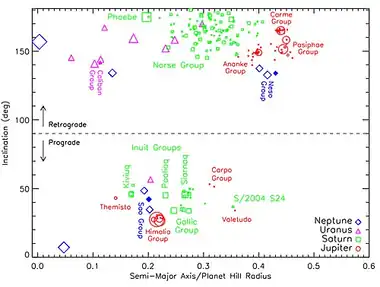
Sao shares similar orbital characteristics with two other Neptunian irregular moons, Laomedeia and S/2002 N 5.[6] Together, they form the Sao group, a family of prograde irregular moons of which Sao is the largest member.[6] The Sao group was first suspected by astronomers in 2004 based on the similar orbits of Sao and Laomedeia,[13][9]: 867 but it was not confirmed until the discovery of S/2002 N 5 as a third member in 2024.[6]: 2 [g] The group is predicted to contain many more smaller members, though they are too faint to be detected with current technology.[24][6]: 9
Because of their similar orbits, the moons of the Sao group have low mutual dispersion velocities between 100 and 200 m/s.[6]: 11–12 The dispersion velocity is the speed needed to eject a fragment from a parent body onto its current orbit.[6]: 11 For fragments produced in collisions, their dispersion velocities are typically below 100 m/s, comparable to the parent body's escape velocity.[6]: 11 The minimum dispersion velocities of the Sao group are low enough to suggest that it originated from a collision, meaning it may be a collisional family.[6]: 12 The Sao group is believed to have originated from the destruction of a once-larger irregular moon by a collision with a passing asteroid or comet.[24][1] This former moon was likely gravitationally captured by Neptune during the Solar System's early history, during or shortly after the formation of the planets.[6]
If the Sao group is a collisional family, then its members are expected to are expected to share similar surface characteristics, such as color.[22]: 11 Compared to other collisional families, the Sao group is unusual in that two of its largest members—Sao and Laomedeia—have similar brightness and estimated sizes.[6]: 12
Physical characteristics
Little is known about Sao's physical characteristics.[1] Like most of Neptune's irregular moons, Sao is extremely faint and difficult to observe due to its small size and great distance from the Sun.[13] In red light (R band), Sao has an apparent magnitude of 25.4,[9][11] making it about 100 million times fainter than what can be seen with the naked eye.[13][1] Because of this, Sao and most of Neptune's irregular moons can only be observed through long-exposure imaging with large optical telescopes.[13][22]: 12
The diameter of Sao has not been directly measured, although it can be indirectly estimated from its brightness and an assumed geometric albedo.[10]: 173–174 Assuming a geometric albedo of 0.04, Sao's diameter would be about 44 km (27 mi).[10]: 174 For a higher albedo of 0.06, Sao would have a diameter of 31 km (19 mi).[9]: 866 Sao appears to be roughly the same size as Laomedeia, if both moons have the same albedo.[6]: 12
See also
- Other Neptunian irregular moons discovered in 2002:
- Halimede
- Laomedeia
- Neso
- S/2002 N 5 (lost in 2002, confirmed much later in 2024)
Notes
- ↑ This is the exact order of discoverers listed by NASA, the International Astronomical Union, and the United States Geological Survey.[1][2][3]
- 1 2 3 4 5 Sheppard et al. (2024) give the mean, minimum, and maximum values for Sao's osculating orbital elements in Table 6: semi-major axis 22239900+128200
−116900 km, eccentricity 0.30+0.33
−0.23, inclination 50°+5°
−11° with respect to the ecliptic, and orbital period 2917+25
−23.[6]: 11 The error bars represent the difference between the minimum/maximum value and the average value over a 10,000-year period.[6]: 11 - ↑ The 31 km diameter estimate comes from Holman et al. (2004) who assume a geometric albedo of 0.06,[9] while the 44 km diameter estimate comes from Sheppard et al. (2006) who assume a geometric albedo of 0.04.[10]
- ↑ According to Nicholson et al. (2008), Neptunian irregular moons with prograde and retrograde orbits are generally given names ending with "a" or "e", respectively, while those with unusually high orbital inclinations are given names ending with "o".[19]: 414 However, the International Astronomical Union does not state this naming scheme on its website.[3] At the time of its naming, Sao had the highest average inclination out of Neptune's known prograde moons,[20] although the later discovery of S/2002 N 5 in 2024 has shown that Sao's inclination is not unique.[6] The only two Neptunian irregular moons with names ending with "o", Sao and Neso, are both in Kozai resonance unlike the rest of the named Neptunian irregular moons.[6][21]: 507
- ↑ Neptune's moons Triton and Nereid are sometimes considered irregular moons, though researchers often discuss them separately due to their unusual orbital characteristics and disproportionately large sizes.[10]: 173 [22]: 1
- ↑ Although Brozović and Jacobson (2022) do not explicitly give the oscillation period for Sao's eccentricity and inclination, they do mention that they are correlated with the moon's argument of pericenter libration, which has a period of ~3,000 years.[22]: 4, 7 This can be seen in Figure 5 of their paper.[22]: 8
- ↑ S/2002 N 5 was discovered in 2002, but its orbit was not determined and published until 2024.[6][24]
References
- 1 2 3 4 5 6 7 "Sao". NASA. 3 November 2024. Archived from the original on 2 April 2026. Retrieved 4 July 2026.
- ↑ "Planetary Satellite Discovery Circumstances". JPL Solar System Dynamics. NASA. Archived from the original on 27 September 2021. Retrieved 22 June 2026.
- 1 2 3 4 "Planet and Satellite Names and Discoverers". Gazetteer of Planetary Nomenclature. USGS Astrogeology Science Center. Archived from the original on 18 June 2026. Retrieved 22 June 2026.
- ↑ "Σαώ". Logeion (ΛΟΓΕΙΟΝ). University of Chicago. Archived from the original on 3 July 2026. Retrieved 3 July 2026.
- ↑ Cf. the etymology of Saonia
- 1 2 3 4 5 6 7 8 9 10 11 12 13 14 15 16 Sheppard, Scott S.; Tholen, David J.; Brozović, Marina; Jacobson, Robert A.; Trujillo, Chadwick A.; Lykawka, Patryk Sofia (December 2024). "New Moons of Uranus and Neptune from Ultradeep Pencil-beam Surveys". The Astronomical Journal. 168 (6): 258. arXiv:2410.00108. Bibcode:2024AJ....168..258S. doi:10.3847/1538-3881/ad7fed. S2CID 273022766.
- 1 2 "MPC Explorer - Neptune 11". Minor Planet Center. Archived from the original on 5 July 2026. Retrieved 4 July 2026.
- 1 2 3 4 5 6 7 "Planetary Satellite Mean Elements". JPL Solar System Dynamics. NASA. Archived from the original on 6 June 2026. Retrieved 22 June 2026.
- 1 2 3 4 5 6 7 8 9 10 11 Holman, Matthew J.; Kavelaars, J. J.; Grav, Tommy; Gladman, Brett J.; Fraser, Wesley C.; Milisavljevic, Dan; et al. (August 2004). "Discovery of five irregular moons of Neptune" (PDF). Nature. 430 (7002): 865–867. Bibcode:2004Natur.430..865H. doi:10.1038/nature02832. PMID 15318214. S2CID 4412380.
- 1 2 3 4 Sheppard, Scott S; Jewitt, David C.; Kleyna, Jan (July 2006). "A Survey for "Normal" Irregular Satellites around Neptune: Limits to Completeness". The Astronomical Journal. 132 (1): 171–176. arXiv:astro-ph/0604552. Bibcode:2006AJ....132..171S. doi:10.1086/504799. S2CID 154011.
- 1 2 Sheppard, Scott S. "Moons of Neptune". Earth & Planets Laboratory. Carnegie Institution for Science. Archived from the original on 23 January 2026. Retrieved 4 July 2026.
- ↑ "Natural Satellites Ephemeris Service". Minor Planet Center. Archived from the original on 4 October 2022. Retrieved 22 June 2026. Check "Just the following Neptunian outer irregular satellites", then check "Neptune 11 (Sao)", then go to "Output Format(s) Required" and check "I require Orbital Elements", and then click the gray "Get Information" button.
- 1 2 3 4 5 6 7 8 9 Gladman, Brett J. (15 January 2003). "Discovery of 3 satellites of Neptune". University of British Columbia. Archived from the original on 15 April 2003. Retrieved 23 June 2026.
- 1 2 3 4 Marsden, Brian G. (13 January 2003). "MPEC 2003-A75 : S/2002 N 1, 2002 N 2, 2002 N3". Minor Planet Electronic Circulars. Minor Planet Center. Archived from the original on 6 February 2026. Retrieved 4 July 2026.
- 1 2 Holman, M.; Kavelaars, J.; Grav, T.; Fraser, W.; Milisavljevic, D.; et al. (13 January 2003). Green, Daniel W. E. (ed.). "IAUC 8047: Sats OF NEPTUNE; N IN NGC 185; 2003H". IAU Circular (8047). Central Bureau of Astronomical Telegrams: 1. Bibcode:2003IAUC.8047....1H. Archived from the original on 7 December 2025. Retrieved 4 July 2026.
- ↑ Whitehouse, David (14 January 2003). "New moons for Neptune". BBC News. Archived from the original on 3 December 2003.
- ↑ Green, Daniel W. E., ed. (3 February 2007). "IAUC 8802: P/2006 XG_16; Sats OF NEPTUNE; C/2006 P1". IAU Circular (8802). Central Bureau of Astronomical Telegrams: 2. Bibcode:2007IAUC.8802....2G. Archived from the original on 15 March 2026. Retrieved 23 June 2026.
- ↑ Blunck, Jürgen (2010). "The Satellites of Neptune". Solar System Moons: Discovery and Mythology. Springer Berlin, Heidelberg. p. 123. doi:10.1007/978-3-540-68853-2. ISBN 978-3-540-68853-2.
- ↑ Nicholson, Philip D.; Ćuk, Matija; Sheppard, Scott S.; Nesvorný, David; Johnson, Torrence V. (2008). "Irregular Satellites of the Giant Planets" (PDF). The Solar System Beyond Neptune. University of Arizona Press. pp. 411–424. Bibcode:2008ssbn.book..411N. ISBN 9780816527557. Archived (PDF) from the original on 12 September 2025. Retrieved 22 June 2026.
- 1 2 3 4 5 6 Brozović, Marina; Jacobson, Robert A.; Sheppard, Scott S. (April 2011). "The Orbits of Neptune's Outer Satellites". The Astronomical Journal. 141 (4): 135. Bibcode:2011AJ....141..135B. doi:10.1088/0004-6256/141/4/135.
- ↑ Grishin, Evgeni (August 2024). "Irregular fixation – II. The orbits of irregular satellites". Monthly Notices of the Royal Astronomical Society. 533 (1): 497–509. arXiv:2407.05123. Bibcode:2024MNRAS.533..497G. doi:10.1093/mnras/stae1752. S2CID 271051291.
- 1 2 3 4 5 6 7 8 9 10 11 12 Brozović, Marina; Jacobson, Robert A. (May 2022). "Orbits of the Irregular Satellites of Uranus and Neptune". The Astronomical Journal. 163 (5): 241. Bibcode:2022AJ....163..241B. doi:10.3847/1538-3881/ac617f. S2CID 248458067.
- 1 2 Lei, Hanlun; Leng, Xiaoyan; Grishin, Evgeni (May 2026). "Extensions of Brown Hamiltonian–III. Applications to irregular satellites of giant planets". Monthly Notices of the Royal Astronomical Society. 549 (2) stag921. arXiv:2605.12864. Bibcode:2026MNRAS.549ag921L. doi:10.1093/mnras/stag921.
- 1 2 3 "New moons of Uranus and Neptune announced". Earth & Planetary Laboratory. Carnegie Institution for Science. 23 February 2024. Archived from the original on 15 February 2026. Retrieved 2 July 2026.
External links

- Marsden, Brian G. (26 September 2003). "MPEC 2003-S67 : S/2002 N 2 (2003 recovery of Sao)". Minor Planet Electronic Circulars. Minor Planet Center.
- "Five new moons for planet Neptune". BBC News. 18 August 2004. Archived from the original on 27 August 2004.
- Whitehouse, David (14 January 2003). "New moons for Neptune". BBC News. Archived from the original on 3 December 2003.
- "Neptune Moons – Sao". NASA Science. 3 November 2024.
- Sheppard, Scott S. "Moons of Neptune". Carnegie Institution for Science.
Listed in approximately increasing distance from Neptune | |||||||||||
| Regular (inner) | |||||||||||
| Irregular |
| ||||||||||
| See also | |||||||||||


| Geography |  | ||||||
|---|---|---|---|---|---|---|---|
| Moons | |||||||
| Astronomy |
| ||||||
| Exploration |
| ||||||
| Related | |||||||