Argo (NASA spacecraft)
| Mission type | Reconnaissance Multiple flyby Outer planets Kuiper belt exploration |
|---|---|
| Operator | NASA |
| Spacecraft properties | |
| Power | RTG (proposed) |
| Start of mission | |
| Launch date | Launch window: 2020s |
| Flyby of Neptune, Triton, and one KBO | |
| Closest approach | Neptune: 8-11 years after launch.[1] KBO: an additional 3-5 years[1] |

Argo was a 2009 spacecraft mission concept by NASA to the outer planets and beyond.[1][2][3] The concept included flybys of Jupiter, Saturn, Neptune, and a Kuiper belt object.[1] A focus on Neptune and its largest moon Triton would have helped answer some of the questions generated by Voyager 2's flyby in 1989,[1] and would have provided clues to ice giant formation and evolution.[2]
Mission
The Argo mission was meant to compete for the New Frontiers mission 4 (~$650M). One of the reasons Argo was not formally proposed was the shortage of plutonium-238 for the required radioisotope thermoelectric generator (RTG) for electric power.[4] The current launch window for this mission had been particularly favorable. It opened in 2015 and lasted through the end of 2019, so future missions would need to be redesigned for the relevant planetary alignments.[4]
It was noted that although it offered a Neptune mission at the price of New Frontier's budget, it would be flyby only, limiting the amount of time at Neptune and Triton compared to an orbiter.[5] However, the advantage would be access to a wide variety of Kuiper belt objects by using a gravity assist at Neptune, which would allow a wide range of objects to potentially be targeted.[5] In addition, with a flyby of Jupiter and Saturn, the Planetary Society compared the mission to Voyager 2.[5]
Itinerary
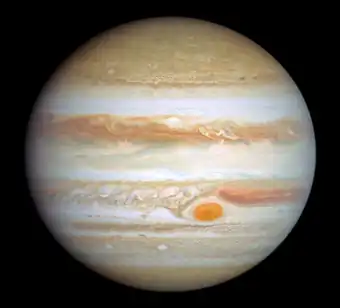
During its flybys of the giant planets, there would have been potentially well over 100 other moons that could have been studied, and beyond Neptune, the possibility of visiting Kuiper belt objects.
 |
 |
 |
 |
See also
- New Horizons probe, performed a Pluto flyby in 2015
- New Horizons 2
References
- 1 2 3 4 5 Hansen, C. J.; Aljabri, A. S.; Banfield, D.; Bierhaus, E. B.; Brown, M.; Colwell, J. E.; Dougherty, M.; Hendrix, A. R.; Ingersoll, A.; Khurana, K.; Landau, D.; McEwen, A.; Paige, D. A.; Paranicas, C.; Satter, C. M.; Schmidt, B.; Showalter, M.; Spiker, L. J.; Spilker, T.; Stansberry, J.; Strange, N.; Tiscareno, M. (August 27, 2009). Neptune Science with Argo – A Voyage through the Outer Solar System (PDF) (Technical report). NASA/JPL. p. 3. S2CID 2593563. Archived (PDF) from the original on June 12, 2025.
A launch opportunity to the outer Solar System via Neptune opens in 2015 and lasts through the end of 2019, with backup options in 2020. It allows trajectories with reasonably short trip times to Neptune (8-11 years) and the Kuiper Belt (an additional 3-5 years), as well as low Triton approach speeds <17 km/sec.
- 1 2 Hansen, C. J.; Hammel, H. B.; Spiker, L. J. (September 2009). Argo: Exploring the Neptune System and Beyond (PDF). European Planetary Science Congress. EPSC Abstracts. Vol. 4. Potsdam, Germany: Europlanet. p. 796. Bibcode:2009epsc.conf..796H. S2CID 172230804. Archived (PDF) from the original on June 7, 2025. Retrieved November 7, 2016.
- ↑ "White Paper: Argo Mission to Neptune, Triton, and a KBO". Future Planetary Exploration. August 30, 2009. Archived from the original on January 22, 2026.
- 1 2 Betz, Eric (August 24, 2015). "NASA's next big spacecraft mission could visit an ice giant". Astronomy. Archived from the original on March 15, 2026. Retrieved November 7, 2016.
- 1 2 3 Lakdawalla, Emily (November 7, 2008). "A launch to Neptune in 2019?". The Planetary Society. Archived from the original on April 20, 2026. Retrieved January 21, 2018.
External links
| Geography | | ||||||
|---|---|---|---|---|---|---|---|
| Moons | |||||||
| Astronomy |
| ||||||
| Exploration |
| ||||||
| Related | |||||||


| Geography (features) |
| | ||||||||||
|---|---|---|---|---|---|---|---|---|---|---|---|---|
| Astronomy |
| |||||||||||
| Exploration |
| |||||||||||
| Related | ||||||||||||