SN 2022esa
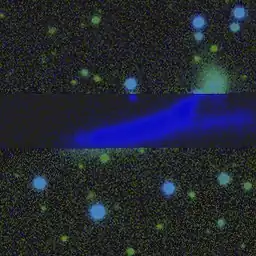 Image of host galaxy imaged by Legacy Surveys | |
| Event type | Supernova |
|---|---|
| Ic-CSM | |
| Date | 12 March 2022, 20:08:32[1] |
| Instrument | ATLAS |
| Constellation | Ursa Major |
| Right ascension | 16h 53m 57.60s[2] |
| Declination | −09° 42′ 10.3″[2] |
| Epoch | J2000 |
| Distance | 320 Mly (98 Mpc)[3] |
| Redshift | 0.02314[4] |
| Host | LEDA 987574 (2MFGC 13525) |
| Progenitor | Wolf-Rayet star |
| Peak apparent magnitude | +18.057[1] |
| Other designations | SN 2022esa, ATLAS22iyt, Gaia22bgw, PS22dfl, ZTF22aaemvhi[1] |
SN 2022esa (also known as ATLAS22iyt) is a peculiar Type Ic supernova with circumstellar material (Ic-CSM) that was discovered in galaxy LEDA 987574 (2MFGC 13525) located approximately 320 million light-years away in the constellation of Ursa Major.[3] It is notable for its association with the explosion of a massive Wolf–Rayet star in a binary system and is a potential candidate for a binary black hole system.[5] Observations suggest it provides evidence that the collapse of some massive stars can produce supernovae rather than as a failed supernova with direct black hole formation.[6]
Observation
Follow-up observations were conducted using the Seimei telescope in Okayama, Japan, and the Subaru telescope at Mauna Kea, Hawaii. These multi-epoch photometric and spectroscopic data spanned over 400 days.[6][5]
Spectra revealed late-time emergence of narrow emission lines from oxygen and other intermediate-mass elements formed in the star's core, characteristic of interaction between supernova ejecta and oxygen-rich circumstellar material (CSM).[4] This firmly places it in the rare Type Ic-CSM subclass.[4]
The progenitor is proposed to be a massive Wolf–Rayet (WR) star in a binary system (WR–WR or WR–black hole).[4] In either case, the system is viewed as a potential candidate for a binary black hole system.[7][3]
References
- 1 2 3 "2022esa | Transient Name Server". www.wis-tns.org. Retrieved 2026-05-11.
- 1 2 "SN 2022esa". SIMBAD. Centre de données astronomiques de Strasbourg. Retrieved 2026-05-11.
- 1 2 3 published, Robert Lea (2026-01-14). "Massive supernova explosion may have created a binary black hole". Space. Retrieved 2026-05-26.
- 1 2 3 4 Maeda, Keiichi; Kuncarayakti, Hanindyo; Nagao, Takashi; Kawabata, Miho; Taguchi, Kenta; Uno, Kohki; De, Kishalay (2026-02-05). "Peculiar SN Ic 2022esa: An explosion of a massive Wolf–Rayet star in a binary as a precursor to a BH–BH binary?". Publications of the Astronomical Society of Japan. 78 (1): 1–7. arXiv:2512.02680. doi:10.1093/pasj/psaf140. ISSN 0004-6264.
- 1 2 Thompson, Mark (2026-01-14). "A Supernova That Shouldn't Exist". Universe Today. Retrieved 2026-05-26.
- 1 2 "Massive supernova from Wolf-Rayet star could be precursor to black hole binary". phys.org. 2026-01-14. Retrieved 2026-05-26.
- ↑ "Born in brightness, leading to darkness". KYOTO UNIVERSITY. 2026-01-13. Retrieved 2026-05-26.
