4C 49.22
| 4C 49.22 | |
|---|---|
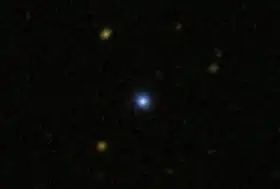 The quasar 4C 49.22 | |
| Observation data (J2000.0 epoch) | |
| Constellation | Ursa Major |
| Right ascension | 11h 53m 24.46s[1] |
| Declination | +49° 31′ 08.83″[1] |
| Redshift | 0.333640[1] |
| Heliocentric radial velocity | 100023 km/s[1] |
| Distance | 3.848 Gly |
| Apparent magnitude (V) | 17.66 |
| Apparent magnitude (B) | 17.94 |
| Characteristics | |
| Type | FSRQ[1] |
| Size | ~470,000 ly (144 kpc) (estimated)[1] |
| Other designations | |
| SBS 1150+497, 21P 164, 2MASX J11532449+4931090, LEDA 2821081, CoNFIG 114, LB 02136, LHE 310, NVSS J115324+493109, OM +484, RBS 1046, RX J1153.4+4931[1] | |
4C 49.22 is a radio-loud quasar[2] located in the constellation of Ursa Major. The redshift of the object is (z) 0.333[1] and it was first discovered as an astronomical radio source in 1967 by astronomers.[3] The radio spectrum of the object is considered flat, making this a flat spectrum radio quasar.[4][5]
Description
4C 49.22 is categorized as a blazar, mainly due to its variability on the electromagnetic spectrum, with one gamma ray displayed on 15 May 2011 after being in a long period of low gamma-ray activity state when observed by the Large Area Telescope (LAT).[6][5] Its host is an extremely large luminous elliptical galaxy[7] with an off-centered nucleus and a slight elongation towards the north-east. A faint tidal arm is curved, suggesting an interaction with a small companion 10 arcseconds away from it.[8] The central supermassive black hole of the quasar is estimated to be 3.3 × 10⁸ M☉.[5]
The radio structure of 4C 49.22 is compact. When observed by the Very Long Baseline Array (VLA), the source is found to be a triple with a halo structure located in north to south direction. There is a bright radio core present with an estimated flux density of 338 mJy at 5 GHz frequencies and a flat spectrum between frequencies of 1.6 and 15 GHz.[9][10]
The one-sided radio jet of the quasar is extensively studied. When observed by very-long-baseline interferometry (VLBI), the jet is found be slightly extended for about three milliarcseconds. There is also a knot feature present in the jet at around 1.39 ± 0.1 milliarcsecond from the core region. On the southwest side its intensity is increasing brightly until the knot position, where it fades away.[11] This jet is described as having a knotty appearance, with the knot features having a jet power between 2.0 × 1045 to 1.4 × 1048 erg s−1.[4] There is also a high amount of polarization present in the jet as well as variations along the rotation measure of the jet, increasing from 15 rad m−2 at the core position until 25 rad m−2 at a knot feature.[10] This jet has also been studied in X-rays, where a hotspot feature is located in its southern lobe and further separated into two components.[12]
References
- 1 2 3 4 5 6 7 8 "NED Search results for 4C 49.22". NASA/IPAC Extragalactic Database. Retrieved 2025-12-09.
- ↑ Sambruna, Rita M.; Gliozzi, Mario; Tavecchio, F.; Maraschi, L.; Foschini, Luigi (2006-11-20). "The Jet-Disk Connection in AGNs:ChandraandXMM-NewtonObservations of Three Powerful Radio-Loud Quasars". The Astrophysical Journal. 652 (1): 146–156. arXiv:astro-ph/0606659. Bibcode:2006ApJ...652..146S. doi:10.1086/507420. ISSN 0004-637X. Archived from the original on 2024-08-04.
- ↑ Wills, D. (1967). "Optical identifications of selected 4C radio sources". Monthly Notices of the Royal Astronomical Society. 135: 339. Bibcode:1967MNRAS.135..339W. doi:10.1093/mnras/135.4.339 (inactive 9 December 2025). ISSN 0035-8711.
{{cite journal}}: CS1 maint: DOI inactive as of December 2025 (link) - 1 2 Zhang, Jin; Zhang, Hai-Ming; Yao, Su; Guo, Sheng-Chu; Lu, Rui-Jing; Liang, En-Wei (October 2018). "Jet Radiation Properties of 4C +49.22: from the Core to Large-scale Knots". The Astrophysical Journal. 865 (2): 100. arXiv:1808.07978. Bibcode:2018ApJ...865..100Z. doi:10.3847/1538-4357/aadd0b. ISSN 0004-637X.
- 1 2 3 Cutini, S.; Ciprini, S.; Orienti, M.; Tramacere, A.; D'Ammando, F.; Verrecchia, F.; Polenta, G.; Carrasco, L.; D'Elia, V.; Giommi, P.; González-Nuevo, J.; Grandi, P.; Harrison, D.; Hays, E.; Larsson, S. (2014-11-07). "Radio–gamma-ray connection and spectral evolution in 4C +49.22 (S4 1150+49): the Fermi, Swift and Planck view". Monthly Notices of the Royal Astronomical Society. 445 (4): 4316–4334. doi:10.1093/mnras/stu2011. ISSN 1365-2966.
- ↑ Cutini, Sara; Ciprini, Stefano; Larsson, Stefan; Orienti, Monica; D'Ammando, Filippo; Collaboration, Fermi-LAT (December 2012). "Multi-wavelength observations of blazar 4C + 49.22 during flaring state". High Energy Gamma-Ray Astronomy: 5th International Meeting on High Energy Gamma-Ray Astronomy. AIP Conference Proceedings. 1505: 530–533. Bibcode:2012AIPC.1505..530C. doi:10.1063/1.4772314. ISSN 0094-243X.
- ↑ Floyd, David J. E.; Kukula, Marek J.; Dunlop, James S.; McLure, Ross J.; Miller, Lance; Percival, Will J.; Baum, Stefi A.; O'Dea, Christopher P. (November 2004). "The host galaxies of luminous quasars". Monthly Notices of the Royal Astronomical Society. 355 (1): 196–220. arXiv:astro-ph/0308436. Bibcode:2004MNRAS.355..196F. doi:10.1111/j.1365-2966.2004.08315.x. ISSN 0035-8711.
- ↑ Hutchings, J. B.; Johnson, I.; Pyke, R. (April 1988). "Optical images of quasars and radio galaxies". The Astrophysical Journal Supplement Series. 66: 361. Bibcode:1988ApJS...66..361H. doi:10.1086/191261. ISSN 0067-0049. Archived from the original on 2024-05-17.
- ↑ Cheng, X.-P.; An, T.; Frey, S.; Hong, X.-Y.; He, X.; Kellermann, K. I.; Lister, M. L.; Lao, B.-Q.; Li, X.-F.; Mohan, P.; Yang, J.; Wu, X.-C.; Zhang, Z.-L.; Zhang, Y.-K.; Zhao, W. (2020-04-01). "Compact Bright Radio-loud AGNs. III. A Large VLBA Survey at 43 GHz". The Astrophysical Journal Supplement Series. 247 (2): 57. arXiv:2003.01382. Bibcode:2020ApJS..247...57C. doi:10.3847/1538-4365/ab791f. ISSN 0067-0049.
- 1 2 Akujor, C. E.; Garrington, S. T. (1991-06-01). "MERLIN and VLA observations of the quasar 1150 + 497". Monthly Notices of the Royal Astronomical Society. 250 (3): 644–649. doi:10.1093/mnras/250.3.644. ISSN 0035-8711.
- ↑ Linfield, R. (December 1983). "VLBI observations of the QSO 4C49.22". The Astrophysical Journal. 275: 461. Bibcode:1983ApJ...275..461L. doi:10.1086/161546. ISSN 0004-637X. Archived from the original on 2024-09-05.
- ↑ Sambruna, Rita M.; Gambill, Jessica K.; Maraschi, L.; Tavecchio, F.; Cerutti, R.; Cheung, C. C.; Urry, C. Megan; Chartas, G. (2004-06-20). "A Survey of Extended Radio Jets withChandraand theHubble Space Telescope". The Astrophysical Journal. 608 (2): 698–720. arXiv:astro-ph/0401475. Bibcode:2004ApJ...608..698S. doi:10.1086/383124. ISSN 0004-637X.
External links
- 4C 49.22 on SIMBAD
- 4C 49.22 on WikiSky: DSS2, SDSS, GALEX, IRAS, Hydrogen α, X-Ray, Astrophoto, Sky Map, Articles and images
