São Paulo Metropolitan Trains
| São Paulo Metropolitan Train | |||
|---|---|---|---|
 | |||
 | |||
 | |||
| Overview | |||
| Native name | Trem Metropolitano de São Paulo | ||
| Owner | São Paulo State Government | ||
| Area served | Greater São Paulo and Jundiaí, Brazil | ||
| Transit type | Commuter rail, Rapid Transit | ||
| Number of lines | 7 | ||
| Line number |
| ||
| Number of stations | 99[notes 1] | ||
| Daily ridership | 2.373 million - weekdays, entire network (2023)[1][2][3] 1.573 million - weekdays, CPTM-operated lines (2023)[1] 770 thousand - weekdays, ViaMobilidade-operated lines (2023)[2][3] | ||
| Annual ridership | 644.35 million - entire network (2023)[2][3][4] 417.93 million - CPTM-operated lines (2023)[4] 226.42 million - ViaMobilidade-operated lines (2023)[2][3] | ||
| Website |
| ||
| Operation | |||
| Began operation | 1889 | ||
| Operator(s) |  Companhia Paulista de Trens Metropolitanos (Line 10) TIC Trens (Line 7)  ViaMobilidade Linhas 8 e 9 (Lines 8 and 9)  Trivia Trens (Lines 11–13) | ||
| Headway | 10–28 minutes 35 minutes (weekends and holidays) | ||
| Technical | |||
| System length |
| ||
| Track gauge | 1,600 mm (5 ft 3 in) | ||
| Electrification | Overhead line, 3,000 V DC | ||
| Average speed | 60 km/h (37 mph) | ||
| Top speed | 90 km/h (56 mph) | ||
| |||


The São Paulo Metropolitan Train (Brazilian Portuguese: Trem Metropolitano de São Paulo) is a public railway system of commuter rail services operating in Greater São Paulo, serving 23 of its 39 municipalities. The system comprises 281 km (175 mi) of length, 7 lines and 100 unique (110 overall) stations, carrying around 3 million passengers on an average weekday.[notes 1][1][2][3]
Currently, it is operated by three different companies: one is the state-owned Companhia Paulista de Trens Metropolitanos (CPTM), which took over the lines formerly operated by the Companhia Brasileira de Trens Urbanos (CBTU) in 1994 and by FEPASA in 1996; the others are private: ViaMobilidade Linhas 8 e 9, which took over the former FEPASA lines under a concession granted by the São Paulo State Government and began operating lines 8 and 9 in January 2022; TIC Trens, which began operating line 7 on November 26, 2025, and will also be responsible for the Northern Corridor of the regional rail network service.[6]
The São Paulo metropolitan rail network is the largest urban rail system in Brazil by route length and the country's second-busiest in terms of daily ridership, behind only the São Paulo Metro. It is integrated into the Metro system, composing a network of over 300 km (190 mi), making it the largest metropolitan rail transport network in Latin America.[7]
History
Origin of the lines
Federal railways
The history of railways in the state of São Paulo dates back to 1867 with the construction of the first link between the cities of Santos, São Paulo and Jundiaí by São Paulo Railway, inaugurated on 16 February 1867, which crossed the state plateau and going down the Serra do Mar.[8][9]: 15–16 The first commuter train service on this railway dates back to 1883, between Pirituba and Pilar (Mauá) stations, gradually expanded over the years from Jundiaí to Paranapiacaba (shortened to Rio Grande da Serra in 2001), forming the current lines 7–Ruby and 10–Turquoise.[10][11]
In the 1870s, the Companhia São Paulo e Rio de Janeiro build the Estrada de Ferro do Norte, a railway that connected São Paulo to the cities of the Paraíba Valley. In the 1890s, this railway was incorporated by Estrada de Ferro Central do Brasil (EFCB), connecting São Paulo to Rio de Janeiro.[12] The commuter train service on this line was operated between do Norte and Mogi das Cruzes stations, constituting what is currently Line 11–Coral.[13]: 72 In 1921, the EFCB began constructing a variant to the main trunk called the Poá Variant, between Tatuapé and Calmon Viana stations. The service started its operation in 1934 and it now comprises the entirety of Line 12–Sapphire.[14]: 6
In 1946, Estrada de Ferro Santos-Jundiaí, administered by the federal government, took over the railway, which corresponds to the current lines 7-Ruby and 10-Turquoise.[15]
In 1957, the federal railway are unified into one state-owned company, Rede Ferroviária Federal (RFFSA), amongst them EFCB and Estrada de Ferro Santos-Jundiaí.[16][17] RFFSA's commuter train operations throughout the country originated, in the 1970s, the Empresa Brasileira de Transporte Urbano (EBTU), merged in 1984 with the Empresa de Engenharia Ferroviária (ENGEFER), creating the Companhia Brasileira de Trens Urbanos (CBTU).[18] In Greater São Paulo, CBTU was responsible for operating the northwest–southeast, East (also called Trunk) and Variant lines of the commuter train system.[19]: 1–2
State railways

In 1875, the Sorocabana Railway was inaugurated, with a connection between the cities of São Paulo and Sorocaba, called the Trunk Line. The EFS was nationalized by the Government of São Paulo in 1919. In 1934, a commuter train service began operating between São Paulo and Mairinque stations (and later shortened to Amador Bueno), constituting what is today Line 8–Diamond.[11][20]: 40
After Sorocabana was incorporated by FEPASA in 1971, the Regional Unit of the Suburbs was created, later renamed to Metropolitan Regional Direction. It was a division that managed passenger transportation within the metropolitan areas of the state of São Paulo. In Greater São Paulo, it was responsible for operating the West and South lines of the commuter rail system.[21][22]
Operations in the second half of the 20th century

From 1975 to 1980, FEPASA/DRM developed a great plan of remodeling of the suburbs trains, transformed into metropolitan trains (West and South Lines). Yet, the economic crisis jeopardized the investments and delayed the projects implementations.[23][21]
At the same time, the suburban trains operated by RFFSA (Lines Santos-Jundiaí, Tronco Mogi and Variante Poá) received modest investments. With that, breakdowns and riots were common, with commuters promoting vandalism in stations, trains and other railway facilities. In 1972, during the discussion of the project of East-West Line, the Metro proposed the transfer of Tronco-Mogi Line and its conversion into a metropolitan train, proposed rejected by RFFSA.[24]
Even with the transfer of the suburban lines from RFFSA to the recently created CBTU, the precariousness of the urban trains administered by the federal government reached a peak in 1987 with the Itaquera rail crash. Caused by the lack of investments and maintenance failures, the accident caused the death of 51 passengers. On 30 April 1987, the state government and the Ministry of Transports signed an intention protocol for the transfer of CBTU East Line-Mogi to the Metro administration. The cost of the transfer and conversion of the line into metropolitan train was of US$ 350 million (almost Cz$ 9 billion) for the state.[25] During 1987, the state government negotiated with the federal government. The lack of state funds and lack of interest of CBTU in the transfer (the company proposed to the state government a shared operation of the lines among CBTU, RFFSA and Metrô)[26] blocked the continuation of the project, besides it was the first step of the acquisition of the network by the state government years later.[27][22]
Creation of CPTM and complete state takeover

On May 28, 1992, through Law No. 7,861, the São Paulo government created the Companhia Paulista de Trens Metropolitanos (CPTM),[28] which would be responsible for assuming management of the commuter train system in the São Paulo Metropolitan Region, replacing CBTU's São Paulo Urban Trains Superintendency (STU/SP) and Fepasa DRM, to ensure continuity and improvement of services. Effective control of the lines belonging to CBTU occurred only in 1994.[29]: 31–32 The Fepasa lines were incorporated into CPTM in 1996, at the same time the company's freight railway network was transferred to RFFSA, being subsequently privatized along with the company's entire railway system around the country.[29]: 30

CPTM established a new visual communication for the system, adopting a silver livery with blue and red details for the trains, replacing the blue and green on CBTU rolling stock and the red and white of Fepasa compositions. The lines also gained a new naming convention, replacing regions with letters and colors. The CBTU's Northwest, Southeast, East and Variant lines were renamed A–Brown, D–Bege, E–Orange and F–Violet, and Fepasa's West and South lines became B–Grey and C–Celestial.[30][29]: 45
Expansion and modernization
At the beginning of CPTM's management, the frequent occurrence of breakdowns, sexual harassment, street vending, strikes, train surfing, among other problems,[31] led some passengers to cause a series of depredations at trains and stations from September 30 to October 16, 1996, causing the interruption of services on the then Line A–Brown for six months.[32] Due to having such an extensive and degraded railway network, CPTM began modernizing its systems, investing 1.5 billion dollars in the network between 1995 and 2004.[33]
Early construction works began in 1998 for the then-called Line G–Lilac, which had been planned for years by Fepasa as the Campo Limpo Branch.[34] The section between Largo Treze and Capão Redondo, in the south zone of São Paulo, required the construction of 7.5 kilometres (4.7 mi) of elevated tracks, 1 km (0.62 miles) of at-grade tracks, and 850 m (2,790 feet) of underground tracks,[35] as well as a maintenance and switching yard in Capão Redondo. However, the section was handed over in 2001 to the São Paulo Metro in exchange for the Expresso Leste, built by CMSP.[36]: 33 The shortcut between Corinthians-Itaquera and Guaianases led to the extinction of the "trunk line" layout that went through the Itaquera district (current José Pinheiro Borges Avenue route), as well as the shutdown several stations between Corinthians-Itaquera and Tatuapé. Following the handover, works began on Line 5 of the São Paulo Metro, which replaced the previous project and started operation in 2002.[37]
In November 2006, the CPTM Operational Control Center (CCO) building was inaugurated in an area adjacent to Brás Station. Besides metropolitan trains, it also manages the circulation of freight trains on the sections where they share tracks with passenger trains. The CCO became responsible for the operation of the six lines of the system, which were previously commanded from different points.[38]

In March 2008, the nomenclature of the lines belonging to the train system was unified with the scheme used by the Metro. Each line was assigned a number (starting from 7) and the name of a gemstone. Thus, lines A–Brown, B–Grey, C–Celestial, D–Bege, E–Orange and F–Violet became 7–Ruby, 8–Diamond, 9–Emerald, 10–Turquoise, 11–Coral and 12–Sapphire.[39]
In December 2013, construction began on the Guarulhos Branch, renamed Line 13–Jade. Phase I was defined with 12.2 km (7.6 miles) of extension and three stations (Engenheiro Goulart, Guarulhos-Cecap and Aeroporto–Guarulhos).[40] On March 31, 2018, the first phase of the line was inaugurated, the first to be entirely built and operated by CPTM.[41]
Concession of system lines

The first official attempt at a concession for Metropolitan Train lines to the private sector occurred in 1999, during the Mário Covas government, when the intention to privatize CPTM lines by 2001 was announced, with the state-owned company retaining only the Barra Funda-Brás section.[42]
In April 2001, the Geraldo Alckmin government announced its plans to award concessions for four of the six lines (Lines A, B, D, and F) and to merge CPTM with CMSP, which would then operate Lines C and E.[43] Despite the concession proposal, the state government guaranteed that it would provide funding for the restoration of the rail network covered by the concession.[44]
No company will agree to it unless that’s the case. The system doesn’t generate enough revenue to cover operating and maintenance costs and investments. The government’s role is to always invest, regardless of whether the project is in the hands of the private sector.
— Claudio de Senna Frederico, then state secretary of Metropolitan Transportation, interview to Folha de S.Paulo, published on April 23, 2001
The project was eventually shelved. The next proposal for the concession of the lines came from Triunfo Participações e Investimentos S/A, which published a Private Expression of Interest (MIP) for the concession of Lines 8 and 9.[45] Triunfo's proposal served as the basis for drafting the call for bids for the concession of Lines 8 and 9, initiated by the João Doria administration. Despite expectations that several domestic and foreign companies would participate (Triunfo, the author of the MIP, entered into judicial reorganization, claiming this was one of the effects of Operation Car Wash, and withdrew from the process),[46] the following proposals were submitted:[47]
- ViaMobilidade Lines 8 and 9 (Motiva and RuasInvest) – concession fee of R$ 980,000,000.00
- Mobitrens (Comporte, Líder, Consbem, and CAF) – concession fee of R$ 787,737,800.00
- Integração (Iberica Holding and Metra) – concession of R$ 519,500,000.00
- Itapemirim and Encalso Mobility Rail (Itapemirim and Encalso Construções) – concession of R$ 400,000,000.00
Following the state's review, ViaMobilidade's bid was declared the winner on April 20, 2021, with a concession fee of 890 million reais. The concession contract for Lines 8 and 9 was signed on June 30, 2021[48] and operations were transferred to the concessionaire on January 27, 2022.[49]
System
Lines
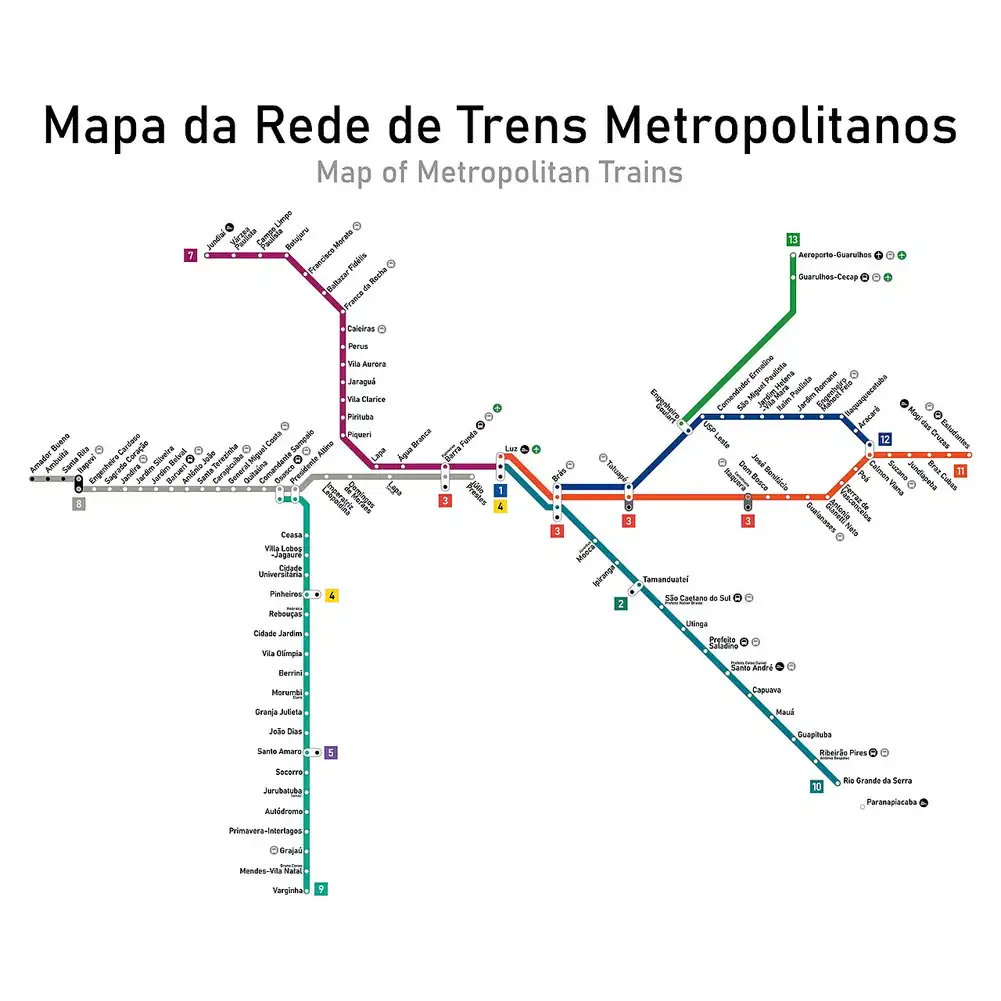
| Line[50] | Color | Termini | Opened | Hours of Operation |
Length[51] | Stations | Notes[39][51] |
|---|---|---|---|---|---|---|---|
| Line 7 | Ruby | Jundiaí ↔ Palmeiras-Barra Funda | 16 February 1867 | Daily (4:00 AM–12:00 AM) |
62.7 km (39.0 mi) | 17 |
|
| Line 8 | Diamond | Júlio Prestes ↔ Amador Bueno | 10 July 1875 | Daily (4:00 AM–12:00 AM) |
41.6 km (25.8 mi)[53] | 23 |
|
| Line 9 | Emerald | Osasco ↔ Varginha | 25 January 1957 | Daily (4:00 AM–12:00 AM) |
37.3 km (23.2 mi)[55] | 21 |
|
| Line 10 | Turquoise | Palmeiras-Barra Funda ↔ Rio Grande da Serra | 16 February 1867 | Daily (4:00 AM–12:00 AM) |
35 km (22 mi) | 15 |
|
| Line 11 | Coral | Palmeiras-Barra Funda ↔ Estudantes | 1890 | Daily (4:00 AM–12:00 AM) |
54.1 km (33.6 mi) | 17 |
|
| Line 12 | Sapphire | Brás ↔ Calmon Viana | 1 April 1934 | Daily (4:00 AM–12:00 AM) |
38.8 km (24.1 mi) | 13 |
|
| Line 13 | Jade | Engenheiro Goulart ↔ Aeroporto-Guarulhos | 31 March 2018 | Daily (4:00 AM–12:00 AM) |
12.2 km (7.6 mi) | 3 |
|
| Total in operation: | 286.9 | 109 total stations[notes 1] | |||||
- 1 2 3 The count of unique stations considers interchange stations only once, while the total station count is obtained by the sum of the stations of each line, including interchange stations more than once. Interchange stations are Osasco, Presidente Altino, Palmeiras–Barra Funda, Luz, Brás, Tatuapé, Engenheiro Goulart, and Calmon Viana. Details are available in the system table.
Express services
| Line | Service | Termini | Length | Stations |
|---|---|---|---|---|
| Line 10 | Line 10 Express | Tamanduateí ↔ Prefeito Celso Daniel-Santo André | 9.3 km (5.8 mi) | 3 |
| Line 13 | Airport Express | Palmeiras-Barra Funda ↔ Aeroporto-Guarulhos | 31.1 km (19.3 mi) | 5 |
Former services
| Line | Service[58][59] | Termini | Length | Stations |
|---|---|---|---|---|
| Line 7 | Service 710 | Jundiaí ↔ Rio Grande da Serra | 101.7 km (63.2 mi) | 32 |
| Line 10 | ||||
| Line 10 | Line 10+ Express | Luz ↔ Prefeito Celso Daniel-Santo André | 17.7 km (11.0 mi) | 5 |
| Line 13 | Connect | Brás ↔ Aeroporto-Guarulhos | 25.2 km (15.7 mi) | 5 |
Under development
| Line | Color | Termini | Length | Stations | Start of
construction |
Completion
(forecast) |
Current status |
|---|---|---|---|---|---|---|---|
| Line 11 | Coral | Penha | N/a | 1 | 2020[60] | 2027[61] | Under construction |
Planned
| Line | Color | Termini[62] | Length | Stations | Current status |
|---|---|---|---|---|---|
| Line 8 | Diamond | Água Branca | N/a | 1 | In project[63][64] |
| Line 9 | Emerald (Expansion) | Ceasa ↔ Água Branca | N/a | 4 | In project[64] |
| Line 10 | Turquoise | Bom Retiro | N/a | 1 | |
| Cerealista | N/a | 1 | |||
| Parque da Mooca | N/a | 1 | |||
| ABC | N/a | 1 | In project[65] | ||
| Line 11 | Coral (Expansion) | Estudantes ↔ César de Sousa | 4.3 km (2.7 mi) | 1 | In project[66] |
| Coral | Bom Retiro | N/a | 1 | In project[67] | |
| Cerealista | N/a | 1 | |||
| Lajeado | N/a | 1 | In project[68] | ||
| Line 12 | Sapphire (Expansion) | Calmon Viana ↔ Suzano | 2.6 km (1.6 mi) | 1 | |
| Sapphire | Gabriela Mistral | N/a | 1 | ||
| Cangaíba | N/a | 1 | |||
| União de Vila Nova | N/a | 1 | In project[68] | ||
| Line 13[69] | Jade (Expansion) | Aeroporto-Guarulhos ↔ Bonsucesso | 10.5 km (6.5 mi) | 4 | In project[70] |
| Engenheiro Goulart ↔ Gabriela Mistral | 4.3 km (2.7 mi) | 2 | |||
| Line 14[71] | Onyx | Bonsucesso ↔ Jardim Irene | 39 km (24 mi) | 23 | In project[72] |
| Line 24[71][73] | Quartz | Santana de Parnaíba ↔ Campo Limpo | 34 km (21 mi) | 21 | In project[74][75] |
| Line 25[76] | Topaz | Embu das Artes ↔ ABC | 43 km (27 mi) | 25 | In project[77] |
| Line 26[78] | Amethyst | Sanazar ↔ Imperador | 41 km (25 mi) | 23 | In project[79] |
Rolling stock
The metropolitan trains rolling stock has trains of 19 different series, some of them out of service for being older,[80][81] and some of them recently delivered.[82][83][84]
Signaling
Centralized Traffic Control (1960–2010)


Following World War II and the growth of passenger traffic, railway companies began studying signaling improvements to cope with the increasing volume of train traffic. Following the creation of the Brazil–United States Joint Commission for Economic Development (CMBEU) in 1951, public railways sought funding from the newly established BNDE to modernize their networks.[85] In 1952, the Sorocabana Railway sought loans from the recently founded BNDE to modernize the railway. In a report by BNDE auditor Pércio Reis (1914–1978),[86] it was suggested that Sorocabana adopt Automatic Train Control (ATC) on the 140-kilometer section between São Paulo and Iperó and Centralized Traffic Control (CTC) on the rest of the company's network. The estimated cost of implementing ATC was 23 million cruzeiros.[85]
Despite the report, Sorocabana postponed signaling investments until the late 1950s. In February 1959, Sorocabana secured a US$ 8.3 million loan from Eximbank and allocated part of these resources to the implementation of the CTC system across its network, including the São Paulo–Iperó section.[87] The equipment was imported from Union Switch & Signal and installed in Brazil by Companhia Brasileira de Sinalização, owned by Hélio de Almeida.[88] The first section, between Júlio Prestes and Barra Funda, was inaugurated by Governor Carvalho Pinto on September 15, 1960.[88] The São Paulo–Iperó section started operating on September 27, 1962.[89]
At the time, Sorocabana's suburban trains were the only ones controlled by a then modern signaling system. Sorocabana's investment encouraged the Central do Brasil Railway to begin implementing CTC on the Poá Variant in 1962.[90] Its inauguration occurred in 1966.[91] In 1967, installation of CTC began on the Engineer Gualberto–Mogi das Cruzes section.[92] Work on the Central do Brasil suburban network was completed in 1971.[93] The final section was inaugurated on April 11, 1973.[94]
The Santos-Jundiaí Railway had imported equipment for the implementation of CTC many years earlier, but only began installing the system in 1962.[95] After the inauguration of the first section between Santos and Piaçaguera in March 1963,[96] the project was halted. In 1967, work resumed under Rede Ferroviária Federal.[97] The Santos–Jundiaí Railway CTC system was finally completed on April 29, 1971.[98]
Even after signaling modernization during the 1970s and 1980s through the implementation of ATC, CTC remained in operation on the Metropolitan Train system until April 30, 2010, when the final section (Itapevi–Amador Bueno) was decommissioned after forty-nine years of operation.[99][100]
| Implementation of Centralized Traffic Control on the Metropolitan Train[88][89][93] | |||
|---|---|---|---|
| Line | Inauguration date | ||
| Itapevi – Julio Prestes | September 15, 1960 | ||
| Osasco – Varginha | September 27, 1962 | ||
| Luz – Francisco Morato | April 29, 1971 | ||
| Luz – Rio Grande da Serra | April 29, 1971 | ||
| Luz – Estudantes | 1971 | ||
| Brás – Calmon Viana | 1966 | ||
Automatic Train Control (ATC)


With the growth of train and passenger traffic during the 1970s, the CTC signalling system used on São Paulo's suburban railways proved insufficient. In 1975, Fepasa (the successor to the Sorocabana Railway) began its suburban modernization plan and announced the procurement of an Automatic Train Control (ATC) system for the Júlio Prestes–Itapevi and Osasco–Jurubatuba lines, costing US$ 23.2 million.[101][102] Fepasa inaugurated its ATC system on November 10, 1986, initially covering the 22-kilometer section between Júlio Prestes and Carapicuíba.[103] In April 1987, the ATC system was extended to the Osasco–Pinheiros section.[104] ATC works were only completed in 1992, while the Itapevi–Amador Bueno section continued operating solely under the CTC system until 2010, when it was decommissioned and replaced by ATC.[99][100]
At the same time, Rede Ferroviária Federal (successor to the Central do Brasil and Santos–Jundiaí railways) began commissioning and installing ATC on its lines. In 1979, the first Metropolitan Train section equipped with ATC started operating between Mogi das Cruzes and Engineer Sebastião Gualberto.[105] ATC installation on Rede Ferroviária Federal lines continued until mid-1983.[106] Nevertheless, CTC remained in use on the Brás–Calmon Viana line until the late 2000s.[107]
As of 2025, signaling systems used on the São Paulo Metropolitan Train network are divided as follows:
- Automatic Train Control (ATC) – Lines 7, 8, 9, 10, 11 and 12.[107]
- Automatic Train Operation (ATO) – Line 13;[108] Lines 8 (under installation),[109] 9 (under installation), and 12 (under installation).[110]
Ridership
1944–1970
| Annual ridership on Metropolitan Trains by Railway Company (1944–1970) | |||||||||||
|---|---|---|---|---|---|---|---|---|---|---|---|
| Year | Total | Sorocabana [a 1] | Cantareira [a 2] | Santos– Jundiaí |
Central do Brasil [a 3] |
Year | Total | Sorocabana | Cantareira | Santos– Jundiaí |
Central do Brasil [a 3] |
| 1944 | 22,572,195 | 2,603,573 | 7,040,954 | 12,927,668 | N/A | 1958 | 62,017,416 | 11,471,232 | 9,363,184 | 41,183,000 | N/A |
| 1945 | 23,944,917 | 2,575,138 | 7,865,067 | 13,504,712 | 1959 | 74,547,839 | 16,107,000 | 10,515,839 | 47,925,000 | ||
| 1946 | 24,200,157 | 3,535,761 | 8,663,067 | 12,001,329 | 1960 | 117,726,308 | 19,268,000 | 11,284,308 | 46,774,000 | 40,400,000 | |
| 1947 | 26,867,535 | 4,310,306 | 9,369,825 | 13,187,404 | 1961 | 131,778,557 | 18,784,000 | 11,095,557 | 51,199,000 | 50,700,000 | |
| 1948 | 33,011,435 | 4,459,216 | 9,003,219 | 19,549,000 | 1962 | 138,590,915 | 17,317,000 | 10,377,915 | 52,696,000 | 58,200,000 | |
| 1949 | 35,569,749 | 6,185,000 | 7,768,749 | 21,616,000 | 1963 | 137,684,245 | 16,329,000 | 9,729,245 | 49,826,000 | 61,800,000 | |
| 1950 | 53,125,718 | 7,030,000 | 7,677,694 | 24,086,000 | 11,800,000 | 1964 | 134,131,623 | 18,818,000 | 5,356,623 | 52,857,000 | 57,100,000 |
| 1951 | 41,325,718 | 7,606,000 | 7,405,718 | 26,314,000 | N/A | 1965 | 125,066,510 | 20,911,000 | 310,510 | 51,945,000 | 51,900,000 |
| 1952 | 44,704,258 | 8,093,000 | 7,809,258 | 28,802,000 | 1966 | 123,977,000 | 20,894,000 | N/A | 52,783,000 | 50,300,000 | |
| 1953 | 48,827,751 | 8,879,000 | 7,366,751 | 32,582,000 | 1967 | 121,618,000 | 23,048,000 | 52,570,000 | 46,000,000 | ||
| 1954 | 53,878,711 | 9,785,780 | 6,390,931 | 37,702,000 | 1968 | 78,030,000 | 25,049,000 | 52,981,000 | N/A | ||
| 1955 | 58,993,891 | 9,633,430 | 6,247,461 | 43,113,000 | 1969 | 77,798,000 | 25,455,000 | 52,343,000 | |||
| 1956 | 67,298,767 | 11,184,776 | 8,662,991 | 52,343,000 | 1970 | 78,443,000 | 26,330,000 | 52,113,000 | |||
| 1957 | 62,463,272 | 11,878,542 | 8,314,730 | 42,270,000 | Total | 1,998,193,487 | 357,469,445 | 177,619,596 | 1,032,301,113 | 428,200,000 | |
Notes:
Sources:
| |||||||||||
1971–1995
| Annual ridership on Metropolitan Trains by Railway Company (1971–1995) | |||||||
|---|---|---|---|---|---|---|---|
| Year | Fepasa | RFFSA | Total | Year | Fepasa | CBTU | Total |
| 1971 | 27,822,000 | 50,938,000[b 1] | 78,760,000 | 1984 | 79,040,638 | 192,800,000 | 271,840,638 |
| 1972 | 30,378,000 | 96,493,000 | 126,493,000 | 1985 | 86,731,479 | 213,933,000 | 300,664,479 |
| 1973 | 32,415,000 | 98,000,000 | 130,415,000 | 1986 | 94,529,071 | 213,536,000 | 308,065,071 |
| 1974 | 32,204,000 | 103,000,000 | 135,204,000 | 1987 | 101,932,168 | 217,508,000 | 319,440,168 |
| 1975 | 32,522,000 | 91,853,000 | 124,375,000 | 1988 | 92,375,968 | 205,502,000 | 297,877,968 |
| 1976 | 32,612,000 | 99,200,000 | 131,812,000 | 1989 | 111,938,629 | 216,793,000 | 328,731,629 |
| 1977 | 30,841,407 | 110,400,000 | 141,241,407 | 1990 | 111,242,209 | 212,014,000 | 323,256,209 |
| 1978 | 24,644,490 | 141,300,000 | 165,944,490 | 1991 | 112,697,791 | 230,040,000 | 342,737,791 |
| 1979 | 43,740,490 | 146,100,000 | 189,840,490 | 1992 | 109,440,803 | 168,155,000 | 277,595,803 |
| 1980 | 56,413,137 | 157,200,000 | 213,613,137 | 1993 | 104,899,689 | 154,874,000 | 259,773,689 |
| 1981 | 57,511,057 | 155,400,000 | 212,911,057 | 1994 | 101,570,558 | 64,500,000[b 2] | 166,070,558 |
| 1982 | 56,166,581 | 168,300,000 | 224,466,581 | 1995 | 105,912,281 | 149,095,719[b 3] | 255,008,000 |
| 1983 | 64,966,200 | 190,000,000 | 254,966,200 | Total | 1,734,547,646 | 3,759,637,719 | 5,494,185,365 |
| Notes:
Sources: | |||||||
CPTM (1995–2021)
CPTM took over the metropolitan lines of CBTU in São Paulo on 1 June 1994 and those of Fepasa in February 1996.[30][137] From 1994 to 2021, the following number of passengers were carried:[138][139][140]

| Year | Ridership | Year | Ridership |
|---|---|---|---|
| 1994 | 84,570,442 (Jun–Dec) |
2008 | 541,100,000 |
| 1995 | 149,095,719 | 2009 | 586,300,000 |
| 1996 | 253,831,000 | 2010 | 642,000,000 |
| 1997 | 272,232,000 | 2011 | 700,200,000 |
| 1998 | 219,081,000 | 2012 | 764,200,000 |
| 1999 | 204,562,000 | 2013 | 795,400,000 |
| 2000 | 207,708,000 | 2014 | 832,900,000 |
| 2001 | 262,496,000 | 2015 | 831,400,000 |
| 2002 | 271,709,000 | 2016 | 819,500,000 |
| 2003 | 277,905,000 | 2017 | 827,700,000 |
| 2004 | 368,800,000 | 2018 | 863,300,000 |
| 2005 | 389,600,000 | 2019 | 867,700,000[c 1] |
| 2006 | 430,200,000 | 2020 | 414,557,930[145] |
| 2007 | 465,700,000 | 2021 | 447,945,853[146] |
| Total 13,791,693,944 | |||
Note:
| |||
CPTM, Tic Trens and ViaMobilidade (2022–)
| Year | Ridership (CPTM) |
Ridership (ViaMobilidade Lines 8 and 9) |
Ridership (Tic Trens) |
Total |
|---|---|---|---|---|
| 2022 | 441,400,000 | 199,500,000 | N/A | 640,900,000 |
| 2023 |
457,400,000 | 228,700,000 | 686,100,000 | |
| 2024 | 480,600,000 | 232,800,000 | 713,400,000 | |
| 2025 | 473,400,000 | 240,100,000 | 10,200,000 (Nov–Dec) |
723,700,000 |
| Source: São Paulo Metro Company 2023,[147] 2024,[148] 2025[149] | ||||
Accidents
- 13 April 1941 – São Paulo (SP) – The F-15 trainset of the Cantareira Railway derailed on a curve between Barro Branco and Mandaqui stations, overturning three of its cars and causing the deaths of three people and injuries to another 39.[150]
- 26 March 1944 – São Paulo (SP) – Tucuruvi rail accident. Derailment of a Cantareira Railway train after a coupling failure. The accident resulted in 35 deaths and more than 100 injuries.[151]
- 23 October 1958 – São Paulo (SP) – A collision between trains S–52 and CL-4 occurred near Lapa station (Sorocabana Railway) in São Paulo, resulting in two dead and dozens injured.[152]
- 5 June 1959 – São Paulo (SP) – Engenheiro Goulart rail accident. A collision between two suburban trains caused the deaths of 48 passengers and injured 120 others.[153]
- 3 March 1966 – São Paulo (SP) – A collision between train PE 6 and a bus at the level crossing of Tatuapé station left 11 people dead and 22 injured.[154]
- 21 March 1969 – São Paulo (SP) – Perus rail accident. A collision between a suburban train and a maintenance locomotive resulted in 20 people dead and 400 injured.[155]
- 30 November 1971 – São Paulo (SP) – A collision between a TUE General Electric/Pullman Company (EFS) trainset and a GE 1-C+C-1 (EFS) locomotive in the Água Branca area resulted in 12 dead and 60 injured.[156]
- 17 May 1972 – São Paulo (SP) – A collision between suburban train U-75 and a truck at the level crossing of Lapa station (EFS) resulted in 13 people dead and dozens injured.[157]
- 8 June 1972 – Suzano – Student Train Disaster. A collision between a suburban train and a long-distance train. The accident caused 23 deaths and about 100 injuries.[158]
- 22 August 1977 – São Paulo (SP) – Arthur Alvim level crossing accident. A city bus crossed the Arthur Alvim level crossing and was struck by a suburban train. The collision caused the deaths of 22 people aboard the bus.[159]
- 26 November 1981 – Itaquaquecetuba (SP) – A Series 400 train collided with a freight train at Manoel Feio station. Seven passengers were killed and 256 were injured.[160]
- 8 December 1984 – São Paulo – A collision between two trains near Pinheiros station left two people dead and 50 injured.[161]
- 26 December 1984 – Jandira – A collision between a freight train and a passenger train left three people dead and 43 injured.[162]
- 17 February 1987 – São Paulo (SP) – Itaquera rail crash. A collision between two suburban trains near the former Itaquera station caused 51 deaths and 153 injuries.[163]
- 28 July 2000 – São Paulo (SP) – Second Perus station accident. A collision between trains at Perus station caused the deaths of nine passengers and injuries to 115 others.[164]
- 23 November 2000 – Barueri – One person died and 17 were injured in a collision between a bus and a CPTM train.[165]
See also
References
- 1 2 3 Companhia Paulista de Trens Metropolitanos. "The Company" (in Brazilian Portuguese). Archived from the original on 2024-03-04. Retrieved February 10, 2024.
- 1 2 3 4 5 "Passengers Transported - Line 8-Diamond" (in Brazilian Portuguese). ViaMobilidade Linhas 8 e 9. Retrieved February 10, 2024.
- 1 2 3 4 5 "Passengers Transported - Line 9-Emerald". ViaMobilidade Linhas 8 e 9. Retrieved February 10, 2024.
- 1 2 "Accumulated boardings - 2023". Companhia Paulista de Trens Metropolitanos. Retrieved February 10, 2024.
- ↑ "Governo de SP entrega Estação Jardim Colonial da Linha 15-Prata do Metrô" (in Brazilian Portuguese). 29 December 2021. Retrieved 29 December 2021.
- ↑ Rodrigo Rodrigues (March 31, 2025). "Empresa vencedora do leilão das linhas 11, 12 e 13 da CPTM deve assinar contrato de concessão ainda no 1° semestre de 2025" [Winning bidder for the CPTM Lines 11, 12 and 13 auction is expected to sign the concession contract in the first half of 2025] (in Brazilian Portuguese). g1. Retrieved November 6, 2025.
- ↑ "São Paulo". UrbanRail.Net. Retrieved 6 July 2025.
- ↑ "Memória | A abertura da primeira ferrovia paulista, a São Paulo Railway" [History | The opening of São Paulo’s first railroad, the São Paulo Railway]. BNDigital (in Brazilian Portuguese). Retrieved 2026-06-18.
- ↑ Antunes, Camila; Pássaro, Thiago; Ferreira, Fernanda (2017-02-16). Entre Trilhos (in Brazilian Portuguese). Clube de Autores.
- ↑ "Nossa História" [Our story]. Turismo - Mauá (in Brazilian Portuguese). Retrieved 2026-06-18.
- 1 2 Santos, Cecília Rodrigues dos; Lage, Claudia; Secco, Gustavo (February 2017). "São Paulo Railway 150 anos - Patrimônio industrial ferroviário ameaçado" [São Paulo Railway: 150 Years - Threatened Industrial Railway Heritage]. Arquitextos. ISSN 1809-6298 – via Vitru Vius.
- ↑ "Estrada de Ferro Central do Brasil" [Central Brazilian Railroad]. Public and Historical Archive of Jacareí (in Brazilian Portuguese). Retrieved 2026-06-19.
- ↑ Grinberg, Isaac (1961). Historia de Mogi das Cruzes: (Do começo até 1954) [History of Mogi das Cruzes: (From the Beginning to 1954)] (in Brazilian Portuguese). Saraiva, S.A.
- ↑ Camilo, Jorge Braz (January 2023). "Modernização da Sinalização na Linha 12 – Safira da CPTM" [Signal System Modernization on CPTM Line 12 – Sapphire] (PDF). Revista da Associação de Engenheiros Ferroviários (in Brazilian Portuguese) (158).
- ↑ <DECREE-LAW No. 9,869. Brazilian Government. September 13, 1946.
- ↑ LAW No. 3.115. Brazilian Government. March 16, 1957.
- ↑ "Histórico da Antiga RFFSA" [History of the Former RFFSA]. Ministério dos Transportes (in Brazilian Portuguese). Archived from the original on 2025-10-28. Retrieved 2026-06-19.
- ↑ "CBTU promete transportar 1 milhão 300 mil por dia" [CBTU promises to transport 1.3 million people per day]. Jornal do Brasil (in Brazilian Portuguese). XCIII (343): 7. 20 March 1984 – via National Library of Brazil.
- ↑ Rebelo, Jorge M. (2003). "The rail decentralization and modernization program in Brazil : lessons learned". The World Bank. Retrieved 2026-06-19.
- ↑ Junior, Antonio Soukef (2001). Sorocabana Railway: uma saga ferroviária (in Brazilian Portuguese). Dialeto, Latin American Documentary. ISBN 978-85-88373-03-7.
- 1 2 "Subúrbios: um metrô de 200 km para São Paulo". Folha de S. Paulo (in Portuguese) (17060). São Paulo: 30. 26 November 1975. Retrieved 15 September 2022.
- 1 2 "IE NA MÍDIA - Memórias do transporte: FEPASA" [IE IN THE MEDIA - Transportation Memories: FEPASA]. Instituto de Engenharia (in Brazilian Portuguese). 2020-01-10. Retrieved 2026-06-19.
- ↑ "Vinte anos sem renovações". Folha de S. Paulo (in Portuguese) (17924). São Paulo. 30 April 1978. ISSN 1414-5723.
- ↑ Prefeitura do Município de São Paulo (1979). "Leste-Oeste: em busca de uma solução integrada" [East-West: in search of an integrated solution]. Companhia do Metropolitano de São Paulo (in Portuguese): 203.
- ↑ "Linha Leste deve custar Cz$ 9 bilhões" [The East Line is expected to cost 9 billion Cz$]. Folha de S. Paulo (in Portuguese) (21212): 11. 1 May 1987. Retrieved 15 September 2022.
- ↑ "Relatório Anual de 1987" (PDF). Companhia Brasileira de Trens Urbanos: C-18. 1988. Archived from the original (PDF) on 2019-06-09. Retrieved 15 September 2022.
- ↑ COMPANHIA DO METROPOLITANO DE SÃO PAULO (1988). Relatório da Administração, 1987 [Administration Report, 1987]. Metrô-SP. p. 16.
- ↑ "Lei nº 7.861, de 28 de maio de 1992". www.al.sp.gov.br (in Brazilian Portuguese). Retrieved 2026-06-22.
- 1 2 3 Luz, Luciano Ferreira Da (2010-11-25). A geografia do transporte de passageiros: avaliação da modernização da CPTM e de seu papel no planejamento e na estruturação do espaço metropolitano de São Paulo [The Geography of Passenger Transportation: An Assessment of CPTM’s Modernization and Its Role in the Planning and Structuring of the São Paulo Metropolitan Area] (Ph.D. in Human Geography thesis) (in Brazilian Portuguese). São Paulo: Universidade de São Paulo (USP). doi:10.11606/t.8.2010.tde-10022011-094138.
- 1 2 3 4 Fagundes, Homero Gottberg. "A remodelação das linhas B e C da CPTM" [The renovation of CPTM Lines B and C] (PDF). Associação Nacional de Transportes Públicos (in Brazilian Portuguese).
- ↑ Suzy Gasparini (May 7, 1995). "Superlotação ameaça vida de usuário do trem urbano" [Overcrowding threatens life of urban train user]. Folha de S. Paulo (in Brazilian Portuguese). p. 1. Archived from the original on 2014-01-17.
- ↑ Schivartche, Fabio; Cabral, Otavio (October 15, 1996). "Depredação suspende trens por 4 meses" [Depredation suspends trains for 4 months]. Folha de S. Paulo (in Brazilian Portuguese) (24667 ed.). p. 1. Archived from the original on 2014-01-17.
- ↑ "Sobre a CPTM" [About CPTM] (in Brazilian Portuguese). CPTM. Archived from the original on October 2, 2007.
- ↑ Meier, Ricardo (2018-09-24). "Duas décadas após início das obras, Linha 5 está prestes a ter ligação direta com outras linhas de metrô" [Two decades after construction began, Line 5 is about to have a direct connection to other subway lines]. Metrô CPTM (in Brazilian Portuguese). Retrieved 2026-06-23.
- ↑ "Breve histórico - Processo SMA no 7185/f99" [Brief History - SMA Case No. 7185/f99] (PDF). Transparência Metrô SP (in Brazilian Portuguese). CETESB - Companhia Ambiental do Estado de São Paulo. p. 1. Archived (PDF) from the original on 2026-06-23.
- ↑ Stefani, Celia Regina Baider (2007-11-21). O sistema ferroviário paulista: um estudo sobre a evolução do transporte de passageiros sobre trilhos [The São Paulo Railway System: a study about the evolution of the passengers' transport on trains] (Master in Human Geography thesis) (in Brazilian Portuguese). São Paulo: Universidade de São Paulo. doi:10.11606/d.8.2007.tde-12022008-102649.
- ↑ "Trem da Frota F da Linha 5 aparece com pintura da ViaMobilidade" [Fleet F train from Line 5 appears with ViaMobilidade livery]. Metrô CPTM (in Brazilian Portuguese). January 29, 2019. Retrieved July 22, 2021.
- ↑ "Governador inaugura novo Centro de Controle Operacional da CPTM" [Governor inaugurates CPTM's new Operational Control Center]. Governo do Estado de São Paulo (in Brazilian Portuguese). November 27, 2006. Archived from the original on 2020-09-24. Retrieved July 22, 2021.
- 1 2 "Linhas de trem em SP ganham novos nomes e cores" [Train lines in São Paulo get new names and colors]. Estadão (in Brazilian Portuguese). 2008. Retrieved 2026-06-23.
- ↑ "Apresentação de audiência pública para linha 13 Jade" [Public hearing presentation for line 13 Jade] (PDF). cptm.sp.gov.br. Archived from the original (PDF) on 2013-05-12. Retrieved August 3, 2013.
- ↑ "CPTM completa 25 anos: Um trem rumo à Cumbica" [CPTM turns 25 years old: A train towards Cumbica] (634 ed.). Revista Engenharia. July–August 2017.
- ↑ "Governo de SP anuncia privatização da CPTM" [SP Government announces privatization of CPTM] (in Brazilian Portuguese). Diário do Grande ABC. October 21, 1999. Retrieved August 1, 2021.
- ↑ Izidoro, Alencar (April 20, 2001). "Estado vai fundir Metrô e CPTM em 2002" [State will merge Metro and CPTM in 2002] (26315 ed.). Folha de S. Paulo. p. C7. Retrieved August 1, 2021.
- ↑ Izidoro, Alencar (23 April 2001). "Governo de SP garante investir mesmo após concessão" [São Paulo State Government Pledges to Continue Investing Even After the Concession]. Folha de S. Paulo (in Brazilian Portuguese). 81 (26318): C10. ISSN 1414-5723.
- ↑ Meier, Ricardo (2016-04-13). "Linhas 8 e 9 da CPTM podem ser repassadas à iniciativa privada" [CPTM Lines 8 and 9 may be transferred to the private sector]. Metrô CPTM (in Brazilian Portuguese). Retrieved 2026-06-23.
- ↑ Amorim, Lucas; Flach, Natália (2019-06-26). "Construtora Triunfo entra com pedido de recuperação judicial" [Triunfo Construction Files for Judicial Recovery]. Exame (in Brazilian Portuguese). ISSN 0102-2881. Archived from the original on 2024-12-02. Retrieved 2026-06-23.
- ↑ "Linhas 8-Diamante e 9-Esmeralda são arrematadas pela CCR e RuasInvest, do consórcio ViaMobilidade" [Lines 8 (Diamante) and 9 (Esmeralda) were awarded to CCR and RuasInvest, part of the ViaMobilidade consortium]. Metrô CPTM (in Brazilian Portuguese). 2021-04-20. Retrieved 2026-06-23.
- ↑ "Concessão das linhas 8 e 9 da CPTM teve contrato assinado nesta quarta-feira, 30" [The contract for the CPTM Lines 8 and 9 concession was signed on Wednesday, the 30th]. Metrô CPTM (in Brazilian Portuguese). 2021-07-01. Retrieved 2026-06-23.
- ↑ Guedes, Phelipe (January 26, 2022). "Após concessão, ViaMobilidade assume nesta quinta-feira gestão das linhas 8 e 9 da CPTM" [After concession, ViaMobilidade takes over management of CPTM lines 8 and 9 this Thursday]. G1. Retrieved January 30, 2022.
- ↑ "Linhas e estações" [Lines and stations]. CPTM (in Brazilian Portuguese).
- 1 2 "Veja o mapa de estações do Metrô e CPTM em 2026 com a Linha 17 incluída" [Take a look at the map of Metro and CPTM stations in 2026, including Line 17]. Metrô CPTM (in Brazilian Portuguese). 2019-09-27. Retrieved 2026-06-23.
- ↑ Bom Dia SP - CPTM elimina baldeação em Francisco Morato [Good Morning, São Paulo - CPTM Eliminates the Need to Transfer Trains in Francisco Morato] (Television production) (in Brazilian Portuguese). Retrieved 2026-06-23 – via Globoplay.
- ↑ "Linha 8 - Diamante" (in Brazilian Portuguese). ViaMobilidade. Retrieved 7 July 2025.
- ↑ "Reconstrução do trecho Amador Bueno Itapevi da CPTM" [Reconstruction of the Amador Bueno–Itapevi section of the CPTM] (in Portuguese). Assembléia Legislativa de São Paulo. 23 November 2011. Retrieved 9 October 2025.
- ↑ "Linha 9 - Esmeralda" (in Brazilian Portuguese). ViaMobilidade. Retrieved 7 July 2025.
- ↑ "CPTM testa novo horário do Expresso Linha 10" [CPTM tries out a new schedule for the Line 10 Express]. Mobilidade Estadão (in Brazilian Portuguese). 2025-07-28. Archived from the original on 2026-02-14. Retrieved 2026-06-23.
- ↑ "Expresso Leste-Mogi completa 1 mês nesta quinta" [Expresso Leste-Mogi Celebrates Its First Month This Thursday]. CPTM (in Brazilian Portuguese). Archived from the original on 2023-07-29. Retrieved 2026-06-23.
- ↑ "Serviço 710 deve voltar após modernização prevista para até 5 anos, diz Artesp" [Route 710 is expected to resume service after an upgrade scheduled to take up to five years, says Artesp]. G1 (in Brazilian Portuguese). 2025-08-28. Retrieved 2026-06-23.
- ↑ Meier, Ricardo (16 November 2020). "Baldy afirma que serviço Connect, da Linha 13-Jade, "não volta mais"" [Baldy says the Connect service on Line 13-Jade "won't come back"]. Metrô CPTM (in Portuguese). Retrieved 16 November 2020.
- ↑ Freitas, Clayton (May 26, 2022). "Penha will have a transportation complex with more Metro and CPTM stops" (in Brazilian Portuguese). Veja São Paulo. Retrieved December 30, 2023.
- ↑ Moreira, William (August 11, 2023). "New station on Line 11-Coral will be delivered in 2027" (in Brazilian Portuguese). Diário dos Trilhos. Retrieved December 30, 2023.
- ↑ "Qual status atual das futuras linhas do Metrô de São Paulo?" [What is the current status of the future São Paulo Metro lines?]. Metrô CPTM (in Brazilian Portuguese). 2026-03-12. Retrieved 2026-06-23.
- ↑ Lobo, Renato (April 10, 2023). "Água Branca Station should gain triple integration between lines" (in Brazilian Portuguese). Via Trolebus. Retrieved February 5, 2024.
- 1 2 Lobo, Renato (August 7, 2024). "ViaMobilidade should study extending Line 9 to Água Branca" (in Brazilian Portuguese). Via Trolebus. Retrieved August 9, 2024.
- ↑ Carlos, Jean (April 8, 2024). "Government announces new ABC station on Line 10-Turquoise in Santo André" (in Brazilian Portuguese). MetrôCPTM. Retrieved April 9, 2024.
- ↑ Lobo, Renato (March 15, 2024). "São Paulo Government announces extension of Lines 11 and 12 of CPTM" (in Brazilian Portuguese). Via Trolebus. Retrieved April 9, 2024.
- ↑ Lobo, Renato (May 15, 2025). "Understand what the Train Station will be like next to Moinho slum" (in Brazilian Portuguese). Via Trolebus. Retrieved July 19, 2025.
- 1 2 Carlos, Jean (April 18, 2024). "Lajeado and União de Vila Nova stations of CPTM were postponed to 2028" (in Brazilian Portuguese). MetrôCPTM. Retrieved April 18, 2024.
- ↑ "Linha 13-Jade facilitará integração de moradores de Guarulhos". Secretaria de Parcerias em Investimentos (in Brazilian Portuguese). 2 April 2025. Retrieved 28 September 2025.
- ↑ Meier, Ricardo (April 29, 2022). "CPTM selects consortium that will develop preliminary project of Line 13 extension to Bonsucesso" (in Brazilian Portuguese). MetrôCPTM. Retrieved April 17, 2023.
- 1 2 Meier, Ricardo (3 December 2023). "Linha 24 da CPTM tem seu 'mineral' revelado, o quartzo". Metrô CPTM (in Brazilian Portuguese). Retrieved 3 December 2023.
- ↑ Carlos, Jean (September 17, 2022). "Line 14-Onyx of CPTM gets new layout" (in Brazilian Portuguese). MetrôCPTM. Retrieved April 17, 2023.
- ↑ Lobo, Renato (30 November 2023). "Nova Linha 24 da CPTM ganha nomenclatura: Quartzo". Via Trólebus (in Brazilian Portuguese). Retrieved 3 December 2023.
- ↑ Ricardo Meier (December 3, 2023). "Line 24 of CPTM has its "mineral" revealed, quartz" (in Brazilian Portuguese). MetrôCPTM. Retrieved December 25, 2023.
- ↑ Renato Lobo (September 19, 2025). "Line 24-Quartz of CPTM gains extension to Santana de Parnaíba" (in Brazilian Portuguese). Via Trolebus. Retrieved September 19, 2025.
- ↑ Meier, Jean Carlos (12 August 2024). "Fim do mistério: Linha 25-Topázio é o nome oficial do ferrovia 'Arco Sul', de trens metropolitanos". Metrô CPTM (in Brazilian Portuguese). Retrieved 14 August 2024.
- ↑ Jean Carlos Meier (August 12, 2024). "Mystery solved: Line 25-Topaz is the official name of the 'South Arc' railway of metropolitan trains" (in Brazilian Portuguese). MetrôCPTM. Retrieved August 12, 2024.
- ↑ Meier, Ricardo (19 September 2025). "Com Linha 26-Ametista, CPTM planeja anel ferroviário em São Paulo". Metrô CPTM (in Brazilian Portuguese). Retrieved 13 March 2026.
- ↑ Ricardo Meier (September 19, 2025). "With Line 26-Amethyst, CPTM plans a railway ring in São Paulo" (in Brazilian Portuguese). MetrôCPTM. Retrieved September 19, 2025.
- ↑ "Trem mais antigo da CPTM fará sua despedida neste sábado, dia 26" [CPTM's Oldest Train Will Make Its Farewell This Saturday, the 26th]. Noticiando (in Portuguese). 25 May 2018. Retrieved 15 September 2022.
- ↑ Meier, Ricardo (5 June 2017). "Novo trem coreano da CPTM está prestes a estrear na Linha 7". Metrô CPTM (in Portuguese). Retrieved 15 September 2022.
- ↑ Lobo, Renato (18 July 2018). "CPTM recebe novos trens e companhia realoca unidades entre linhas". Via Trólebus (in Portuguese). Retrieved 15 September 2022.
- ↑ "Entrega e Operação dos Trens" (PDF). Companhia Paulista de Trens Metropolitanos (in Portuguese). Archived from the original (PDF) on 2 July 2018. Retrieved 15 September 2022.
- ↑ "Frota de Trens - CPTM". Companhia Paulista de Trens Metropolitanos (in Portuguese). Archived from the original on 12 June 2018. Retrieved 15 September 2022.
- 1 2 BNDES (1952). "Parecer do Dr. Percio Reis sobre a Estrada de Ferro Sorocabana" [Dr. Percio Reis's Report on the Sorocabana Railway] (in Portuguese). Memória Estatística do Brasil – Biblioteca do Ministério da Fazenda no Rio de Janeiro, republished on Internet Archive. Retrieved March 30, 2025.
- ↑ "Conheça a história do auditório Pércio Reis!" [Learn the History of the Pércio Reis Auditorium!] (in Brazilian Portuguese). Universidade Federal de Santa Maria. August 5, 2016. Retrieved March 23, 2025.
- ↑ "11 milhões de dólares para a Sorocabana e E.F. Araraquara" [11 Million Dollars for Sorocabana and Araraquara Railway]. National Library of Brazil. 105 (in Brazilian Portuguese) (31551 ed.). Correio Paulistano. February 6, 1959. p. 16. Retrieved March 30, 2025.
- 1 2 3 "Governador inaugura CTC na Sorocabana: os passageiros terão mais segurança" [Governor Inaugurates CTC on Sorocabana: Passengers Will Have Greater Safety]. National Library of Brazil. year XXXV, issue 10929 (in Brazilian Portuguese). Diário da Noite (São Paulo). September 16, 1960. p. 5. Retrieved March 30, 2025.
- 1 2 "Em operação na Sorocabana o "CTC" moderna aparelhagem de sinalização" [The Modern "CTC" Signaling Equipment Starts Operation on the Sorocabana Railway]. National Library of Brazil. year 109, issue 32663 (in Brazilian Portuguese). Correio Paulistano. September 28, 1962. p. 7. Retrieved March 30, 2025.
- ↑ "Automotrizes da Central do Brasil ligarão S.Paulo ao Rio em 6 horas" [Central do Brasil Railcars Will Connect São Paulo and Rio in 6 Hours]. National Library of Brazil. year XXXVII, issue 11565 (in Brazilian Portuguese). Diário da Noite. October 4, 1962. p. 5. Retrieved April 5, 2025.
- ↑ "Sinalização" [Signaling]. Biblioteca do Ministério da Fazenda no Rio de Janeiro – Memória Estatística do Brasil. Annual Report 1966 (in Portuguese). Rede Ferroviária Federal S/A. 1967. p. 5. Retrieved April 5, 2025.
- ↑ "Licenciamento e sinalização" [Licensing and Signaling]. Biblioteca do Ministério da Fazenda no Rio de Janeiro – Memória Estatística do Brasil. Annual Report 1967 (in Portuguese). Rede Ferroviária Federal S/A. 1968. p. 8. Retrieved April 5, 2025.
- 1 2 "Sinalização e licenciamento" [Signaling and Licensing]. Annual Report 1971 (in Portuguese). Rede Ferroviária Federal S/A. 1972. p. 20. Retrieved April 5, 2025.
- ↑ "Andreazza inaugura obras ferroviárias na Capital" [Andreazza Inaugurates Railway Works in the Capital]. National Library of Brazil. year VI, issue 2014 (in Brazilian Portuguese). Cidade de Santos. April 12, 1973. p. 7. Retrieved April 5, 2025.
- ↑ "Controle de tráfego centralizado em instalação na E.F. Santos-Jundiaí" [Centralized Traffic Control Being Installed on the Santos–Jundiaí Railway]. National Library of Brazil. year LXIX, issue 112 (in Brazilian Portuguese). A Tribuna. August 8, 1962. p. 22. Retrieved April 5, 2025.
- ↑ "A sinalização eletrônica da Santos a Jundiaí" [Electronic Signaling from Santos to Jundiaí]. National Library of Brazil. year LXXV, issue 13 (in Brazilian Portuguese). A Tribuna. April 7, 1968. p. 27. Retrieved April 5, 2025.
- ↑ "RFFSA vai transportar com rapidez e economia" [RFFSA will transport with speed and economy]. National Library of Brazil. year LXXIV, issue 257 (in Brazilian Portuguese). A Tribuna. December 21, 1967. p. 7. Retrieved April 5, 2025.
- ↑ "Andreazza vê a Santos-Jundiaí, fala da Rio-Niterói e de outros problemas" [Andreazza Inspects the Santos–Jundiaí Railway and Discusses the Rio–Niterói Project and Other Issues]. National Library of Brazil. year XLV, issue 13928 (in Brazilian Portuguese). Diário da Noite. April 30, 1971. p. 8. Retrieved April 5, 2025.
- 1 2 "Reconstrução do trecho Amador Bueno " Itapevi da CPTM" [Reconstruction of the CPTM Amador Bueno–Itapevi Section] (in Portuguese). Legislative Assembly of São Paulo. November 23, 2011. Retrieved March 30, 2025.
- 1 2 "Itapevi inaugura Estação Ambuitá e entra na rota do futuro trem Intercidades Sorocaba / São Paulo" [Itapevi opens the Ambuitá Station and becomes part of the route for the future Sorocaba–São Paulo Intercity Train]. Agência Itapevi de Notícias (in Brazilian Portuguese). 2025-05-05. Retrieved 2026-06-23.
- ↑ "Concorrência para a Asa Sul do Anel Ferroviário: Reforma dos subúrbios" [Bid for the Southern Section of the Railway Ring: Suburban Railway Modernization]. National Library of Brazil. year LXXXII, issue 234 (in Brazilian Portuguese). A Tribuna. November 18, 1975. p. 3. Retrieved April 5, 2025.
- ↑ "Realizações governamentais (março de 1975-setembro de 1976): Visando melhoria..." [Government Achievements (March 1975–September 1976): Aiming Improvement...]. National Library of Brazil. year LXXXVI, issue 204 (in Portuguese). Diário Oficial do Estado de São Paulo. October 26, 1976. p. 4. Retrieved April 5, 2025.
- ↑ GOVERNO DO ESTADO DE SÃO PAULO (1986). Transportes: Participação, descentralização e bom senso [Transportation: Participation, Decentralization and Common Sense] (in Portuguese). RMC. pp. 67–68.
- ↑ "Fepasa: Ferrovia Paulista S/A". volume 97, issue 76 (in Brazilian Portuguese). Diário Oficial do Estado de São Paulo. April 24, 1987. p. 28. Retrieved April 5, 2025.
- ↑ "Subúrbio da Grande São Paulo" [Greater São Paulo Suburban Network]. Biblioteca do Ministério da Fazenda no Rio de Janeiro – Memória Estatística do Brasil. Annual Report 1979 (in Brazilian Portuguese). Rede Ferroviária Federal S/A. 1980. p. 29. Retrieved April 5, 2025.
- ↑ "São Paulo: Sinalização" [São Paulo: Signalling]. Biblioteca do Ministério da Fazenda no Rio de Janeiro – Memória Estatística do Brasil. Annual Report 1983 (in Brazilian Portuguese). Rede Ferroviária Federal S/A. 1984. p. 45. Retrieved April 5, 2025.
- 1 2 "Perfil do Setor Metroferroviário" [Profile of the Urban Rail Sector] (PDF). Transporte metroferroviário no Brasil, Technical Notebook 2 (in Brazilian Portuguese). Associação Nacional de Transportes Públicos. July 2005. p. 9. Retrieved March 1, 2025.
- ↑ "Linha 13-Jade é a primeira na CPTM a ter operação de trens automatizada" [Line 13–Jade Is the First CPTM Line to Have Automated Train Operation] (in Portuguese). Metrô CPTM. January 25, 2022. Retrieved March 1, 2025.
- ↑ "ViaMobilidade moderniza sistema de sinalização das Linhas 8-Diamante e 9-Esmeralda" [ViaMobilidade Modernizes the Signalling System of Lines 8–Diamond and 9–Emerald] (in Portuguese). Motiva. February 17, 2024. Retrieved May 18, 2025.
- ↑ "Alstom vai levar mais de 16 anos para concluir projeto de 24 meses nas linhas 9 e 12" [Alstom Will Take More Than 16 Years to Complete a 24-Month Project on Lines 9 and 12] (in Portuguese). Metrô CPTM. February 14, 2025. Retrieved May 18, 2025.
- ↑ Juliana Sayuri (March 23, 2025). "SP vai bancar custo bilionário para sinalização de trens de linhas privadas" [São Paulo State Will Bear the Billion-Real Cost of Signalling for Privately Operated Rail Lines] (in Portuguese). UOL. Retrieved May 18, 2025.
- ↑ Jean Carlos (July 29, 2024). "Atrasou de novo: CPTM adia sistema CBTC para 2028 nas linhas 10 e 11" [Delayed Again: CPTM Postpones the CBTC System on Lines 10 and 11 Until 2028] (in Portuguese). Metrô CPTM. Retrieved May 18, 2025.
- 1 2 "Quadro 11 - Transporte remunerado de passageiros" [Table 11 – Revenue Passenger Transport]. Estatistica das Estradas de Ferro do Brasil Relativo ao Ano de 1944, p. 112 / Biblioteca do Ministério da Fazenda no Rio de Janeiro (in Brazilian Portuguese). Ministério da Indústria, Viação e Obras Públicas. 1950. Retrieved February 8, 2025.
- 1 2 "Quadro 11 - Transporte remunerado de passageiros" [Table 11 – Revenue Passenger Transport]. Fundação SEADE Digital Library. Estatistica das Estradas de Ferro do Brasil Relativo ao Ano de 1945. Ministério da Indústria, Viação e Obras Públicas. 1952. p. 114. Retrieved February 8, 2025.
- 1 2 "Quadro 11 - Transporte remunerado de passageiros" [Table 11 – Revenue Passenger Transport]. Biblioteca do Ministério da Fazenda no Rio de Janeiro. Estatistica das Estradas de Ferro do Brasil Relativo ao Ano de 1946 (in Brazilian Portuguese). Ministério da Indústria, Viação e Obras Públicas. 1952. p. 114. Retrieved February 8, 2025.
- 1 2 "Quadro 11 - Transporte remunerado de passageiros" [Table 11 – Revenue Passenger Transport]. Biblioteca do Ministério da Fazenda no Rio de Janeiro. Estatistica das Estradas de Ferro do Brasil Relativo ao Ano de 1947. Ministério da Indústria, Viação e Obras Públicas. 1955. p. 108. Retrieved February 8, 2025.
- ↑ "Quadro 11: Transportes remunerados: passageiros" [Table 11: Revenue Transport: Passengers]. Fundação SEADE Digital Library. Estatísticas das Estradas de Ferro do Brasil relativa ao ano 1948-1951 (in Brazilian Portuguese). Ministério da Viação e Obras Públicas do Brasil. 1955. p. 82. Retrieved February 8, 2025.
- ↑ "Quadro 3A: Transporte remunerado de passageiros de subúrbio" [Table 3A: Revenue Suburban Passenger Transport]. Fundação SEADE Digital Library. Estatísticas das Estradas de Ferro do Brasil: Principais dados relativos ao quinquênio 1949-1953, p. 14 (in Brazilian Portuguese). Ministério da Viação e Obras Públicas do Brasil. 1954. Retrieved February 8, 2025.
- ↑ "Transportes: Estrada de Ferro Sorocabana" [Transportation: Sorocabana Railway]. Message presented by Governor Jânio Quadros to the Legislative Assembly of the State of São Paulo on March 14, 1956 (in Brazilian Portuguese). Governo do Estado de São Paulo. March 1956. p. 161. Retrieved February 8, 2025.
- ↑ "Quadro 8 - Transporte remunerado de passageiros de subúrbio" [Table 8 – Revenue Suburban Passenger Transport]. Estatística - Resumo das Estradas de Ferro do Brasil: Principais Dados Relativos ao Triênio 1955–1957 (in Brazilian Portuguese). Biblioteca do Ministério da Fazenda no Rio de Janeiro, Ministério da Viação e Obras Públicas do Brasil. 1958. p. 17. Retrieved February 8, 2025.
- ↑ "Rede Sorocabana" [Sorocabana Network]. Message presented by Governor Carlos Alberto A. de Carvalho Pinto to the Legislative Assembly of the State of São Paulo on March 14, 1959 (in Brazilian Portuguese). Governo do Estado de São Paulo. March 1959. p. 212. Retrieved February 8, 2025.
- 1 2 "3.6. Passageiros: 3.6.6. Subúrbios, segundo as estradas 1959-1968" [3.6. Passengers: 3.6.6. Suburban Services by Railway, 1959–1968]. Anuário Estatístico dos Transportes 1970 (in Brazilian Portuguese). Biblioteca do Ministério da Fazenda no Rio de Janeiro, Empresa Brasileira de Planejamento de Transportes - GEIPOT. 1970. p. 78. Retrieved February 8, 2025.
- 1 2 "3.5. Transporte de Passageiros: 3.5.1. Passageiros transportados: 3.5.1.3: Subúrbio, segundo as estradas 1968-1972" [3.5. Passenger Transport: 3.5.1. Passengers Carried: 3.5.1.3. Suburban Services by Railway, 1968–1972]. Anuário Estatístico dos Transportes 1973 (in Brazilian Portuguese). Biblioteca do Ministério da Fazenda no Rio de Janeiro, Empresa Brasileira de Planejamento de Transportes - GEIPOT. 1973. p. 135. Retrieved February 8, 2025.
- ↑ Silva, Stanley Plácido da Rosa (2018). "O Tramway da Cantareira e sua relação com o desenvolvimento local: infraestrutura urbana e transporte de passageiros (1893-1965)" [The Cantareira Tramway and Its Relationship with Local Development: Urban Infrastructure and Passenger Transport (1893–1965)] (PDF) (in Brazilian Portuguese). Doctoral thesis submitted to the Graduate Program in Economic History of the Faculty of Philosophy, Letters and Human Sciences of the University of São Paulo, p. 158. doi:10.11606/T.8.2018.tde-22102018-141355. Retrieved February 8, 2025.
- ↑ "Passageiros: 3 - Subúrbio" [Passengers: 3 – Suburban Services]. Anuário Estatístico da RFFSA 1948/61 (in Brazilian Portuguese). Biblioteca do Ministério da Fazenda no Rio de Janeiro, Rede Ferroviária Federal. 1963. p. 16. Retrieved February 8, 2025.
- ↑ Sistema integrado de transporte rápido coletivo da cidade de São Paulo, 1 : estudos sócioeconômicos de tráfego e de viabilidade econômico-financeira. 1 [Integrated Rapid Transit System for the City of São Paulo, Vol. 1: Socioeconomic Traffic and Financial Feasibility Studies] (in Brazilian Portuguese) (1st ed.). São Paulo PMSP. 1968. p. 88.
- ↑ "3.5. Transporte de Passageiros: 3.5.1. Passageiros transportados- 3.5.1.3. Subúrbios, segundo as estradas" [3.5. Passenger Transport: 3.5.1. Passengers Transported – 3.5.1.3. Suburban Services by Railway]. Anuário Estatístico dos Transportes 1973 (in Brazilian Portuguese). GEIPOT, Biblioteca do Ministério da Fazenda no Rio de Janeiro. 1973. p. 135. Retrieved April 17, 2022.
- ↑ "3.4. Transporte de Passageiros: 3.4.1. Passageiros transportados- 3.4.1.3. Subúrbios, segundo as estradas" [3.4. Passenger Transport: 3.4.1. Passengers Transported – 3.4.1.3. Suburban Services by Railway]. Anuário Estatístico dos Transportes 1977 (in Brazilian Portuguese). GEIPOT, Biblioteca do Ministério da Fazenda no Rio de Janeiro. 1977. p. 134. Retrieved April 17, 2022.
- ↑ "Resultados alcançados no período 1973-77: Produção e produtividade do serviço de transportes" [Results Achieved During 1973–77: Production and Productivity of Transport Services]. Relatório Anual 1977 (in Brazilian Portuguese). Rede Ferroviária Federal S/A, Biblioteca do Ministério da Fazenda no Rio de Janeiro. 1978. p. 6. Retrieved April 12, 2025.
- ↑ "Variáveis associadas ao balanço operacional" [Variables Associated with the Operating Balance] (PDF). Relatório Anual 1984, p. 96 (in Brazilian Portuguese). Companhia Brasileira de Trens Urbanos. 1985. Archived from the original (PDF) on 2019-06-28. Retrieved April 17, 2022.
- ↑ "Passageiros transportados-STU SP" [Passengers Transported – STU São Paulo]. Relatório 1986, p. C41 (in Brazilian Portuguese). Companhia Brasileira de Trens Urbanos. 1987. Retrieved April 17, 2022.
- ↑ "STU-SP:Evolução do transporte de passageiros" [STU-SP: Evolution of Passenger Transport]. Relatório Anual 1988, p. 42 (in Brazilian Portuguese). Companhia Brasileira de Trens Urbanos. 1989. Retrieved April 17, 2022.
- ↑ "Dados estatísticos" [Statistical Data] (PDF). Relatório 1990, p. 77 (in Brazilian Portuguese). Companhia Brasileira de Trens Urbanos. 1991. Archived from the original (PDF) on 2019-06-26. Retrieved April 17, 2022.
- ↑ "Dados estatísticos:São Paulo" [Statistical Data: São Paulo] (PDF). Relatório Anual 1992, p. 38 (in Brazilian Portuguese). Companhia Brasileira de Trens Urbanos. 1993. Archived from the original (PDF) on 2019-06-26. Retrieved April 17, 2022.
- ↑ "Desempenho Operacional-SP" [Operational Performance – São Paulo] (PDF). Relatório Anual 1994, p. 40 (in Brazilian Portuguese). Companhia Brasileira de Trens Urbanos. 1995. Archived from the original (PDF) on 2019-05-25. Retrieved April 17, 2022.
- ↑ "Orçamento Plurianual de Investimentos 1975-1977 Tráfego de passageiros de subúrbio" [Multi-Year Investment Budget 1975–1977: Suburban Passenger Traffic]. Caderno Suplemento-Executivo, p. 48 (in Brazilian Portuguese). Diário Oficial do Estado de São Paulo. October 10, 1974. Retrieved April 3, 2026.
- ↑ "STU-SP" [STU-SP]. Companhia Brasileira de Trens Urbanos (in Portuguese). Relatório Anual de 1994, p. 40. 1995. Retrieved May 31, 2020.
- ↑ "6 - Passageiros Transportados por Trens de Subúrbio - Município de São Paulo e Região Metropolitana de São Paulo (1990-2003)" [6 - Passengers Transported by Suburban Trains - Municipality of São Paulo and São Paulo Metropolitan Region (1990–2003)]. Anuário Estatístico de São Paulo 2003 (in Portuguese). Companhia Brasileira de Trens Urbanos - CBTU (Superintendência de Trens Urbanos de São Paulo - STU/SP) e Companhia Paulista de Trens Metropolitanos - CPTM. 2004. Retrieved May 31, 2020.
- ↑ "Desempenho Operacional - Passageiros transportados (2004-2017)" [Operational Performance – Passengers Transported (2004–2017)]. Relatório Anual 2017 (in Portuguese). Companhia Paulista de Trens Metropolitanos. 2018. p. 10. Retrieved May 31, 2020.
- ↑ "Capital produtivo-passageiros transportados" [Productive Capital – Passengers Transported]. Relatório Anual 2019 (in Portuguese). Companhia Paulista de Trens Metropolitanos. 2020. p. 19. Archived from the original on April 28, 2020. Retrieved May 31, 2020.
- ↑ "Superintendência de Trens Urbanos de São Paulo" [São Paulo Urban Trains Superintendence] (PDF) (in Portuguese). Relatório Anual 1992, p. 24. 1993. Archived from the original (PDF) on July 8, 2017. Retrieved March 3, 2019.
- ↑ "RELATÓRIO DE ADMINISTRAÇÃO 2002" [2002 Management Report] (in Portuguese). Diário Oficial do Estado de São Paulo, p. 3. April 11, 2003. Retrieved March 3, 2019.
- ↑ "RELATÓRIO DE ADMINISTRAÇÃO 2017" [2017 Management Report] (PDF) (in Portuguese). Portal CPTM. 2018. Archived from the original (PDF) on April 7, 2019. Retrieved March 3, 2019.
- ↑ "RELATÓRIO DA ADMINISTRAÇÃO 2018" [2018 Management Report] (in Portuguese). Diário Oficial do Estado de São Paulo, Volume 129, Number 55, Business Supplement, p. 2. March 23, 2019. Retrieved March 24, 2019.
- ↑ Méier, Ricardo (January 20, 2021). "Linhas de metrô e trens perderam 1 bilhão de passageiros em 2020" [Metro and Train Lines Lost 1 Billion Passengers in 2020] (in Portuguese). Metrô-CPTM. Retrieved February 23, 2021.
- ↑ Meier, Ricardo (January 19, 2022). "Linhas da CPTM transportaram 8% mais passageiros em 2021" [CPTM Lines Carried 8% More Passengers in 2021] (in Portuguese). Metrô CPTM. Retrieved April 17, 2022.
- ↑ "Passageiros transportados no sistema de transporte na Região Metropolitana de São Paulo (RMSP) 2019 e 2020, 2021, 2022 e 2023" [Passengers Transported in the Transportation System of the São Paulo Metropolitan Region (RMSP) in 2019 and 2020, 2021, 2022 and 2023] (PDF). Relatório Integrado 2023 (in Portuguese). Companhia do Metropolitano de São Paulo. 2024. p. 12. Retrieved March 24, 2024.
- ↑ "Passageiros transportados no sistema de transporte na Região Metropolitana de São Paulo (RMSP) 2019, 2020, 2021, 2022, 2023 e 2024" [Passengers Transported in the Transportation System of the São Paulo Metropolitan Region (RMSP) in 2019, 2020, 2021, 2022, 2023 and 2024] (PDF). Relatório Integrado 2024 (in Portuguese). Companhia do Metropolitano de São Paulo. 2025. p. 13. Retrieved April 5, 2025.
- ↑ "Passageiros transportados no sistema de transporte na RMSP 2023, 2024 e 2025" [Passengers Transported in the RMSP Transportation System in 2023, 2024 and 2025] (PDF). Relatório Integrado 2025 (in Portuguese). Companhia do Metropolitano de São Paulo. 2026. p. 12. Retrieved April 2, 2026.
- ↑ "O domingo de Páscoa enlutado por pavoroso desastre" [Easter Sunday Mourned by a Terrible Disaster]. National Library of Brazil. year LXXXVII, issue 26106 (in Portuguese). Correio Paulistano. 15 April 1941. p. 16.
- ↑ "Trinta e cinco mortos e mais de cem feridos" [Thirty-Five Dead and More Than One Hundred Injured]. National Library of Brazil. A Noite, year XXXIII, issue 11538 (in Portuguese). 27 March 1944. pp. 1–2.
- ↑ "Dois mortos e dezesseis feridos no choque de trens da Sorocabana" [Two Dead and Sixteen Injured in Sorocabana Train Collision]. Correio Paulistano, year 105, issue 31463 (in Portuguese). 24 October 1958. p. 16.
- ↑ "Centenas de feridos num desastre ferroviário ocorrido em São Paulo" [Hundreds Injured in a Train Accident in São Paulo] (PDF). Correio da manhã (in Brazilian Portuguese) (20.304): 14. 1959-06-06 – via National Library of Brazil.
- ↑ "Trem rompe cancela em S. Paulo e bate em ônibus matando 11 e ferindo 22" [Train Breaks Through Gate in São Paulo and Hits Bus, Killing 11 and Injuring 22]. National Library of Brazil. year LXXV, issue 51 (in Portuguese). Jornal do Brasil. 4 March 1966. p. 14.
- ↑ "Desastre ferroviário em SP com dezenas de mortos" [Rail Disaster in São Paulo with Dozens Dead]. year XLIX, issue 14565 (in Portuguese). O Jornal. 22 March 1969. pp. 1, 9.
- ↑ "Um choque de trens: 12 mortos e 60 feridos" [A Train Collision: 12 Dead and 60 Injured]. National Library of Brazil. year XLVII, issue 14112 (in Portuguese). Diário da Noite. 1 December 1971. pp. 1, 20.
- ↑ "Acidente com trens mata 13 em S.Paulo" [Train Accident Kills 13 in São Paulo]. year LXXVIII, issue 53 (in Portuguese). A Tribuna (Santos). 18 May 1972. p. 1.
- ↑ Oliveira, Gabriel (2016-06-10). "Tragédia do 'Trem dos Estudantes' deixa 23 mortos e mais de 100 feridos em SP" ['Student Train' Tragedy kills 23 and injures more than 100 in São Paulo]. Acervo O Globo (in Brazilian Portuguese). Retrieved 2026-06-25.
- ↑ "22 mortos na colisão entre um ônibus e trem" [22 Dead in Collision Between a Bus and a Train]. year XI, issue 3630 (in Portuguese). Cidade de Santos. 24 August 1977. p. 6.
- ↑ "Choque de trens em subúrbio de S.Paulo mata 7 e fere 256" [Train Collision in São Paulo Suburbs Kills 7 and Injures 256] (in Portuguese). Jornal do Brasil, year XCI, issue 233, p. 14. 27 November 1981.
- ↑ "Pânico e mortes na colisão de trens" [Panic and Deaths in Train Collision]. year XVIII, issue 6275 (in Portuguese). Cidade de Santos. 9 December 1984. p. 15. Retrieved 30 September 2025.
- ↑ "Outro acidente com trens faz 3 mortos e 43 feridos" [Another Train Accident Leaves 3 Dead and 43 Injured]. year XVIII, issue 6294 (in Portuguese). Cidade de Santos. 28 December 1984. p. 10. Retrieved 30 September 2025.
- ↑ Moreira, Willian (2023-02-26). "Acidente de trens no bairro de Itaquera, em São Paulo, completou 36 anos neste mês de fevereiro" [The train accident in the Itaquera neighborhood of São Paulo turned 36 this February]. Diário do Transporte (in Brazilian Portuguese). Retrieved 2026-06-25.
- ↑ "Maquinista do trem de Perus presta depoimento na CPTM" [Perus train engineer testifies at CPTM]. Folha de S. Paulo (in Brazilian Portuguese). 2000-07-31. Retrieved 2026-06-25.
- ↑ "Choque entre ônibus e trem deixa um morto" [Collision Between Bus and Train Leaves One Dead]. year CLXXIV, issue 44 (in Portuguese). Jornal do Commércio (Rio de Janeiro). 24 November 2000. p. A14. Retrieved 30 September 2025.


