Shantinatha temple, Ramtek
| Shantinatha temple, Ramtek | |
|---|---|
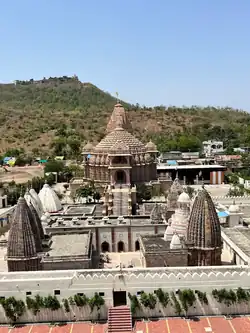 Temple complex | |
  Location within Maharashtra | |
| Religion | |
| Affiliation | Jainism |
| Sect | Digambara |
| District | Nagpur |
| Deity | Shantinatha |
| Festival | Mahavir Jayanti |
| Governing body | Digambar Jain Parwar Mandir Trust |
| Location | |
| Location | Ramtek, Maharashtra |
| State | Maharastra |
| Coordinates | 21°24′20″N 79°19′47.4″E / 21.40556°N 79.329833°E |
| Architecture | |
| Established | 11th century |
| Temple | 10 |
Shantinatha temple, Ramtek is a major Jain tirth (pilgrimage site) in the Indian state of Maharashtra, located between the villages of Ramtek in Nagpur district. The complex comprises a combination of historic and modern Jain shrines arranged around an open courtyard. The principal shrine contains a colossal image of Shantinatha, accompanied by smaller images representing the other Tirthankaras.[1]
The historic Shantinatha temple has been dated to the eleventh or twelfth century.[2] The complex was enlarged in later periods through the construction of additional shrines and has undergone subsequent renovation.[3]
History
Ramtek has a long history as a religious centre. The hill was an important sacred landscape by the Vakataka period, although this earlier history should be distinguished from the chronology of the surviving Jain temple complex.[4]
The Shantinatha temple itself is generally assigned to the eleventh or twelfth century.[2] The surviving complex does not represent a single phase of construction. The original temple was supplemented over time by additional Jain shrines, producing the present assemblage of old and modern religious structures.[3][1]
Several additions were made during the Maratha period. Shrines dating to the eighteenth and nineteenth centuries were erected by an accountant associated with the court of the Bhonsles of Nagpur during the reign of Raghoji I Bhonsle.[5] The expansion of the Jain complex occurred within a broader transformation of the religious landscape of Ramtek under the Bhonsles. During the eighteenth century, Ramtek saw extensive construction and renovation of religious buildings around the hill and its associated sacred landscape.[6]
The temple complex has subsequently undergone further renovation and the addition of modern structures. The National Monuments Authority records renovation work at both the Shantinatha and nearby Parshvanatha temples.[1]
Architecture

The historic temple is built of yellow sandstone and represents a northern Indian architectural tradition. Titze and Bruhn identify the tower of the Shantinatha temple as an important surviving example of north Indian temple architecture predating the widespread development of Indo-Islamic architectural forms.{sfn|Titze|Bruhn|1998|p=98}}
The present temple complex consists of multiple shrines constructed during different periods rather than a single architecturally uniform structure. These are arranged around an open central courtyard.The main central shrine houses the principal image is a 4 m (13 ft) Shantinatha idol.[7] The National Monuments Authority describes the image as colossal and records that it is flanked by smaller representations of the other Tirthankaras.[1]
A notable sculpture elsewhere in the complex represents figures identified in the National Monuments Authority documentation as possibly the parents of Mahavira; the sculpture is singled out in the government survey for the quality of its artistic execution.[1]
Temple complex
The Shantinatha complex combines the principal historic shrine with a number of subsidiary shrines of different dates. The National Monuments Authority characterises these as a mixture of old and modern structures containing numerous images of Jain deities. This arrangement gives the complex the form of an enclosed Jain religious precinct centred on an open courtyard, rather than that of an isolated freestanding temple.[1]
Later structures and facilities within the complex include additional Jain shrines, a manastambha, Sant Bhavan and Pratibhasthali. The temple also has a dharamshala equipped with modern facilities, including a bhojanalaya (restaurant).[2]
Jain monuments at Ramtek
The Shantinatha temple is not the only historic Jain structure at Ramtek. The National Monuments Authority also documents a Parshvanatha temple in the area. Its entrance porch contains ceiling decoration, while the lintel of its mahamandapa bears a ten-armed image of the Jain goddess Chakreshvari mounted on Garuda. The sanctum of the Parshvanatha temple contains a seated image of Parshvanatha.[1] Together, the Shantinatha and Parshvanatha temples demonstrate the presence of a broader Jain sacred complex at Ramtek, incorporating architecture and sculpture dedicated to Tirthankaras and associated Jain deities.[1]
Sculpture and iconography
The principal object of worship is the monumental image of Shantinatha, the sixteenth Tirthankara.[2] The main shrine also contains smaller representations of the other Tirthankaras around the principal Shantinatha image. The Jain sculptural programme at Ramtek is not restricted to representations of the Tirthankaras. The nearby Parshvanatha temple contains an image of Chakreshvari, the yakshini associated with Rishabhanatha, represented with ten arms and riding Garuda.[1] The government heritage survey also identifies a sculpture within the Shantinatha complex that appears to depict Mahavira's parents and describes it as notable for its artistic execution.[1]
Religious significance
The temple remains an active Digambara Jain place of worship and pilgrimage.
Mahavir Jayanti and Paryushana are among the major Jain festivals observed at the site. The National Monuments Authority records that the complex receives approximately 100–150 visitors on ordinary days, increasing to around 700–750 on weekends. The survey recorded larger gatherings of approximately 1,400–1,500 visitors during the October–March pilgrimage season and on occasions including Mahavira Jayanti and Paryushana.[1]
Association with Vidyasagar
Digambara Jain monk Acharya Vidyasagar spent several Chaturmas periods at Ramtek, including in 1993, 1994, 2008, 2013 and 2017. His association with Ramtek contributed to modern religious development at the site. Pratibhasthali Gyanodaya Vidyapeeth, an educational institution for girls, was established at Ramtek with his inspiration and inaugurated in 2014.
In 2013, Vidyasagar conducted a major initiation ceremony at Ramtek in which twenty-four Jain monks received muni diksha.
Conservation
The National Monuments Authority's condition assessment describes the Jain monuments at Ramtek as being in a good state of preservation. It also records that renovation work has been carried out at both the Shantinatha and Parshvanatha temples. The combination of historic fabric, later additions and continuing religious use means that the present complex reflects successive phases of construction, renovation and active Jain worship.[1]
Gallery
 Ramtek Panch Balyati Temple Main Sanctum
 Main Temple Shikhara
 Outer Enclosure of Shantinatha Temple
 New Manstambha built in 2010s
 Panch Balyati Temple
 Outer Carvings
 13 feet (4.0 m) Shantinatha idol
See also
Notes
References
Citation
- 1 2 3 4 5 6 7 8 9 10 11 12 NMA 2022.
- 1 2 3 4 Titze & Bruhn 1998, p. 98.
- 1 2 Titze & Bruhn 1998, pp. 98–99.
- ↑ Bakker 1989, pp. 79–102.
- ↑ Michell & Zebrowski 1999, p. 261.
- ↑ Cummings 2022, pp. 472–484.
- ↑ Michell 2012, p. 161.
Bibliography
Books
- Michell, George; Zebrowski, Mark (1999). Architecture and Art of the Deccan Sultanates. New Cambridge history of India: The Mughals and their contemporaries. Vol. 7. Cambridge University Press. ISBN 9780521563215.
- Michell, George (2012). Southern India. Bangalore: Roli Books. ISBN 9788174369031.
- Ray, Himanshu Prabha; Kulshreshtha, Salila; Suvrathan, Uthara (2022). The Routledge Handbook of Hindu Temples: Materiality, Social History and Practice. Routledge. ISBN 9781000785814.
- Titze, Kurt; Bruhn, Klaus (1998). Jainism: A Pictorial Guide to the Religion of Non-Violence (2 ed.). New Delhi: Motilal Banarsidass. ISBN 81-208-1534-3.
- Bakker, Hans T. (1989). "The Antiquities of Ramtek Hill, Maharashtra". South Asian Studies. 5 (1): 79–102. doi:10.1080/02666030.1989.9628387.
- Cummings, Cathleen A. (2022). "The remaking of Ramtek Hill under the Yadavas and Bhosles of Nagpur". In Ray, Himanshu Prabha; Kulshreshtha, Salila; Suvrathan, Uthara (eds.). The Routledge Handbook of Hindu Temples: Materiality, Social History and Practice. Routledge. pp. 472–484.
- National Monuments Authority (2022). Heritage Bye-Laws for Centrally Protected Monuments at Ramtek, District Nagpur, Maharashtra (Report). Ministry of Culture, Government of India.
External links
 Media related to Jain temple, Ramtek at Wikimedia Commons
See also : Jain temples in North America and Jain temples in Pakistan | |
| Bihar | |
| Delhi | |
| Gujarat | |
| Jharkhand | |
| Karnataka | |
| Kerala | |
| Madhya Pradesh | |
| Maharashtra | |
| Nagaland | |
| Odisha | |
| Rajasthan | |
| Tamil Nadu | |
| Telangana | |
| Uttar Pradesh | |
| West Bengal | |


| Gods | |||||
|---|---|---|---|---|---|
| Philosophy | |||||
| Branches |
| ||||
| Practices | |||||
| Literature | |||||
| Symbols | |||||
| Ascetics | |||||
| Scholars | |||||
| Community |
| ||||
| Jainism in |
| ||||
| Jainism and | |||||
| Dynasties and empires | |||||
| Related | |||||
| Lists | |||||
| Navboxes |
| ||||