Presidency of Jaime Lusinchi
 | |
| Presidency of Jaime Lusinchi 2 February 1984 – 2 February 1989 | |
| Cabinet | See list |
|---|---|
| Party | Acción Democrática |
| Election | |
| Seat | Miraflores Palace |
 Presidential Standard | |
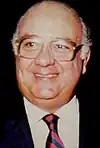
The Presidency of Jaime Lusinchi or the Lusinchi Presidency or the Lusinchi Administration refers to Jaime Lusinchi’s tenure as the President of Venezuela which lasted from 2 February 1984 to 2 February 1989 as a member of the Partido Acción Democrática.
Background
The adecos chose Jaime Lusinchi and Caldera once more stood up for his party COPEI. The divided socialists offered Teodoro Petkoff and José Vicente Rangel. Petkoff had broken with the Communist Party and, with the veteran leader Pompeyo Márquez, had founded in 1971 the Movement for Socialism (MAS in Spanish), which was more or less inspired by the Prague Spring, when Czech communists tried to liberalize their country in 1968.[1] MAS was still Marxist but edging to left of center. Rangel was the son of a general during the Gómez autocracy, but he entered politics in 1958 as a moderate leftist. Rangel denounced the abuses of the adeco governments of Betancourt and Leoni—he accused them of allowing the secret police and the army to torture detainees—and he was the MAS presidential candidate in 1973 and 1978, both times doing badly. Teodoro was particularly disliked by adeco pardos. Teodoro was always trying to displace Rangel as his party's choice and finally, in 1983, the two men had a chance to test each other's popularity.
Much of the campaign was taken up by an "underground" debate about Lusinchi's mistress, Blanca Ibañez, and adecos insisted that his legal wife had simply "to bite the bullet". When the results were in, bipolarity worked and the adecos proved that they still had the pardos on their side by garnering 56% of the vote, the highest margin ever in a Venezuelan election. Caldera was down, but, as we shall see, definitely not out. But there were two novelties in the results: although Petkoff got more votes than Rangel, together they got 7% of the vote, which the left had never before achieved, although it is questionable whether Teodoro at that point was in any way the radical he had been before. Another result was that abstentions were 12% and this was significant because, as we saw, voting was compulsory in Venezuela and by and large Venezuelans had been very dutiful in this respect, and now they showed that not voting was catching on.
Presidency
Overview
Corruption had always been an issue in Venezuela, but under Lusinchi it became the main issue, and most Venezuelans considered that corruption, and not sheer incompetence, was the root of all of society's ills. Lusinchi had divorced his wife and married Blanca Ibañez, who was considered very influential behind the scene and was blamed for abuse of power and nepotism. The Venezuelan economy stagnated, and the country at the end of Lusinchi's regime was reportedly bankrupt. It would be reasonable to surmise that this should have been the end of bipolarity in the next elections, but it would be wrong. In the 1988 elections, the two ruling parties got a total of 93% of the vote. Petkoff fared very badly, but abstentions went up to 18%. The winner was none other than Carlos Andrés Pérez, for his second term. (In the Venezuelan constitution you could be re-elected as many times as you wanted as long as it wasn’t in successive elections.) The question was: How could a country whose descent into insolvency began with Pérez, who had botched so badly his first term, when corruption flourished as never before, have re-elected him with a majority that was barely less than the one Lusinchi got? This enigma has various explanations. That pardos were still adecos is an obvious one. The opposition to bipolarity did not have a leader is another. But especially, Venezuelans of all hues simply remembered that during Pérez's first term there had been a lot of money in circulation, things over-all had not been so dismal, and somehow they figured that Pérez could perform the miracle of making Venezuela "prosperous" again.
Inauguration
In his 1984 presidential inauguration speech, Jaime Lusinchi announced a period of realism and economic austerity with the aim of ending "the era of the mirages of an oil country that filled much of the 20th century". He spoke about the country's economic situation, administrative corruption, unemployment, and the need to achieve a social pact that would help stabilize the economy and reactivate production.[2]
Lusinchi's cabinet (1984–1989)
| Ministries[3] | ||
|---|---|---|
| OFFICE | NAME | TERM |
| President | Jaime Lusinchi | 1984–1989 |
| Homeland Affairs | Octavio Lepage | 1984–1986 |
| José Ángel Ciliberto | 1986–1988 | |
| Simón Alberto Consalvi | 1988–1989 | |
| Foreign Affairs | Isidro Morales Paúl | 1984–1985 |
| Simón Alberto Consalvi | 1985–1988 | |
| Germán Nava Carrillo | 1988–1989 | |
| Finance | Manuel Azpúrua Arreaza | 1984–1987 |
| Héctor Hurtado | 1987–1989 | |
| Defense | Humberto Alcalde Álvarez | 1984 |
| Andrés Brito Martínez | 1984–1986 | |
| José Cardozo Grimaldi | 1986–1987 | |
| Heliodoro Guerrero | 1987–1988 | |
| Italo del Valle Alliegro | 1988–1989 | |
| Development (Public Works) | Héctor Hurtado | 1984–1986 |
| José Ángel Ciliberto | 1986 | |
| Gustavo Mirabal Bustillos | 1986–1987 | |
| Héctor Meneses | 1987–1989 | |
| Transportation and Communications | Juan Pedro del Moral | 1984–1988 |
| Vicente Pérez Cayena | 1988–1989 | |
| Education | Ruth Lerner de Almea | 1984–1985 |
| Luis Manuel Carbonell | 1985–1987 | |
| Pedro Cabello Poleo | 1987–1988 | |
| Laura Castillo de Gourfinkel | 1988–1989 | |
| Justice | José Manzo González | 1984–1988 |
| Pedro Torres Agudo | 1988–1989 | |
| Energy (Mines and Oil) | Arturo Hernández Grisanti | 1984–1988 |
| Julio César Gil | 1988–1989 | |
| Environment | Orlando Castejón | 1984 |
| Juan Francisco Otaola Paván | 1984–1986 | |
| Guillermo Colmenares Finol | 1986–1989 | |
| José Arnaldo Puigbó Motales | 1988–1989 | |
| Agriculture | Felipe Gómez Álvarez | 1984–1988 |
| Wenceslao Mantilla | 1988–1989 | |
| Labor | Simón Antonio Paván | 1984–1988 |
| José Arnaldo Puigbó Morales | 1988–1989 | |
| Health and Social Assistance | Luis Maniel Manzanilla | 1984–1985 |
| Otto Hernández Pieretti | 1985–1987 | |
| Francisco Montbrum | 1987–1989 | |
| Urban Development | Rafael Martín Guédez | 1984–1986 |
| César Quintana Romero | 1986–1989 | |
| Youth | Milena Sardi de Selle | 1984–1987 |
| Virginia Olivo de Celli | 1987–1989 | |
| Secretary of Presidency | Simón Alberto Consalvi | 1984–1985 |
| Carmelo Lauría Lesseur | 1985–1988 | |
| Carlos Croes | 1988–1989 | |
| Office for Coordination and Planification | Luis Raúl Matos Azócar | 1984–1986 |
| Leopoldo Carnevali | 1986–1988 | |
| Modesto Freites | 1988–1989 | |
| CVG | Leopoldo Sucre Figarella | 1984–1989 |
Domestic policy
Economic policy

Following Viernes Negro on 18 February 1983, 1984 closed with an economic recession of 6% of GDP. Between that year and 1986, there were three consecutive years of depreciation of the national currency that culminated in a 93% devaluation of the bolívar at the official exchange rate in 1986. The Barcelona Centre for International Affairs described Lusinchi's economic policy as a "return to economic populism characteristic of previous Acción Democrática administrations".[4]
Legislative policy


Electoral policy
COPRE
The Presidential Commission for State Reform (COPRE) was a presidential commission created on 26 December 1984 by President Jaime Lusinchi to examine the reform of the Venezuelan state and its political system, the democratization of regional governmental processes, and the creation of the office of municipal mayor. Lusinchi decided to appoint all state governors from among the general secretaries of Acción Democrática at the state level, bypassing regional leadership.[5]
Infrastructure policy

During his government, the first phase of the San Agatón Hydroelectric Plant was completed, which had been initiated by his predecessor, requiring the evacuation of the small town of Potosí, which ultimately ended up under water.[6]
Media and communications policy
During Lusinchi's presidency there were reports of coercion against journalists.[4] Broadcasting concessions were granted to operate new television channels, including Televen, Omnivisión and regional channels, as well as FM radio stations. Indeed, the first commercial station on that band was 107.3 MHz (today La Mega). Jaime Lusinchi decided to appoint all state governors from among the general secretaries of Acción Democrática at the state level, bypassing regional leadership.[5]
In 1985 the two hundred copies existing in Venezuela of the book Narcotráfico S. A. by the American political activist Lyndon LaRouche were seized by the Dirección de los Servicios de Inteligencia y Prevención (DISIP).[7]
Human rights policy
During Lusinchi's government there were reports of disappearances associated with the actions of some police forces.[8] According to Revista SIC, during this time: "Allegedly officials of the former Judicial Technical Police killed more than 50 people and later threw their bodies into wells".[9] In Zulia state, the appearance of mass graves called "Pozos de la muerte" was reported, containing bodies of people who had been detained by police or reported as missing.[8]
Since the 1980s, various religious figures began to establish non-governmental organizations to denounce cases of police abuse, arbitrary detention, torture and extrajudicial executions.[10] Among these were Justicia y Paz, founded by Matías Camuñas.[10] Meanwhile, in 1985, the priest Esteban Wood of the Maryknoll missionaries, together with other activists, created the Human Rights Commission of the Maryknoll Missionaries, which later became the Red de Apoyo por la Justicia y la Paz.[10]
In 1984, Congress attempted to approve the Law on Provisional Release for Justifying Causes. This sought to exempt officers who committed killings from responsibility, justifying them as self-defense and fulfillment of duty.[8] In response, various academics and the NGO Comité Luto Activo organized protests arguing that it violated the right to life, preventing the project from passing.[8]
They also denounced cases of police abuse and promoted the collection of signatures to urge Congress to repeal the Law of Vagrants and Delinquents.[8] NGO reports drew the attention of international organizations to the human rights situation, prompting visits from members of Amnesty International, Human Rights Watch and the Inter-American Institute of Human Rights.[8]
Amnesty International published reports investigating cases of extrajudicial executions committed by police.[8] The organization Index on Censorship mentioned several cases of censored media outlets and that some critical journalists were imprisoned.[11]
Since the 1980s, the first cases of HIV/AIDS began to be reported in the country. This led to discriminatory treatment in the media against the LGBTQ+ community, and at the beginning of the disease there were cases of arbitrary detention of people suspected of carrying it. In response to discrimination and high medication costs, the organization Acción Ciudadana Contra el Sida (ACCSI) was created in 1987 to provide support and pressure the government to acquire medications.[12]
Tazón massacre
In September 1984, the Tazón massacre occurred, in which a group of about 200 students heading to Caracas for a protest were attacked by members of the Bolivarian National Guard, leaving 35 injured. The events provoked rejection and protests demanding a ban on the use of firearms to control demonstrations.[13]
Massacre of El Amparo
On 29 October 1988, the massacre of El Amparo occurred, in which 14 fishermen were killed by police officers after being mistaken for guerrillas. The event led to a lengthy judicial process, eventually brought before the Inter-American Court of Human Rights of the Organization of American States on 14 January 1994; the Court issued a ruling on the merits on 18 January 1995 and a second ruling establishing compensation and ordering investigation and punishment on 14 September 1996.[14]
Environmental policy
Toxic waste scandal
It was an environmental scandal that occurred in 1987, in which two ships carrying barrels of toxic waste from Italy arrived in the country. These events triggered protests, strong criticism in public opinion and Venezuelan politics at the time, leading to the creation of laws and prohibitions on the matter.[15]
Corruption scandals
RECADI
On 24 February 1989, an investigation was opened by presidential order against RECADI for alleged financial fraud during the government of Jaime Lusinchi.[16] RECADI constituted a turning point in the history of Venezuelan corruption and became a major scandal in 1989 when five former ministers were detained.[17] However, charges were later dropped.[18] Notable was the purchase of vehicles for the Acción Democrática presidential campaign of 1988, A pesar de las denuncias durante el Second presidency of Carlos Andrés Pérez el asunto no pasa a mayores debido a que los denunciantes se retractan o no presentan pruebas de los casos.
Foreign policy

In his 1984 inaugural speech, Jaime Lusinchi called for Latin American integration.[2]
Colombia
Caldas corvette crisis
On 9 August 1987, the Caldas corvette crisis began when a Colombian warship crossed into disputed waters in the Gulf of Venezuela, placing itself in the center of the area claimed by Colombia. The conflict nearly escalated into war, but was resolved diplomatically with mediation by the Organization of American States.[19]
International trips
The following list provides a summary of the official foreign visits made by Lusinchi as President of Venezuela:
1984
| Date | Place | Main purpose |
|---|---|---|
| 3–5 December | Washington, D.C., San Francisco (  United States) |
Official visit[20] |
1985
| Date | Place | Main purpose |
|---|---|---|
| 25 September | ( Mexico) |
[21] |
1986
| Date | Place | Main purpose |
|---|---|---|
| 31 January | Cancún ( Mexico) |
Discussion on oil prices with President Miguel de la Madrid.[22][23] |
| 8 June | Rome (  Italy) |
Visit to the Italo-Latin American Institute.[24] |
| September | ( Trinidad and Tobago) |
[25] |
| 5–7 October | Madrid (  Spain) |
[26][27] |
1987
| Date | Place | Main purpose |
|---|---|---|
| 17–19 July | ( Barbados) |
Tour and visit to four Caribbean states.[28][29] |
( Dominica) | ||
| 27–30 July | Mexico City ( Mexico) |
Establishment of the Sponsoring Committee for the Evaluation Conferences of Venezuelan Exile in Mexico. Speech before the Permanent Commission of the Congress of the Union. Inauguration of the Simón Bolívar Chair at the National Autonomous University of Mexico.[23][30] |
Opposition
Protests
According to El Nacional, in 1984 there were 293 protests nationwide; in 1985 there were 262, in 1986 there were 70, in 1987 there were 83, and in 1988 there were 103, totaling 811.[31]
March protests in Mérida
On 13 March 1987, unrest began in Mérida following the killing of university student Luis Carvallo Cantor, known as the March protests in Mérida.[32]
Yumare massacre
In 1986, the Yumare massacre occurred, in which nine members of the insurgent group Punto Cero were executed by DISIP forces.[33] In 2006, relatives of the victims sued Lusinchi and officials for the events.[4]
Night of the Tanks
On 26 October 1988, while Lusinchi was abroad and shortly before the elections, a column of 26 Dragón armored vehicles moved from Fuerte Tiuna toward Miraflores Palace in Caracas, later described as an aborted coup attempt.[34]
Historical impact
Corruption in Venezuela had always been a problem, but under the government of Jaime Lusinchi it became the main problem, and the majority of Venezuelans considered that corruption, and not mere incompetence, was the root of all the evils of society. This period was also characterized by allegations of immorality and abuse of power. Lusinchi had divorced his wife Gladys Castillo and had married Blanca Ibáñez, who was considered very influential behind the scenes and was blamed for abuse of power and nepotism,[35] which reached the extreme of appointments and dismissals of public officials, financial and social conditioning of public contracts, and selection of promotions to Generals of the Armed Forces.[36]
The disparity of the bolívar with respect to the dollar would grow, as would inflation, the Venezuelan economy stagnated, would continue to be dependent on oil, and at the end of Lusinchi's government Venezuela entered into sovereign default on the external debt contracted by the nation prior to 1983,[37] which motivated his successor Carlos Andrés Pérez to take economic measures (El Gran Viraje) that led to a generalized social upheaval (the sadly celebrated Caracazo).[38]
See also
References
- ↑ Petkoff, Teodoro, Checoeslovaquia: el socialismo como problema, 1969
- 1 2 Yuste, Juan González (1984-02-03). "El presidente de Venezuela, Jaime Lusinchi, anuncia realismo y austeridad para poner fin a los "espejismos" petroleros" [The president of Venezuela, Jaime Lusinchi, announces realism and austerity to put an end to the "oil mirages"]. El País (in Spanish). ISSN 1134-6582.
- ↑ Gaceta Oficial de Venezuela, period 1984-1989.
- 1 2 3 Roberto Ortiz de Zárate. "Jaime Lusinchi". Barcelona Centre for International Affairs (in Spanish).
- 1 2 Rivero, Mirtha (2016-01-24). La rebelión de los náufragos [The Rebellion of the Castaways] (in Spanish). Editorial Alfa. ISBN 978-84-16687-01-5. Retrieved 2024-01-23.
- ↑ "Potosí: Pueblo en el Táchira bajo las aguas". Venelogía (in Spanish). Retrieved 2022-10-14.
- ↑ Ernesto Carmona Ulloa (2002). Los dueños de Chile. ISBN 956-7495-08-4.
- 1 2 3 4 5 6 7 Montes de Oca, Rodolfo (2022). "Capítulo VI. Un luto activo" [Chapter VI. An active mourning]. Sospechosos habituales. Diez aproximaciones a los antecedentes históricos del movimiento por los derechos humanos en Venezuela (1936-1999) [Usual Suspects. Ten Approaches to the Historical Background of the Human Rights Movement in Venezuela (1936-1999)] (PDF) (in Spanish). Caracas: Programa Venezolano de Educación-Acción en Derechos Humanos (PROVEA). pp. 365–391. ISBN 978-980-6544-74-1.
- ↑ Alvarado Betancourt, Marino (2015-05-04). "La desaparición forzada en Venezuela" [Forced disappearance in Venezuela]. Revista SIC (in Spanish).
- 1 2 3 Montes de Oca, Rodolfo (2022). "Estar del lado de los desposeídos" [Being on the side of the dispossessed]. Sospechosos habituales. Diez aproximaciones a los antecedentes históricos del movimiento por los derechos humanos en Venezuela (1936-1999) [Usual Suspects. Ten Approaches to the Historical Background of the Human Rights Movement in Venezuela (1936-1999)] (PDF) (in Spanish). Caracas: Programa Venezolano de Educación-Acción en Derechos Humanos (PROVEA). pp. 225–294. ISBN 978-980-6544-74-1.
- ↑ Bamrud, Joachim (November 1988). "Free elections, unfree press". Index on Censorship. 17 (10): 10–11. doi:10.1080/03064228808534548. ISSN 0306-4220. Retrieved 2024-06-18.
- ↑ Montes de Oca, Rodolfo (2022). "Capítulo VIII. Diversxs y libres" [Chapter VIII. Diverse and free]. Sospechosos habituales. Diez aproximaciones a los antecedentes históricos del movimiento por los derechos humanos en Venezuela (1936-1999) [Usual Suspects. Ten Approaches to the Historical Background of the Human Rights Movement in Venezuela (1936-1999)] (PDF) (in Spanish). Caracas: Programa Venezolano de Educación-Acción en Derechos Humanos (PROVEA). pp. 441–486. ISBN 978-980-6544-74-1.
- ↑ Montes de Oca, Rodolfo (2022). "Luchamos por la vida" [We fought for life]. Sospechosos habituales. Diez aproximaciones a los antecedentes históricos del movimiento por los derechos humanos en Venezuela (1936-1999) [Usual Suspects. Ten Approaches to the Historical Background of the Human Rights Movement in Venezuela (1936-1999)] (PDF) (in Spanish). Caracas: Programa Venezolano de Educación-Acción en Derechos Humanos (PROVEA). pp. 487–532. ISBN 978-980-6544-74-1.
- ↑ Case of El Amparo v. Venezuela (PDF). Inter-American Court of Human Rights. 1995.
- ↑ Ambiente estado y sociedad: crisis y conflictos socio-ambientales en América Latina y Venezuela. Universidad Simón Bolívar. 1991.
- ↑ "Los "viernes" que empavaron la economía". Diario 2001.
- ↑ "El chino de RECADI". El Universal.
- ↑ Damarys Canache, Michael R. Kulisheck (1998), Reinventing legitimacy: democracy and political change in Venezuela. Greenwood Publishing Group.
- ↑ "El incidente internacional conocido con el nombre de "crisis de la corbeta Caldas"".
- ↑ "Visits by Foreign Leaders of Venezuela". Office of the Historian of the United States Department of State. Retrieved 10 November 2024.
- ↑ "President of Venezuela visits Mexico; 1985". Senate of Mexico. Retrieved 2024-11-10.
- ↑ "Mexican, Venezuelan presidents to discuss oil situation". United Press International. Retrieved 2024-11-10.
- 1 2 "Visits of South American leaders to Mexico". Archived from the original on 13 August 2014. Retrieved 13 July 2017.
- ↑ Istituto italo-latino americano (1988). "Visit to the IILA by the President of the Republic of Venezuela, Jaime Lusinchi". Google Books. Retrieved 10 November 2024.
- ↑ "Foreign Relations". countrystudies. Retrieved 16 January 2020.
- ↑ "Lusinchi's visit breaks a period of distancing between Venezuela and Spain". El País. Retrieved 11 November 2024.
- ↑ "President of the Republic of Venezuela, Jaime Lusinchi, 7 October 1986. Congress of Deputies". Congress of Deputies of Spain. Retrieved 9 November 2024.
- ↑ Fundación Polar. "1987 - Chronology of Venezuelan history". Dictionary of Venezuelan History. Retrieved 2024-11-10.
- ↑ Fundación Polar. "1987 - Chronology of Venezuelan history". Dictionary of Venezuelan History. Retrieved 2024-11-10.
- ↑ Hurtado, Miguel de la Madrid (1987-12-01). "Speech by the President of Mexico, Miguel de la Madrid Hurtado, at the dinner offered in honor of the President of Venezuela, Jaime Lusinchi". Revista Mexicana de Política Exterior (in Spanish) (17): 86–88. ISSN 2594-2441. Retrieved 2024-11-10.
- ↑ "Venezuela después del Caracazo" [Venezuela after the Caracazo] (PDF).
- ↑ "Hoy se cumplen 35 años de aquel 13 de Marzo de 1987" [Today marks 35 years since 13 March 1987].
- ↑ "Infografía".
- ↑ "EL TANQUETAZO".
- ↑ "Historia de Venezuela en Imágenes". Fundación Polar. 2009-02-14. Archived from the original on 14 February 2009. Retrieved 2022-05-17.
- ↑ "Jaime Lusinchi". Tal Cual. Retrieved 2022-06-27.
- ↑ "El presidente de Venezuela anuncia la suspensión de pagos de su deuda externa". El País (in Spanish). 1989-01-01. ISSN 1134-6582. Retrieved 2023-03-17.
- ↑ "Cuáles son las consecuencias del Paquetazo". Notilogía (in Spanish). 2016-02-19. Retrieved 2023-03-17.
President of Venezuela (1984–1989) | ||
| Presidency |  | |
| Foreign affairs |
| |
| Electoral history | ||
| Family |
| |
| Related | ||

| First Republic of Venezuela |  | |
|---|---|---|
| Second Republic of Venezuela | ||
| Third Republic of Venezuela | ||
| State of Venezuela | ||
| United States of Venezuela |
| |
| Republic of Venezuela | ||
| Bolivarian Republic of Venezuela | ||
Acting / interim / caretaker presidents shown in italics 1 Recognized by the National Assembly as "interim president" during the Venezuelan presidential crisis until 2023 | ||