Portal:United Kingdom


The United Kingdom Portal
 |
 |
 | |
The United Kingdom of Great Britain and Northern Ireland, commonly known as the United Kingdom (UK) or Britain, is a country in northwestern Europe, off the coast of the continental mainland. It comprises England, Scotland, Wales and Northern Ireland, with a population of over 69 million in 2024. The UK includes the island of Great Britain, the north-eastern part of the island of Ireland, and most of the smaller islands within the British Isles, covering 94,354 square miles (244,376 km2). It shares a land border with the Republic of Ireland and is surrounded by the Atlantic Ocean, the North Sea, the English Channel, the Celtic Sea and the Irish Sea, while maintaining sovereignty over the Crown Dependencies and the British Overseas Territories. The capital and largest city of England and the UK is London; Edinburgh, Cardiff and Belfast are the national capitals of Scotland, Wales and Northern Ireland, respectively.
The British Isles have been continuously inhabited since the Neolithic. In AD 43 the Roman conquest of Britain began. The Roman departure between 383 and 410 was followed by Anglo-Saxon settlement beginning around 450. In 1066 the Normans conquered England. Over the 17th century the role of the British monarchy was reduced, particularly as a result of the English Civil War. In 1707 the Kingdom of England and the Kingdom of Scotland united under the Treaty of Union to create the Kingdom of Great Britain. The Acts of Union 1800 incorporated the Kingdom of Ireland to create the United Kingdom of Great Britain and Ireland in 1801. Most of Ireland seceded from the UK in 1922 as the Irish Free State, and the Royal and Parliamentary Titles Act 1927 created the present United Kingdom.
The UK became the first industrialised country and was the world's foremost power for the majority of the 19th and early 20th centuries, particularly during the Pax Britannica between 1815 and 1914. The British Empire was the leading economic power for most of the 19th century, a position supported by its agricultural prosperity, its role as a dominant trading nation, a massive industrial capacity, significant technological achievements, and the rise of 19th-century London as the world's principal financial centre. At its height in the 1920s, the empire encompassed around a quarter of the world's landmass and population, and was the largest in history. However, its involvement in the First World War and in the Second World War damaged Britain's economic power, and a global wave of decolonisation led to the independence of most British colonies. (Full article...)
Featured article

Weymouth is a town in Dorset, England, situated on a sheltered bay at the mouth of the River Wey on the English Channel coast. The town is 13 kilometres (8 mi) south of Dorchester and 8 kilometres (5 mi) north of the Isle of Portland. The population of Weymouth is almost 52,000. The A354 road bridge connects Weymouth to Portland, which together form the borough of Weymouth and Portland. The history of the borough stretches back to the 12th century; including involvement in the Black Death, the settlement of the Americas, the Georgian era, and World War II. Although fishing and trading employ fewer people in the area since their peak in earlier centuries, tourism has had a strong presence in the town since the 18th century. Weymouth is a popular tourist resort, and the town's economy depends on its harbour and visitor attractions. Weymouth is a gateway town situated half-way along the Jurassic Coast, a World Heritage Site on the Dorset and east Devon coast, important for its geology and landforms. Weymouth Harbour is home to cross-channel ferries, pleasure boats and private yachts, and nearby Portland Harbour is home to the Weymouth and Portland National Sailing Academy, where the sailing events of the 2012 Olympic Games will be held. (Full article...)
Featured biography

The early life of Samuel Johnson was marked by great intelligence and an eagerness for learning. Born in Lichfield, Staffordshire, the sickly infant who grew up to become "arguably the most distinguished man of letters in English history" soon began to exhibit the tics that would colour how others viewed him in his later years. His early life was dominated by his family's financial strain and his abortive efforts to establish himself as a school teacher. Johnson spent a year studying at Pembroke College, Oxford, but was unable to continue his education there because of his lack of financial support. He tried to find employment as a teacher, but found it impossible to secure a long-term position. In 1735 he married Elizabeth "Tetty" Porter, a widow 20 years his senior. The responsibilities of marriage made Johnson determined to succeed as an educator, and encouraged him to establish his own school. The venture was unsuccessful however, and so he decided to leave his wife behind in Lichfield and move to London, where he spent the rest of his life, and where his literary career began. Working initially as a minor Grub Street hack writer, he started to write essays for The Gentleman's Magazine, and authored the Life of Mr Richard Savage (his first successful literary biography), the powerful poem London (an 18th-century version of Juvenal's Third Satire), and the unsuccessful tragic drama Irene, which was not produced until 1749. (Full article...)
General images -
 William III and Mary II Presenting the Cap of Liberty to Europe, 1716, Sir James Thornhill. Enthroned in heaven with the Virtues behind them are the royals William and Mary who had taken the throne after the Glorious Revolution and signed the English Bill of Rights of 1689. William tramples on arbitrary power and hands the red cap of liberty to Europe where, unlike Britain, absolute monarchy stayed the normal form of power execution. Below William is the French king Louis XIV. (from Culture of the United Kingdom)
 Emmeline Pankhurst. Named one of the 100 Most Important People of the 20th Century by Time, Pankhurst was a leading figure in the suffragette movement. (from Culture of the United Kingdom)
 Trooping the Colour is an annual ceremony, most notably associated with the British Army, and involves a grand parade featuring hundreds of soldiers, horses, and musicians. (from Culture of the United Kingdom)
 The red telephone box and Royal Mail red post box appear throughout the UK. (from Culture of the United Kingdom)
 The Glastonbury Festival at night in 2025. The festival has an average daily attendance of 175,000 people with millions more watching live on BBC. (from Culture of the United Kingdom)
 Union Flag being flown on The Mall, London looking towards Buckingham Palace (from Culture of the United Kingdom)
 An award-winning Victoria sponge from an English village fête. Competitive baking is part of the traditional village fête, inspiring The Great British Bake Off television series. (from Culture of the United Kingdom)
 The Proms are held annually at the Royal Albert Hall during the summer. Regular performers at the Albert Hall include Eric Clapton who has played at the venue over 200 times. (from Culture of the United Kingdom)
 Bodiam Castle is a 14th-century moated castle in East Sussex. Today there are thousands of castles throughout the UK. (from Culture of the United Kingdom)
 Queen Victoria in her white wedding dress with Prince Albert on their return from the marriage service at St James's Palace, London, 10 February 1840 (from Culture of the United Kingdom)
 Centre Court at Wimbledon. The world's oldest tennis tournament, it has the longest sponsorship in sport with Slazenger supplying tennis balls to the event since 1902. (from Culture of the United Kingdom)
 The Oxford Union debate chamber. Called the "world's most prestigious debating society", the Oxford Union has hosted leaders and celebrities. (from Culture of the United Kingdom)
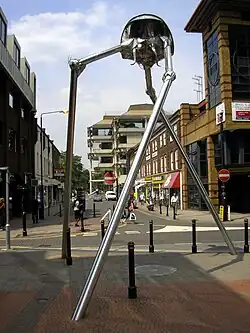 Statue of a tripod from The War of the Worlds in Woking, England, the hometown of author H. G. Wells. The book is a seminal depiction of a conflict between mankind and an extraterrestrial race. (from Culture of the United Kingdom)
 King Alfred the Great statue in Winchester, Hampshire. The 9th-century English king encouraged education in his kingdom, and proposed that primary education be taught in English, with those wishing to advance to holy orders to continue their studies in Latin. (from Culture of the United Kingdom)
 The Grenadier Guards band playing "The British Grenadiers" at Trooping the Colour. Formed in 1685 the band performs at British ceremonial events. (from Culture of the United Kingdom)
 Sunday league football (a form of amateur football). Amateur matches throughout the UK often take place in public parks. (from Culture of the United Kingdom)
 Physicist Stephen Hawking set forth a theory of cosmology explained by a union of the general theory of relativity and quantum mechanics. His 1988 book A Brief History of Time appeared on The Sunday Times best-seller list for a record-breaking 237 weeks. (from Culture of the United Kingdom)
 Smeaton's Eddystone Lighthouse, 9 miles out to sea. John Smeaton pioneered hydraulic lime in concrete which led to the development of Portland cement in England and thus modern concrete. (from Culture of the United Kingdom)
 English novelist Jane Austen was held by literary critic Harold Bloom to be one of the greatest Western writers of all time. (from Culture of the United Kingdom)

 The Beatles are the most commercially successful and critically acclaimed band in popular music, with estimated sales of over one billion.
 Jack in the Green, a traditional English folk custom being celebrated in Hastings Old Town, known for its many historic buildings. (from Culture of the United Kingdom)
 Typical 20th-century, three-bedroom semi-detached houses in England (from Culture of the United Kingdom)
 The British Shorthair was an inspiration for the Cheshire Cat in Lewis Carroll's Alice in Wonderland. (from Culture of the United Kingdom)
 Scouts, Brownies, and Cubs with the local community in Tiverton, Devon on Remembrance Sunday (from Culture of the United Kingdom)
 The Forth Railway Bridge is a cantilever bridge over the Firth of Forth in the east of Scotland. It was opened in 1890, and is designated as a Category A listed building. (from Culture of the United Kingdom)
 Titanic Belfast museum on the former shipyard in Belfast where the RMS Titanic was built (from Culture of the United Kingdom)
 Stonehenge, Wiltshire at sunset (from Culture of the United Kingdom)
 The full breakfast is among the best known British dishes, consisting of fried egg, sausage, bacon, mushrooms, baked beans, toast, fried tomatoes, and sometimes white or black pudding. (from Culture of the United Kingdom)
 Mo Farah is the most successful British track athlete in modern Olympic Games history, winning the 5000 m and 10,000 m events at two Olympic Games. (from Culture of the United Kingdom)
 Two of the current Ravens of the Tower of London. The ravens' presence is traditionally believed to protect the Crown and the tower; a superstition holds that "if the Tower of London ravens are lost or fly away, the Crown will fall and Britain with it". (from Culture of the United Kingdom)
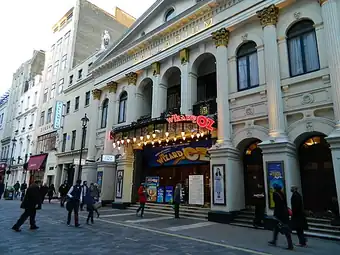 Music hall evolved into variety shows. First performed in 1912, the Royal Variety Performance was first held at the London Palladium (pictured) in 1941. Performed in front of members of the Royal Family, it is held annually in December and broadcast on television. (from Culture of the United Kingdom)
 King Edward's Chair in Westminster Abbey. A 13th-century wooden throne on which the British monarch sits when he or she is crowned at the coronation, swearing to uphold the law and the church. The monarchy is apolitical and impartial, with a largely symbolic role as head of state. (from Culture of the United Kingdom)
 Charles Darwin established that all species of life have descended over time from common ancestors. (from Culture of the United Kingdom)
 Concorde (and the Red Arrows with their trail of red, white and blue smoke) mark the Queen's Golden Jubilee. With its slender delta wings Concorde won the public vote for best British design. (from Culture of the United Kingdom)
 Hadrian's Wall was built in the 2nd century AD. It is a lasting monument from Roman Britain. It is the largest Roman artefact in existence. (from Culture of the United Kingdom)
 Statue of Minnie the Minx, a character from The Beano, in Dundee, Scotland. Launched in 1938, The Beano is known for its anarchic humour, with Dennis the Menace appearing on the cover. (from Culture of the United Kingdom)
 Wembley Stadium, London, home of the England football team and FA Cup finals. Wembley also hosts concerts: Adele's 28 June 2017 concert was attended by 98,000 fans, a stadium record for a music event in the UK. (from Culture of the United Kingdom)
 Ice dancers Torvill and Dean in 2011. Their historic gold medal-winning performance at the 1984 Winter Olympics was watched by a British television audience of more than 24 million people. (from Culture of the United Kingdom)
 One of the UK's many stately homes, Chatsworth House in Derbyshire, surrounded by an English garden. The house is one of the settings of Jane Austen's novel Pride and Prejudice. (from Culture of the United Kingdom)
 The Examination and Trial of Father Christmas (1686), published after Christmas was reinstated as a holy day in England (from Culture of the United Kingdom)
 The Old English heroic poem Beowulf is located in the British Library. (from Culture of the United Kingdom)
 Caricature of British Prime Minister Benjamin Disraeli in Vanity Fair, 30 January 1869 (from Culture of the United Kingdom)
 William Shakespeare has had a significant impact on British theatre and drama. (from Culture of the United Kingdom)


 Josiah Wedgwood was a leading entrepreneur in the Industrial Revolution. (from Culture of the United Kingdom)
 Featherweight champion "Prince" Naseem Hamed was a major name in boxing and 1990s British pop culture. (from Culture of the United Kingdom)
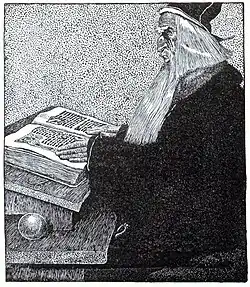 The wizard Merlin features as a character in many works of fiction, including the BBC series Merlin. (from Culture of the United Kingdom)
Subportals
WikiProjects
Things you can do
- Visit the British Wikipedians' notice board.
- The noticeboard is the central forum for information and discussion on editing related to the United Kingdom.
- Comment at the British deletion sorting page.
- This page lists deletion discussions on topics relating to the United Kingdom.
Featured pictures
 Photo: David IliffBeachy Head is a chalk headland on the south coast of England, close to the town of Eastbourne in the county of East Sussex. The cliff there is the highest chalk sea cliff in Britain, rising to 162 m (530 ft) above sea level. The peak allows views of the south east coast from Dungeness to the east, to Selsey Bill in the west.
 Photo credit: David IliffThe City of London skyline as viewed toward the northwest from the top floor viewing platform of London City Hall on the southern side of the River Thames. Not to be confused with the London metropolitan area, the City covers 1.12 mi2 (2.90 km2) and, along with Westminster is the historic core of London around which the modern conurbation grew.
 Photograph credit: David IliffThe Roman Baths complex is a site of historical interest in the English city of Bath, Somerset. It is a well-preserved site dating from Roman Britain once used for public bathing. The Roman baths themselves are below the modern street level. There are four main features: the Sacred Spring, the Roman Temple, the Roman Bath House, and the museum which holds finds from the Roman town. The buildings above street level date from the 19th century. The Baths are a major tourist attraction and, together with the Grand Pump Room, received more than 1.3 million visitors in 2018. Visitors can tour the baths and museum but cannot enter the water.
This picture shows the Great Bath of the Roman Baths complex, with Bath Abbey visible in the background. The entire structure above the level of the pillar bases is of later construction. Photo: David IliffA panoramic view of Skiddaw mountain, the town of Keswick, and Derwentwater, as viewed from Walla Crag on a clear autumn afternoon in the Lake District. Located in North West England, the district is a popular tourist destination and is famous for its lakes and mountains, especially those within its national park.
 Artist: Sir Thomas LawrenceAn oil on canvas portrait of George IV of the United Kingdom as the Prince Regent, by Sir Thomas Lawrence. In 1814, Lord Stewart, who had been appointed ambassador in Vienna and was a previous client of Thomas Lawrence, wanted to commission a portrait by him of the Prince Regent. He arranged that Lawrence should be presented to the Prince Regent at a levée. Soon after, the Prince visited Lawrence at his studio in Russell Square. Lawrence wrote to his brother that: To crown this honour, [he] engag'd to sit to me at one today and after a successful sitting of two hours, has just left me and comes again tomorrow and the next day.
 Photograph credit: Tony JinCanary Wharf is an area of London on the Isle of Dogs. It is defined by the Greater London Authority as being part of London's central business district, alongside Central London. Along with the City of London, Canary Wharf is one of the main financial centres of the United Kingdom and the world, containing many high-rise buildings including the fourth-tallest in the UK, One Canada Square, which opened on 26 August 1991.
 Painting: Anthony van DyckCharles I (19 November 1600 – 30 January 1649) was monarch of the three kingdoms of England, Scotland, and Ireland from 1625 until his execution in 1649. The second son of King James VI of Scotland, he spent most of his life in England after his father inherited the English throne in 1603. His reign was marked by quarrels with the Parliament of England, which sought to curb his royal prerogative. From 1642, Charles fought the armies of the English and Scottish parliaments in the English Civil War. His defeat led to his execution, followed by establishment of a republic called the Commonwealth of England.
This painting, titled Equestrian Portrait of Charles I, is an oil-on-canvas work by Charles's Principal Painter in Ordinary, Anthony van Dyck. The portrait, now in the National Gallery in London, is thought to have been painted in about 1637–38, and is one of many portraits of Charles by van Dyck, including several equestrian portraits. Photo credit: David IliffThe Albert Memorial, a monument to Prince Albert found in Kensington Gardens, London, England, as seen from the south side. Directly to the north of the Royal Albert Hall. It was commissioned by Queen Victoria of the United Kingdom and designed by Sir George Gilbert Scott in the Gothic revival style. Opened in 1872, the memorial is 176 feet (54 m) tall, took over ten years to complete, and cost £120,000.
 Photo credit: Michael ReeveThe National Gallery at night, illuminated for an event to promote the launch of a Pepsi commercial.
The National Gallery in London is an art gallery designed by William Wilkins. It holds part of the National Collection, particularly Western European art from 1250 to 1900. The collection of 2300 paintings belongs to the British public. The Ruins of Holyrood Chapel is an oil painting on canvas completed by Louis Daguerre in c. 1824. It depicts Holyrood Abbey, once the official residence of the Monarch of the United Kingdom in Edinburgh, Scotland, lit by moonlight. The painting is now held by the Walker Art Gallery in Liverpool.
 Photo credit: DiliffThe quadrangle of Windsor Castle, one of the principal official residences of the British monarch. On the far left is the State Apartments, at the end of the quad is the Private Apartments, where Queen Elizabeth II resides on weekends, and on the right, the South Wing. Located at Windsor in the English county of Berkshire, it is the largest inhabited castle in the world and, dating back to the time of William the Conqueror, the oldest in continuous occupation.
 Photograph: Lt. J. W. BrookeWorld War I was a global war originating in Europe that lasted from 28 July 1914 to 11 November 1918. More than 70 million military personnel participated, making it one of the largest wars in history. An estimated nine million combatants and seven million civilians died as a direct result of the war with losses exacerbated by technological developments and the tactical stalemate caused by trench warfare (pictured). The war is also considered a contributory factor in a number of genocides and the 1918 influenza epidemic, which caused between 50 and 100 million deaths worldwide. Unresolved rivalries at the end of the conflict contributed to the outbreak of World War II about twenty years later.
 Photograph: Son of GrouchoInveraray Castle is a country house near Inveraray in the county of Argyll, in western Scotland, on the shore of Loch Fyne, Scotland’s longest sea loch. Designed in part by William Adam and Roger Morris, work on the Gothic Revival castle began in the 1740s. The castle, the seat of the Duke of Argyll, chief of Clan Campbell, is open to the public.
 Photo credit: Phil ChambersA portrait of David Suchet OBE, an English actor best known for his television portrayal of Agatha Christie's Hercule Poirot in the television series Agatha Christie's Poirot. For this role, he earned a 1991 British Academy Television Award (BAFTA) nomination. In preparation for the role he says that he read every novel and short story, and compiled an extensive file on Poirot.
 Photo: David IliffThe castle on Eilean Donan, a small island in Loch Duich in the western Scottish Highlands. The castle, which was built in the 13th century and destroyed in the 18th century, is widely familiar from many photographs and appearances in film and television. The present buildings are a 20th-century reconstruction.
Did you know -

- ... that the Kensington Treaty was the first bilateral Germany–United Kingdom treaty since World War II?
- ... that Sting wrote "We Work the Black Seam" because he felt that "the case for coal was never put to the nation" during the 1984–85 British miners' strike, which began 40 years ago today?
- ... that Anne was the last circus elephant in the United Kingdom?
- ... that the ecclesiastical site at Devenish Island was among the first protected monuments in the United Kingdom?
- ... that the prime ministers of the United Kingdom and Australia took sides on a 2023 controversy involving their countries' cricket teams?
- ... that when Sarah Jane Baker was released after 30 years, she was the United Kingdom's longest serving transgender prisoner?
In the news

- 27 August 2026 – Middle Eastern crisis
- The United Kingdom Maritime Trade Operations reports that a tanker in the Strait of Hormuz was hit by an "unknown projectile", causing a fire that was later extinguished. (Marine Insight)
- 25 August 2026 – Middle Eastern crisis
- The United Kingdom Maritime Trade Operations reports that an oil tanker has been struck by a unknown projectile off the coast of Oman near the strait. No casualties are reported. (AFP via Arab News) (Gulf News)
- 24 August 2026 – Russo-Ukrainian war
- Military aid to Ukraine during the Russo-Ukrainian war, Ukraine–United Kingdom relations
- British prime minister Andy Burnham, during a visit to Kyiv, confirms that he has approved supplying Ukraine with the classified blueprints to produce Storm Shadow cruise missiles despite Russian threats against such a move, which will give Ukrainian forces the ability to strike key targets deep inside Russian territory. (BBC News) (The Japan Times)
- 24 August 2026 –
- Former British snooker player Graeme Dott is found guilty of sexually abusing two primary school children. (Al Jazeera) (The Guardian)
- 22 August 2026 –
- Seven people are killed, including two police officers, and several others are injured in a three-vehicle collision on the A66 road in Middlesbrough, North Yorkshire, England. (BBC News) (Reuters)
Categories

Other UK-connected Wikipedias
Wikimedia
The following Wikimedia Foundation sister projects provide more on this subject:
-
 Commons
Free media repository -
 Wikidata
Free knowledge base -
 Wikiquote
Collection of quotations -
 Wikisource
Free-content library -
 Wikiversity
Free learning tools -
 Wikivoyage
Free travel guide -
 Wiktionary
Dictionary and thesaurus
-
 List of all portals
-

-

-

-

-

-

-

-

-

-
 Random portal
-
 WikiProject Portals