Portal:Telecommunication

The Telecommunication Portal

Telecommunication, often used in its plural form or abbreviated as telecom, is the transmission of information over a distance using electrical or electronic means, typically through cables, radio waves, or other communication technologies. These means of transmission may be divided into communication channels for multiplexing, allowing for a single medium to transmit several concurrent communication sessions. Long-distance technologies invented during the 19th, 20th and 21st centuries generally use electric power, and include the electrical telegraph, telephone, television, and radio.
Early telecommunication networks used metal wires as the medium for transmitting signals. These networks were used for telegraphy and telephony for many decades. In the first decade of the 20th century, a revolution in wireless communication began with breakthroughs including those made in radio communications by Guglielmo Marconi, who won the 1909 Nobel Prize in Physics. Other early pioneers in electrical and electronic telecommunications include co-inventors of the telegraph Charles Wheatstone and Samuel Morse, numerous inventors and developers of the telephone including Antonio Meucci, Philipp Reis, Elisha Gray and Alexander Graham Bell, inventors of radio Edwin Armstrong and Lee de Forest, as well as inventors of television like Vladimir K. Zworykin, John Logie Baird and Philo Farnsworth.
Since the 1960s, the proliferation of digital technologies has meant that voice communications have gradually been supplemented by data. The physical limitations of metallic media prompted the development of optical fibre. The Internet, a technology independent of any given medium, has provided global access to services for individual users and further reduced location and time limitations on communications. (Full article...)
Selected article -
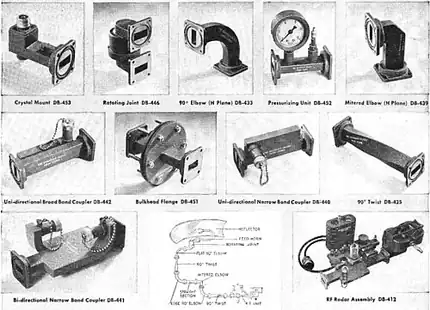
In radio-frequency engineering and communications engineering, a waveguide is a hollow metal pipe used to carry radio waves. This type of waveguide is used as a transmission line mostly at microwave frequencies, for such purposes as connecting microwave transmitters and receivers to their antennas, in equipment such as microwave ovens, radar sets, satellite communications, and microwave radio links.
The group velocity of guided electromagnetic waves (EMW) is a fraction of the speed of light. Propagation in a (metal-pipe) waveguide may be imagined as a zig-zag path, with the EMW being repeatedly reflected between opposite walls of the guide. For the particular case of rectangular waveguide, it is possible to base an exact analysis on this view. Propagation in a dielectric waveguide may be viewed in the same way, with the waves confined to the dielectric by total internal reflection at its surface. Some structures, such as non-radiative dielectric waveguides and the Goubau line, use both metal walls and dielectric surfaces to confine the wave. (Full article...)
General images
 Ad for the beginning of experimental television broadcasting in New York City by RCA in 1939 (from History of television)
 Around 1920, radio broadcasting started to get popular. The Brox Sisters, a popular singing group, gathered around the radio at the time. (from History of radio)
 Typical low-cost webcam used with many personal computers (from History of videotelephony)

 The "Kerbango Internet Radio" was the first stand-alone product that let users listen to Internet radio without a computer. (from History of broadcasting)
 Philo Farnsworth in 1924 (from History of television)
 The Nipkow disk. This schematic shows the circular paths traced by the holes, which may also be square for greater precision. The area of the disk outlined in black shows the region scanned. (from History of television)
 Lee DeForest broadcasting Columbia phonograph records on New York station 2XG, 1916 (from History of broadcasting)
 Oliver Lodge's 1894 lectures on Hertz demonstrated how to transmit and detect radio waves. (from History of radio)
 A French Gower telephone of 1912 at the Musée des Arts et Métiers in Paris (from History of the telephone)
 Broadcasting pioneer Frank Conrad in a 1921 portrait (from History of broadcasting)
 Artist's conception: 21st-century videotelephony imagined in the early 20th century (1910) (from History of videotelephony)
 Swedish Prime Minister Tage Erlander using an Ericsson videophone to speak with Lennart Hyland, a popular TV show host (1969) (from History of videotelephony)
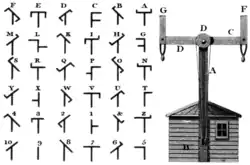 Code of letters and symbols for Chappe telegraph (Rees's Cyclopaedia) (from History of telecommunication)
 Family watching TV, 1958 (from History of television)
 "Fiction becomes fact": Imaginary "Edison" combination videophone-television, conceptualized by George du Maurier and published in Punch magazine. The drawing also depicts then-contemporary speaking tubes, used by the parents in the foreground and their daughter on the viewing display (1878). (from History of videotelephony)
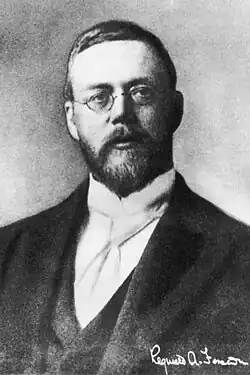 Reginald Fessenden, the "father" of radio broadcasting in the U.S. (from History of broadcasting)
 Naomi ("Joan") Melwit and Norman Banks at the 3KZ microphone, in the late 1930s (from History of broadcasting)
 The 1969 AT&T Mod II Picturephone, the result of decades long R&D at a cost of over $500M. (from History of telecommunication)
 Actor portraying Alexander Graham Bell in a 1932 silent film. Shows Bell's second telephone transmitter (microphone), invented 1876 and first displayed at the Centennial Exposition, Philadelphia. (from History of the telephone)
 Tihanyi' Radioskop patent (1926) was recognized as Document of Universal Significance by the UNESCO (from History of television)
 The earliest photograph of a television picture, showing the face of Oliver Hutchinson in June 1926. The television picture was projected using Baird's television camera. (from History of television)
 Apple iPhone smartphone (from History of the telephone)
 A replica of one of Claude Chappe's semaphore towers (optical telegraph) in Nalbach, Germany (from History of telecommunication)
 Screen idol Rudolph Valentino at the microphone of WSB in Atlanta, 1923 (from History of broadcasting)
 The first commercial AM Audion vacuum tube radio transmitter, built in 1914 by Lee De Forest who invented the Audion (triode) in 1906 (from History of radio)
 An early Smart TV from 2012 running the discontinued Orsay platform (from History of television)
 AT&T magazine advertisement announcing commercial launch of Picturephone service. (from History of videotelephony)
 Philipp Reis, 1861, constructed the first telephone, today called the Reis telephone. (from History of the telephone)
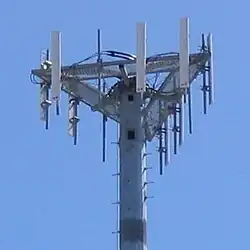 Top of cellular telephone tower (from History of the telephone)

 Early pioneers of radio science and technology in the United States, including Charles Steinmetz, David Sarnoff, Irving Langmuir, and Alfred Goldsmith in 1921, photographed next to the antenna feed wires of the New Brunswick Marconi Station, one of the first transatlantic radio links. The photo includes Albert Einstein as a visiting guest. (from History of radio)
 Alexander Graham Bell was awarded the first U.S. patent for the invention of the telephone in 1876. (from History of the telephone)
 Elisha Gray, 1876, designed a telephone using a water microphone in Highland Park, Illinois. (from History of the telephone)
 A 19th century acoustic tin can or "lovers' telephone" (from History of the telephone)
 The first mass-produced Czechoslovak TV-set Tesla 4001A (1953–57) (from History of television)
 DBS satellite dishes (from History of television)
 Fessenden operating an underwater oscillator in 1915. (from History of radio)
 1917 wall telephone, open to show magneto and local battery (from History of the telephone)
 Reis's telephone around 1861, first device called telephone (from History of the telephone)
 Thomas Edison invented the carbon microphone which produced a strong telephone signal. (from History of the telephone)
 The master telephone patent, 174465, granted to Bell, March 7, 1876 (from History of telecommunication)
 Antonio Meucci, 1849, developing a voice-communication apparatus that several sources credit as the first telephone. (from History of the telephone)
 British Post Office engineers inspect Guglielmo Marconi's wireless telegraphy (radio) equipment in 1897. (from History of radio)

 First television test broadcast transmitted by the NHK Broadcasting Technology Research Institute in May 1939 (from History of television)
 Innocenzo Manzetti considered the idea of a telephone in 1844 (from History of the telephone)
 John Logie Baird in 1925 with his televisor equipment and dummies "James" and "Stooky Bill" (right) (from History of television)
 Manfred von Ardenne in 1933 (from History of television)
Things to do
 |
Here are some tasks awaiting attention:
|
Selected biography -

Alexander Graham Bell (/ˈɡreɪ.əm/ ⓘ; born Alexander Bell; March 3, 1847 – August 2, 1922) was a Scottish-born Canadian-American inventor, scientist, and engineer who is credited with patenting the first practical telephone. He also co-founded the American Telephone and Telegraph Company (AT&T) in 1885.
Bell's father, grandfather, and brother had all been associated with work on elocution and speech, and both his mother and wife were deaf, profoundly influencing Bell's life's work. His research on hearing and speech further led him to experiment with hearing devices, which eventually culminated in his being awarded the first U.S. patent for the telephone, on March 7, 1876. Bell considered his invention an intrusion on his real work as a scientist and refused to have a telephone in his study. (Full article...)
Did you know (auto-generated) -

- ... that Colleen McCullough described the television adaptation of her best-known novel as "instant vomit"?
- ... that SHeDAISY's record label sent spatulas to radio programmers to encourage them to "flip" a poorly-received single?
- ... that Anna DeShawn started E3 Radio to help educate others about Black women that she did not learn about in grade school?
- ... that a cable TV channel in the UK was still broadcasting primarily in black and white as late as 1979?
- ... that the rise of CONUS Communications spurred the Big Three American TV networks to subsidize the purchase of satellite trucks for local newsgathering?
- ... that one of the earliest Ukrainian science fiction novels, written in 1918 by Mykola Chaikovsky, features solar power and a radiotelephone?
Related portals
Topics



Telecommunications in Asia | |
|---|---|
| Sovereign states |
|
| States with limited recognition |
|
| Dependencies and other territories |
|

{ }}
Subcategories

Associated Wikimedia
The following Wikimedia Foundation sister projects provide more on this subject:
-
 Commons
Free media repository -
 Wikidata
Free knowledge base -
 Wikiquote
Collection of quotations -
 Wikisource
Free-content library -
 Wikiversity
Free learning tools -
 Wiktionary
Dictionary and thesaurus
-
 List of all portals
-

-

-

-

-

-

-

-

-

-
 Random portal
-
 WikiProject Portals