Portal:Snakes

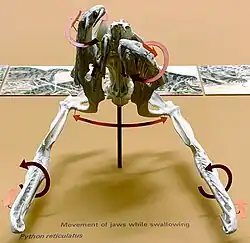
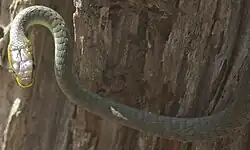
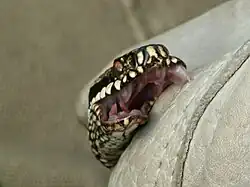
The Snake PortalSnakes are limbless reptiles of the squamate suborder Serpentes. Closely related to lizards and the tuatara, snakes are ectothermic, amniote, air-breathing vertebrates with an elongated rope-Iike body covered by overlapping scales, and they move around using undulatory, rectilinear, concertina, sidewinding or slide-pushing locomotions, with some arboreal species even capable of short-ranged gliding flight by flaring out the ribs to flatten and widen the body for aerodynamic lift. Snakes have skulls with significantly fewer sutures and more hypermobile articulations (i.e. cranial kinesis) than their lizard relatives, enabling them to greatly widen the mouth and swallow prey much larger than their heads. To accommodate their narrow bodies, snakes' paired organs (such as kidneys) appear one in front of the other instead of side by side, and most only have one functional lung. Despite being tetrapods from a cladistic prospective, snakes lack limbs completely, although pythons and boids retain a vestigial pelvic girdle. Some lizards have also independently evolved a snake-like elongated body without limbs or with greatly reduced limbs at least twenty-five times via convergent evolution, leading to many lineages of legless lizards, who have eyelids, external ears and a fleshy non-forked tongue that snakes lack, although this rule is not universal. Snakes are mostly terrestrial with a cosmopolitan distribution, and extant species are found on every continent except Antarctica, and on most islands — exceptions include Ireland, Iceland, Greenland and the islands of New Zealand, as well as many small islands of the Atlantic and Central Pacific oceans. Additionally, secondarily aquatic groups such as the sea snakes are widespread throughout the Indo-Pacific regions, while water snakes are found worldwide. Around thirty families are currently recognized, comprising about 520 genera and about more than 4,170 species. They range in size from the tiny, 10.4 cm-long (4.1 in) Barbados threadsnake to the reticulated python up to 6.95 m (22.8 ft) in length. The fossil species Titanoboa cerrejonensis was 12.8 meters (42 ft) long. Snakes are thought to have evolved from either burrowing or aquatic lizards, perhaps during the Jurassic period, with the earliest known fossils dating to between 143 and 167 Ma ago. The diversity of modern snakes appeared during the Paleocene epoch (c. 66 to 56 Ma ago, after the Cretaceous–Paleogene extinction event). The oldest preserved descriptions of snakes can be found in the Brooklyn Medical Papyrus. (Full article...) Selected article - Vipera aspis is a viper species found in southwestern Europe. Its common names include asp, asp viper, European asp, and aspic viper, among others. Like all other vipers, it is venomous. Bites from this species can be more severe than from the European adder, V. berus; not only can they be very painful, but approximately 4% of all untreated bites are fatal. The specific epithet, aspis, is a Greek word that means "viper." Five subspecies are currently recognized, including the nominate subspecies described here. (Full article...) Did you know (auto-generated) -
More did you know? -
Quality ContentFeatured snake-related articles - George Went Hensley - List of snakes of Trinidad and Tobago Good snake-related articles - Agkistrodon piscivorus - Bitis arietans - Bitis gabonica - Black mamba - Black-necked spitting cobra - Eastern green mamba - Forest cobra - Hydrophiinae - Many-banded krait - Nerodia clarkii - Russell's viper - Snake scales - Vipera berus - Western green mamba General imagesThe following are images from various snake-related articles on Wikipedia.
Selected image
TopicsLists - List of snakes by common name - List of Serpentes families - List of snake genera - List of dangerous snakes
Families - Acrochordidae - Aniliidae - Anomochilidae - Boidae - Bolyeriidae - Colubridae - Cylindrophiidae - Elapidae - Loxocemidae - Pythonidae - Tropidophiidae - Uropeltidae - Viperidae - Xenopeltidae - Anomalepididae - Leptotyphlopidae - Typhlopidae Anatomy and physiology - Infrared sensing in snakes - Pelvic spur - Snake scales - Snake skeleton Subcategories Select [►] to view subcategories
Related portalsNeed help?Do you have a question about Snakes that you can't find the answer to? Consider asking it at the Wikipedia reference desk. Snakes in the newsNo recent news Things you can do
Help at WikiProjects:
Associated WikimediaThe following Wikimedia Foundation sister projects provide more on this subject:
Discover Wikipedia using portals
|