Seoul's history traces back to 18 BC when it was founded by the people of Baekje, one of the Three Kingdoms of Korea. During the Joseon dynasty, Seoul was officially designated as the capital, surrounded by the Fortress Wall of Seoul. In the early 20th century, Seoul was occupied by the Empire of Japan, temporarily renamed "Keijō" ("Gyeongseong" in Korean). The Korean War brought fierce battles, with Seoul changing hands four times and leaving the city mostly in ruins. Nevertheless, the city has since undergone significant reconstruction and rapid urbanization.
The de facto administrative capital has gradually switched to the planned city of Sejong City, which opened in 2012 and is located about 121 kilometers further south. As of 2019, Sejong hosts 10 out of the South Korean government's 18 ministries. Despite this, the Constitutional Court of Korea declared in 2004 that Seoul must remain the national capital due to it being an "unwritten constitutional custom", unless otherwise changed by a nationwide referendum. (Full article...)
Selected article -
Namsan at dusk
Namsan (Korean:남산; lit.'South Mountain') is a 270-metre-high (890ft) peak in Jung District, Seoul, South Korea. It was also known as Mongmyeoksan (목멱산;木覓山) in the past. It offers some hiking, picnic areas and views of downtown Seoul's skyline. Namsan Seoul Tower is located at the summit of Namsan.
The mountain and its surrounding area is Namsan Park, a public park maintained by the city government, which has panoramic views of Seoul. It is also the location of a smoke signal station called Mongmyeoksan Beacon Tower (목멱산 봉수대), which was part of an emergency communication system during much of Seoul's history until 1985. From 1925 to 1945 the Shinto shrine known as Chōsen Shrine was situated on Namsan. This is also where the Japanese Residency-General of Korea Building was from 1906-1962 when it was demolished (Full article...)
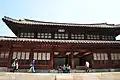
Deoksugung Palace (Korean:덕수궁) is a walled compound of palaces in Seoul that was inhabited by members of Korea's royal family during the Joseon monarchy.
WikiProjects
General images
The following are images from various Seoul-related articles on Wikipedia.
Image 13Gyeongjo-obu-do, an old map of Seoul (from History of Seoul)
Image 14A narrow street of 19th-century Seoul (from History of Seoul)
Image 15Gyeonghungak was an attached two-storied building of Daejojeon Hall of Changdeok Palace. The first story was Gyeonghungak, and the second story was Jinggwangru. (from History of Seoul)