The Selected picture box on the portal chooses one of the following at random when displaying the page. Follow the instructions below for adding or nominating a new picture to the list.
Picture candidates
Feel free to add related featured pictures to the list. Nominate other pictures on the portal talk page.
Pictures must be
Free to use and hosted on Commons
Of good quality (not blurred, grainy or discoloured)
Interesting
Relevant to an article or topic
To find appropriate pictures, use search box below:
Instructions
For pictures, which appeared as picture of the day on the Main Page, just add the date in YYYY-MM-DD format to the list (please keep the list sorted).
For other pictures, use following parameters:
|iN=
|titleN=
|creditN=
|captionN=
where N is the next unused number.
The above documentation is transcluded from Template:Portal pictures/portal doc. (edit | history)
A painting depicting Ivan Tsarevich, one of the main heroes of Russian folklore, riding a magic carpet after having captured the Firebird, which he keeps in a cage. This work was Viktor Vasnetsov's first attempt at illustrating Russian folk tales and inaugurated a famous series of paintings on the themes drawn from Russian folklore.
Maslenitsa, a 1919 painting depicting the carnival of the same name, which takes place the last week before Great Lent. The painting encompasses a broad range of things associated with Russia, such as snowy winter weather, a troika, an Orthodox church with onion domes. Painted in the aftermath of the October Revolution, the canvas was intended as a farewell to the unspoilt "Holy Russia" of yore.
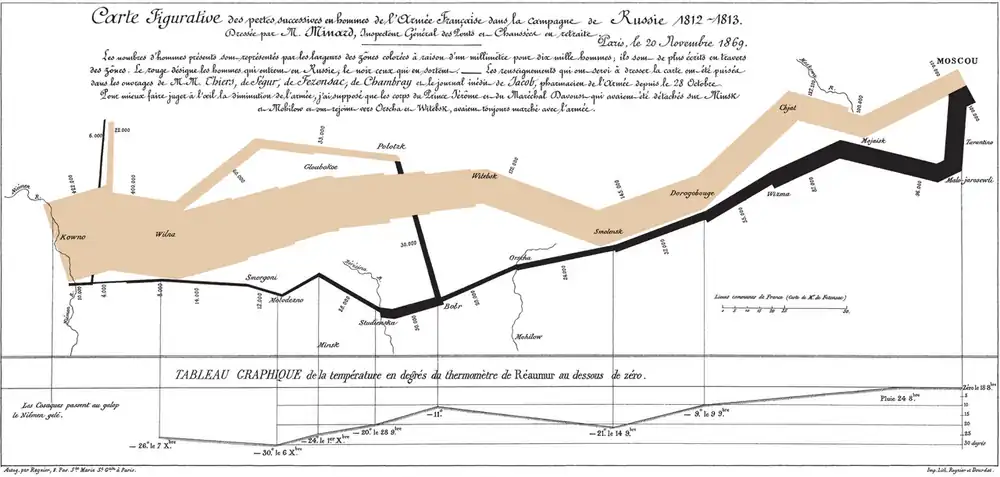
Charles Minard'sCarte figurative (1869), which details the losses of men, the position of the army, and the freezing temperatures on Napoleon's disastrous 1812 invasion of Russia. Created in an effort to show the horrors of war, the graph "defies the pen of the historian in its brutal eloquence" and has been called the best statistical graphic ever drawn.
A late nineteenth-century photochrom of a reindeer sled, Arkhangelsk, Russia. Reindeer have been herded for centuries by several Arctic and Subarctic people including the Sami and the Nenets. They are raised for their meat, hides, antlers and, to a lesser extent, for milk and transportation.
A map detailing the events of the 2008 South Ossetia war, which began one year ago today, when Georgia launched an operation in the disputed region of South Ossetia. Ossetian, Russian, and Abkhazian forces ejected the Georgian forces after five days of heavy fighting. All parties reached a ceasefire agreement on August 12, and Russian troops remain stationed in Abkhazia and South Ossetia to this day.
The Great Coat of Arms of the Russian Empire, as presented to Emperor PaulI in October 1800. The use of the double-headed eagle in the coat of arms (seen in multiple locations here) goes back to the 15th century. With the fall of Constantinople and the end of the Byzantine Empire in 1453, the Grand Dukes of Moscow came to see themselves as the successors of the Byzantine heritage, a notion reinforced by the marriage of IvanIII to Sophia Paleologue. Ivan adopted the golden Byzantine double-headed eagle in his seal, first documented in 1472, marking his direct claim to the Roman imperial heritage and his assertion as sovereign equal and rival to the Holy Roman Empire.
A female Siberian tiger (Panthera tigris altaica), a subspecies of tiger native to Central Asia, and her cub. The Siberian tiger is the largest of the extant tiger subspecies as well as the largest felid, attaining 320kg (710lb) in an exceptional specimen. Considered an endangered subspecies, the wild population is down to several hundred individuals and is limited to eastern Siberia.
Photo: Herman Mishkin; Restoration: Fallschirmjäger
Maxim Gorky (1868–1936) was a Russian political activist and writer who helped establish the Socialist Realism literary method. This portrait dates from a trip Gorky made to the United States in 1906, on which he raised funds for the Bolsheviks. During this trip he wrote his novel The Mother.
Fyodor Dostoevsky (1821–81; depicted in 1872) was a Russian novelist, short story writer, essayist and philosopher. After publishing his first novel, Poor Folk, at age 25, Dostoyevsky wrote (among others) eleven novels, three novellas, and seventeen short novels, including Crime and Punishment (1866), The Idiot (1869), and The Brothers Karamazov (1880).
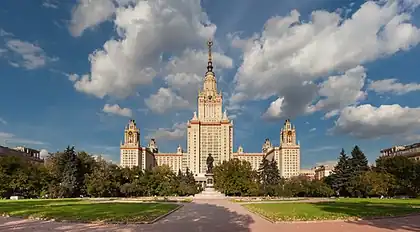
The current main building of the Moscow State University in Sparrow Hills, Moscow, Russia. Designed by Lev Rudnev and completed by 1953, the 240-metre (790ft) tall structure was the tallest building in Europe until the completion of the Messeturm in 1990.
Kikin Hall, commissioned by Alexander Kikin in 1714, is one of the oldest buildings in Saint Petersburg. Incomplete at the time of Kikin's execution, the building was seized by the Russian crown and used for a variety of purposes. In the 1950s, Irina Benois arranged for the restoration of the dilapidated building. It is now home to a music school.
Hotel Astoria is a five-star hotel located on Saint Isaac's Square in Saint Petersburg. Commissioned in 1910 by the Palace Hotel Company to host visitors to the Romanov tercentenary, the hotel was designed by Fyodor Lidval and first opened in 1912. After the October Revolution, it continued to be used as a state-operated hotel, though during World WarII it was also a field hospital. The hotel, now owned by Rocco Forte Hotels, has been renovated several times, most recently in 2012.
The Solovetsky Monastery is a Russian Orthodox monastery in Solovetsky, Arkhangelsk, Russia. Founded in 1436 by the monk Zosima, the monastery grew in power into the 16th century, becoming an economic and political center of the White Sea region and eventually hosting 350 monks. After the Bolshevik Revolution, Soviet authorities closed down the monastery and incorporated many of its buildings into Solovki prison camp, one of the earliest forced-labor camps of the gulag system. The camp closed after the region's trees had been harvested. Today the monastery has been re-established, and also serves as a museum.
The Sukhoi Superjet 100 is a modern fly-by-wiretwin-engineregional jet with 8 to 108 passenger seats. Development began in 2000; the aircraft had its maiden flight on 19 May 2008 and entered commercial service on 21 April 2011. This aircraft is seen flying off the coast of Italy near Sanremo.
The Last Day of Pompeii is an oil painting on canvas completed by the Russian artist Karl Bryullov between 1830 and 1833. The painting is based on sketches the artist completed in 1828 while visiting Pompeii, a city destroyed by the eruption of Mount Vesuvius in 79AD. It is now held in the State Russian Museum.
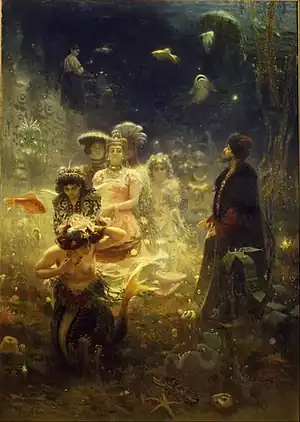
Sadko is a character in the Russian medieval epic Bylina. An adventurer, merchant and gusli musician from Novgorod, Sadko becomes wealthy with the help of the Sea Tsar, but is thrown in the sea when he fails to pay the Sea Tsar his due respects. This story was widely adapted in the 19th century, including in a poem by Alexei Tolstoy and an opera by Nikolai Rimsky-Korsakov.
Shown here is Sadko in the Underwater Kingdom, an 1876 painting by Ilya Repin. It depicts Sadko meeting the Sea Tsar under the sea.
An Alaskan parchment scrip banknote in the denomination of 1 ruble, printed on vellum or parchment by the Russian-American Company. On the obverse, the horizontal text immediately beneath the double-headed eagle reads "Seal of the Russian American Company". The oval text reads "under august protection of His Imperial Majesty", and under the oval is the value of the note "one ruble".
Alaskan parchment scrip was used as a form of company scrip in Alaska when it was a possession of the Russian Empire. In circulation from 1816 to 1867, such scrip could be printed on vellum, parchment, or pinniped skin. Denominations of 10, 25, 50 kopecks and 1, 5, 10, and 25 rubles were issued.
Ivan Goremykin (1839–1917) was a Russian prime minister during World War I. A politician with archconservative views, after some time in the Ministry of Justice, he transferred to the Ministry of the Interior in 1891. He held the rank of prime minister from May to July 1906 and again from 1914 to 1916; during both terms his effectiveness was strongly limited by opposition from the State Duma. In the aftermath of the October Revolution, Goremykin was recognized as a member of the Tsarist government and killed by a street mob.
Saint Basil's Cathedral is a church in Red Square in Moscow, Russia. It was built from 1555 to 1561 on orders from Ivan the Terrible and commemorates the capture of Kazan and Astrakhan. The city's tallest building until the completion of the Ivan the Great Bell Tower in 1600, the original building contained eight side churches arranged around the ninth, central church of Intercession; the tenth church was erected in 1588 over the grave of venerated local saint Vasily (Basil). Although the Bolsheviks considered demolishing the church in the 1930s, it was spared. Since 1991 it has housed a branch of the State Historical Museum and hosted occasional church services.
Barge Haulers on the Volga is an oil painting on canvas completed between 1870 and 1873 by the realist artist Ilya Repin. It depicts eleven men physically dragging a barge on the banks of the Volga River. Depicting these men as at the point of collapse, the work has been read as a condemnation of profit from inhumane labor. Barge Haulers on the Volga drew international praise for its realistic portrayal of the hardships of working men, and launched Repin's career. It has been described as "perhaps the most famous painting of the Peredvizhniki movement [for]....its unflinching portrayal of backbreaking labor". Today, the painting hangs in the Russian Museum in Saint Petersburg.
Leo Tolstoy (1828–1910) was a Russian writer who is regarded as one of the world's greatest novelists. He is best known for War and Peace (1869) and Anna Karenina (1877), often cited as pinnacles of realist fiction. Born to an aristocratic family on 9 September[O.S. 28 August]1828, Tolstoy was orphaned when he was young. He studied at Kazan University, but this was not a success, and he left university without completing his degree. During this time, he began to write and published his first novel, Childhood, in 1852. Tolstoy later served at the Siege of Sevastopol during the Crimean War, and was appalled by the number of deaths and left at the conclusion of the war. He spent the remainder of his life writing whilst also marrying and starting a family. In the 1870s he converted to a form of fervent Christian anarchism.
Alexis (1629–1676) was the tsar of Russia from 1645 until his death. Born in Moscow on 29 March 1629, the son of Tsar Michael and Eudoxia Streshneva, the sixteen-year-old Alexis acceded to the throne after his father's death. Boris Morozov, a shrewd boyar open to Western ideas, took charge of Russia in the early years of Alexis's reign, but was exiled from Moscow following a popular uprising. Alexis responded to the uprising with a new legal code. His reign saw wars with Poland and with Sweden, a schism in the Russian Orthodox Church, and the major Cossack revolt of Stenka Razin. Alexis was married twice and had sixteen children, including tsars Fyodor III; Ivan V; Peter the Great; and Sofia, who ruled as regent for her brothers from 1682 to 1689.
This oil painting, made by an unknown artist in the 1670s, is now located in a museum in Ptuj, Slovenia.
The Bolshoi Theatre is a historic theatre in Moscow, Russia, which holds ballet and opera performances. The company was founded on 28 March[O.S. 17 March]1776, when Catherine the Great granted Prince Pyotr Urusov a licence to organise theatrical performances, balls and other forms of entertainment. Usunov set up the theatre in collaboration with English tightrope walker Michael Maddox. The present building was built between 1821 and 1824 and designed by architect Joseph Bové.
An aerial view of the Field of Mars, a large park in central Saint Petersburg, Russia, pictured in 2016. It is named after Mars, the Roman god of war. The park's history goes back to the 18th century, when it was converted from bogland and named the Grand Meadow. Later, it was the setting for celebrations to mark Russia's victory over Sweden in the Great Northern War. Its next name, the Tsaritsyn Meadow, appears after the royal family commissioned Francesco Bartolomeo Rastrelli to build the Summer Palace for Empress Elizabeth. It became the Field of Mars during the reign of PaulI. Towards the end of the 18th century, the park became a military drill ground, where they erected monuments commemorating the victories of the Russian Army and where parades and military exercises took place regularly. After the February Revolution in 1917, the Field of Mars became a memorial area for the revolution's honoured dead. In the summer of 1942, as the city was besieged by the German army in the Siege of Leningrad, the park was covered with vegetable gardens to supply food. An eternal flame was lit in the centre of the park in 1957, in memory of the victims of various wars and revolutions.
Kombat (Russian for 'battalion commander') is a black-and-white photograph by Soviet photographer Max Alpert. It depicts a Soviet military officer, armed with a TT pistol, raising his unit for an attack during World War II. This work is regarded as one of the most iconic Soviet World WarII photographs, yet neither the date nor the subject is known with certainty. According to the most widely accepted version, it depicts junior politruk Aleksei Gordeyevich Yeryomenko, minutes before his death on 12July1942, in Voroshilovgrad Oblast, now part of Ukraine. The photograph is in the archives of RIA Novosti, a Russian state-owned news agency.
The Portrait of Chaliapin is an oil-on-canvas painting by Boris Kustodiev, produced in 1921. Feodor Chaliapin was a Russian opera singer; possessing a deep and expressive bass voice, he enjoyed an important international career at major opera houses. He is depicted here wearing an expensive fur coat, which had come from a Soviet warehouse containing items confiscated from rich people during the Russian Revolution, and which he had received in lieu of payment for a performance. The background shows festivities at the traditional folk holiday of Maslenitsa. Dressed in a smart suit and holding a cane, Chaliapin is portrayed as having risen above his contemporaries. His favourite dog is at his feet and, at the bottom left, his two daughters stroll on the festive square in front of a poster promoting his concert. This copy of the painting is in the collection of the Russian Museum in Saint Petersburg.
Photograph credit: Arto Jousi; restored by Adam Cuerden
Yuri Gagarin (9March1934– 27March1968) was a Soviet Air Forces pilot and cosmonaut who became the first human to journey into outer space; his capsule, Vostok 1, completed a single orbit of Earth on 12April1961. Gagarin became an international celebrity and was awarded many medals and titles, including Hero of the Soviet Union, his nation's highest honour. In 1967, he served as a member of the backup crew for the ill-fated Soyuz 1 mission, after which the Russian authorities, fearing for the safety of such an iconic figure, banned him from further spaceflights. However, he was killed the following year, when the MiG-15 training jet that he was piloting with his flight instructor Vladimir Seryogin crashed near the town of Kirzhach.
This photograph of Gagarin, dated July1961, was taken at a press conference during a visit to Finland approximately three months after his spaceflight.
Photograph credit: NASA; retouched by Coffeeandcrumbs
Alexei Leonov (1934–2019) was a Soviet cosmonaut, Air Force major general, writer, and artist. On 18March1965, he became the first human to conduct a spacewalk, exiting the capsule during the Voskhod 2 mission for 12minutes and 9seconds. At the end of the spacewalk, his spacesuit had inflated in the vacuum of space to the point that he had great difficulty re-entering the airlock, forcing him to open a valve to deflate his suit. His second trip into space took place ten years later, when he was commander of Soyuz19, the Soviet half of the 1975 Apollo–Soyuz Test Project, the first joint space mission between the Soviet Union and the United States. The crater Leonov on the far side of the Moon is named after him.
This picture shows Leonov photographed in 1974, wearing a lapel pin with a version of the emblem for the Apollo–Soyuz Test Project, which was then in development.
Yekaterina Skudina (born 21 March 1981) is a Russian world champion and Olympic sailor. She was awarded the Roy Yamaguchi Memorial Trophy for winning the world championships in the women's Snipe class in 1998, and the bronze medal at the Yngling open world championships in 2007. At the 2011 World Championships, Skudina finished fourth in the Elliott 6m class. In addition, she has competed in three Olympic Games, finishing eighth in the Yngling class in 2004, sixth in the same class in 2008, and fourth in the Elliott6m class in 2012.
This photograph of Skudina, taken in 2009, is part of a collection of 500 images of Russian sportspeople released to Wikimedia Commons by Bolshoi Sport.
Saint Michael's Castle is a former royal residence in the historic centre of Saint Petersburg, Russia. It was built for Emperor PaulI between 1797 and 1801, and named after Saint Michael, the patron saint of the royal family. Constructed like a castle around a small octagonal courtyard, the four facades were built in different architectural styles, including French Classicism, Italian Renaissance and Gothic. The emperor was assassinated in the castle forty days after taking up residence. After his death, the imperial family returned to the Winter Palace and the building was transferred to the Russian Army's Main Engineering School. In 1990, it became a branch of the Russian Museum, and now houses its portrait gallery.
Lenin, a Soviet nuclear-powered icebreaker, was both the world's first nuclear-powered surface ship and the first nuclear-powered civilian vessel. The ship entered operation in 1959 and worked to clear sea routes for cargo ships along Russia's northern coast. Nuclear power proved to be an ideal technology for a vessel working in such a remote area, as it obviated the need for regular replenishment of fuel. From 1960 to 1965, the ship covered over 85,000mi (137,000km) during the Arctic navigation season, of which three-quarters was through ice. After being decommissioned in 1989, the vessel was subsequently converted into a museum ship and is now permanently based at Murmansk.
A Boyar Wedding Feast is an oil-on-canvas painting created by Russian artist Konstantin Makovsky in 1883. The boyars were members of the highest rank of the feudal aristocracy of Russia in the 16th and 17th centuries, and a wedding was an important social event. In this painting, the guests are depicted toasting a newlywed couple. They stand at the head of the table, where the groom sees his bride without her veil for the first time; she appears timid and bashful as the men toast for the first kiss. Behind the couple, the Lady of Ceremony gently urges on the bride. A roasted swan is being brought in on a large platter, the last dish to be served before the couple retires to the bedroom. The work is in the collection of the Hillwood Estate, Museum & Gardens, in Washington, D.C.
The Tauride Palace is one of the largest and most historic palaces in Saint Petersburg, Russia. It was designed by Ivan Starov for Prince Grigory Potemkin, and was constructed between 1783 and 1789. After the owner's death, it was purchased by Catherine the Great, who constructed a theatre in the east wing and a church in the west wing. Many improvements were also made to the grounds, including construction of the Admiralty Pavilion, the gardener house, the orangery, glass-houses, bridges, and ironwork fences. Although the exterior of the building was rather plain, the interior was very luxurious. More recently, the building housed the first Imperial State Duma (1906–1917) and the post-revolution provisional government.
The Chesme Column is a victory column in the Catherine Park at the Catherine Palace, a former Russian royal residence in Tsarskoye Selo, a suburb of Saint Petersburg. It was erected to commemorate three Russian naval victories in the 1768–1774 Russo-Turkish War, including the Battle of Chesma in 1770. The column is made from three pieces of white-and-pink marble; decorated with the rostra of three ships' bows, and crowned by a triumphal bronze statue depicting a Russian eagle trampling a crescent moon, the symbol of Turkey. Bronze plaques on three sides of the pedestal depict scenes from the battles, and the campaign is described on the plaque on the fourth side.
The Krestovsky Stadium is the home ground of FC Zenit Saint Petersburg. Photographed here in 2016, when construction was nearing completion, it is situated on Krestovsky Island in the Russian city of Saint Petersburg. It was opened in 2017 as a venue for the 2017 FIFA Confederations Cup, and hosted the final, in which Germany beat Chile 1–0. It was one of the venues for the 2018 FIFA World Cup the following year. Among other features, it has a retractable roof, and is equipped with a video-surveillance and identification system, as well as security-alarm, fire-alarm and robotic fire-extinguishing systems. The stadium's seating capacity is 67,800.
Gorky Park is a park in central Moscow, Russia, inaugurated in 1928 following the use of the site in 1923 for the First All-Russian Agricultural and Handicraft Industries Exhibition. The park was named after the writer and political activist Maxim Gorky. It underwent a major reconstruction in 2011; nearly all the amusement rides and other attractions were removed, extensive lawns and flower beds were created, and new roadways were laid. A 15,000m2 (160,000sqft) ice rink was installed at the same time. This picture shows the colonnaded main portal of Gorky Park.
Sergey Prokudin-Gorsky was a Russian pioneer of color photographer. This view of Lugano was most likely taken in 1909.
Although James Clerk Maxwell made the first color photograph in 1861, the results were far from realistic until Prokudin-Gorsky perfected the technique with a series of improvements around 1905. His process used a camera that took a series of monochrome pictures in rapid sequence, each through a different colored filter. Prokudin-Gorskii then went on to document much of the country of Russia, travelling by train in a specially equipped darkroomrailroad car.
This photo of the Nilov Monastery on Stolobny Island in Tver Oblast, Russia, was taken by Sergey Prokudin-Gorsky in 1910 before the advent of colour photography. His process used a camera that took a series of monochrome pictures in rapid sequence, each through a different coloured filter. By projecting all three monochrome pictures using correctly coloured light, it was possible to reconstruct the original colour scene.