Portal:Pennsylvania

The Pennsylvania Portal Pennsylvania, officially the Commonwealth of Pennsylvania, is a state located in the Mid-Atlantic, Northeastern, Appalachian, and Great Lakes regions of the United States. The state borders Delaware to its southeast, Maryland to its south, forming the Mason–Dixon line, West Virginia to its southwest, Ohio to its west, the Canadian province of Ontario to its northwest via Lake Erie, New York to its north, and the Delaware River and New Jersey to its east. Pennsylvania's most populous city is Philadelphia, and the state capital is Harrisburg. Pennsylvania is the fifth-most populous U.S. state, home to over 13 million residents as of the 2020 United States census. Pennsylvania has the ninth-highest by population density, and is the 33rd-largest by land area. The largest metropolitan statistical area is the Philadelphia metropolitan area, centered on Philadelphia, the sixth-most populous U.S. city. Pennsylvania's second-largest metropolitan area, Greater Pittsburgh, is centered in and around Pittsburgh, the commonwealth's second-largest city. Pennsylvania was founded in 1681 through a royal land grant to William Penn, the son of the commonwealth's namesake. Before that, between 1638 and 1655, a southeast portion of the state was part of New Sweden, a Swedish colony. Established as a haven for religious and political tolerance, the British colonial-era Province of Pennsylvania was known for its relatively peaceful relations with native tribes, innovative government system, and religious pluralism. Pennsylvania played a vital historical role in the American Revolution and the ultimately successful quest for independence from the British Empire, hosting the First and Second Continental Congress in Philadelphia, the latter of which formed the Continental Army commanded by George Washington in 1775, during the American Revolutionary War, unanimously adopted the Declaration of Independence the following year. On December 12, 1787, Pennsylvania was the second state to ratify the U.S. Constitution after Delaware. The Battle of Gettysburg, fought in July 1863 around Gettysburg, was the bloodiest battle of the American Civil War with over 51,000 Union and Confederate casualties, and resulted in a repulsion of the Confederacy's invasion of the North. Throughout the late 19th and 20th centuries, the state's steel production and manufacturing-based economy contributed to the development of much of the nation's early infrastructure, including key bridges, skyscrapers, and military hardware used in U.S.-led victories in World War I, World War II, and the Cold War. In the 21st century, Pennsylvania has garnered the nickname "Cellicon State" for the central role of Philadelphia and Pittsburgh in the development of immunotherapies to treat different cancers. (Full article...)
|


 |
 |
 |
| Pennsylvania | Philadelphia | Pittsburgh |
 |
 |
 |
| Erie | Lehigh Valley | Pennsylvania Roads |
 Good article -

The Battle of Jumonville Glen, also known as the Jumonville affair, was the opening battle of the French and Indian War, fought on May 28, 1754, near present-day Hopwood and Uniontown in Fayette County, Pennsylvania. A company of provincial troops from Virginia under the command of Lieutenant Colonel George Washington, and a small number of Mingo warriors led by the chieftain Tanacharison (also known as the "Half King"), ambushed a force of 35 French Canadians under the command of Joseph Coulon de Jumonville.
A larger French Canadian force had driven off a small crew attempting to construct Fort Prince George under the auspices of the Ohio Company at present-day Pittsburgh, Pennsylvania, land claimed by the French. A British colonial force led by George Washington was sent to protect the fort under construction. The French Canadians sent Jumonville to warn Washington about encroaching on French-claimed territory. Washington was alerted to Jumonville's presence by Tanacharison, and they joined forces to ambush the French Canadian camp. Washington's force killed Jumonville and some of his men in the ambush and captured most of the others. The exact circumstances of Jumonville's death are a subject of historical controversy and debate. (Full article...)
Selected article -

William Henry Cosby Jr. (/ˈkɒzbi/ KOZ-bee; born July 12, 1937) is an American former comedian, actor, and media personality. Often deemed a trailblazer for African Americans in the entertainment industry, Cosby was well known in the United States for his stand-up comedy routines and television career before achieving global recognition for his portrayal of Cliff Huxtable in the sitcom The Cosby Show (1984–1992). He was also prolific in advertising for decades and was the recipient of numerous awards and honorary degrees throughout his career, many of which were revoked after dozens of allegations of sexual assault were made against him, starting in 2014 and culminating in a 2018 conviction for aggravated indecent assault.
Cosby began his career as a stand-up comic at the Hungry I nightclub in San Francisco in 1961, and primarily performed observational comedy in a conversational style. He released LP records of numerous standup specials starting with Bill Cosby Is a Very Funny Fellow...Right! (1963) and starred in the comedy film Bill Cosby: Himself (1983). Cosby still holds the record for winning the most Grammy Awards for Best Comedy Album, with seven wins. His acting career began with a starring role in the NBC secret-agent show I Spy (1965–1968), which broke new ground for African Americans when he made history by winning three Primetime Emmy Awards for Best Actor in a Drama Series, becoming the first black actor to do so. (Full article...)
Pennsylvania news
- July 24, 2026 – 2026 United States cyclosporiasis outbreak
- The U.S. Centers for Disease Control and Prevention (CDC) reports that the ongoing cyclosporiasis outbreak, which is caused by Cyclospora cayetanensis, has spread to an additional four states: Illinois, Kansas, Oklahoma, and Pennsylvania. (CNBC)
- July 23, 2026 –
- The International Mathematical Union awards the 2026 Fields Medals to Yu Deng, John Pardon, Jacob Tsimerman, and Hong Wang at the International Congress of Mathematicians in Philadelphia, Pennsylvania, United States. Wang becomes the third woman to receive the prize after Maryam Mirzakhani in 2014 and Maryna Viazovska in 2022. (AFP via Le Monde)
Categories

State facts
State Facts

- Nickname: The Keystone State
- Capital: Harrisburg
- Largest city: Philadelphia
- Total area: 119,283 square kilometers (46,055 square miles)
- Population (2000 census): 12,281,054
- Date admitted to the Union: December 12, 1787 (2nd)
State symbols

- Bird: Ruffed grouse
- Fish: Brook trout
- Floral emblem: Mistletoe
- Flower: Mountain laurel
- Insect: Pennsylvania firefly
- Mammal: White-tailed deer
- Tree: Eastern Hemlock
- Fossil: Trilobite
- Soil: Hazleton
- Song: Pennsylvania
Pennsylvania topics

General images
 Pat's King of Steaks in South Philadelphia is widely credited with inventing the cheesesteak in 1933. (from Pennsylvania)
 Pennsylvania population density map (from Pennsylvania)
 A map of New Netherland (in magenta) and New Sweden (in blue) in the 17th century. New Sweden was later absorbed by New Netherland and then the British in the Second Anglo-Dutch War. (from History of Pennsylvania)


 Citizens Bank Park in South Philadelphia, home of the Philadelphia Phillies, the oldest continuous same-name, same-city franchise in American professional sports (from Pennsylvania)
 William Penn, a Quaker and son of a prominent admiral, founded the colonial Province of Pennsylvania in 1681. (from Pennsylvania)
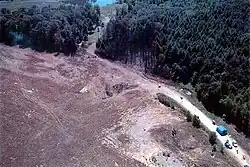 The Stonycreek Township crash site of Flight 93, one of four planes hijacked in the September 11 attacks; the site is now a national memorial. Flight 93 passengers wrestled with al-Qaeda terrorist hijackers for control of the plane, preventing it from being flown into the White House or U.S. Capitol. (from Pennsylvania)

 Map of counties in Pennsylvania by racial and ethnic plurality, per the 2020 U.S. census (from Pennsylvania)
 On November 19, 1863, President Abraham Lincoln (center, facing camera) traveled to present-day Gettysburg National Cemetery and delivered the Gettysburg Address, a 271-word address considered one of the most famous speeches in American history. (from Pennsylvania)
 The Battle of Gettysburg, an 1887 portrait by Thure de Thulstrup depicting the Battle of Gettysburg, fought over three days from July 1 to 3, 1863, in Gettysburg. It was the deadliest battle ever fought on American soil and the bloodiest battle in all of American military history. But the Union army's victory at Gettysburg proved the Civil War's turning point, paving the way for the Union's ultimate victory two years later and the nation's preservation. (from Pennsylvania)
 A graph of unemployment in Pennsylvania vs United States average (from Pennsylvania)
 Simon Cameron of Maytown was Secretary of War and head of Pennsylvania's Republican Party, whose party machine controlled Pennsylvania into the 20th century. (from History of Pennsylvania)
 A woodcut illustration of the crowd at the first Republican National Convention in 1856 at Musical Fund Hall at 808 Locust Street in Philadelphia (from History of Pennsylvania)
 The Philadelphia Eagles are presented with the Vince Lombardi Trophy on February 4, 2018, after winning Super Bowl LII, in which they defeated the New England Patriots 41–33. (from Pennsylvania)


 Independence Hall in Philadelphia, where the Declaration of Independence and United States Constitution were adopted in 1776 and 1787–88, respectively (from Pennsylvania)
 Ethnic origins of Pennsylvanians (from Pennsylvania)
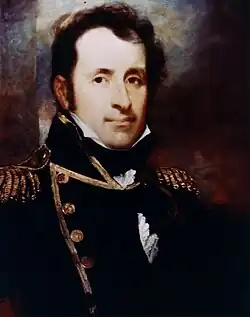 Stephen Decatur, a 19th-century naval commander who served in the War of 1812 and other engagements (from History of Pennsylvania)
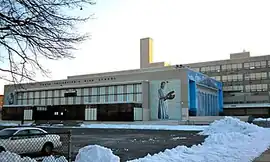 South Philadelphia High School on Broad Street in South Philadelphia in February 2010 (from Pennsylvania)
 Pittsburgh Steelers' fans waving the Terrible Towel, a tradition that dates back to 1975 (from Pennsylvania)
 Historical coat of arms of Pennsylvania (illustrated, 1876) (from Pennsylvania)
- One of only two confirmed photos of Abraham Lincoln (sitting in center, facing camera, without his traditional top hat) at Gettysburg a few hours prior to giving the Gettysburg Address at Gettysburg National Cemetery on November 19, 1863. The address, which was only 271 words in length, ranks among the most famed speeches in American history. (from History of Pennsylvania)

 The Statue of Benjamin Franklin on the campus of the University of Pennsylvania in West Philadelphia, which pays tribute to Benjamin Franklin, a Founding Father who founded the university, now an Ivy League institution and one of the world's top universities, in 1740 (from Pennsylvania)
 Largest alone or in any combination ethnic origin by county in Pennsylvania, per the 2020 census (from Pennsylvania)
 Map of Pennsylvania's 67 counties (from Pennsylvania)
 An Amish family riding in a traditional Amish buggy in Lancaster County. As of 2024, Pennsylvania has an Amish population of 92,660, the largest of any state in the nation. (from Pennsylvania)

 Bethlehem Steel in Bethlehem was one of the world's leading steel manufacturers for most of the 20th century. In 1982, however, it discontinued most of its operations, declared bankruptcy in 2001, and was dissolved in 2003. (from Pennsylvania)
 The colonial possessions of Britain (in pink), France (in blue), and Spain (in orange) as of 1750. The French later lost their possessions in North America to Britain following its defeat in the French and Indian War, fought from 1754 to 1763 (from History of Pennsylvania)
 Philadelphia International Airport, the busiest airport in the state and the 21st-busiest airport in the nation with over 13 million passengers in 2023 (from Pennsylvania)

 Dorney Park & Wildwater Kingdom's Steel Force and Thunderhawk roller coasters in Allentown; Steel Force is the eighth-longest steel roller coaster in the world with a first drop of 205 feet (62 m) and a top speed of 75 miles per hour (121 km/h). (from Pennsylvania)
 The Gettysburg campaign, which culminated in the Battle of Gettysburg, was a major turning point in the American Civil War and the war's bloodiest battle with an estimated 46,000 to 51,000 casualties (from History of Pennsylvania)
 Benjamin Franklin, a Founding Father of the United States and Pennsylvania delegate to the Second Continental Congress, which created the Continental Army in 1775 and unanimously adopted and issued the Declaration of Independence on July 4, 1776 (from History of Pennsylvania)
 Frederick Winslow Taylor of Philadelphia, a late 19th and early 20th century pioneer in scientific management (from History of Pennsylvania)
 Rivers Casino, located in the Chateau section of Pittsburgh on the Ohio River, one of Pennsylvania's 17 casinos (from Pennsylvania)
 The Birth of Pennsylvania, a portrait of William Penn (standing with document in hand), who founded the Province of Pennsylvania in 1681 as a refuge for Quakers after receiving a royal deed to it from King Charles II (from History of Pennsylvania)
 Lenape chief Lappawinsoe, depicted in a 1735 painting by Gustavus Hesselius (from History of Pennsylvania)
 2024 U.S. presidential election results by county in PennsylvaniaDemocraticRepublican(from Pennsylvania)
 The locomotive Tioga in Philadelphia in 1848; Pennsylvania was an important railroad center throughout the 19th century. (from History of Pennsylvania)
 Shelter House in Emmaus, constructed in 1734 by Pennsylvania German settlers, is the oldest continuously occupied building structure in the Lehigh Valley and one of the oldest in Pennsylvania (from Pennsylvania)
Associated Wikimedia
The following Wikimedia Foundation sister projects provide more on this subject:
-
 Commons
Free media repository -
 Wikidata
Free knowledge base -
 Wikiquote
Collection of quotations -
 Wikisource
Free-content library -
 Wikiversity
Free learning tools -
 Wikivoyage
Free travel guide -
 Wiktionary
Dictionary and thesaurus
-
 List of all portals
-

-

-

-

-

-

-

-

-

-
 Random portal
-
 WikiProject Portals