Portal:New Zealand/Selected article
Selected articles
Selected article 1
Portal:New Zealand/Selected article/1

The hei-tiki (Māori pronunciation: [hɛi ˈtiki], New Zealand English: /heɪˈtɪki/) is an ornamental pendant of the Māori of New Zealand. Hei-tiki are usually made of pounamu (greenstone), and are considered a taonga (treasure) by Māori. They are commonly called tiki by New Zealanders, a term that originally refers to the first mortal. (The word hei in Māori can mean "to wear around the neck".)
Retailers sell tourist versions of hei-tiki throughout New Zealand—these can be made from jade, other types of stone, plastic, or other materials. (Full article...)
Selected article 2
Portal:New Zealand/Selected article/2

Captain William Hobson (26 September 1792 – 10 September 1842) was a Royal Navy officer and colonial administrator who served as the first governor of New Zealand from 1841 to 1842. He was a co-author of the Treaty of Waitangi which he, as Crown representative, and several Maori chiefs signed on 6 February 1840. On 3 May 1840, he proclaimed British sovereignty over New Zealand. He also selected the site for a new capital, which he named Auckland. In May 1841, New Zealand was constituted as a separate Crown colony with Hobson promoted to governor and commander-in-chief. In his final months, Hobson was dogged by poor health which left him detached from political affairs. He died in office in September 1842. (Full article...)
Selected article 3
Portal:New Zealand/Selected article/3

The University of Auckland (UoA; Māori: Waipapa Taumata Rau) is a public research university in Auckland, New Zealand. It is the largest university in New Zealand. It was established in 1883 as Auckland University College, a constituent college of the University of New Zealand, following the passage of the Auckland University College Act 1882. In its early years the college operated from a disused courthouse and jail. The university's Māori name, Waipapa Taumata Rau, was gifted by Ngāti Whātua Ōrākei in 2021.
As of the mid-2020s, the university is widely reported as the largest in New Zealand by enrolment, with a student population of around 44,000. Teaching and research are centred on three main campuses in central Auckland: City (the historic core), Grafton (home to the Faculty of Medical and Health Sciences), and Newmarket (acquired in 2013 on the former Lion Breweries site). (Full article...)
Selected article 4
Portal:New Zealand/Selected article/4


New Zealand wine is produced in several of its distinct winegrowing regions. As an island country in the South Pacific Ocean, New Zealand has a largely maritime climate, although its elongated geography produces considerable regional variation from north to south. Like many other New World wines, New Zealand wine is usually produced and labelled as single varietal wines, or if blended, winemakers list the varietal components on the label. New Zealand is best known for its Marlborough Sauvignon Blanc, and more recently for premium cool-climate Pinot Noir from Marlborough, Martinborough, Central Otago and the limestone-rich Waitaki Valley.
While New Zealand wine traces its history to the early 19th century, the modern wine industry in New Zealand began in the mid-20th century and expanded rapidly in the early 21st century, growing by 17% a year from 2000 to 2020. In 2020, New Zealand produced 329 million litres (87,000,000 US gal) from 39,935 hectares (98,680 acres) of vineyard area, of which 25,160 ha (about two-thirds) is dedicated to Sauvignon Blanc. Nearly 90% of total production is exported, chiefly to the United States, Britain and Australia, reaching a record NZ$1.92 billion in export revenue in 2020. (Full article...)
Selected article 5
Portal:New Zealand/Selected article/5
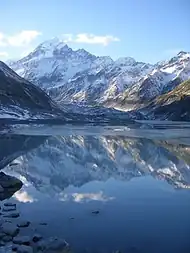

Aoraki / Mount Cook is the highest mountain in New Zealand. Its height, as of 2014, is listed as 3,724 metres (12,218 feet). It is situated in the Southern Alps, the mountain range that runs the length of the South Island. A popular tourist destination, it is also a favourite challenge for mountaineers. Aoraki / Mount Cook consists of three summits: from south to north, the Low Peak (3,593 m or 11,788 ft), the Middle Peak (3,717 m or 12,195 ft) and the High Peak. The summits lie slightly south and east of the main divide of the Southern Alps, with the Tasman Glacier to the east and the Hooker Glacier to the southwest. Mount Cook is ranked 10th in the world by topographic isolation. (Full article...)
Selected article 6
Portal:New Zealand/Selected article/6

The Huntly Power Station is the largest thermal power station in New Zealand and is located in the town of Huntly in the Waikato. It is operated by Genesis Energy Limited, a publicly listed company (currently 51% owned by the NZ Government). The station has five operational generating units – three 250 MW coal-and-gas-fired steam turbine units, a 50 MW gas peaking plant, and a 403 MW combined cycle gas turbine plant. The station also plays an important role in voltage support for the Northland, Auckland and Waikato regions. (Full article...)
Selected article 7
Portal:New Zealand/Selected article/7

The Treaty of Waitangi (Māori: Te Tiriti o Waitangi), sometimes referred to as Te Tiriti (lit. 'The Treaty'), is a document of importance to the history of New Zealand, and its national identity. The cornerstone legislative recognition of the Treaty in the Treaty of Waitangi Act 1975 represented a paradigm shift and a radically altered official discourse, relating to Māori rights and the relationship between Māori and the Crown. The role of the Treaty in the relationship between Māori and the Crown has become more prominent from the late 20th century. Although the Treaty of Waitangi is not incorporated as a binding international treaty within New Zealand's domestic law, its status as international law is debated. It was first signed on 6 February 1840 by Captain William Hobson as consul for the Crown and by Māori chiefs (rangatira) from the North Island of New Zealand. The treaty's status has clouded the question of whether Māori had ceded sovereignty to the Crown in 1840, and if so, whether such sovereignty remains intact.
The treaty was written at a time when the New Zealand Company, acting on behalf of large numbers of settlers and would-be settlers, was establishing a colony in New Zealand, and when some Māori leaders had petitioned the British for protection against French ambitions. Once it had been written and translated, it was first signed by Northern Māori leaders at Waitangi. Copies were subsequently taken around New Zealand and over the following months many other chiefs signed. Around 530 to 540 Māori, at least 13 of them women, signed the Māori language version of the Treaty of Waitangi, despite some Māori leaders cautioning against it. Only 39 signed the English version. An immediate result of the treaty was that Queen Victoria's government gained the sole right to purchase land. In total there are nine signed copies of the Treaty of Waitangi, including the sheet signed on 6 February 1840 at Waitangi. (Full article...)
Selected article 8
Portal:New Zealand/Selected article/8

The Pink and White Terraces (Māori: Te Otukapuarangi, lit. 'the Fountain of the Clouded Sky' and Te Tarata, 'the Tattooed Rock'), were natural wonders of New Zealand. They were reportedly the largest silica sinter deposits on Earth. They disappeared in the 1886 eruption of Mount Tarawera and were generally thought to have been destroyed, until evidence emerged in the early twenty-first century of their possible survival.
The Pink and White Terraces were formed by upwelling geothermal springs containing a cocktail of silica-saturated, near-neutral pH chloride water. These two world-famous springs were part of a group of hot springs and geysers, chiefly along an easterly ridge named Pinnacle Ridge (or the Steaming Ranges by Mundy). The main tourist attractions included Ngahapu, Ruakiwi, Te Tekapo, Waikanapanapa, Whatapoho, Ngawana, Koingo and Whakaehu. (Full article...)
Selected article 9
Portal:New Zealand/Selected article/9
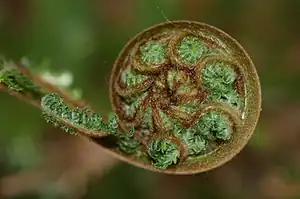
The koru (Māori for 'loop or coil') is a spiral shape evoking a newly unfurling frond from a silver fern frond. It is an integral symbol in Māori art, carving and tattooing, where it symbolises new life, growth, strength and peace. Its shape "conveys the idea of perpetual movement," while the inner coil "suggests returning to the point of origin". (Full article...)
Selected article 10
Portal:New Zealand/Selected article/10

Sir Edmund Percival Hillary (20 July 1919 – 11 January 2008) was a New Zealand mountaineer, explorer, and philanthropist. On 29 May 1953, he and Tenzing Norgay became the first climbers confirmed to have reached the summit of Mount Everest. They were part of the ninth British expedition to Everest, which was led by John Hunt. From 1985 to 1988, he served as New Zealand's High Commissioner to India and Bangladesh and concurrently as Ambassador to Nepal.
Hillary became interested in mountaineering while in secondary school. He made his first major climb in 1939, reaching the summit of Mount Ollivier. He served in the Royal New Zealand Air Force as a navigator during World War II and was wounded in an accident. Prior to the Everest expedition, Hillary had been part of the British reconnaissance expedition to the mountain in 1951 as well as an unsuccessful attempt to climb Cho Oyu in 1952. (Full article...)
Selected article 11
Portal:New Zealand/Selected article/11

The Waikato River is the longest river in New Zealand, running for 425 kilometres (264 mi) through the North Island. It starts on the eastern slopes of Mount Ruapehu, joining the Tongariro River system and flowing through Lake Taupō, New Zealand's largest lake. It then drains Taupō at the lake's northeastern edge, creates the Huka Falls, and flows northwest through the Waikato Plains. It empties into the Tasman Sea south of Auckland, at Port Waikato. It gives its name to the Waikato region that surrounds the Waikato Plains. The present course of the river was largely formed about 17,000 years ago. Contributing factors were climate warming, forest being reestablished in the river headwaters and the deepening, rather than widening, of the existing river channel. The channel was gradually eroded as far up river as Piarere, leaving the old Hinuera channel through the Hinuera Gap high and dry. The remains of the old course are seen clearly at Hinuera, where the cliffs mark the ancient river edges. The Waikato's main tributary is the Waipā River, which converges with it at Ngāruawāhia.
The name Waikato comes from the Māori language and translates as flowing water. The Waikato River has spiritual meaning for various local Māori tribes, including the large Tainui, who regard it as a source of their mana, or pride. The widely respected marae of Tūrangawaewae is close to its banks at Ngāruawāhia. (Full article...)
Selected article 12
Portal:New Zealand/Selected article/12


Ernest Rutherford, 1st Baron Rutherford of Nelson (30 August 1871 – 19 October 1937), was a New Zealand physicist and chemist who was a pioneering researcher in both atomic and nuclear physics. He has been described as "the father of nuclear physics" and "the greatest experimentalist since Michael Faraday." In 1908, he was awarded the Nobel Prize in Chemistry "for his investigations into the disintegration of the elements, and the chemistry of radioactive substances."
Rutherford's discoveries include the concept of radioactive half-life, the radioactive element radon, and the differentiation and naming of alpha and beta radiation. Together with Thomas Royds, Rutherford is credited with proving that alpha radiation is composed of helium nuclei. In 1911, he theorised that atoms have their charge concentrated in a very small nucleus. He arrived at this theory through his discovery and interpretation of Rutherford scattering during the gold foil experiment performed by Hans Geiger and Ernest Marsden. In 1912, he invited Niels Bohr to join his lab, leading to the Bohr model of the atom. In 1917, he performed the first artificially induced nuclear reaction by conducting experiments in which nitrogen nuclei were bombarded with alpha particles. These experiments led him to discover the emission of a subatomic particle that he initially called the "hydrogen atom", but later (more precisely) renamed the proton. He is also credited with developing the atomic numbering system alongside Henry Moseley. His other achievements include advancing the fields of radio communications and ultrasound technology. (Full article...)
Selected article 13
Portal:New Zealand/Selected article/13 The New Zealand national rugby union team, known as the All Blacks (Māori: Ōpango [ɔːpaŋɔ]), represents New Zealand in men's rugby union, which is considered the country's national sport. Famed for their international success, the All Blacks have often been regarded as one of the most successful sports teams in history.
The team won the Rugby World Cup in 1987, 2011, and 2015. They were the first country to retain the Rugby World Cup. Since their international debut in 1903, the All Blacks have played test matches against 19 nations, of which 12 have never won a game against the team. New Zealand has a 76% winning record in test match rugby, and has recorded more wins than losses against every international opponent. Since the introduction of the World Rugby Rankings in 2003, New Zealand has held the number-one ranking longer than all other teams combined. They jointly hold the men's record for the most consecutive test match wins for a tier-one ranked nation, along with England. (Full article...)
Selected article 14
Portal:New Zealand/Selected article/14


The Auckland Harbour Bridge is an eight-lane motorway bridge over Waitematā Harbour in Auckland, New Zealand. It joins St Marys Bay on the Auckland city side with Northcote on the North Shore side. It is part of State Highway 1 and the Auckland Northern Motorway. The bridge is operated by the NZ Transport Agency Waka Kotahi (NZTA). It is the second-longest road bridge in New Zealand, and the longest in the North Island.
The original inner four lanes, opened in 1959, are of box truss construction. Two lanes were added to each side in 1968–1969 and are of orthotropic box structure construction extend as cantilevers from the original piers. The bridge is 1,020 m (3,348 ft) long, with a main span of 243.8 metres (800 feet) rising 43.27 metres (142 feet) above high water, allowing ships access to the deepwater wharf at the Chelsea Sugar Refinery, one of the few such wharves west of the bridge. (Full article...)
Selected article 15
Portal:New Zealand/Selected article/15


The New Zealand bellbird (Anthornis melanura), also known by its Māori language names korimako, makomako and kōmako, is a medium-sized species of honeyeater endemic to New Zealand. It has been the only living member of the genus Anthornis since the Chatham Islands bellbird went extinct in the early 20th century. The bellbird's closest living relative is the only other New Zealand honeyeater, the tūī (Prosthemadera novaeseelandiae). The bellbird forms a significant component of the famed New Zealand dawn chorus of birdsong, which was much noted by early European settlers. Exceptional singing abilities were already observed by Captain James Cook, who described its song as "like small bells most exquisitely tuned".
Bellbirds measure about 17–20 cm (6.7–7.9 in) in length, with females weighing approximately 25 g (0.88 oz) and males 33 g (1.2 oz). Males are mostly olive-green with paler underparts, and bluish-black wings and tail. Females are paler and browner. Like other honeyeaters, the bellbird has a brush-like tongue that enables effective feeding on nectar from deep flowers. The species is common across much of New Zealand, its offshore islands, and the Auckland Islands, but it is scarce north of Waikato and across the Canterbury Plains and Central Otago. Its habitat includes both native and exotic forests and scrublands, and it is commonly found in parks and gardens. (Full article...)
Selected article 16
Portal:New Zealand/Selected article/16


Anzac Day is a national day of remembrance in Australia and New Zealand that broadly commemorates all Australians and New Zealanders "who served and died in all wars, conflicts, and peacekeeping operations" and "the contribution and suffering of all those who have served". Observed on 25 April each year, Anzac Day was originally devised to honour the members of the Australian and New Zealand Army Corps (ANZAC) who served in the Gallipoli campaign, their first engagement in the First World War (1914–1918). (Full article...)
Selected article 17
Portal:New Zealand/Selected article/17


David Russell Lange ONZ CH PC (/ˈlɒŋi/ LONG-ee; 4 August 1942 – 13 August 2005) was a New Zealand politician who served as the 32nd prime minister of New Zealand from 1984 to 1989. A member of the New Zealand Labour Party, Lange was also the minister of Education and the minister of Foreign Affairs alongside his term as prime minister. He was also the attorney-general of New Zealand from 1989 to 1990.
Lange was born and brought up in Ōtāhuhu, the son of a physician. He became a lawyer, and represented poor and struggling people in civil rights causes in the rapidly changing Auckland of the 1970s. After serving as legal advisor to the Polynesian Panthers, Lange was first elected to the New Zealand Parliament in the Mangere by-election of 1977. He became a prominent debater within parliament, and soon gained a reputation for cutting wit (sometimes directed against himself) and eloquence. Lange became the leader of the Labour Party and leader of the Opposition in 1983, succeeding Bill Rowling. (Full article...)
Selected article 18
Portal:New Zealand/Selected article/18
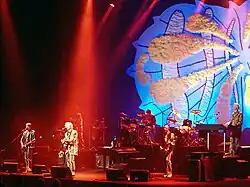

Split Enz are a New Zealand band formed in 1972 in Auckland. Regarded as the first New Zealand band to gain significant recognition outside of Australasia, they were initially noted for their progressive/art rock sound, flamboyant visual style and theatrical performances. The band later moved toward a pop/new wave sound that yielded hit singles such as "I See Red" (1978), "I Got You" (1980), "History Never Repeats" (1981), "Dirty Creature" (1982) and "Message to My Girl" (1983). The band also released several critically acclaimed and commercially successful albums, including Mental Notes (1975), Dizrythmia (1977), True Colours (1980), Waiata (1981) and Time and Tide (1982). Split Enz broke up in 1984. From 1986 to 2009, the band staged several reunion concerts. In 2026, they reformed again for Electric Avenue Festival in Christchurch, followed by a tour of New Zealand and Australia. (Full article...)
Selected article 19
Portal:New Zealand/Selected article/19


Hector's dolphin (Cephalorhynchus hectori) is one of six dolphin species belonging to the genus Cephalorhynchus. Hector's dolphin is the only cetacean endemic to New Zealand, and comprises two subspecies: C. h. hectori, the more numerous subspecies, also referred to as South Island Hector's dolphin, and C. h. maui, the critically endangered Māui dolphin that is found off the West Coast of New Zealand's North Island.
Distinctive features of the species include a rounded dorsal fin, grey, white, and black coloration, and a stocky body shape. Their lifespan is typically around 20 years, and the species favours shallow coastal waters around the South Island, where they live in small groups and use echolocation clicks to communicate. (Full article...)
Selected article 20
Portal:New Zealand/Selected article/20


Flight of the Conchords are a New Zealand musical comedy duo formed in Wellington in 1998. The band consists of multi-instrumentalists Bret McKenzie and Jemaine Clement. Beginning as a popular live comedy act in the early 2000s, the duo's comedy and music became the basis of the self-titled BBC radio series (2005) and, subsequently, the HBO series Flight of the Conchords (2007–2009). They released their first full-length comedy special Live in London in 2018 on HBO, which was concurrently released by Sub Pop as their fifth album.
The duo's live performances are a combination of skits, audience-interactions and songs while they continue to tour periodically. They were named Best Alternative Comedy Act at the 2005 US Comedy Arts Festival and Best Newcomer at the Melbourne Comedy Festival, and received a nomination for the Perrier Comedy Award at the 2003 Edinburgh Festival Fringe. They have been twice-nominated for a Grammy Award—winning Best Comedy Album in 2008—and have received seven nominations for Emmy Awards. (Full article...)
Selected article 21
Portal:New Zealand/Selected article/21


A bach (pronounced /ˈbætʃ/), also called a crib in the southern half of the South Island, is a small, often modest holiday home or beach house in New Zealand. Baches are an iconic part of the country's history and culture. In the middle of the 20th century, they symbolised the beach holiday lifestyle that was becoming more accessible to the middle class.
Baches began to gain popularity in the 1950s as roads improved and the increasing availability of cars allowed for middle-class beach holidays, often to the same beach every year. With yearly return trips being made, baches began to spring up in many family vacation spots. (Full article...)
Selected article 22
Portal:New Zealand/Selected article/22

The biodiversity of New Zealand, a large island country located in the south-western Pacific Ocean, is varied and distinctive. The species of New Zealand accumulated over many millions of years as lineages evolved in the local circumstances. New Zealand's pre-human biodiversity exhibited high levels of species endemism, but has experienced episodes of biological turnover. Global extinction approximately 66 Ma (million years ago) resulted in the loss of fauna such as non-avian dinosaurs, pterosaurs and marine reptiles e.g. mosasaurs, elasmosaurs and plesiosaurs. The ancient fauna is not well known, but at least one species of terrestrial mammal existed in New Zealand around 19 Ma. For at least several million years before the arrival of humans, the islands had no terrestrial mammals except for bats and seals, the main component of the terrestrial fauna being insects and birds. It was not until the 14th century CE that new species were introduced by humans.
New Zealand has developed a national biodiversity action plan to address conservation of considerable numbers of threatened flora and fauna within New Zealand. (Full article...)
Selected article 23
Portal:New Zealand/Selected article/23


David Gallaher (30 October 1873 – 4 October 1917) was an Irish-born New Zealand rugby union footballer best remembered as the captain of the "Original All Blacks"—the 1905–06 New Zealand national team, the first representative New Zealand side to tour the Irish and British Isles. Under Gallaher's leadership the Originals won 34 out of 35 matches over the course of tour, including legs in France and North America; the New Zealanders scored 976 points and conceded only 59. Before returning home he co-wrote the classic rugby text The Complete Rugby Footballer with his vice-captain Billy Stead. Gallaher retired as a player after the 1905–06 tour and took up coaching and selecting; he was a selector for both Auckland and New Zealand for most of the following decade.
Born in Ramelton, Ireland, Gallaher migrated to New Zealand with his family as a small child. After moving to Auckland, in 1895 he joined Ponsonby RFC and was selected for his province in 1896. In 1901–02 he served with the New Zealand Contingent in the Anglo–Boer War. He first appeared on the New Zealand national team for their unbeaten tour of Australia in 1903, and played in New Zealand's first ever Test match, against Australia in Sydney. The Originals Gallaher captained during 1905–06 helped to cement rugby as New Zealand's national sport, but he was relentlessly pilloried by the British press for his role as wing-forward. The use of a wing-forward, which critics felt was a tactic to deliberately obstruct opponents, contributed to decades of strain between the rugby authorities of New Zealand and the Home Nations; the International Rugby Football Board (IRFB) effectively outlawed the position in 1931. (Full article...)
Selected article 24
Portal:New Zealand/Selected article/24

The kākāpō (Māori: [ˈkaːkaːpɔː]; : kākāpō; Strigops habroptilus), sometimes known as the owl-parrot, is a species of large, nocturnal, ground-dwelling parrot of the superfamily Strigopoidea. It is endemic to New Zealand.
Kākāpō can be up to 64 cm (25 in) long. They have a combination of unique traits among parrots: finely blotched yellow–green plumage, a distinct facial disc, owl-like forward-facing eyes with surrounding discs of specially textured feathers, a large grey beak, short legs, large blue feet, relatively short wings and a short tail. It is the world's only flightless parrot, the world's heaviest parrot, and also is nocturnal, herbivorous, visibly sexually dimorphic in body size, has a low basal metabolic rate, and does not have male parental care. It is the only parrot to have a polygynous lek breeding system. It is also possibly one of the world's longest-living birds, with a reported lifespan of up to 100 years. Adult males weigh around 1.5–3 kilograms (3.3–6.6 lb); the equivalent figure for females is 0.950–1.6 kilograms (2.09–3.53 lb). (Full article...)
Selected article 25
Portal:New Zealand/Selected article/25

Selected article 26
Portal:New Zealand/Selected article/26


In Māori culture, Matariki (Māori pronunciation: [ˈmɐtɐɾiki]) is the Pleiades star cluster and a celebration of its first rising in late June or early July. The rising marks the beginning of the new year in the Māori lunar calendar.
Historically, Matariki was usually celebrated for a period of days during the last quarter of the moon of the lunar month Pipiri (around June). The ceremony involved viewing the individual stars for forecasts of the year to come, mourning the deceased of the past year, and making an offering of food to replenish the stars. Some Māori use the rise of Puanga (Rigel) or other stars to mark the new year. (Full article...)
Selected article 27
Portal:New Zealand/Selected article/27

The Observer grouped Ladyhawke in with other singers gaining notice with their distinct fashion, 1980s references, and androgyny, including Lady Gaga, Little Boots, Lissy Trullie, and Elly Jackson's synth duo La Roux. (Full article...)
Selected article 28
Portal:New Zealand/Selected article/28

The Shield is currently held by Wellington, who won it from Auckland in Round 8 of the Round Robin in the 2008 Air New Zealand Cup.
Although the professional era of rugby has seen competitions such as the National Provincial Championship and its successor, the Air New Zealand Cup, and Super Rugby detracting from the pre-eminence of the Ranfurly Shield, many still regard it as the greatest prize in New Zealand rugby, thanks to its long history, the fact that every challenge is a sudden-death defence of the Shield, and that any team, no matter how lowly, has a chance to win. (Full article...)
Selected article 29
Portal:New Zealand/Selected article/29

The project is engineered to remove all non-native pest mammals and predators and restore endangered native flora and fauna to Maungatautari. There is no intention to restrict all introduced birds, but efforts will be made to control non-native wasps.
It includes private land and a government-owned scenic reserve administered by Waipa District Council. It is a community project under the Maungatautari Ecological Island Trust. (Full article...)
Selected article 30
Portal:New Zealand/Selected article/30
In 2008, 138,000 players were registered with Netball New Zealand, the governing body for organised netball in the country. Organised competition ranges from interschool and local club netball to premier domestic competitions such as the ANZ Championship, with the pinnacle for netball players in New Zealand being selection for the national team. (Full article...)
Selected article 31
Portal:New Zealand/Selected article/31

Fernando Pereira, a photographer, drowned on the sinking ship. Two French agents were arrested by the New Zealand Police on passport fraud and immigration charges. They were charged with arson, conspiracy to commit arson, willful damage, and murder. As part of a plea bargain, they pleaded guilty to manslaughter and were sentenced to ten years, of which they served just over two.
The scandal resulted in the resignation of the French Defence Minister Charles Hernu, and the subject remained controversial. It was twenty years afterwards that the personal responsibility of French President François Mitterrand was admitted. (Full article...)
Selected article 32
Portal:New Zealand/Selected article/32

Holyoake was the third longest-serving New Zealand prime minister (just under 12 years), surpassed only by Richard Seddon's 13 years and William Massey's close to 13 years; he was also the first to be born in the 20th century. He was known for his diplomatic style and "plummy" voice. He was also fondly (or mockingly) known as Kiwi Keith, a name given to him in childhood to distinguish him from an Australian child with the same name. (Full article...)
Selected article 33
Portal:New Zealand/Selected article/33

According to one tradition (Craig 1989:127), Kupe was a great chief of Hawaiki who arrived in New Zealand in 925 AD. He left his cousin Hoturapa to drown during a fishing expedition and kidnapped his wife, Kuramārōtini, with whom he fled in her great canoe Matahourua. During their subsequent journeys, they overcame numerous monsters and sea demons, including the great octopus named as Te Wheke-a-Muturangi, and discovered New Zealand. Returning to Hawaiki, Kupe told of his adventures and convinced others to migrate with him. Traditions about Kupe appear among the peoples of the following areas: Northland, Ngāti Kahungunu, Tainui, Whanganui-Taranaki, Rangitāne, and the South Island.
A.H. Reed wrote that "When Kupe, the first discoverer of New Zealand, first came in sight of the land, his wife cried,'He ao! He ao!" (a cloud! a cloud!). Great Barrier Island was therefore named Aotea (white cloud), and the long mainland Aotearoa (long white cloud). When Kupe finally returned to his homeland his people asked him why he did not call the newly discovered country after his fatherland. He replied, 'I preferred the warm breast to the cold one, the new land to the old land long forsaken'." (Full article...)
Selected article 34
Portal:New Zealand/Selected article/34

It is featured in a Mountain Dew jingle and it is also in the 1979 single "Lone Ranger" by British band Quantum Jump. It is the subject of a 1960 song by the New Zealand balladeer Peter Cape[1], as well as Hardcore DJ's Darkraver and DJ Vince in the song 'Thunderground'.
The name of this hill translates roughly as
| “ | The summit where Tamatea, the man with the big knees, the climber of mountains, the land-swallower who travelled about, played his nose flute to his loved one. | ” |
At 85 letters, it has been listed in the Guinness World Records as one of the longest place names in the world. (Full article...)
Selected article 35
Portal:New Zealand/Selected article/35

Kea are known for their intelligence and curiosity, both vital to their survival in a harsh mountain environment. Kea can solve logical puzzles, such as pushing and pulling things in a certain order to get to food, and will work together to achieve a certain objective.
Most people only encounter wild kea in the South Island's skifield areas. Kea are attracted by the prospect of food scraps. Often described as "cheeky", keas' curiosity leads them to peck and carry away unguarded items of clothing, or to pry apart rubber parts of cars - to the entertainment and annoyance of human observers. In 2009, a Scottish tourist reported that a kea stole his passport while he was visiting the Fiordland National Park. (Full article...)
Selected article 36
Portal:New Zealand/Selected article/36

Walker is best known for being the first human being to run the mile in under 3:50 minutes, posting a time of 3:49.4, breaking the existing world record by over 1.5 seconds. This was a full 10 seconds faster than Roger Bannister's historic sub-Four-Minute Mile of 3:59.4 that was run twenty-one years previous. He was named Athlete of the Year by Track and Field News the same year.
The following year, 1976, Walker won the Olympic Games 1500 metres in Montreal, with a time of 3:39.17. Walker also broke the world record for the 2000 metres, running 4:51.4 minutes in Oslo, Norway, on 30 June 1976. He smashed the existing ten-year-old record held by Michel Jazy by nearly five seconds, Walker regarded this run as the best he ever ran. Steve Cram would not better Walker's record by running 4:51.4 at Budapest, Hungary until 4 August 1985. Indoors, Walker broke the 1500 metre world record with a time of 3:37.4 in 1979. (Full article...)
Selected article 37
Portal:New Zealand/Selected article/37

The Māori name Te Whanganui-A-Hei (the Great Bay of Hei) refers to Hei, a tohunga from the Te Arawa waka. According to tradition, Hei chose the area around Mercury Bay as home for his tribe, proclaiming ownership by calling Motueka Island "Te Kuraetanga-o-taku-Ihu" (the outward curve of my nose.)
Cathedral Cove is named after the cave located there linking Mare's Leg Cove to Cathedral Cove. Gemstone Bay and Stingray Bay are also located within the reserve. The area is very popular with tourists, and receives around 150,000 visitors a year. The cave and beach was used as the tunnel through which the Pevensie children first re-enter Narnia in the movie version of The Chronicles of Narnia: Prince Caspian. (Full article...)
Selected article 38
Portal:New Zealand/Selected article/38

The tree grows up to 20 metres (66 ft) in height, with a dome-like spreading form. Its natural range is the coastal regions of the North Island of New Zealand, north of a line stretching from New Plymouth (39° S) to Gisborne (38° S). It also grows on the shores of lakes in the Rotorua area. A giant pōhutukawa at Te Araroa on the East Coast is reputed to be the largest in the country, with a height of 20 metres and a spread of 38 metres (125 ft). The tree is renowned as a cliff-dweller, able to maintain a hold in precarious, near-vertical situations. Some specimens have matted, fibrous aerial roots. Like its Hawaiian relative the ʻōhiʻa lehua (M. polymorpha), the pōhutukawa has shown itself to be efficient in the colonisation of lava plains – notably on Rangitoto, a volcanic island in the Hauraki Gulf.
The pōhutukawa flowers from November to January with a peak in mid to late December (the Southern Hemisphere summer), with brilliant crimson flowers covering the tree, hence the nickname New Zealand Christmas Tree. (Full article...)
Selected article 39
Portal:New Zealand/Selected article/39

The Catlins, a rugged, sparsely populated area, features a scenic coastal landscape and dense temperate rainforest, both of which harbour many endangered species of birds. Its exposed location leads to its frequently wild weather and heavy ocean swells, which are an attraction to big-wave surfers.
Ecotourism has become of growing importance in the Catlins economy, which otherwise relies heavily on dairy farming and fishing. The region's early whaling and forestry industries have long since died away, along with the coastal shipping that led to several tragic shipwrecks. Only some 1,200 people now live in the area, many of them in the settlement of Owaka. (Full article...)
Selected article 40
Portal:New Zealand/Selected article/40
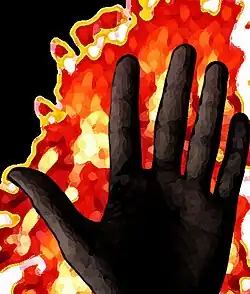
Māui emerged from the sea and found his four brothers, Māui-taha, Māui-roto, Māui-pae, and Māui-waho. Māui's brothers at first are wary of the new-comer but, after he performs several feats such as transforming himself into different kinds of birds, they acknowledge his power and admire him.
With the help of his brothers, Māui netted the Sun and beat him severely with a jaw-bone club until the Sun promised to go slower in future, because the days were getting too short for people to get their work done.
Later, Māui took his brothers fishing, this time using the jaw-bone as a fish-hook. Māui, using blood from his nose for bait, hauled a great fish up from the depths, which became the North Island of New Zealand, or Te Ika-a-Māui (The Fish of Māui).
When the people need to recover the lost secret of fire, it is up to Māui to face Mahuika the Fire-goddess. He succeeds through trickery, infuriating the goddess, and he barely escapes with his life. (Full article...)
Selected article 41
Portal:New Zealand/Selected article/41

Sheppard's interest in women's suffrage went beyond practical considerations regarding temperance: her views were made well known, summarised up with her statement:
| “ | All that separates, whether of race, class, creed, or sex, is inhuman, and must be overcome | ” |
Sheppard was a powerful speaker and a skilled organiser, and quickly built support for her cause. (Full article...)
Selected article 42
Portal:New Zealand/Selected article/42

Traditionally, Māori used the Milford Track for gathering and transporting valuable greenstone. Sutherland and Mackay were the first European explorers to see Mackay Falls and Sutherland Falls, in 1880.
With Milford Sound never exploited by industrial or agricultural interests, most visitors and investors from early on decided that tourism was to be the main draw to the sound, and the Milford Track was established to a large degree to provide a tourism function for guided treks.
The track spans a distance of 53.5 km (33.2 mi) starting at the head of Lake Te Anau and finishing at Milford Sound at Sandfly Point. It traverses rainforests, wetlands, and dramatic alpine passes.
As a popular route, it is well maintained by the Department of Conservation and is one of the nine Great Walks. (Full article...)
Selected article 43
Portal:New Zealand/Selected article/43

In 1987, the nation was captivated by KZ7 "Plastic Fantastic", racing well in Fremantle, but finally beaten by the American Dennis Conner. The following year, Michael Fay built and raced a gigantic monohull called KZ1 (or the Big Boat) but was outclassed by Conner's catamaran.
In 1995 TNZ stunned the world, beating Team Dennis Conner 5-0 off the coast of San Diego, after winning the Louis Vuitton Cup. The 1995 yacht NZL 32 was nicknamed Black Magic, ably skippered by Russell Coutts, and the legendary Sir Peter Blake. Coining the famous phrase by sailing commentator Peter Montgomery, "The America's Cup is now New Zealand's cup!".
The 2000 challenge was held on Auckland's Hauraki Gulf. On crossing the finish line in the final race, TNZ (NZL 60) beat Italy's Prada Challenge (Luna Rossa) 5-0. Team New Zealand's eight-year reign ended after they were defeated 5-0 by Swiss-based challenger Alinghi in 2003. (Full article...)
Selected article 44
Portal:New Zealand/Selected article/44

The flight was specifically designed and marketed as a unique sight-seeing experience, carrying an experienced Antarctic guide who would point out scenic features and landmarks using the aircraft public address system.
On November 28, 1979, at 12:49pm NZDT, flight TE901 collided with Mount Erebus, Antarctica, killing all 237 passengers and 20 crew members. The flight that day was being operated by the DC-10 registered ZK-NZP, which was just under 5 years old. The aircraft altitude at the time of the collision was just 1465 feet (445 metres). (Full article...)
Selected article 45
Portal:New Zealand/Selected article/45

The core 'Think Big' projects included the construction of the Mobil synthetic-petrol plant at Motunui, the complementary expansion of the oil-refinery at Marsden Point near Whangarei, and the building of a stand-alone plant at Waitara to produce methanol for export. Motunui converted natural gas from the off-shore Maui field to methanol, which it then converted to petrol on-site. Declining oil prices rendered this process uneconomic and New Zealand abandoned the manufacture of synthetic petrol. The construction of the Clyde Dam on the Clutha River formed part of a scheme to generate electricity for smelting aluminium.
The New Zealand economy probably benefited from economic activity during the construction period, but the basic justification for the projects, a permanently higher oil-price, did not happen. Oil prices subsequently dropped in real terms. (Full article...)
Selected article 46
Portal:New Zealand/Selected article/46

Before taking leadership of the Labour Party, Clark had held portfolios in Health, Housing, Conservation, Labour, and served as Deputy Prime Minister. She also had ministerial responsibility for the New Zealand Security Intelligence Service and for Ministerial Services. Her particular interests included social policy and international affairs.
Before resigning from Parliament in April 2009, Clark was Labour's foreign affairs spokeswoman and MP for the Mount Albert electorate which she had held since 1981. Forbes magazine ranked her the 20th most powerful woman in the world in 2006. (Full article...)
Selected article 47
Portal:New Zealand/Selected article/47
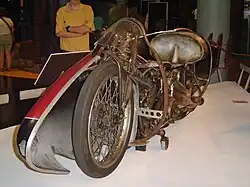
Working from his home in Invercargill, he worked for 20 years to highly modify the 1920 Indian motorcycle which he had bought in 1920. Munro set his first New Zealand speed record in 1938 and later set seven more. He travelled to compete at the Bonneville Salt Flats, attempting to set world speed records. During his ten visits to the salt flats, he set three speed records, one of which still stands today. His efforts, and success, are the basis of the motion picture The World's Fastest Indian (2005), starring Anthony Hopkins, and an earlier 1971 short documentary film Burt Munro: Offerings to the God of Speed (Full article...)
Selected article 48
Portal:New Zealand/Selected article/48

Designed by George Troup, the station is the fourth building to have served as Dunedin's railway station. It earned its architect the nickname of "Gingerbread George".
In Flemish style, it is constructed from local dark basalt rock capped with lighter Oamaru stone, giving it the distinctive light and dark pattern common to many of the more stately buildings of Dunedin and Christchurch. The booking hall features a mosaic floor of almost 750,000 tiles of Royal Doulton porcelain. Its main platform is the country's longest, being one kilometre in length. It was opened in 1906 by Prime Minister Joseph Ward. A thorough refurbishment of the exterior took place in the late 1990s, accompanied by the landscaping of the gardens outside the entrance, in Anzac Square.
With the decrease in passenger rail traffic, the station now serves more functions that the one for which it was originally designed. It is still the city's railway station, catering for the Otago Excursion Train Trust's Taieri Gorge Railway tourist train. Much of its ground floor is now used as a restaurant, and the upper floor is home to both the New Zealand Sports Hall of Fame and the Otago Art Society. (Full article...)
Selected article 49
Portal:New Zealand/Selected article/49

Some sources say the recipe originated in New Zealand, while others claim it was invented in Australia. However, like the Anzac biscuit, the earliest known books containing the recipe were published in New Zealand.
Professor Helen Leach, a culinary anthropologist at Otago University in New Zealand found a pavlova recipe in a 1933 Rangiora Mothers' Union cookery book. Professor Leach also has an even earlier copy of the pavlova recipe from a 1929 rural New Zealand magazine.
Keith Money, a biographer of Anna Pavlova, wrote that a chef at a hotel in Wellington, New Zealand, created the dish when Pavlova visited there in 1926 on her world tour.
The claim that it was an Australian invention states that the pavlova is based on a cake baked by Bert Sachse at the Esplanade Hotel in Perth on 3 October 1935. Sachse's descendants believe he may have come up with the recipe earlier than that, since Anna Pavlova visited Australia in 1926 and 1929 and died in 1931. (Full article...)
Selected article 50
Portal:New Zealand/Selected article/50

Manuka (from Māori mānuka) is the name used in New Zealand. It is also commonly called the tea tree. This name arose because Captain Cook used the leaves to make a tea drink. (Full article...)
Selected article 51
Portal:New Zealand/Selected article/51

Selected article 52
Portal:New Zealand/Selected article/52

Scott Base participates in ANDRILL, investigating Antarctica's impact on global ocean currents and climate over the past 65 million years, by retrieving ice and rock samples representing ancient geologic time. Scott Base is administered by Antarctica New Zealand, as part of their efforts to "support scientific research, conserve the intrinsic values of Antarctica and the Southern Ocean, and raise public awareness of the international significance of the continent."
New Zealand also co-operates with the US Operation Deep Freeze which uses Christchurch International Airport as a staging point for McMurdo Station. (Full article...)
Selected article 53
Portal:New Zealand/Selected article/53 George Arthur Emilius Ross (some sources say Aemilius, Æmilius, or Emileus; 1829 – 23 November 1876) was a New Zealand farmer and provincial politician. A cultured and well-educated man, he suffered a breakdown while at Oxford University and relocated to Christchurch for health reasons before he finished his degree. After a short period as a cadet to learn the basics of sheep farming, he became a major land owner. He was an elected member of the Canterbury Provincial Council (1858–1861; 1862–1865) for the rural Rakaia electorate and was on the Canterbury Provincial Executive Council on a number of occasions (1859; 1863–1867) including nearly two years as provincial treasurer. Well-liked as an individual, he was chaotic as a businessman and went bankrupt after a harsh winter in 1867 that caused great loss of stock. He suffered a mental breakdown and disappeared from public life thereafter, with his young wife, Sibella, sustaining the family by running a school that her parents had financed for them. Ross died young aged 48 and his wife outlived him by five decades, bringing up a family of eight children by herself. The West Coast town of Ross was named after him during his lifetime. (Full article...)
Selected article 54
Portal:New Zealand/Selected article/54

A major earthquake occurred in Christchurch on Tuesday 22 February 2011 at 12:51 p.m. local time (23:51 UTC, 21 February). The Mw 6.2 (ML 6.3) earthquake struck the Canterbury Region in the South Island, centred 6.7 kilometres (4.2 mi) south-east of the central business district. It caused widespread damage across Christchurch and killed 185 people, making it New Zealand's fifth-deadliest disaster. Scientists classified it as an intraplate earthquake and a potential aftershock of the September 2010 Canterbury earthquake.
Christchurch's central city and eastern suburbs were badly affected, with damage to buildings and infrastructure already weakened by the 2010 Canterbury earthquake and its aftershocks. Significant liquefaction affected the eastern suburbs, producing around 400,000 tonnes of silt. The earthquake was felt across the South Island and parts of the lower and central North Island. While the initial quake only lasted for approximately 10 seconds, the damage was severe because of the location and shallowness of the earthquake's focus in relation to Christchurch as well as previous quake damage. Subsequent population loss saw the Christchurch main urban area fall behind the Wellington equivalent, to decrease from second- to third-most populous area in New Zealand. Adjusted for inflation, the 2010–2011 Canterbury earthquakes caused over $54.8 billion in damage, making it New Zealand's costliest natural disaster and one of the most expensive disasters in history. (Full article...)
Selected article 55
Portal:New Zealand/Selected article/55

Ella Marija Lani Yelich-O'Connor (born 7 November 1996), known professionally as Lorde (/lɔːrd/ LORD), is a New Zealand singer-songwriter. She is known for her unconventional style of pop music and introspective songwriting.
Lorde first gained recognition as a teenager during a talent show performance. She signed with Universal Music Group (UMG) in 2009 and began collaborating with producer Joel Little in 2011. Their first effort, an extended play (EP) titled The Love Club EP, was self-released in 2012 for free download on SoundCloud before it was commercially released in 2013. Its single "Royals" topped charts in multiple regions and spent nine weeks atop the Billboard Hot 100. It sold 10 million units worldwide, making it one of the best-selling singles of all time. Her debut studio album, Pure Heroine, was released that same year to critical and commercial success. The following year, Lorde curated the soundtrack for the 2014 film The Hunger Games: Mockingjay – Part 1. (Full article...)
Selected article 56
Selected article 57
Selected article 58
Selected article 59
Selected article 60
The current week is :
Week 36.
Use the template {{Selected article}} to add pages.
For previous selected articles, pictures and DYK?, see Portal:New Zealand/Previously_featured.