Portal:New York (state)

The New York State portal

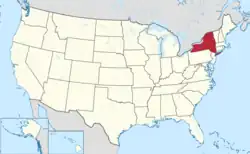
New York, also called New York state, is a state located in the Northeastern United States. Bordering New England to its east, Pennsylvania and New Jersey to the south, and Canada to its north, New York extends into both the Atlantic Ocean and the Great Lakes. It is the fourth-most populous state in the United States, with over 20 million residents, and the 27th-largest state by area, with a total area of 54,556 square miles (141,300 km2).
New York has a varied geography. The southeastern part of the state, known as Downstate, encompasses New York City, the most populous city in the United States; Long Island, with approximately 40% of the state's population, the nation's most populous island; and the cities, suburbs, and wealthy enclaves of the lower Hudson Valley. These areas are the center of the expansive New York metropolitan area and account for approximately two-thirds of the state's population. The larger Upstate area spreads from the Great Lakes to Lake Champlain and includes the Adirondack Mountains and the Catskill Mountains (part of the wider Appalachian Mountains). The east–west Mohawk River Valley bisects the more mountainous regions of Upstate and flows into the north–south Hudson River valley near the state capital of Albany. Western New York, which is sometimes considered to be a separate region from the Upstate, is home to the cities of Buffalo and Rochester, and is part of the Great Lakes region, bordering Lake Ontario and Lake Erie. Central New York is anchored by the city of Syracuse; between the central and western parts of the state, the Finger Lakes are a prominent landmark and tourist destination. To the south, along the state border with Pennsylvania, the Southern Tier sits atop the Allegheny Plateau, representing some of the northernmost reaches of Appalachia.
New York was one of the original Thirteen Colonies that went on to form the United States. The area of present-day New York had been inhabited by tribes of the Algonquians and the Iroquois Confederacy Native Americans for several thousand years by the time the earliest Europeans arrived. Stemming from Henry Hudson's expedition in 1609, the Dutch established the multiethnic colony of New Netherland in 1621. England seized the colony from the Dutch in 1664, renaming it the Province of New York. Upstate New York was fought over between the British and the French during the French and Indian War from 1754 to 1763. During the American Revolutionary War, a group of colonists eventually succeeded in establishing independence, and the state ratified the then new United States Constitution in 1788. From the early 19th century, New York's development of its interior, beginning with the construction of the Erie Canal, gave it incomparable advantages over other regions of the United States. The state built its political, cultural, and economic ascendancy over the next century, earning it the nickname of the "Empire State". Although deindustrialization eroded a portion of the state's economy in the second half of the 20th century, New York in the 21st century continues to be considered as a global node of creativity and entrepreneurship, social tolerance, and environmental sustainability. (Full article...)
 Good article -

Kirsten Elizabeth Gillibrand (née Rutnik; /ˈkɪərstən ˈdʒɪlɪbrænd/ ⓘ KEER-stən JIL-ib-rand; born December 9, 1966) is an American lawyer and politician serving as the junior United States senator from New York since 2009. A member of the Democratic Party, she served as a member of the U.S. House of Representatives from 2007 to 2009.
Born and raised in upstate New York, Gillibrand graduated from Dartmouth College and from the UCLA School of Law. After holding positions in government and private practice and working on Hillary Clinton's 2000 U.S. Senate campaign, Gillibrand was elected to the United States House of Representatives in 2006. She represented New York's 20th congressional district and was reelected in 2008. During her House tenure, Gillibrand was a Blue Dog Democrat noted for voting against the Emergency Economic Stabilization Act of 2008. (Full article...)
Selected article -

Paul Jackson Pollock (/ˈpɒlək/; January 28, 1912 – August 11, 1956) was an American painter. A major figure in the abstract expressionist movement, he was widely noticed for his "drip technique" of pouring or splashing liquid household paint onto a horizontal surface, enabling him to view and paint his canvases from all angles. It was called all-over painting and action painting, because Pollock covered the entire canvas and used the force of his whole body to paint, often in a frenetic dancing style. This extreme form of abstraction divided critics: some praised the immediacy of the creation, while others derided the random effects.
A reclusive and volatile personality, Pollock struggled with alcoholism for most of his life. In 1945, he married artist Lee Krasner, who became an important influence on his career and on his legacy. Pollock died in August 1956 at age 44 in an alcohol-related single-car collision when he was driving. Four months after his death, Pollock was given a memorial retrospective exhibition at the Museum of Modern Art (MoMA) in New York City. A larger, more comprehensive exhibition of his work was held there in 1967. In 1998 and 1999, Pollock's work was honored with large-scale retrospective exhibitions at MoMA and the Tate Gallery in London. (Full article...)
General images
 The Yoshio Taniguchi building at the Museum of Modern Art (from Culture of New York City)
 Map of the Province of New York. (from History of New York (state))

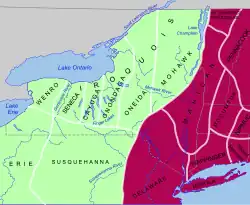
 John Trumbull's Surrender of General Burgoyne stylizes the American win at Saratoga. (from History of New York (state))
 Flooding on Avenue C in Lower Manhattan caused by Hurricane Sandy. (from History of New York (state))
 A historical juxtaposition: a replica of Henry Hudson's 17th-century Halve Maen passes modern-day lower Manhattan where the original ship would have sailed while investigating New York Harbor. (from History of New York (state))

 Companies such as Eastman Kodak (Rochester headquarters pictured ca. 1900) epitomized New York's manufacturing economy in the late 19th century. (from History of New York (state))
 Langston Hughes was part of the Harlem Renaissance that flourished in the 1920s. (from Culture of New York City)
 SUR by Xefirotarch at the P.S.1 Contemporary Art Center in Queens (from Culture of New York City)
 A Phoenix rises to new life at the Village Halloween Parade fifty days after the September 11, 2001, terrorist attacks (from Culture of New York City)
 The Macy's Thanksgiving Day Parade is the world's largest parade. (from Culture of New York City)
 The Stadt Huys in Albany became the state's seat of government when Albany became the permanent capitol in 1797. (from History of New York (state))
 Street vendors at the Feast of San Gennaro in Little Italy, Lower Manhattan (from Culture of New York City)

 Theodore Roosevelt (from History of New York (state))
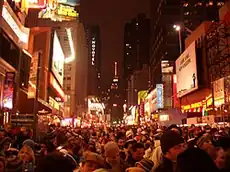 A crowd in Times Square awaits the countdown to the start of 2006. (from Culture of New York City)
 United Airlines Flight 175 crashes into the South Tower of the World Trade Center during the September 11 attacks. (from History of New York (state))
 The West Indian Labor Day Parade is an annual carnival along Eastern Parkway in Brooklyn. (from Culture of New York City)
 A frameworker tightens bolts on the Empire State Building in 1930; the recently completed Chrysler Building is seen in the background. (from History of New York (state))
Selected quote -
 Featured article -

Millard Fillmore (January 7, 1800 – March 8, 1874) was the 13th president of the United States, serving from 1850 to 1853. He was the last president to be a member of the Whig Party while in the White House, and the last to be neither a Democrat nor a Republican. A former member of the U.S. House of Representatives, Fillmore was elected vice president in 1848, and succeeded to the presidency when Zachary Taylor died in 1850. Fillmore was instrumental in passing the Compromise of 1850, which led to a brief truce in the battle over the expansion of slavery.
Fillmore was born into poverty in the Finger Lakes area of upstate New York. He had little formal schooling, but studied to become a lawyer. Fillmore became prominent in the Buffalo area as an attorney and politician, and was elected to the New York Assembly in 1828 and the House of Representatives in 1832. Fillmore initially belonged to the Anti-Masonic Party, but became a member of the Whig Party as it formed in the mid-1830s. He was a rival for the state party leadership with Thurlow Weed and his protégé William H. Seward. Throughout his career, Fillmore declared slavery evil but said it was beyond the federal government's power to end it. Conversely, Seward argued that the federal government had a role to play. Fillmore was an unsuccessful candidate for Speaker of the U.S. House of Representatives when the Whigs took control of the chamber in 1841, but was made chairman of the Ways and Means Committee. Defeated in bids for the Whig nomination for vice president and for New York governor in 1844, Fillmore was elected Comptroller of New York in 1847, the first to hold that post by election. (Full article...)
Selected picture -
This view of Times Square in New York City shows many billboards for Broadway shows. Times Square resides within the Broadway Theater district. This photo was taken near the intersection of 7th Avenue and West 47th Street. A small sampling of Broadway shows represented here include Shrek the Musical, Jersey Boys, Wicked, Hair, Phantom of the Opera, South Pacific, and West Side Story.
New York news
- August 9, 2026 –
- The boat operator involved in a capsizing that killed two people, including a 5-month-old toddler, and injured 12 others near the Statue of Liberty, New York City, United States on August 8 has been arrested on 13 counts of reckless endangerment. (ABC)
- August 3, 2026 –
- In horse racing, Churchill Downs Incorporated and the New York Racing Association announce a new championship series for 3-year old Thoroughbreds beginning in 2027, involving the Kentucky Derby and Belmont Stakes, but notably omitting the traditional middle leg of the U.S. Triple Crown, the Preakness Stakes. (Courier Journal) (The Daily Gazette)
- July 25, 2026 –
- One person is killed and at least 22 others are injured in a five-alarm fire in Flushing, New York City, United States. (WNBC)
- July 22, 2026 – Stabbing of Salman Rushdie
- The federal trial against Hadi Matar, the man who attempted to kill author Salman Rushdie in August 2022 in New York, United States, opens. If he is convicted, Matar faces a sentence of life in prison. He is already serving a 25-year state prison sentence in New York. (AP) (The Guardian)
- July 21, 2026 – Middle Eastern crisis
- The U.S. military confirms that a third service member, identified as 28-year-old Sgt. Angel S Rampersad of New York, was killed during a recent attack on the Muwaffaq Salti Air Base in Jordan, bringing the total American casualties to 18. (Military Times)
Did you know? -

- ...that in 1813, British forces set up a camp on the land of Richard Beasley, causing considerable damage to his property?
- ...that the Ma-Yi Theater Company had not intended for it to be started as an Asian American theatre, but it eventually remained so after its first plays were Filipino and Filipino-American?
- ...that the New York City Police Department, which was established in 1845, is the current largest police force in North America?
August selected anniversaries
- Rob Carpenter (born August 1, 1968) is a retired American football wide receiver who played for the New England Patriots, New York Jets and Philadelphia Eagles of the National Football League.
- George Herbert "Pete" Bostwick (August 14, 1909 in Bisby Lake, New York - January 13, 1982) was an American court tennis player, a steeplechase jockey and horse trainer, and an eight-goal polo player.
- Thomas Christian Murphy (born August 27, 1979, in Suffern, New York) is a Major League Baseball outfielder with the Los Angeles Angels of Anaheim. Murphy is a 1997 graduate of Charlotte High School in Punta Gorda, Florida.
- George Dupont Pratt (16 August 1869 in Brooklyn – 20 January 1935) was a conservationist, philanthropist, Boy Scout sponsor, big-game hunter and collector of ancient antiquities.
Selected panorama -

Albany is the capital of New York and one of the three main cities making up the Capital District. This view is from Rensselaer County and features the Empire State Plaza, the Helderberg Mountains (the northern tip of the Catskill Mountains), and Interstate 90, which passes through the city.
Topics

Categories

Recognized content
 | This is a list of recognized content, updated weekly by JL-Bot (talk · contribs) (typically on Saturdays). There is no need to edit the list yourself. If an article is missing from the list, make sure it is tagged (e.g. {{WikiProject New York (state)}}) or categorized correctly and wait for the next update. See WP:RECOG for configuration options. |
Featured articles
 1 Wall Street
- 55 Wall Street
- 270 Park Avenue (1960–2021)
- December 1969 nor'easter
- Christmas 1994 nor'easter
- 2009 International Bowl
- 2009 New York's 20th congressional district special election
- Aaliyah
- Albany Charter half dollar
- American Airlines Flight 11
- American Bank Note Company Printing Plant
- Art Deco architecture of New York City
- Chester A. Arthur
- Tropical Storm Barry (2007)
- Battle of Ticonderoga (1759)
- Big Duck
- Boot Monument
- Briarcliff Manor, New York
- David Hillhouse Buel (priest)
- Mariah Carey
- The Cat and the Canary (1927 film)
- Frances Cleveland
- Grover Cleveland
- Rose Cleveland
- Daily News Building
- John Doubleday (restorer)
- Enrico Fermi
- Millard Fillmore
- Eunice Newton Foote
- Joseph B. Foraker
- Fort Ticonderoga
- The Great Gatsby
- Horace Greeley
- Jake Gyllenhaal
- Maggie Gyllenhaal
- Ethan Hawke
- Here Is Mariah Carey
- Philip Seymour Hoffman
- Hudson Sesquicentennial half dollar
- Hudson Valley Rail Trail
- Anne Hutchinson
- James II of England
- Derek Jeter
- Joppenbergh Mountain
- Sandy Koufax
- Ursula K. Le Guin
- Live and Let Die (novel)
- Low Memorial Library
- 1955 MacArthur Airport United Air Lines crash
- Kitty Marion
- John McGraw
- Assassination of William McKinley
- Merchant's House Museum
- New Rochelle 250th Anniversary half dollar
- New York State Route 22
- New York State Route 28
- New York State Route 28N
- New York State Route 32
- New York State Route 174
- New York State Route 175
- New York State Route 308
- New York State Route 311
- Niagara Falls Suspension Bridge
- Oakwood Cemetery (Troy, New York)
- 1991 Perfect Storm
- Providence and Worcester Railroad
- RKO Pictures
- Isidor Rabi
- Riegelmann Boardwalk
- Rosendale Trestle
- Rex Ryan
- Margaret Sanger
- William H. Seward
- Elliott Fitch Shepard
- Silent Parade
- Harry F. Sinclair House
- State Route 343 (New York−Connecticut)
- New Paltz station
- Statue of Liberty
- Capture of Fort Ticonderoga
- Harriet Tubman
- Battle of Valcour Island
- Mary van Kleeck
- Barry Voight
- Walden–Wallkill Rail Trail
- Felix M. Warburg House
- P. G. Wodehouse
- Robert Sterling Yard
Featured lists
- 1970 NBA expansion draft
- List of highways in Warren County, New York
- List of winners of the New York City Marathon
- List of Buffalo Bills head coaches
- List of Buffalo Sabres draft picks
- List of Buffalo Sabres head coaches
- List of Buffalo Sabres players
- List of Buffalo Sabres seasons
- List of Nobel laureates affiliated with Columbia University as alumni or faculty
- List of archbishops of New York
- List of counties in New York
- List of tallest buildings in New York City
- Battle of Long Island order of battle
- Lou Gehrig Memorial Award
- List of New York hurricanes
- List of governors of New York
- List of presidents of New York University
- List of State University of New York units
- Timeline of Briarcliff Manor
- List of international goals scored by Abby Wambach
Good articles
- 2nd Canadian Regiment
- 14th Street Tunnel shutdown
- 15 Central Park West
- 116th Street–Columbia University station
- 140 Broadway
- 185 Montague Street
- 370 Jay Street
- 750 Seventh Avenue
- 1893 New York hurricane
- 1912–1913 Little Falls textile strike
- 1920 Buffalo All-Americans season
- 1973–74 Buffalo Braves season
- 1973 Belmont Stakes
- 1973 Buffalo Bills season
- 1974–75 Buffalo Braves season
- 1974–75 Buffalo Sabres season
- 1975–76 Buffalo Braves season
- July 1989 Northeastern United States tornado outbreak
- 2000 United States Senate election in New York
- 2008 NHL Winter Classic
- 2010 Heluva Good! Sour Cream Dips at the Glen
- 2017 New York City ePrix
- 2018 New York City ePrix
- 2020 New York's 22nd congressional district election
- 2024 New York Proposal 1
- 2025 CS John Nicks International Pairs Competition
- Nick Abruzzese
- Curtis Aiken
- Air traffic control during the September 11 attacks
- Coat of arms of Albany, New York
- Albany Free School
- Albany Pine Bush
- USS Albany (1846)
- Algonquin Hotel
- All Saints' Episcopal Church (Briarcliff Manor, New York)
- Joseph H. Allen
- Alley Pond Park
- Alma Mater (New York sculpture)
- The Amazing Spider-Man 2
- Amazon HQ2
- Mary Amdur
- The Ansonia
- Johnny Antonelli
- Arbor Hill Historic District–Ten Broeck Triangle
- Arden Valley Road
- Armageddon (2008)
- ArtRave
- Astoria Park
- Attack on German Flatts (1778)
- Austin J. Tobin Plaza
- Austin, Nichols and Company Warehouse
- Avianca Flight 052
- William Bliss Baker
- Patricia Banks Edmiston
- Barracuda Lounge
- Ed Barrow
- Barryville–Shohola Bridge
- Battle of Bennington
- Battle of Oriskany
- Battle of Cobleskill
- Battle of Fort Anne
- Battle of Fort Washington
- Battle of Harlem Heights
- Battle of Long Island
- Battle of Setauket
- Battle of Staten Island
- Battle of White Plains
- Battle on Snowshoes
- Battles of Saratoga
- Beechwood (Vanderlip mansion)
- John Beilein
- Paula Ben-Gurion
- Ann Eliza Bleecker
- Jessie Bonstelle
- Emil Bove
- Bowery Savings Bank Building (130 Bowery)
- Boxers NYC Washington Heights
- James T. Brady
- Tawana Brawley rape hoax
- Briarcliff College
- Briarcliff Farms
- Briarcliff High School
- Briarcliff Lodge
- Briarcliff Manor Fire Department
- Briarcliff Manor Public Library
- Briarcliff Manor Union Free School District
- Brooklyn Botanic Garden
- Dan Brouthers
- Bryant Park restroom
- Pavel Buchnevich
- Buffalo, New York
- Buffalo Sabres
- James A. Burden House
- William Burnet (colonial administrator)
- Wellington R. Burt
- Canajoharie Creek
- Candler Building (New York City)
- Joseph A. Canning
- Cannonball (LIRR train)
- La Caravelle (New York City)
- Carlyle Hotel
- Andrew Carnegie Mansion
- Mark Caso
- Center Square/Hudson–Park Historic District
- Central Park
- Central Synagogue (Manhattan)
- Central Troy Historic District
- Ice Box Chamberlain
- Cherry Valley massacre
- Shirley Chisholm
- Chittenango ovate amber snail
- Francis Pharcellus Church
- Church Offensive
- Chyna
- Bill Clinton
- The Cock
- Roy Cohn
- Eileen Collins
- 2021–2022 Columbia University strike
- Coney Island
- USS Contoocook (1864)
- Dwayne Cooper
- Richard Coote, 1st Earl of Bellomont
- John E. Corbally
- Patrick Corbin
- Cornell Botanic Gardens
- County Route 106 (Rockland County, New York)
- The Culinary Institute of America
- Cushing House
- Richard J. Daronco
- Joseph Dart
- Daughters of Mary, Mother of Our Savior
- Honey Davenport
- Bruce Davidson (equestrian)
- Davison House
- Nina Davuluri
- Johnston de Peyster
- Death and funeral of Babe Ruth
- December 2013 Spuyten Duyvil derailment
- Murder of Bianca Devins
- William J. Devlin
- Dia Bridgehampton
- Robert Dirks
- Dive Bar Tour (Lady Gaga)
- Dollar slice
- Dongan Charter
- Alphonsus J. Donlon
- Downtown Ossining Historic District
- Dr. Holbrook's Military School
- Crystal Dunn
- E (New York City Subway service)
- East Side Access
- Eastern Air Lines Flight 663
- Edward M. Cotter (fireboat)
- Eighth Grade (film)
- Electric Company (football)
- Ely Hall
- William J. Ennis
- Entranceway at Main Street at Roycroft Boulevard
- Entranceways at Main Street at Lamarck Drive and Smallwood Drive
- Esopus Creek
- Ethan Allen Express
- Arthur Eve
- Johnny Evers
- Joel Farabee
- Thomas Farrell (United States Army officer)
- Fellows v. Blacksmith
- Bob Ferguson (infielder)
- Geraldine Ferraro
- Tina Fey
- Abigail Fillmore
- First American International Road Race
- First Battery Armory
- Hamilton Fish
- Val Logsdon Fitch
- Flaco (owl)
- Floyd Bennett Field
- Flushing Meadows–Corona Park
- Jerry Fodor
- Fonteyn Kill
- Siege of Fort Ticonderoga (1777)
- Battle of Forts Clinton and Montgomery
- Four Seasons Restaurant
- James Franco
- The French Connection (ice hockey)
- Frick Collection
- Henry Clay Frick House
- Milton Friedman
- Klaus Fuchs
- Garbage Offensive
- Gay Youth
- George Zurcher
- Kirsten Gillibrand
- Ruth Bader Ginsburg
- Kate Gleason
- Glenwood Generating Station
- Maria Goeppert Mayer
- Golos Truda
- Dennis Gorski
- Stephen Jay Gould
- Grand Army Plaza (Manhattan)
- Grand Central Terminal
- Mike Gravel
- Mallory Hagan
- Ray Hall (basketball)
- Alexander Hamilton
- Elizabeth Schuyler Hamilton
- William S. Hamilton
- Edward A. Hanna
- Harriman station (Erie Railroad)
- Abram Lincoln Harris
- Hart Island
- Joseph Hazelwood
- Heckscher State Parkway
- Helmsley Building
- Lorena Hickok
- Lauryn Hill
- Joseph J. Himmel
- History of Briarcliff Manor
- Hotel Chelsea
- Hotel McAlpin
- Louis Howe
- Hudson River
- Huletts Landing, New York
- Shane Hurlbut
- Tillinghast L'Hommedieu Huston
- Hutchinson River Parkway
- Hyatt Grand Central New York
- Hyatt Regency Times Square
- In Your House 1
- Independent Democratic Conference
- Industry Bar
- International Aviation Meet at Belmont Park
- Interstate 87 (New York)
- Interstate 190 (New York)
- Interstate 287
- Invasion of Quebec (1775)
- The Irishman
- Washington Irving
- Jehovah's Witnesses
- Caitlyn Jenner
- Oliver Gould Jennings House
- Jewett House
- Jewish dairy restaurant
- John Nicks Pairs Challenge
- George McTurnan Kahin
- Jack Kemp
- PS Keystone State
- Joyce Kilmer
- Landing at Kip's Bay
- Kissena Creek
- Gordon Klingenschmitt
- Knife Edge Two Piece 1962–65
- Seymour H. Knox I
- Chris Kreider
- Harold Kushner
- Lafayette Afro Rock Band
- Lafayette Park Historic District
- Lafayette Square (Buffalo, New York)
- Lake Ontario Ordnance Works
- Lathrop House (Vassar College)
- Walter W. Law
- Legendaddy (How I Met Your Mother)
- Lexington Hotel (New York City)
- Loop Parkway
- Sid Luckman
- Lucky and Squash
- Howard Lutnick
- Lyons Pool Recreation Center
- John Van Antwerp MacMurray
- Sal Maglie
- Sean Patrick Maloney
- Sandro Mamukelashvili
- Manhattan House
- Marcellus Formation
- Nancy Marcus
- James C. Marshall
- Ashley Massaro
- Massena Terminal Railroad
- Steven Matz
- Mary Arthur McElroy
- Jason McElwain
- Priscilla Johnson McMillan
- Meadowbrook State Parkway
- Meigs Raid
- SS Merchant
- Meteorological history of Hurricane Sandy
- Metropolitan Life Insurance Company Tower
- Millennium Times Square New York
- Aaron Miller (ice hockey)
- Mirabito Outdoor Classic
- Montauk Point land claim
- Thomas Mooney (American chaplain)
- Grandma Moses
- Mural (Julie Mehretu)
- Mark Murphy (American football executive)
- Michael P. Murphy
- NASCAR Craftsman Truck Series at Watkins Glen International
- Joe Nathan
- IRT New Lots Line
- New York and New Jersey campaign
- USS New York (BB-34)
- New York Biltmore Hotel
- New York Court of Appeals Building
- New York Hall of Science
- New York Public Library Main Branch
- New York Rangers
- New York State Pavilion
- New York State Route 5
- New York State Route 9A
- New York State Route 20SY
- New York State Route 23
- New York State Route 28A
- New York State Route 31
- New York State Route 43
- New York State Route 45
- New York State Route 59
- New York State Route 78
- New York State Route 92
- New York State Route 101
- New York State Route 108
- New York State Route 111
- New York State Route 114
- New York State Route 117
- New York State Route 118
- New York State Route 120A
- New York State Route 120
- New York State Route 128
- New York State Route 129
- New York State Route 132
- New York State Route 134
- New York State Route 141
- New York State Route 146
- New York State Route 164
- New York State Route 173
- New York State Route 210
- New York State Route 216
- New York State Route 217
- New York State Route 284
- New York State Route 292
- New York State Route 293
- New York State Route 306
- New York State Route 312
- New York State Route 335
- New York State Route 344
- New York State Route 361
- New York State Route 375
- New York State Route 376
- New York State Route 402
- New York State Route 448
- New York State Route 598
- New York State Route 878
- New York Yankees
- New York-class battleship
- Newburgh, Dutchess and Connecticut Railroad
- Francis Nicholson
- Joe Nieuwendyk
- Noble train of artillery
- North Shore Towers
- Not My Presidents Day
- Leo J. O'Donovan
- Logan O'Hoppe
- Arthur A. O'Leary
- Alexandria Ocasio-Cortez
- County of Oneida v. Oneida Indian Nation of New York State
- Peter Ostrum
- The Other Woman (2014 film)
- Otsego Lake (New York)
- Our Lady of Pompeii Church (Manhattan)
- Park Avenue Armory
- Alton B. Parker
- George N. Parks
- Henry B. Payne
- The Peninsula New York
- The Philaletheis Society
- The Place Beyond the Pines
- Michael Plumb
- Pompey stone
- Pond Eddy Bridge
- Port of Albany–Rensselaer
- Natalie Portman
- Loretta Preska
- Publishers Clearing House
- Puerto Rican Revolutionary Workers Organization
- Q35 (New York City bus)
- The Q (nightclub)
- Raid on Unadilla and Onaquaga
- James Rainwater
- Norman Ramsey Jr.
- Vic Raschi
- Rector v. Major League Baseball Advanced Media
- Kiliaen van Rensselaer (merchant)
- Rhinebeck and Connecticut Railroad
- Rhinecliff station
- Richmond Hill station (LIRR)
- Dick Rifenburg
- Franklin D. Roosevelt
- Rosendale (CDP), New York
- Rosendale Theatre
- Murray Rothbard
- Lester Rowe
- Nicholas Russo
- Sagtikos State Parkway
- St. Mary's Church (Albany, New York)
- St. Mary's-in-Tuxedo Episcopal Church
- St. Pat's for All
- St. Regis New York
- Salt (2010 film)
- Savanna Samson
- Jedediah Sanger
- Saratoga campaign
- Peter Sarsgaard
- Linda Sarsour
- Satti Majid
- Richard Henry Savage
- Marilyn Saviola
- Saw Mill River
- Scarborough Day School
- Scarborough Historic District
- Scarborough station (Metro-North)
- Schinasi House
- Norman Schwarzkopf Jr.
- Seeley G. Mudd Chemistry Building
- Seneca Falls Convention
- Seneca Nation of Indians v. Christy
- September 11 attacks
- September 2023 New York floods
- Cy Seymour
- Whitney North Seymour Jr.
- Siege of Fort Stanwix
- Siege of Fort William Henry
- Skinners Falls–Milanville Bridge
- Sleepy Hollow Country Club
- Sloatsburg station
- Joseph Smith
- Battle on Snowshoes (1757)
- Snug Harbor
- Snyder, New York
- Sonia Sotomayor
- South End–Groesbeckville Historic District
- St. Patrick's Cathedral (New York City)
- Elizabeth Cady Stanton
- State Route 346 (New York–Vermont)
- Staten Island Peace Conference
- Statue of James S. T. Stranahan
- Stonewall Inn
- Stork Club
- Street Transvestite Action Revolutionaries
- Students' Building (Vassar College)
- Syracuse University Alma Mater
- Martin F. Tanahey
- Henry Taube
- Telluride House
- Al Thake
- Therapy (New York City)
- Third Onondaga County courthouse
- Antoine Thompson
- Obi Toppin
- Trump National Golf Club Westchester
- Taro Tsujimoto
- U.S. Route 4 in New York
- Underground World Home
- Unisphere
- 2024 United States drone sightings
- United States v. McMahon
- Harold Urey
- Utica, New York
- Valencia Theatre
- Valhalla train crash
- Van Tran Flat Bridge
- The View
- William Vitarelli
- WFTY-DT
- WXXI-TV
- Gertrude Rhinelander Waldo House
- Marquise Walker
- Wallkill Valley Rail Trail
- Michael P. Walsh (Jesuit)
- Nina de Creeft Ward
- Pop Warner
- PS Washington Irving
- Washington Park Historic District (Albany, New York)
- Max Weinberg
- Murder of Peter Weinberger
- Weinstein Hall occupation
- West Kill
- Elmer White
- Walt Whitman
- John Wieting
- Wieting Opera House
- The Wilbraham
- Bradley Winslow
- WKOF
- WLNY-TV
- WNYO-TV
- The Wolf of Wall Street (2013 film)
- Woodstock 50
- Woolworth Building
- WSKG-TV
- Chien-Shiung Wu
- Yonkers, New York
- Young Lords
Related portals
State facts
- Nicknames: The Empire State, The Excelsior State
- Capital: Albany
- Governor: Kathy Hochul (D)
- Lieutenant Governor: Antonio Delgado (D)
- Secretary of State: Robert J. Rodriguez (D)
- Attorney General: Letitia James (D)
- Total area: 54,555 mi2
- Land: 47,190 mi2
- Water: 7,365 mi2
- Highest elevation: 5,344 ft (Mount Marcy)
- Population 19,745,289 (2016 est)
- Admission to the Union: July 26, 1788 (11th)
State symbols:
- Animal: Beaver
- Bird: Eastern Bluebird
- Colors: Blue & Gold
- Freshwater Fish: Brook trout
- Saltwater Fish: Striped bass
- Flower: Rose
- Fossil: Eurypterus remipes
- Insect: Nine-spotted Ladybug
- Songs: "I Love New York"
- Tree: Sugar Maple
- Gem: Garnet
WikiProjects

- Main project
- New York State
- Regional
- Capital District
- Hudson Valley
- Long Island
- New York City
- Syracuse
- Western New York
- Specific topics
- Columbia University
- Cornell University
- State University of New York
Things you can do

- Requested articles: Hinduism in New York
- Help assess articles supported by WikiProject New York (state)
- Help suggest content for usage in this portal by using the archive links to obtain instructions
- Write New York topics if you see a redlink which is worthy of an article
- Cleanup and expand stub-class articles relating to New York
Associated Wikimedia
The following Wikimedia Foundation sister projects provide more on this subject:
-
 Commons
Free media repository -
 Wikidata
Free knowledge base -
 Wikiquote
Collection of quotations -
 Wikisource
Free-content library -
 Wikiversity
Free learning tools -
 Wikivoyage
Free travel guide -
 Wiktionary
Dictionary and thesaurus
Sources
-
 List of all portals
-

-

-

-

-

-

-

-

-

-
 Random portal
-
 WikiProject Portals