In the late 18th century, political leaders from the New England colonies initiated resistance to Great Britain's monarchist enforced taxes without the consent of the British American colonists. Residents of Rhode Island captured and burned a British Royal Navy ship which was enforcing unpopular trade restrictions, and residents of Boston threw British tea into the harbor. Britain responded with a series of punitive laws stripping Massachusetts of self-government which the colonists called the "Intolerable Acts". These confrontations led to the first battles of the American Revolutionary War in 1775 and the expulsion of the British authorities from the region in spring 1776. The region played a prominent role in the movement to abolish slavery in the United States, and it was the first region of the U.S. transformed by the Industrial Revolution, initially centered on the Blackstone and Merrimack river valleys. (Full article...)
Selected article
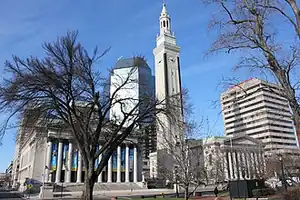
The north facade of the Rhode Island State House in Providence
Providence is the capital of, and the most populous city in, Rhode Island, and one of the first cities established in the United States. Located in Providence County, it is the estimated third-largest city in the New England region. Despite the city proper only having an estimated population of 178,042 as of 2010, it anchors the 37th largest metropolitan population in the country. With an estimated MSA population of 1,600,856, it exceeds that of Rhode Island itself by about 60% due to its reaching into southern Massachusetts. Situated at the mouth of the Providence River, at the head of Narragansett Bay, the city's small footprint is crisscrossed by seemingly erratic streets and contains a rapidly changing demographic. Providence was founded in 1636 by Roger Williams, a religious exile from the Massachusetts Bay Colony. He named the area in honor of "God's merciful Providence", which he believed was responsible for revealing such a haven for him and his followers to settle. One of the first American cities to industrialize, Providence became noted for its jewelry and silverware industry. Today, the city's economy has shifted into the service industries, though it still retains significant manufacturing activity. (Fullarticle...)
This portrait, first published in 1885, was alleged to be a 1625 likeness of Standish, although its authenticity has never been proven
Myles Standish was an English military officer hired by the Pilgrims as military advisor for Plymouth Colony. One of the Mayflower passengers, Standish played a leading role in the administration and defense of Plymouth Colony from its inception. On February 17, 1621, the Plymouth Colony militia elected him as its first commander and continued to re-elect him to that position for the remainder of his life. Standish served as an agent of Plymouth Colony in England, as assistant governor, and as treasurer of Plymouth Colony. He was also one of the first settlers and founders of the town of Duxbury, Massachusetts. (Fullarticle...)
Selected picture
Portrait of Civil War General and Rhode Island Governor Ambrose Burnside
Image 22The MBTA Commuter Rail serves eastern Massachusetts and parts of Rhode Island, radiating from downtown Boston, with planned service to New Hampshire. The CTrail system operates the Shore Line East and Hartford Line, covering coastal Connecticut, Hartford, and Springfield, Massachusetts. (from New England)
Image 33A political and geographical map of New England shows the coastal plains in the southeast, and hills, mountains and valleys in the west and the north. (from New England)
Image 46Largest self-reported ancestry groups in New England. Americans of Irish descent form a plurality in most of Massachusetts, while Americans of English descent form a plurality in much of the central parts of Vermont and New Hampshire as well as nearly all of Maine. (from New England)
Image 47Flag of the New England Governor's Conference (NEGC) (from New England)
... that Cora Agnes Benneson, one of the first female lawyers in New England, was rejected by Harvard Law School because "the equipments were too limited to make suitable provision for receiving women"?
... that Puritan Reverend John Wilson implored Mary Dyer to repent and not be "carried away by deceit of the devil" before her execution in Boston as a Quaker martyr?
Maine is both the northernmost and easternmost portion of New England. It is known for its scenery—its jagged, mostly rocky coastline, its low, rolling mountains, its heavily forested interior and picturesque waterways—as well as for its seafood cuisine, especially lobsters and clams.