A monarchy is a hereditary form of government in which political power is legally passed on to the family members of the monarch, a head of state who rules for life. While most monarchs gain their power based on various hereditary succession laws, they can occasionally gain their authority via election.
Monarchies have historically been a common form of government. Nearly half of all independent states at the start of the 19th century were monarchies. After reaching a peak in the middle of the 19th century, the proportion of monarchies in the world has steadily declined. Republics replaced many monarchies, notably at the end of World War I and World War II.
There are conventionally two types of monarchy: absolute monarchy and constitutional monarchy. Absolute monarchies, of which there are approximately twelve, are governed as autocracies. Most of the modern monarchies are constitutional monarchies, retaining under a constitution unique legal and ceremonial roles for monarchs exercising limited or no political power, similar to heads of state in a parliamentary republic.
Christopher Lekapenos or Lecapenus (Greek: Χριστόφορος Λακαπηνός or Λεκαπηνός, romanized:Christóphoros Lakapēnos or Lekapēnos; diedAugust 931) was the eldest son of Emperor Romanos I Lekapenos (r.920–944) and co-emperor of the Byzantine Empire from 921 until his death in 931. Christopher was given the position of megas hetaireiarches (commander of the palace guard) in spring 919, after Romanos assumed guardianship of the underage Emperor Constantine VII. Romanos, who made himself co-emperor in 920, raised Christopher to co-emperor on 21 May 921 to give his family precedence over Constantine VII's Macedonian line. In 928 Christopher's father-in-law, Niketas, unsuccessfully attempted to incite Christopher to usurp his father, resulting in Niketas being banished. Christopher died in August 931, succeeded by his father and two brothers, Stephen Lekapenos and Constantine Lekapenos, and Constantine VII. In December 944 his brothers overthrew and exiled their father, but they themselves were exiled in January 945 after attempting to oust Constantine VII. (Full article...)
His reign was marked by multiple wars with the Lombards, a Germanic people who had arrived in the former Roman province of Pannonia under the leadership of their king, Audoin. Thurisind also had to face the hostility of the Byzantine Empire, which was resentful of the Gepid takeover of Sirmium and anxious to diminish Gepid power in the Pannonian Basin, a plain covering most of modern Hungary and partly including the bordering states. The Byzantines' plans to reduce the Gepids' power took effect when Audoin decisively defeated Thurisind in 551 or 552. The Byzantine Emperor Justinian forced a peace accord on both leaders so that equilibrium in the Pannonian Basin could be sustained. (Full article...)
Image 3
Seleucus VI's portrait on the obverse of a tetradrachm minted in Antioch
Seleucus VI Epiphanes Nicator (Ancient Greek: Σέλευκος Ἐπιφανής Νικάτωρ, romanized:Séleukos Epiphanḗs Nīkā́tōr; between 124 and 109 BC – 94 BC) was a Seleucid monarch who ruled Syria between 96 and 94 BC. He ascended the throne after the assassination of his father, Antiochus VIII. Antiochus VIII's half-brother and rival, Antiochus IX, then occupied the capital Antioch while Seleucus VI established his power-base in western Cilicia and himself prepared for war. In 95 BC, Antiochus IX marched against his nephew, but lost the battle and was killed. Seleucus VI became the master of the capital but had to share Syria with his brother Demetrius III, based in Damascus, and his cousin, Antiochus IX's son Antiochus X.
According to the ancient historian Appian, Seleucus VI was a violent ruler. He taxed his dominions extensively to support his wars, and resisted allowing the cities a measure of autonomy, as had been the practice of former kings. His reign did not last long; in 94 BC, he was expelled from Antioch by Antiochus X, who followed him to the Cilician city of Mopsuestia. Seleucus took shelter in the city where his attempts to raise money led to riots that eventually claimed his life in 94 BC. Ancient traditions have different versions of his death, but he was most probably burned alive by the rioters. Following his demise, his brothers Antiochus XI and Philip I destroyed Mopsuestia as an act of revenge and their armies fought those of Antiochus X. (Full article...)
Image 4
Satellite image of northern Britain and Ireland showing the approximate area of Dál Riata (shaded)
The Hundred Years' War had recently resumed in France, and in 1369 Pembroke journeyed to Aquitaine. There he took part in a sequence of raids, sieges, and counter-measures against the French, with both notable successes and failures. The latter were compounded by his apparent inability to work alongside the famed soldier Sir John Chandos, who, although head of the King's forces there, was far below Pembroke in rank. He was, however, far above Pembroke in ability, and his subsequent death led to even more problems for Pembroke in France. A couple of years later, the Earl was summoned to Parliament and returned to England. There, perhaps exasperated by the political failures of the King's ecclesiastical ministers, or by their self-indulgence in office, he was responsible for forcing them from power. (Full article...)
Al-Walid ibn Abd al-Malik ibn Marwan (c.674 – 23 February 715), commonly known as al-Walid I, was the sixth Umayyad caliph, ruling from October 705 until his death in 715. He was the eldest son of his predecessor, Caliph Abd al-Malik (r.685–705). As a prince, he led annual raids against the Byzantines from 695 to 698 and built or restored fortifications along the Syrian Desert route to Mecca. He became heir apparent in c.705, after the death of the designated successor, Abd al-Malik's brother Abd al-Aziz ibn Marwan.
Under al-Walid, his father's efforts to centralize government, impose a more Arabic and Islamic character on the state, and expand its borders were continued. He heavily depended on al-Hajjaj ibn Yusuf, his father's powerful viceroy over the eastern half of the caliphate. During his reign, armies commissioned by al-Hajjaj conquered Sind and Transoxiana in the east, while the troops of Musa ibn Nusayr, the governor of Ifriqiya, conquered the Maghreb and Hispania in the west, bringing the caliphate to its largest territorial extent. War spoils from the conquests enabled al-Walid to finance impressive public works, including his greatest architectural achievement, the Great Mosque of Damascus, as well as the Qibli (al-Aqsa) Mosque in Al-Aqsa Compound in Jerusalem, the expansions of the Prophet's Mosque in Medina, the Great Mosque of Sana'a, and Masjid Al-Haram in Mecca, and the building of the historical city of Anjar. He was the first caliph to institute programs for social welfare, aiding the poor and handicapped among the Muslim Arabs of Syria, who held him in high esteem. (Full article...)
Born in Alexandria, Cleopatra was the daughter of Ptolemy XII Auletes, who named her his heir before his death in 51 BC. Cleopatra began her reign alongside her brother Ptolemy XIII, but a falling-out between them led to a civil war. Roman statesman Pompey fled to Egypt after losing the 48 BC Battle of Pharsalus against his rival Julius Caesar, the Roman dictator, in Caesar's civil war. Pompey had been a political ally of Ptolemy XII, but Ptolemy XIII had him ambushed and killed before Caesar arrived and occupied Alexandria. Caesar then attempted to reconcile the rival Ptolemaic siblings, but Ptolemy XIII's forces besieged Cleopatra and Caesar at the palace. Shortly after reinforcements lifted the siege, Ptolemy XIII died in the Battle of the Nile. Caesar declared Cleopatra and her brother Ptolemy XIV joint rulers, and maintained a private affair with Cleopatra which produced a son, Caesarion. Cleopatra traveled to Rome as a client queen in 46 and 44BC, where she stayed at Caesar's villa. After Caesar's assassination, followed shortly afterwards by the sudden death of Ptolemy XIV (possibly murdered on Cleopatra's order), she named Caesarion co-ruler as Ptolemy XV. (Full article...)
Although born in Austria, and brought up in Italy and Germany, Louis enrolled in the British Royal Navy at the age of fourteen. Queen Victoria and her son the Prince of Wales (later King Edward VII) occasionally intervened in his career: the Queen thought that there was "a belief that the Admiralty are afraid of promoting Officers who are Princes on account of the radical attacks of low papers and scurrilous ones". However, Louis welcomed assignments that provided opportunities for him to acquire skills and to demonstrate to his superiors that he was serious about his naval career. Posts on royal yachts and tours arranged by Queen Victoria and the Prince of Wales impeded his progress, as his promotions were perceived as undeserved royal favours. (Full article...)
Image 9
Caxias in 1878
Luís Alves de Lima e Silva, Duke of Caxias (pronounced[kaˈʃi.ɐs]; 25 August 1803– 7 May 1880), nicknamed "o Pacificador" ("the Peacemaker") and "o Duque de Ferro" ("the Iron Duke"), was an army officer, politician and monarchist of the Empire of Brazil. Like his father and uncles, Caxias pursued a military career. In 1823 he fought as a young officer in the Brazilian War of Independence against Portugal, then spent three years in Brazil's southernmost province, Cisplatina, as the government unsuccessfully resisted that province's secession in the Cisplatine War. Though his own father and uncles renounced Emperor DomPedroI during the protests of 1831, Caxias remained loyal. PedroI abdicated in favor of his young son Dom PedroII, whom Caxias instructed in swordsmanship and horsemanship and eventually befriended.
During PedroII's minority the governing regency faced countless rebellions throughout the country. Again breaking with his father and other relatives sympathetic to the rebels, from 1839 to 1845 Caxias commanded loyalist forces suppressing such uprisings as the Balaiada, the Liberal rebellions of 1842 and the Ragamuffin War. In 1851, under his command, the Brazilian army prevailed against the Argentine Confederation in the Platine War; a decade later Caxias, as army marshal (the army's highest rank), led Brazilian forces to victory in the Paraguayan War. As a reward he was raised to the titled nobility, becoming successively a baron, count, and marquis, finally becoming the only person created duke during PedroII's 58-year reign. (Full article...)
Wallis grew up in Baltimore, Maryland. Her father died shortly after her birth, and she and her widowed mother were partly supported by their wealthier relatives. Her first marriage, to United States Navy officer Win Spencer, was punctuated by periods of separation and eventually ended in divorce. In 1931, while married to her second husband Ernest Simpson, she met Edward, the heir apparent to the British throne. Five years later, after Edward's accession as King of the United Kingdom, Wallis divorced Ernest to marry Edward. (Full article...)
Image 11
Fragment of Ramesses VI's stone sarcophagus from his tomb now on display at the British Museum. The sarcophagus was originally painted, its stone quarried in the Wadi Hammamat.
Ramesses VI Nebmaatre-Meryamun (sometimes written Ramses or Rameses, also known under his princely name of Amenherkhepshef C) was the fifth ruler of the Twentieth Dynasty of Egypt. He reigned for about eight years in the mid-to-late 12th century BC and was a son of Ramesses III and queen Iset Ta-Hemdjert. As a prince, he was known as Ramesses Amunherkhepeshef and held the titles of royal scribe and cavalry general. He was succeeded by his son, Ramesses VII Itamun, whom he had fathered with queen Nubkhesbed.
After the death of the ruling pharaoh, Ramesses V, who was the son of Ramesses VI's older brother, Ramesses IV, Ramesses VI ascended the throne. In the first two years after his coronation, Ramesses VI stopped frequent raids by Libyan or Egyptian marauders in Upper Egypt and buried his predecessor in what is now an unknown tomb of the Theban necropolis. Ramesses VI usurped KV9, a tomb in the Valley of the Kings planned by and for Ramesses V, and had it enlarged and redecorated for himself. The craftsmen's huts near the entrance of KV9 covered up the entrance to Tutankhamun's tomb, saving it from a wave of tomb robberies that occurred within 20 years of Ramesses VI's death. Ramesses VI may have planned and made six more tombs in the Valley of the Queens, none which are known today. (Full article...)
Image 12
Solidus of Glycerius marked: d·n· glycerius p·f· aug·
Glycerius (died after 474) was Roman emperor of the West from 473 to 474. He served as comes domesticorum (commander of the palace guard) during the reign of Olybrius (r.472), until Olybrius died in November 472. After a four-month interregnum, Glycerius was proclaimed as emperor in March 473 by Gundobad, the magister militum (master of soldiers) and power behind the throne. Very few of the events of his reign are known other than that an attempted invasion of Italy by the Visigoths was repelled by local commanders, diverting them to Gaul. Glycerius also prevented an invasion by the Ostrogoths through diplomacy, including a gift of 2,000 solidi.
Glycerius was not recognized by the Eastern Roman emperor Leo I (r.457–474), who instead nominated Julius Nepos (r.474–475/480) as Western Emperor and sent him with an army to invade the Western Empire. Glycerius was without allies because Gundobad had abandoned him, and therefore was forced to abdicate on 24 June 474, and was succeeded by Nepos. He was appointed Bishop of Salona, which position he held until his death. He died, possibly in 480, and a nearly contemporaneous source blames him for the assassination of Nepos, but the records for this event are muddled. (Full article...)
Image 13
Eardwulf (fl. 790– c. 830) was king of Northumbria from 796 to 806, when he was deposed and went into exile. He may have had a second reign from 808 until perhaps 811 or 830. Northumbria in the last years of the eighth century was the scene of dynastic strife between several noble families: in 790, king Æthelred I attempted to have Eardwulf assassinated. Eardwulf's survival may have been viewed as a sign of divine favour. A group of nobles conspired to assassinate Æthelred in April 796 and he was succeeded by Osbald: Osbald's reign lasted only twenty-seven days before he was deposed and Eardwulf became king on 14 May 796.
Little is recorded of Eardwulf's family, though his father, also named Eardwulf, is known to have been a nobleman. Eardwulf was married by the time he became king, though his wife's name is not recorded. It is possible he later wed an illegitimate daughter of Charlemagne. In 798, early in his reign, Eardwulf fought a battle at Billington Moor against a nobleman named Wada, who had been one of those who killed King Æthelred. Wada was defeated and driven into exile. In 801, Eardwulf led an army against Coenwulf of Mercia, perhaps because of Coenwulf's support for other claimants to the Northumbrian throne. (Full article...)
Princess Charlotte of Wales (Charlotte Augusta; 7 January 1796 – 6 November 1817) was the only child of George, Prince of Wales (later George IV), and Caroline of Brunswick. She was expected to ascend the British throne after the deaths of her grandfather, George III, and her father, but died in childbirth at the age of 21, predeceasing them both.
Charlotte's parents disliked each other from before their arranged marriage and soon separated. The Prince of Wales left most of Charlotte's care to governesses and servants, only allowing her limited contact with her mother, who eventually left the country. As Charlotte grew to adulthood, her father pressured her to marry William, Hereditary Prince of Orange (later King of the Netherlands). After initially accepting him, Charlotte soon broke off the intended match. This resulted in an extended contest of wills between her and her father, who finally permitted her to marry Leopold of Saxe-Coburg-Saalfeld (later the first King of the Belgians). After a year and a half of happy marriage, Charlotte died after giving birth to a stillborn son. (Full article...)
Wulfhere's father, Penda, was killed in 655 at the Battle of Winwaed, fighting against Oswiu of Northumbria. Penda's son Peada became king under Oswiu's overlordship but was murdered six months later. Wulfhere came to the throne when Mercian nobles organized a revolt against Northumbrian rule in 658 and drove out Oswiu's governors. (Full article...)
Featured picture
Neuschwanstein Castle
Neuschwanstein Castle is a Romanesque Revivalpalace commissioned by King Ludwig II of Bavaria in 1868. This castle on a rugged hill above the village of Hohenschwangau was intended to be Ludwig's personal retreat, though it was still under construction at the time of his death in 1886. It was soon thereafter opened to tourists, and remains a popular destination. Its architecture has inspired several further buildings, including Disneyland's Sleeping Beauty Castle.
... that King Owodo, the last Ogiso of Igodomigodo, was deposed after killing a pregnant widow, an act punishable by deposition under the kingdom's law?
... that Holy Roman EmperorMaximilian I commissioned the Triumphal Arch(pictured), a monumental woodcut print over 3½ m (11½ ft) tall and nearly 3 m (10 ft) wide printed from 192 separate wood blocks?
These are Good articles, which meet a core set of high editorial standards.
Lua error: No page specified.
Featured portrait
Mehmed IV
Mehmed IV (1642–1693) was the Sultan of the Ottoman Empire from 1648 to 1687. He came to the throne at the age of six, and went on to become the second longest reigning sultan in Ottoman history. During his middle years, he oversaw the revival of the empire's fortunes associated with the Köprülü era. Mehmed was known by contemporaries as a particularly pious ruler, and was referred to as gazi, or "holy warrior" for his role in the empire's many conquests. In 1687, after being overthrown, Mehmed retired to Edirne, where he resided until his death.
Selected quote
Related portals
General images -
The following are images from various monarchy-related articles on Wikipedia.
Image 1Photograph of Tsar Alexander II, 1878–81 (from Absolute monarchy)
Image 2Dinzulu kaCetshwayo, the last king of an independent Zulu state, in 1883 (from Non-sovereign monarchy)
Image 3The constituent states of the German Empire (a federal monarchy). Various states were formally suzerain to the emperor, whose government retained authority over some policy areas throughout the federation, and was concurrently King of Prussia, the empire's largest state. (from Non-sovereign monarchy)
Image 8British India and the princely states within the Indian Empire. The princely states (in yellow) were sovereign territories of Indian princes who were practically suzerain to the Emperor of India, who was concurrently the British monarch, whose territories were called British India (in pink) and occupied a vast portion of the empire. (from Non-sovereign monarchy)
Image 13The administrative divisions of the British Protectorate of Uganda, including five of today's six kingdoms (from Non-sovereign monarchy)
Featured content
Extended content
This is a list of recognized content, updated weekly by JL-Bot (talk·contribs) (typically on Saturdays). There is no need to edit the list yourself. If an article is missing from the list, make sure it is taggedor categorized (e.g. Category:Royalty and nobility articles)correctly and wait for the next update. See WP:RECOG for configuration options.




 Good articles -

 Photograph of Tsar Alexander II, 1878–81 (from Absolute monarchy)
 Dinzulu kaCetshwayo, the last king of an independent Zulu state, in 1883 (from Non-sovereign monarchy)
 The constituent states of the German Empire (a federal monarchy). Various states were formally suzerain to the emperor, whose government retained authority over some policy areas throughout the federation, and was concurrently King of Prussia, the empire's largest state. (from Non-sovereign monarchy)
 Waikato, the homeland of the Māori kings (from Non-sovereign monarchy)
 Emperor Naruhito is the hereditary monarch of Japan. The Japanese monarchy is the oldest continuous hereditary monarchy in the world. (from Hereditary monarchy)

 The islands that make up Wallis and Futuna (from Non-sovereign monarchy)
 British India and the princely states within the Indian Empire. The princely states (in yellow) were sovereign territories of Indian princes who were practically suzerain to the Emperor of India, who was concurrently the British monarch, whose territories were called British India (in pink) and occupied a vast portion of the empire. (from Non-sovereign monarchy)
 Subdivisions of the United Arab Emirates (from Non-sovereign monarchy)
 alt=Portrait of Pope Leo XIV (from Absolute monarchy)
 Louis XIV of France (from Absolute monarchy)
 King Frederick II of Prussia, "the Great" (from Absolute monarchy)
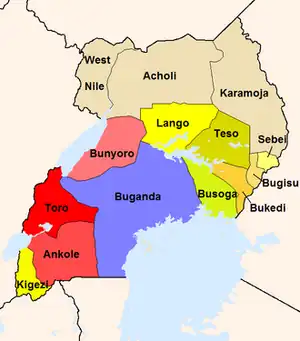 The administrative divisions of the British Protectorate of Uganda, including five of today's six kingdoms (from Non-sovereign monarchy)


 Commons
 Wikidata
 Wikiquote
 Wikisource
 Wikiversity
 Wiktionary
 List of all portals






 Random portal
 WikiProject Portals