Portal:Minerals

The Minerals Portal

In geology and mineralogy, a mineral or mineral species is, broadly speaking, a solid substance with a fairly well-defined chemical composition and a specific crystal structure that occurs naturally in pure form.
The geological definition of mineral normally excludes compounds that occur only in living organisms. However, some minerals are often biogenic (such as calcite) or chemically organic compounds (such as mellite). Moreover, living organisms often synthesize inorganic minerals (such as hydroxylapatite) that also occur in rocks.
The concept of mineral is distinct from rock, which is any bulk solid geologic material that is relatively homogeneous at a large enough scale. A rock may consist of one type of mineral or may be an aggregate of two or more different types of minerals, spacially segregated into distinct phases.
Some natural solid substances without a definite crystalline structure, such as opal or obsidian, are more properly called mineraloids. If a chemical compound occurs naturally with different crystal structures, each structure is considered a different mineral species. Thus, for example, quartz and stishovite are two different minerals consisting of the same compound, silicon dioxide. (Full article...)
Mineralogy is a subject of geology specializing in the scientific study of the chemistry, crystal structure, and physical (including optical) properties of minerals and mineralized artifacts. Specific studies within mineralogy include the processes of mineral origin and formation, classification of minerals, their geographical distribution, and their utilization. (Full article...)
Selected articles

Chalk is a soft, white, porous, sedimentary carbonate rock. It is a form of limestone composed of the mineral calcite and originally formed under the sea by the accumulation and lithification of hard parts of organisms, mostly microscopic plankton, which had settled to the sea floor. Chalk is common throughout Western Europe, where deposits underlie parts of France, and steep cliffs are often seen where they meet the sea in places such as the Dover cliffs on the Kent coast of the English Channel.
Chalk is mined for use in industry, such as for quicklime, bricks and builder's putty, and in agriculture, for raising pH in soils with high acidity. It is also used for "blackboard chalk" for writing and drawing on various types of surfaces, although these can also be manufactured from other carbonate-based minerals or gypsum. (Full article...)
Turquoise is an opaque, blue-to-green mineral that is a hydrous phosphate of copper and aluminium, with the chemical formula CuAl6(PO4)4(OH)8·4H2O. It is rare and valuable in finer grades and has been prized as a gemstone for millennia due to its hue.
The robin egg blue or sky blue color of the Persian turquoise mined near the modern city of Nishapur, Iran, has been used as a guiding reference for evaluating turquoise quality.
Like most other opaque gems, turquoise has been devalued by the introduction of treatments, imitations, and synthetics into the market. (Full article...)
Micas (/ˈmaɪkəz/) are a group of silicate minerals whose outstanding physical characteristic is that individual mica crystals can easily be split into fragile elastic plates. This characteristic is described as perfect basal cleavage. Mica is common in igneous and metamorphic rock and is occasionally found as small flakes in sedimentary rock. It is particularly prominent in many granites, pegmatites, and schists, and "books" (large individual crystals) of mica several feet across have been found in some pegmatites.
Micas are used in products such as drywalls, paints, and fillers, especially in parts for automobiles, roofing, and in electronics. The mineral is used in cosmetics and food to add "shimmer" or "frost". (Full article...)
Rutile is an oxide mineral composed of titanium dioxide (TiO2), and is the most common natural form of TiO2. Rarer polymorphs of TiO2 are known, including anatase, akaogiite, and brookite.
Rutile has one of the highest refractive indices at visible wavelengths of any known crystal and also exhibits a particularly large birefringence and high dispersion. Owing to these properties, it is useful for the manufacture of certain optical elements, especially polarization optics, for longer visible and infrared wavelengths up to about 4.5 micrometres. Natural rutile may contain up to 10% iron and significant amounts of niobium and tantalum.
Rutile derives its name from the Latin rutilus ('red'), in reference to the deep red color observed in some specimens when viewed by transmitted light. Rutile was first described in 1803 by Abraham Gottlob Werner using specimens obtained in Horcajuelo de la Sierra, Madrid (Spain), which is consequently the type locality. (Full article...)
Halite (/ˈhælaɪt, ˈheɪlaɪt/ HAL-yte, HAY-lyte), commonly known as rock salt, is a type of salt, the mineral (natural) form of sodium chloride (NaCl). Halite forms isometric crystals. The mineral is typically colorless or white, but may also be light blue, dark blue, purple, pink, red, orange, yellow or gray depending on inclusion of other materials, impurities, and structural or isotopic abnormalities in the crystals. It commonly occurs with other evaporite deposit minerals such as several of the sulfates, halides, and borates. The name halite is derived from the Ancient Greek word for "salt", ἅλς (háls). (Full article...)
Frameworks of LTA-type (left) and FAU-type zeolites (right)
Zeolites are a group of several microporous, crystalline aluminosilicate minerals commonly used as commercial adsorbents and catalysts. They mainly consist of silicon, aluminium, and oxygen, and have the general formula Mn+
1/n(AlO
2)−
(SiO
2)
x・yH
2O where Mn+
1/n is either a metal ion or H+.
The term was originally coined in 1756 by Swedish mineralogist Axel Fredrik Cronstedt, who observed that rapidly heating a material, believed to have been stilbite, produced large amounts of steam from water that had been adsorbed by the material. Based on this, he called the material zeolith (changed later to zeolite in English, to fit the naming scheme for minerals in -ite) from the Greek ζέω (zéō), meaning "to boil" and λίθος (líthos), meaning "stone". (Full article...)
Galena, also called lead glance, is the natural mineral form of lead(II) sulfide (PbS). It is the most important ore of lead and an important source of silver.
Galena is one of the most abundant and widely distributed sulfide minerals. It crystallizes in the cubic crystal system often showing octahedral forms. It is often associated with the minerals sphalerite, calcite and fluorite.
As a pure specimen held in the hand, under standard temperature and pressure, galena is insoluble in water and so is almost non-toxic. Handling galena under these specific conditions (such as in a museum or as part of geology instruction) poses practically no risk; however, as lead(II) sulfide is reasonably reactive in a variety of environments, it can be highly toxic if swallowed or inhaled, particularly under prolonged or repeated exposure. (Full article...)
The mineral pyrite (/ˈpaɪraɪt/ PY-ryte), or iron pyrite, also known as fool's gold, is an iron sulfide with the chemical formula FeS2 (iron (II) disulfide). Pyrite is the most abundant sulfide mineral.
Pyrite's metallic luster and pale brass-yellow hue give it a superficial resemblance to gold, hence the well-known nickname of fool's gold. The color has also led to the nicknames brass, brazzle, and brazil, primarily used to refer to pyrite found in coal.
Pyrite is usually found associated with other sulfides or oxides in quartz veins, sedimentary rock, and metamorphic rock, as well as in coal beds and as a replacement mineral in fossils, but has also been identified in the sclerites of scaly-foot gastropods. Despite being nicknamed "fool's gold", pyrite is sometimes found in association with small quantities of actual gold. A substantial proportion of this is "invisible gold" incorporated into the pyrite. It has been suggested that the presence of both gold and arsenic is a case of coupled substitution. However, as of 1997, the chemical state of the gold remained controversial. (Full article...)
Hematite (/ˈhiːmətaɪt, ˈhɛm-/ HE(E)M-ə-tyte), also spelled as haematite, is a common iron oxide compound with the formula Fe2O3 and is widely found in rocks and soils. Hematite crystals belong to the rhombohedral lattice system which is designated the alpha polymorph of Fe
2O
3. It has the same crystal structure as corundum (Al
2O
3) and ilmenite (FeTiO
3). With this crystal structure geometry it forms a complete solid solution at temperatures above 950 °C (1,740 °F).
Hematite occurs naturally in black to steel or silver-gray, brown to reddish-brown, or red colors. It is mined as an important ore mineral of iron. It is electrically conductive. Hematite varieties include kidney ore, martite (pseudomorphs after magnetite), iron rose and specularite (specular hematite). While these forms vary, they all have a rust-red streak. Hematite is not only harder than pure iron, but also much more brittle. The term kidney ore may be broadly used to describe botryoidal, mammillary, or reniform hematite. Maghemite is a polymorph of hematite (γ-Fe
2O
3) with the same chemical formula, but with a spinel structure like magnetite.
Large deposits of hematite are found in banded iron formations. Gray hematite is typically found in places that have still, standing water, or mineral hot springs, such as those in Yellowstone National Park in North America. The mineral may precipitate in the water and collect in layers at the bottom of the lake, spring, or other standing water. Hematite can also occur in the absence of water, usually as the result of volcanic activity.
Clay-sized hematite crystals also may occur as a secondary mineral formed by weathering processes in soil, and along with other iron oxides or oxyhydroxides such as goethite, which is responsible for the red color of many tropical, ancient, or otherwise highly weathered soils. (Full article...)
Talc, or talcum, is a clay mineral composed of hydrated magnesium silicate, with the chemical formula Mg3Si4O10(OH)2. Talc in powdered form, often combined with corn starch, is used as baby powder. This mineral is used as a thickening agent and lubricant. It is an ingredient in ceramics, paints, and roofing material. It is a main ingredient in many cosmetics. It occurs as foliated to fibrous masses, and in an exceptionally rare crystal form. It has a perfect basal cleavage and an uneven flat fracture, and it is foliated with a two-dimensional platy form.
The Mohs scale of mineral hardness, based on scratch hardness comparison, defines value 1 as the hardness of talc, the softest mineral. When scraped on a streak plate, talc produces a white streak, though this indicator is of little importance, because most silicate minerals produce a white streak. Talc is translucent to opaque, with colors ranging from whitish grey to green with a vitreous and pearly luster. Talc is not soluble in water, and is slightly soluble in dilute mineral acids.
Soapstone is a metamorphic rock composed predominantly of talc. (Full article...)
The diamond crystal structure belongs to the face-centered cubic lattice, with a repeated two-atom pattern.
In crystallography, a crystal system is a set of point groups (a group of geometric symmetries with at least one fixed point). A lattice system is a set of Bravais lattices (an infinite array of discrete points). Space groups (symmetry groups of a configuration in space) are classified into crystal systems according to their point groups, and into lattice systems according to their Bravais lattices. Crystal systems that have space groups assigned to a common lattice system are combined into a crystal family. Informally, two crystals are in the same crystal system if they have similar symmetries (though there are many exceptions). (Full article...)
Diamond is a mineral form of the element carbon with its atoms arranged in a crystal structure called diamond cubic. Diamond is a tasteless, odorless, strong, brittle solid, a poor conductor of electricity, colorless in pure form, and insoluble in water. Another solid form of carbon known as graphite is the chemically stable form of carbon at room temperature and pressure, but diamond is metastable and converts to it at a negligible rate under those conditions. Diamond has the highest hardness and thermal conductivity of any natural material, properties that are used in major industrial applications such as cutting and polishing tools.
Because the arrangement of atoms in diamond is extremely rigid, few types of impurity can contaminate it (two exceptions are boron and nitrogen). Small numbers of defects or impurities—about one per million of lattice atoms—can color a diamond blue (boron), yellow (nitrogen), brown (defects), green (radiation exposure), purple, pink, orange, or red. Diamond also has a very high refractive index and a relatively high optical dispersion.
Most natural diamonds have ages between 1 billion and 3.5 billion years. Most were formed at depths between 150 and 250 kilometres (93 and 155 mi) in the Earth's mantle, although a few have come from as deep as 800 kilometres (500 mi). Under high pressure and temperature, carbon-containing fluids dissolved various minerals and replaced them with diamonds. Much more recently (hundreds to tens of million years ago), they were carried to the surface in volcanic eruptions and deposited in igneous rocks known as kimberlites and lamproites.
Synthetic diamonds can be grown from high-purity carbon under high pressures and temperatures or from hydrocarbon gases by chemical vapor deposition (CVD). Natural and synthetic diamonds are most commonly distinguished using optical techniques or thermal conductivity measurements. (Full article...)
Mineralogy applies principles of chemistry, geology, physics and materials science to the study of minerals
Mineralogy is a subject of geology specializing in the scientific study of the chemistry, crystal structure, and physical (including optical) properties of minerals and mineralized artifacts. Specific studies within mineralogy include the processes of mineral origin and formation, classification of minerals, their geographical distribution, and their utilization. (Full article...)
Opal is a hydrated amorphous form of silica (SiO2·nH2O); its water content may range from 3% to 21% by weight, but is usually between 6% and 10%. Due to the amorphous (chemical) physical structure, it is classified as a mineraloid, unlike crystalline forms of silica, which are considered minerals. It is deposited at a relatively low temperature and may occur in the fissures of almost any kind of rock, being most commonly found with limonite, sandstone, rhyolite, marl, and basalt.
The name opal is believed to be derived from the Sanskrit word upala (उपल), which means 'jewel', and later the Greek derivative opállios (ὀπάλλιος).
There are two broad classes of opal: precious and common. Precious opal displays play-of-color (iridescence); common opal does not. Play-of-color is defined as "a pseudo chromatic optical effect resulting in flashes of colored light from certain minerals, as they are turned in white light." The internal structure of precious opal causes it to diffract light, resulting in play-of-color. Depending on the conditions in which it formed, opal may be transparent, translucent, or opaque, and the background color may be white, black, or nearly any color of the visual spectrum. Black opal is considered the rarest, while white, gray, and green opals are the most common. (Full article...)
Sapphire is a precious gemstone, a variety of the mineral corundum, consisting of aluminium oxide (α-Al2O3) with trace amounts of elements such as iron, titanium, cobalt, lead, chromium, vanadium, magnesium, boron, and silicon. The name sapphire is derived from the Latin word sapphirus, itself from the Greek word sappheiros (σάπφειρος, itself from a Semitic origin), which referred to lapis lazuli. Sapphire with colors other than its typical blue is referred to as "fancy sapphire", and can be in yellow, purple, orange, and green colors; "parti sapphires" show two or more colors. Red corundum stones also occur, but are called rubies rather than sapphires. Pink-colored corundum may be classified either as ruby or sapphire depending on the locale. Commonly, natural sapphires are cut and polished into gemstones and worn in jewelry. They also may be created synthetically in laboratories for industrial or decorative purposes in large crystal boules. It occurs in association with ruby, zircon, biotite, muscovite, calcite, dravite and quartz.
Sapphire has a remarkable hardness, with a score of 9 on the Mohs scale, the third-hardest mineral after diamond at 10 and moissanite at 9.5. Non-ornamental applications include infrared optical components, high-durability windows, wristwatch crystals and movement bearings, and very thin electronic wafers, which are used as the insulating substrates of special-purpose solid-state electronics such as integrated circuits and GaN-based blue LEDs. (Full article...)
Beryl (/ˈbɛrəl/ BERR-əl) is a mineral composed of beryllium aluminium silicate with the chemical formula Be3Al2(SiO3)6. Well-known varieties of beryl include emerald and aquamarine. Naturally occurring hexagonal crystals of beryl can be up to several meters in size, but terminated crystals are relatively rare. Pure beryl is colorless, but it is frequently tinted by impurities; possible colors are green, blue, yellow, pink, and red (the rarest). It is an ore source of beryllium. (Full article...)
Amethyst is a violet variety of natural quartz. Ancient Greeks wore amethyst and carved drinking vessels from it in the belief that it would prevent intoxication. Amethyst, a semiprecious stone, is often used in jewelry. It occurs mostly in association with calcite, quartz, smoky quartz, hematite, pyrite, fluorite, goethite, agate, and chalcedony. (Full article...)
Malachite (/ˈmæl.əˌkaɪt/) is a copper carbonate hydroxide mineral, with the formula Cu2CO3(OH)2. This opaque, green-banded mineral crystallizes in the monoclinic crystal system, and most often forms botryoidal, fibrous, or stalagmitic masses, in fractures and deep, underground spaces, where the water table and hydrothermal fluids provide the means for chemical precipitation. Individual crystals are rare, but occur as slender to acicular prisms. Pseudomorphs after more tabular or blocky azurite crystals also occur. (Full article...)
Asbestos or asbestus (/æsˈbɛstəs, æz-, -tɒs/ ass-BES-təs, az-, -toss) is a group of naturally occurring, fibrous silicate minerals that have been used for thousands of years to create flexible fire-resistant objects, such as fireproof fabrics. It is toxic and carcinogenic.
There are six types, all of which are composed of long and thin fibrous crystals, with each fibre (particulate with length substantially greater than width) composed of many microscopic "fibrils" that can be released into the atmosphere by abrasion and other processes. Inhalation of asbestos fibres can lead to various dangerous lung conditions, including mesothelioma, asbestosis, and lung cancer. As a result of these health effects, asbestos is considered a serious health and safety hazard.
Archaeological studies have found evidence of asbestos being used as far back as the Stone Age to strengthen ceramic pots, but large-scale mining began at the end of the 19th century when manufacturers and builders began using asbestos for its desirable physical properties. Asbestos is an excellent thermal and electrical insulator, and is highly fire-resistant, so for much of the 20th century, it was very commonly used around the world as a building material (particularly for its fire-retardant properties), until its adverse effects on human health were more widely recognized and acknowledged in the 1970s. Many buildings constructed before the 1980s contain asbestos.
The use of asbestos for construction and fireproofing has been made illegal in many countries. Despite this, around 255,000 people are thought to die each year from diseases related to asbestos exposure. In part, this is because many older buildings still contain asbestos; in addition, the consequences of exposure can take decades to arise. The latency period (from exposure until the diagnosis of negative health effects) is typically 20 years. The most common diseases associated with chronic asbestos exposure are asbestosis (scarring of the lungs due to asbestos inhalation) and mesothelioma (a type of cancer). (Full article...)
Kaolinite (/ˈkeɪ.ələˌnaɪt, -lɪ-/ KAY-ə-lə-nyte, -lih-; also called kaolin) is a clay mineral, with the chemical composition Al2Si2O5(OH)4. It is a layered silicate mineral, with one "tetrahedral" sheet of silicate tetrahedra (SiO4) linked to one "octahedral" sheet of aluminate octahedrons (AlO2(OH)4) through oxygen atoms on one side, and another such sheet through hydrogen bonds on the other side.
Kaolinite is a soft, earthy, usually white, mineral (dioctahedral phyllosilicate clay), produced by the chemical weathering of aluminium silicate minerals like feldspar. It has a low shrink–swell capacity and a low cation-exchange capacity (1–15 meq/100 g).
Rocks that are rich in kaolinite, and halloysite, are known as kaolin (/ˈkeɪ.əlɪn/) or china clay. In many parts of the world kaolin is colored pink-orange-red by iron oxide, giving it a distinct rust hue. Lower concentrations of iron oxide yield the white, yellow, or light orange colors of kaolin. Alternating lighter and darker layers are sometimes found, as at Providence Canyon State Park in Georgia, United States.
Kaolin is an important raw material in many industries and applications. Commercial grades of kaolin are supplied and transported as powder, lumps, semi-dried noodle or slurry. Global production of kaolin in 2021 was estimated to be 45 million tonnes, with a total market value of US $4.24 billion. (Full article...)
Borax (also referred to as sodium borate, tincal (/ˈtɪŋkəl/) and tincar (/ˈtɪŋkər/)) is a salt (ionic compound) normally encountered as a hydrated borate of sodium, with the chemical formula Na2H20B4O17. Borax mineral is a crystalline borate mineral that occurs in only a few places worldwide in quantities that enable it to be mined economically.
Borax can be dehydrated by heating into other forms with less water of hydration. The anhydrous form of borax can also be obtained from the decahydrate or other hydrates by heating and then grinding the resulting glasslike solid into a powder. It is a white crystalline solid that dissolves in water to make a basic solution due to the tetraborate anion.
Borax is commonly available in powder or granular form and has many industrial and household uses, including as a pesticide, as a metal soldering flux, as a component of glass, enamel, and pottery glazes, for tanning of skins and hides, for artificial aging of wood, as a preservative against wood fungus, as a food additive, and as a pharmaceutic alkalizer. In chemical laboratories it is used as a buffering agent.
The terms tincal and tincar refer to the naturally occurring borax historically mined from dry lake beds in various parts of Asia. (Full article...)
A crystalline solid: atomic resolution image of strontium titanate. Brighter spots are columns of strontium atoms and darker ones are titanium-oxygen columns.
Crystallography is the branch of science devoted to the study of molecular and crystalline structure and properties. The word crystallography is derived from the Ancient Greek word κρύσταλλος (krústallos; "clear ice, rock-crystal"), and γράφειν (gráphein; "to write"). In July 2012, the United Nations recognised the importance of the science of crystallography by proclaiming 2014 the International Year of Crystallography.
Crystallography is a broad topic, and many of its subareas, such as X-ray crystallography, are themselves important scientific topics. Crystallography ranges from the fundamentals of crystal structure to the mathematics of crystal geometry, including those that are not periodic or quasicrystals. At the atomic scale it can involve the use of X-ray diffraction to produce experimental data that the tools of X-ray crystallography can convert into detailed positions of atoms, and sometimes electron density. At larger scales it includes experimental tools such as orientational imaging to examine the relative orientations at the grain boundary in materials. Crystallography plays a key role in many areas of biology, chemistry, and physics, as well as in emerging developments in these fields. (Full article...)
Graphite (/ˈɡræfaɪt/) is a crystalline allotrope (form) of the element carbon. It consists of many stacked layers of graphene, typically in excess of hundreds of layers. Graphite occurs naturally and is the most stable form of carbon under standard conditions. Synthetic and natural graphite are consumed on a large scale (1.3 million metric tons per year in 2022) for uses in many critical industries including refractories (50%), lithium-ion batteries (18%), foundries (10%), and lubricants (5%), among others (17%). Graphite converts to diamond under extremely high pressure and temperature. Graphite's low cost, thermal and chemical inertness and characteristic conductivity of heat and electricity finds numerous applications in high energy and high temperature processes. (Full article...)
Corundum is a crystalline form of aluminium oxide (Al2O3) typically containing traces of iron, titanium, vanadium, and chromium. It is a rock-forming mineral. It is a naturally transparent material, but can have different colors depending on the presence of transition metal impurities in its crystalline structure. Corundum has two primary gem varieties: ruby and sapphire. Rubies are red due to the presence of chromium, and sapphires exhibit a range of colors depending on what transition metal is present. A rare type of sapphire, padparadscha sapphire, is pink-orange.
The name "corundum" is derived from the Tamil-Dravidian word kurundam (ruby-sapphire) (appearing in Sanskrit as kuruvinda).
Because of corundum's hardness (pure corundum is defined to have 9.0 on the Mohs scale), it can scratch almost all other minerals. Emery, a variety of corundum with no value as a gemstone, is commonly used as an abrasive on sandpaper and on large tools used in machining metals, plastics, and wood. It is a black granular form of corundum, in which the mineral is intimately mixed with magnetite, hematite, or hercynite.
In addition to its hardness, corundum has a density of 4.02 g/cm3 (251 lb/cu ft), which is unusually high for a transparent mineral composed of the low-atomic mass elements aluminium and oxygen. (Full article...)
Dolomite (/ˈdɒl.əˌmaɪt, ˈdoʊ.lə-/) is an anhydrous carbonate mineral composed of calcium magnesium carbonate, ideally CaMg(CO3)2. The term is also used for a sedimentary carbonate rock composed mostly of the mineral dolomite (see Dolomite (rock)). An alternative name sometimes used for the dolomitic rock type is dolostone. (Full article...)





Selected mineralogist

Franz Ernst Brückmann (27 September 1697 – 21 March 1753) was a German mineralogist born at Marienthal near Helmstedt. Having qualified as a physician in 1721, he practised at Braunschweig and afterwards at Wolfenbüttel (from 1728). In 1747 he was appointed medical assessor in Braunschweig.
His leisure time was given up to natural history, and especially to mineralogy and botany. He appears to have been the first to introduce the term "oolithus" to rocks that resemble in structure the roe of a fish; whence the terms "oolite" and "oolitic". He died at Wolfenbüttel. (Full article...)
Matthias Joseph Anker.
Matthias Joseph Anker (6 May 1771 – 3 April 1843) was an Austrian mineralogist and geologist born in Graz. Some sources place his birthdate as 1 May 1772.
He received his education in Vienna, afterwards working as a surgeon in the town of Stainz. In 1807, he was called to Graz as a district surgeon, from where he intensified his scientific studies in mineralogy. Four years later, he joined the staff of mineralogist Friedrich Mohs at the Johanneum in Graz, where he eventually became a professor of mineralogy as well as curator of the mineral cabinet. In 1839, he resigned from his teaching position, but stayed on as director of collections. (Full article...)- Karl Hugo Strunz (24 February 1910 – 19 April 2006) was a German mineralogist. He is best known for creating the Nickel-Strunz classification, the ninth edition of which was published together with Ernest Henry Nickel. (Full article...)
- François Alluaud (21 September 1778, Limoges – 18 February 1866, Limoges) was a French manufacturer of Limoges porcelain, geologist and mineralogist. He was the grandfather of entomologist Charles Alluaud (1861–1949).
Following the death of his father in 1799, who was also named François Alluaud, he took over ownership of the family porcelain factory in Limoges. The company operated its own quarries; a feldspar mine at Chanteloube and a kaolin quarry at Marcognac. (Full article...) 
George Washington Carpenter (July 31, 1802 – June 7, 1860) was an American scientist. (Full article...)
Thomas Egleston (December 9, 1832 – January 15, 1900) was an American engineer who helped found Columbia University's School of Mines, now the Fu Foundation School of Engineering and Applied Science. Throughout his lifetime, Egleston published numerous lectures and books on metallurgy. Many of his books are preserved today at the archive in the Library of Congress. (Full article...)
Georg August Goldfuß (18 April 1782 – 2 October 1848) was a German palaeontologist, zoologist and botanist. He became a professor of zoology at the University of Erlangen and later at the University of Bonn. He coined the terms "protozoa" and "pelecypoda". (Full article...)- Erika Pohl-Ströher (18 January 1919 – 18 December 2016) was a German business executive, heiress, and collector of minerals and German folk art. She was resident in Switzerland for much of her life. (Full article...)
Ernst Heinrich Oskar Kasimir Weinschenk (6 April 1865, Esslingen am Neckar – 26 March 1921, Munich) was a German mineralogist and petrologist.
He served as a professor at the Technische Hochschule München from 1897 until 1921, and at the Ludwig-Maximilians-Universität München from 1900. His scientific research included mineralogical analysis of meteorites, and studies of contact-metamorphic mineralization in the Alpine region of Central Europe. He also conducted investigations on the origin of the sulfidic ore deposit at Silberberg in the Bavarian Forest, as well as the genesis of graphite deposits near Passau. Through the use of polarizing microscopy and thin sectioning, he determined numerous new minerals. (Full article...)
Félix Pisani (1831–1920)
Félix Pisani (28 April 1831 in Constantinople – 7 November 1920 in Paris) was a French chemist and mineralogist.
He was born in Istanbul, where his Venetian father worked in the Russian diplomatic service. Beginning in 1854, he studied chemistry in Paris at a private school run by Charles Frédéric Gerhardt (1816–1856). (Full article...)
Alfred Louis Olivier Legrand Des Cloizeaux (17 October 1817 – 6 May 1897) was a French mineralogist.
Des Cloizeaux was born at Beauvais, in the department of Oise. He studied with Jean-Baptiste Biot at the Collège de France. He became professor of mineralogy at the École Normale Supérieure and afterwards at the Muséum National d'Histoire Naturelle in Paris. He studied the geysers of Iceland, and wrote also on the classification of some of the eruptive rocks. (Full article...)
Rodney Charles Ewing (September 20, 1946 – July 13, 2024) was an American mineralogist, a materials scientist and a nuclear safety expert whose research was focused on the properties of nuclear materials exposed to radiation and long-term geochemical alterations expected for radioactive waste disposal.
He was the Frank Stanton Professor in Nuclear Security at the Center for International Security and Cooperation, a Senior Fellow of the Freeman Spogli Institute for International Studies, a Senior Fellow of the Precourt Institute for Energy, an Affiliate of the Stanford Woods Institute for the Environment, and a professor in the School of Earth, Energy and Environmental Sciences at Stanford University. (Full article...)- Joseph (Joe) Anthony Mandarino, FRSC (20 April 1929 in Chicago, Illinois – 19 September 2007) was an American-Canadian mineralogist and crystallographer. (Full article...)
Evgraf Stepanovich Fedorov (Russian: Евгра́ф Степа́нович Фёдоров, 22 December [O.S. 10 December] 1853 – 21 May 1919) was a Russian mathematician, crystallographer and mineralogist.
Fedorov was born in the Russian city of Orenburg. His father was a topographical engineer. The family later moved to Saint Petersburg. From the age of fifteen, he was deeply interested in the theory of polytopes, which later became his main research interest. He was a distinguished graduate of the Gorny Institute, which he joined at the age of 26. He was elected the first Director of the Institute in 1905. (Full article...)- Konrad Oebbeke (2 November 1853, Hildesheim – 1 February 1932) was a German geologist and mineralogist.
He studied at Heidelberg University and the University of Erlangen, obtaining his doctorate at the University of Würzburg in 1877. Afterwards he worked as an assistant to the Geological Survey of Bavaria. He served as privat-docent at the Ludwig-Maximilians-Universität München, later becoming a professor of mineralogy and geology at the University of Erlangen (1887).
From 1895 to 1927, he was a professor at the Technische Hochschule München. (Full article...) - Friedrich Alfred Seifert (8 May 1941 – 7 May 2026) was a German mineralogist and geophysicist. He was the founding director of Bayerisches Geoinstitut at University of Bayreuth. A silicate mineral, seifertite, is named after him. (Full article...)
- Harold "Hal" Robert Steacy (June 7, 1923 – April 7, 2012) was a Canadian mineralogist who was the curator of the Canadian National Mineral Collection at the Geological Survey of Canada in Ottawa. The mineral steacyite is named for him. (Full article...)

Sigmund Zois by Janez Andrej Herrlein
Sigmund Zois Freiherr von Edelstein, usually referred as Sigmund Zois (Slovenized: Žiga Zois, formerly Slovenized as Cojs or Cojz; pronunciation) (23 November 1747 – 10 November 1819) was a Carniolan nobleman, natural scientist and patron of the arts. He is considered one of the most influential figures of the Enlightenment Era in the Slovene Lands of Habsburg Austria. (Full article...)- Frank Thomas Matthews White (16 September 1909 – 26 November 1971) was an Australian mineral engineering educator. His career included roles in Australia, Fiji, Malaysia, and Canada. Following industry appointments in Australia, he established the Fiji Department of Mines, lead the post-War rehabilitation of Malayan tin mines, founded the Department of Mining and Metallurgical Engineering at University of Queensland (UQ), was instrumental in founding International House, University of Queensland, and chaired the Department of Mining Engineering and Applied Geophysics at McGill University, Canada. (Full article...)
- Rudolf Koechlin (11 November 1862 – 11 February 1939) was an Austrian mineralogist.
Koechlin was born and died in Vienna. He studied mineralogy, crystallography, petrology and geology at the University of Vienna, obtaining his doctorate in 1887 with a thesis on manganite, polianite and pyrolusite. At Vienna, his instructors included Gustav Tschermak and Albrecht Schrauf. In 1884 he began work as a volunteer in the mineralogical-petrography department of the Naturhistorisches Hofmuseum in Vienna. In 1897 he became a "custos-adjunct", later named a curator first-class (1912), and in 1920, was appointed director of the mineralogical-petrography department. (Full article...) 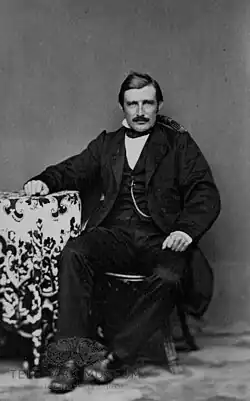
Tellef Dahll (10 April 1825, in Kragerø – 17 June 1893, in Morgedal) was a Norwegian mineralogist and geologist. (Full article...)
Harry von Eckermann, 1916
Harry von Eckermann (1886–1969) was a Swedish industrialist, mineralogist and geologist. His studies were centered around anorogenic alkaline igneous rocks occurring in the Baltic Shield. Following this line he studied the Alnö Complex, Norra Kärr Alkaline Complex and various Rapakivi granites.
In a 1948 publication on Alnö, von Eckermann correctly claimed a magmatic origin of carbonatite, albeit his finds were only widely accepted after the Ol Doinyo Lengai eruption of carbonatite lava in the 1960s showed contemporary evidence on the existence of such magmas. In relation to the mid-20th century granitization controversy von Eckermann rejected the notion that rapakivi granites were Jotnian sediments turned into granite. (Full article...)- József Sándor Krenner or Joseph Krenner (3 March 1839 – 6 January 1920) was a Hungarian mineralogist. He discovered several new minerals.
Krenner was born in Buda and studied at the University of Pest, Vienna and Tübingen mineralogy and geology. He received his Ph.D. in 1865 for work with Friedrich August Quenstedt in Tübingen. Krenner worked in the mineralogy section of the Hungarian National Museum. From 1870 on he also lectured at the Technical University of Budapest. In 1888 he became a member of the Hungarian Academy of Science.
Krenner discovered several new minerals, for example, Krennerite which he discovered in 1877 in Sacaramb, Romania. The mineral is obviously named after himself. Another mineral he discovered was Semseyite, the lead antimony sulfide discovered in 1881 was named after Andor Semsey (1833–1923), a Hungarian nobleman and mineralogist. He also discovered and described kornelite (1888), szomolnokite (1891) and rhomboclase (1891), all hydrated iron sulfates from Szomolnok (present-day Smolník, Slovakia). (Full article...) - Robert Minard Garrels (August 24, 1916 – March 8, 1988) was an American geochemist. Garrels applied experimental physical chemistry data and techniques to geology and geochemistry problems. The book Solutions, Minerals, and Equilibria co-authored in 1965 by Garrels and Charles L. Christ revolutionized aqueous geochemistry.
Garrels earned a bachelor's degree in geology from the University of Michigan in 1937. He went on to earn an M.S. degree from Northwestern University in 1939, his thesis work was on iron ores of Newfoundland in 1938. His Ph.D. was awarded in 1941 based on lab studies of complex formation between lead and chloride ions in aqueous solution. (Full article...) 
Bust of Frederic Cailliaud
Frédéric Cailliaud (9 June 1787 – 1 May 1869) was a French naturalist, mineralogist and conchologist. He was born, and died, in Nantes, where he was the curator of the Natural History Museum of Nantes from 1836 to 1869.
He travelled in Egypt, Nubia, and Ethiopia, collecting minerals and making observations. He was a part of the military expedition that his patron Viceroy Muhammad Ali sent south to conquer the Kingdom of Sennar, but also marched further into Fazogli where Caillaud searched for outcroppings of gold while the commander Ismail, son of Muhammad Ali, enslaved locals and slaughtered all who resisted him. Although he failed to find any sizeable deposits of gold in the mountains along the modern Sudan-Ethiopia border, he did make a sufficiently detailed survey of the area to be published after he returned to France in 1827. (Full article...)


Related portals
Did you know...
- ... that nine days after his heart transplant, J. C. Walter Jr. merged his company Houston Oil & Minerals with Tenneco, then retired to his ranch and shortly after founded Walter Oil & Gas?
Get involved
For editor resources and to collaborate with other editors on improving Wikipedia's Minerals-related articles, see WikiProject Rocks and minerals.
General images
 Diamond is the hardest natural material, and has a Mohs hardness of 10. (from Mineral)
 Hübnerite, the manganese-rich end-member of the wolframite series, with minor quartz in the background (from Mineral)
 Sphalerite crystal partially encased in calcite from the Devonian Milwaukee Formation of Wisconsin (from Mineral)

 Black andradite, an end-member of the orthosilicate garnet group. (from Mineral)
 Pink cubic halite (NaCl; halide class) crystals on a nahcolite matrix (NaHCO3; a carbonate, and mineral form of sodium bicarbonate, used as baking soda). (from Mineral)
 Gypsum desert rose (from Mineral)
 Mohs hardness kit, containing one specimen of each mineral on the ten-point hardness scale (from Mohs scale)
 When minerals react, the products will sometimes assume the shape of the reagent; the product mineral is termed a pseudomorph of (or after) the reagent. Illustrated here is a pseudomorph of kaolinite after orthoclase. Here, the pseudomorph preserved the Carlsbad twinning common in orthoclase. (from Mineral)

 Epidote often has a distinctive pistachio-green colour. (from Mineral)


 Native gold. Rare specimen of stout crystals growing off of a central stalk, size 3.7 x 1.1 x 0.4 cm, from Venezuela. (from Mineral)
 Mohs Scale versus Absolute Hardness (from Mineral)

 Perfect basal cleavage as seen in biotite (black), and good cleavage seen in the matrix (pink orthoclase). (from Mineral)
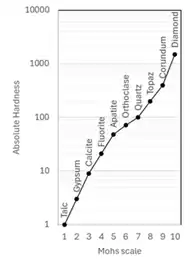 Mohs scale along the horizontal axis matched with the absolute hardness of each of the Mohs reference minerals along the vertical. Notice that the vertical scale is logarithmic. (from Mohs scale)
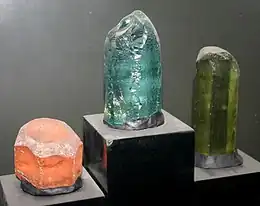
 An example of elbaite, a species of tourmaline, with distinctive colour banding. (from Mineral)
 Pyrite (from Lustre (mineralogy))
 Red cinnabar (HgS), a mercury ore, on dolomite. (from Mineral)
 Muscovite, a mineral species in the mica group, within the phyllosilicate subclass (from Mineral)
 Schist is a metamorphic rock characterized by an abundance of platy minerals. In this example, the rock has prominent sillimanite porphyroblasts as large as 3 cm (1.2 in). (from Mineral)


Did you know ...?

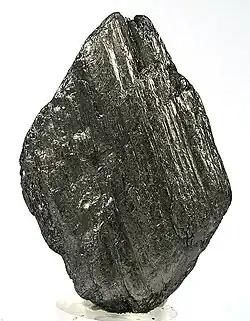
- ... that the uncommon mineral aguilarite (pictured), named for discoverer Ponciano Aguilar, is known from the Americas, Europe, Asia, and Australasia?
- ... that the thallium-rich mineral lorandite from the Allchar deposit is being used to determine the flux of solar neutrinos?
- ... that seamanite is known from only four locations, with three in Michigan and one in Australia?
- ...that jerrygibbsite ((Mn,Zn)9(SiO4)4(OH)2) is a rare mineral of which there are only five known samples in the world?
Subcategories

- Select [►] to view subcategories
Topics
| Overview | | |
|---|---|---|
| Common minerals | ||
Gemmological classifications by E. Ya. Kievlenko (1980), updated | |||||||||
| Jewelry stones |
| ||||||||
| Jewelry-Industrial stones |
| ||||||||
| Industrial stones |
| ||||||||

Associated Wikimedia
The following Wikimedia Foundation sister projects provide more on this subject:
-
 Commons
Free media repository -
 Wikidata
Free knowledge base -
 Wikiquote
Collection of quotations -
 Wikisource
Free-content library -
 Wikiversity
Free learning tools -
 Wiktionary
Dictionary and thesaurus
References
-
 List of all portals
-

-

-

-

-

-

-

-

-

-
 Random portal
-
 WikiProject Portals