Selected article |
|---|
|
Eurostar is a high-speed railway service connecting London with Paris and Brussels. All its trains traverse the Channel Tunnel between the United Kingdom and France, owned and operated separately by Eurotunnel.
The London terminus is St Pancras International, with the other British calling points being at Ebbsfleet International and Ashford International in Kent. Calling points in France are Calais-Fréthun and Lille-Europe, with the main Paris terminus at Gare du Nord. Trains to Belgium terminate at Midi/Zuid station in Brussels. In addition, there are limited services from London to Disneyland Paris at Marne-la-Vallée – Chessy, and to seasonal destinations in southern France.
The service is operated by eighteen-coach Class 373/1 trains which run at up to 300 kilometres per hour (186 mph) on a network of high-speed lines. The LGV Nord line in France opened before Eurostar services began in 1994, and newer lines enabling faster journeys were added later—HSL 1 in Belgium and High Speed 1 in southern England. The French and Belgian parts of the network are shared with Paris–Brussels Thalys services and also with TGV trains. In the United Kingdom the two-stage Channel Tunnel Rail Link project was completed on 14 November 2007 and renamed High Speed 1, when the London terminus of Eurostar transferred from Waterloo International to St Pancras International. (Full article...)
All selected articles
|
Selected biography |
|
Sir Joseph William Bazalgette, CB (28 March 1819 – 15 March 1891) was an English civil engineer. As chief engineer of London's Metropolitan Board of Works his major achievement was the creation (in response to the Great Stink of 1858) of a sewer network for central London which was instrumental in relieving the city from cholera epidemics, while beginning the cleansing of the River Thames.
Bazelgette was also responsible for the design of the Albert, Victoria and Chelsea Embankments along the north and south sides of the River Thames and bridges over the Thames at Putney, Hammersmith and Battersea. He also prepared early proposals for Blackwall Tunnel and Tower Bridge. (Full article...)
All Selected biographies
|
Did you know... |
- ...that Arsenal is the only Underground station to be named after a London football club (it was previously known as Gillespie Road)? Watford and West Ham are both named after the areas they serve.
- ...that at Euston Underground station, a passenger changing between the Victoria line and Northern line Bank branch will find that trains on adjacent platforms travel in opposite directions even though both are either northbound or southbound?
More Did you know...
|
Related portals |
|
|
|
Selected pictures |
|---|
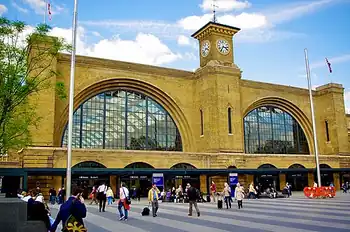
Image 1Southern approach to the Rotherhithe Tunnel that runs under the River Thames in east London between Rotherhithe and Limehouse. Image 2Central London Railway poster, published in 1905. Image 4Helicopter landing at London Heliport, a jetty constructed in the River Thames in Battersea. Image 5London General Omnibus Company B-type bus B340 built in 1911 by AEC. One of a number of London buses purchased by the British military during World War I, this vehicle was operated on the Western Front. Image 6Escalators at Westminster Underground station descend between beams and columns of the station box to reach the deep-level Jubilee line platforms. Image 7Ruislip Lido Railway's 12-inch (300 mm) gauge locomotive "Mad Bess" hauling a passenger train. Image 8Albert Bridge, opened in 1873, crosses the River Thames between Chelsea and Battersea. Image 9The western departures concourse of King's Cross railway station. Image 11TX4 London Taxi at Heathrow Airport. Image 12Preserved AEC Routemaster coaches in London Transport Green Line livery. Image 13Original stations on the Metropolitan Railway from The Illustrated London News, 27 December 1862. Image 15View of Old London Bridge, circa 1632 by Claude de Jongh. Image 16Early style tube roundel in mosaic at Maida Vale Underground station. Image 17Hornsey Lane Bridge, Archway, more commonly known as "Suicide Bridge". Image 18London Underground Battery-electric locomotive L16 designed to operate over tracks where the traction current is turned off for maintenance work. Image 19Rail, road and river traffic, seen from the London Eye. Image 21Hammersmith Bridge, opened in 1887, crosses the River Thames in west London. Image 22Planes waiting at Heathrow Airport's Terminal 4. Image 23Clapham Common Underground station north and south-bound platforms on the Northern line. Image 24Qantas Boeing 747-400 about to land at Heathrow Airport, seen beyond the roofs of Myrtle Avenue, Hounslow. Image 25The south façade of King's Cross railway station London terminus of the East Coast Main Line. Image 26Day (left) and Night (right) sculptures by Sir Jacob Epstein on the London Underground's headquarters at 55 Broadway. Image 27The newly constructed junction of the Westway ( A40) and the West Cross Route ( A3220) at White City, circa 1970. Continuation of the West Cross Route northwards under the roundabout was cancelled leaving two short unused stubs for the slip roads that would have been provided for traffic joining or leaving the northern section. Image 28London Underground A60 Stock (left) and 1938 Stock (right) trains showing the difference in the sizes of the two types of rolling stock operated on the system. A60 stock trains operated on the surface and sub-surface sections of the Metropolitan line from 1961 to 2012 and 1938 Stock operated on various deep level tube lines from 1938 to 1988. Image 29"Boris Bikes" from the Santander Cycles hire scheme waiting for use at a docking station in Victoria. Image 31Tram 2548 calls at Arena tram stop. This is one of the trams on the Tramlink network centred on Croydon in south London. Image 32The original Hampton Court Bridge in 1753, the first of four on the site. Image 34The New Routemaster built by Wrightbus has three entrances, two staircases and is designed to be reminiscent of the Routemaster. Image 35Vauxhall Bridge across the River Thames opened in 1906 and features sculptures by F. W. Pomeroy. Image 38Woolwich Ferry boats "John Burns" and "James Newman" on the River Thames, 2012. Image 40The multi-level junction between the M23 and M25 motorways near Merstham in Surrey. The M23 passes over the M25 with bridges carrying interchange slip roads for the two motorways in between. Image 42Sailing ships at West India Docks on the Isle of Dogs in 1810. The docks opened in 1802 and closed in 1980 and have since been redeveloped as the Canary Wharf development. Image 43The Circle routes of Victorian London, comprising the Inner Circle, Middle Circle, Outer Circle and Super Outer Circle. Image 44Arguably the best-preserved disused station building in London, this is the former Alexandra Palace station on the GNR Highgate branch (closed in 1954). It is now in use as a community centre (CUFOS). Image 4655 Broadway, headquarters of the UERL and its successors, is a Grade I listed building in Westminster designed by Charles Holden. Image 47Archer statue by Eric Aumonier at East Finchley Underground station. Image 48A tram of the London United Tramways at Boston Road, Hanwell, circa 1910.
All Selected pictures
|
Anniversaries |
- 30 August
- There are no anniversaries today
|
Maps |
|
|
|







 List of all portals






 Random portal
 WikiProject Portals
