Portal:Language


Introduction




Language is a structured system of communication that consists of grammar and vocabulary. It is the primary means by which humans convey meaning, both in spoken and signed forms, and may also be conveyed through writing. Human language is characterized by its cultural and historical diversity, with significant variations observed between cultures and across time. Human languages possess the properties of productivity and displacement, which enable the creation of an infinite number of sentences, and the ability to refer to objects, events, and ideas that are not immediately present in the discourse. The use of human language relies on social convention and is acquired through learning.
Estimates of the number of human languages in the world vary between 5,000 and 7,000. Precise estimates depend on an arbitrary distinction (dichotomy) established between languages and dialects. Natural languages are spoken, signed, or both; however, any language can be encoded into secondary media using auditory, visual, or tactile stimuli – for example, writing, whistling, signing, or braille. In other words, human language is modality-independent, but written or signed language is the way to inscribe or encode the natural human speech or gestures.
Depending on philosophical perspectives regarding the definition of language and meaning, when used as a general concept, "language" may refer to the cognitive ability to learn and use systems of complex communication, or to describe the set of rules that makes up these systems, or the set of utterances that can be produced from those rules. All languages rely on the process of semiosis to relate signs to particular meanings. Oral, manual and tactile languages contain a phonological system that governs how symbols are used to form sequences known as words or morphemes, and a syntactic system that governs how words and morphemes are combined to form phrases and utterances.
The scientific study of language is called linguistics. Critical examinations of languages, such as philosophy of language, the relationships between language and thought, how words represent experience, etc., have been debated at least since Gorgias and Plato in ancient Greek civilization. Thinkers such as Jean-Jacques Rousseau (1712–1778) have argued that language originated from emotions, while others like Immanuel Kant (1724–1804) have argued that languages originated from rational and logical thought. Twentieth century philosophers such as Ludwig Wittgenstein (1889–1951) argued that philosophy is really the study of language itself. Major figures in contemporary linguistics include Ferdinand de Saussure and Noam Chomsky. (Full article...)
Selected language -
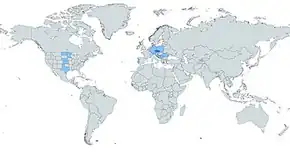
Czech (/tʃɛk/ CHEK; endonym: čeština [ˈtʃɛʃcɪna] ⓘ), historically known as Bohemian (/boʊˈhiːmiən, bə-/ boh-HEE-mee-ən, bə-; Latin: lingua Bohemica), is a West Slavic language of the Czech–Slovak group, written in Latin script. Spoken by over 12 million people including second-language speakers, it serves as the official language of the Czech Republic. Czech is closely related to Slovak, to the point of high mutual intelligibility, as well as to Polish to a lesser degree. Czech is a fusional language with a rich system of morphology and relatively flexible word order. Its vocabulary has been extensively influenced by Latin and German.
The Czech–Slovak group developed within West Slavic in the high medieval period, and the standardization of Czech and Slovak within the Czech–Slovak dialect continuum emerged in the early modern period. In the later 18th to mid-19th century, the modern written standard became codified in the context of the Czech National Revival. The most widely spoken non-standard variety, known as Common Czech, is based on the vernacular of Prague, but is now spoken as an interdialect throughout most of Bohemia. The Moravian dialects spoken in Moravia and Czech Silesia are considerably more varied than the dialects of Bohemia. (Full article...)
Did you know (auto-generated)

- ... that the Lviv branch of the Ukrderzhnatsmenvydav was the main publisher of Polish literature in the Soviet Union by 1941?
- ... that the Kurtöp language has a word for an assortment of sounds like "hard, non-spherical object[s] rolling down a paved road"?
- ... that the novel The Poison of Polygamy was rediscovered almost a century after its publication by a researcher studying early Chinese-language Australian newspapers?
- ... that George W. Grace described living languages as existing on a continuum between "bird languages" and "crocodilian languages"?
- ... that in an effort to reclaim "the most offensive word in the English language" as aspirational, some people describe being "powerful in an unapologetic and feminine manner" as "serving cunt"?
- ... that The Oceanic Languages is so ubiquitous among scholars of the Oceanic languages that it is known simply as "the blue book"?
More did you know -
- ...that we know about Latin profanity from both graffiti at Pompeii, and from the poems of Martial, Catullus, and Horace?
- ...that virtually all Italian-speakers in Albania have learnt the language by watching Italian television and not through reading textbooks?
- ...that the indigenous Nambikwara language of Brazil has a special implosive consonant used only by elderly people?
- ...that Venetian, spoken in and around Venice, Italy, is not a dialect of Italian?
Categories
Linguistics: Computational linguistics • Grammar • Historical linguistics • Morphology • Phonetics • Phonology • Pragmatics • Reading • Semantics • Sociolinguistics • Syntax • Writing
Languages: Language families • Pidgins and creoles • Sign languages
Linguists: By nationality • Historical linguists • Morphologists • Phoneticians • Phonologists • Sociolinguists • Syntacticians • Translators
Stubs: Constructed languages • Languages • Linguists • Pidgins and creoles • Typography • Vocabulary and usage • Writing systems
Full Language category tree |
|---|
|
Select [►] to view subcategories
|
Related portals
Selected topic -

The official languages of Singapore are English, Mandarin Chinese, Malay and Tamil. Spoken natively by the majority of Singaporeans, English is the de facto main language in daily, governmental, legal, trade and commercial affairs. Among themselves, Singaporeans often speak Singlish, a contact language arising from centuries of contact between Singapore's multi-ethnic and multilingual society and its legacy as a British colony. The Constitution of Singapore designates Malay as the national language of Singapore. This plays a symbolic role as Malays are constitutionally recognised as the indigenous peoples of Singapore, and is also largely due to Singapore's geographical location in the Malay Archipelago.
In the early years, the lingua franca of the island was Bazaar Malay (Melayu Pasar), a creole of Malay and Chinese, the language of trade in the Malay Archipelago. English gained prominence during the British rule of Singapore as the language of government, law and business. Upon independence, English became the official medium of instruction across all levels of education in Singapore due to the country's heavy reliance on international trade, commerce and finance, thus displacing Malay as the common language. The three languages other than English were chosen to correspond with the major ethnic groups present in Singapore at the time: Mandarin Chinese had gained pre-eminent status with the overseas Chinese since the introduction of Chinese-medium schools; Malay was deemed the "most obvious choice" for the Malay community; and Tamil for the largest Indian ethnic group in Singapore. In 2009, more than 20 languages were identified as being spoken in Singapore, reflecting a rich linguistic diversity in the city. Singapore's historical roots as a trading settlement gave rise to an influx of foreign traders, and their languages were slowly embedded in Singapore's modern day linguistic repertoire. (Full article...)
Language News
- 20 August 2026 – Sudanese civil war
- The Sudan People's Liberation Movement–North led by Abdelaziz al-Hilu regains control of Kauda, South Kordofan, following two days of clashes with Otoro fighters. (Sudan Tribune)
- 8 August 2026 – Sudanese civil war
- A tribe leader in the Nuba Mountains in South Kordofan accuses the Sudan People's Liberation Movement–North of launching attacks on Otoro villages in Kauda. Additionally, four aid workers are reported to be detained. (Sudan Tribune)
- 19 July 2026 – AI boom
- Mathematician and Anthropic employee Levent Alpöge presents an explicit counterexample to the Jacobian conjecture in three-dimensional space that disproves the -variable conjecture for using the large language model Fable 5. The Jacobian conjecture for remains true. (VNexpress) (NewScientist)
- 9 July 2026 – AI boom
- OpenAI releases the large language model tool GPT-5.6, with significant advancements in cybersecurity. (Axios)
- 12 June 2026 – Regulation of artificial intelligence in the United States
- The U.S. Department of Commerce orders artificial intelligence company Anthropic to ban non-Americans from accessing its large language models Claude Mythos and Fable 5. (BBC News) (CNBC)
- 23 May 2026 – Ukraine–Vietnam relations, Kazakhstan–Ukraine relations
- In accordance with bilateral agreements, Vietnam grants 40 scholarships to Ukrainians for the 2026–2027 academic year for bachelor's, master's, and postgraduate degrees, including a one-year language course for those who do not speak Vietnamese. Kazakhstan also grants 40 scholarships for similar degrees. (Interfax-Ukraine)


Topics

Languages of Africa: Arabic, Chadic, Cushitic, Kanuri, Maasai, Setswana, Swahili, Turkana, Xhosa, Yoruba, Zulu, more...
Languages of the Americas: Aleut, Carib, Cherokee, Inuktitut, Iroquois, Kootenai, Mayan, Nahuatl, Navajo, Quechuan, Salish, American Sign Language, more...
Languages of Asia: Arabic, Assamese, Balochi, Bengali, Chinese, Japanese, Hajong, Hebrew, Hindustani, Kannada, Kokborok, Marathi, Khasi, Korean, Kurdish, Malayalam, Manipuri, Meithei, Mongolian, Persian, Rajasthani, Sindhi, Sanskrit, Sylheti, Tamil, Tanchangya, Tulu, Telugu, Tibetan, Thai, Turkish, Vietnamese, Khowar, more...
Languages of Austronesia: Austric, Fijian, Hawaiian, Javanese, Malagasy, Malay, Maori, Marshallese, Samoan, Tahitian, Tagalog, Tongan, Auslan, more...
Languages of Europe: Basque, Czech, Danish, Dutch, English (book), French, German, Greek, Italian, Latin, Leonese, Norwegian, Polish, Portuguese, Romanian, Russian, Slovak, Spanish, Ukrainian more...
Constructed languages: Esperanto, Ido, Volapük, more...
Agglutinative language, Analytic language, Constructed language, Creole, Context-free language, Extinct language, Dialect, Fusional language, Inflectional language, International language, Isolating language, Language isolate, National language, Natural language, Pidgin, Pluricentric language, Polysynthetic language, Proto-language, Sign language, Spoken language, Synthetic language, Variety (linguistics)

Applied linguistics, Cognitive linguistics, Accent (dialect), Computational linguistics, Descriptive linguistics, Eurolinguistics, Generative linguistics, Historical linguistics, Lexicology, Lexical semantics, Morphology, Onomasiology, Phonetics, Phonology, Pragmatics, Prescription, Prototype semantics, Psycholinguistics, Semantics, Stylistics, Sociolinguistics, Syntax
See also: List of linguists

Alphabets: Arabic alphabet, Bengali alphabet, Cyrillic alphabet, Hebrew alphabet, Latin alphabet, more...
Other writing systems: Abjad, Abugida, Braille, Hieroglyphics, Logogram, Syllabary, SignWriting, more..
See also: History of the alphabet, Script
Associated Wikimedia
The following Wikimedia Foundation sister projects provide more on this subject:
-
 Commons
Free media repository -
 Wikidata
Free knowledge base -
 Wikiquote
Collection of quotations -
 Wikisource
Free-content library -
 Wikiversity
Free learning tools -
 Wiktionary
Dictionary and thesaurus
-
 List of all portals
-

-

-

-

-

-

-

-

-

-
 Random portal
-
 WikiProject Portals