Portal:Games

The Games Portal

A game is an activity defined by a challenge and a set of rules, typically done for enjoyment, competition, or development. Games may be played informally or in professional competitive settings before audiences. Popular formats include board games, card games, video games, and sports, distinguished from unstructured play by having rules. Scholars have long debated the essence of games, with no single definition achieving universal acceptance.
Games are a universal feature of human culture. The Royal Game of Ur and Senet are among the oldest known games, dating back to at least 2600 BCE. Throughout history, games have served as tools for entertainment, teaching, ritual, and socialization. In the modern era, the global video game industry has grown to surpass both film and music in annual revenue, reflecting how central games have become to contemporary life.
Philosophically, games have attracted attention as a test case for the nature of rules and meaning. Psychologists link play to cognitive development in children and to the intense, satisfying concentration called flow in adults. Game theory uses the structure of games to model decision making in fields such as economics and evolutionary biology. (Full article...)
Selected article -

The Mansion of Happiness: An Instructive Moral and Entertaining Amusement is a children's board game inspired by Christian ethics. Players race about a 67-space spiral track depicting virtues and vices with their goal being the Mansion of Happiness at track's end. Instructions upon virtue spaces advance players toward the goal while those upon vice spaces force them to retreat.
The Mansion of Happiness was designed by George Fox, a children's author and game designer in England. The first edition, printed in gold ink "containing real gold" using one copperplate engraving and black ink using a second copper plate engraving, produced a few hundred copies. Water coloring was used to complete the game board, making a brilliant, colorful, and expensive product fit for the nobility. Later in 1800, a second edition was printed, probably for rich but common folk. Only one copper plate was used to print black ink and no water coloring was used. The game must have become quite popular in England as a third edition was printed using two copper plates, one for black, and the second for green lines to indicate blank spaces. Water colors were added to make a beautiful product. Laurie and Whittle published all three editions in 1800. On all three editions George Fox was listed as the inventor and the game honored the Duchess of York. In the first edition, gold not only added color and price but homage to royalty. In all three editions, the paper was glued to linen so it could fold up and be inserted into a heavy attractively labeled cardboard case. The game influenced later games, such as The Checkered Game of Life. (Full article...)
Did you know? -

- ...that the 2005 World Series of Poker Ladies Champion (pictured) had been nominated for an Academy Award in 1994?
- ...that Bruce Webster was so burned out from writing the computer game SunDog: Frozen Legacy for the Apple II, that he gave up programming for four years?
- ...that the chess Grandmaster Wolfgang Uhlmann is one of the world's leading experts on the French Defence?
- ...that Dungeons & Dragons, an album by Midnight Syndicate, is the only official soundtrack to the Dungeons & Dragons role-playing game?
- ...that the video game Scarygirl puts players in control of a young girl with an eye patch, a sewn-shut mouth, and a hook-capped tentacle for one arm?
General images
 Tug of war is an easily organized, impromptu game that requires little equipment. (from Game)
 Chinese mother-of-pearl gambling tokens used in scoring and bidding of card games (from Card game)
 Association football is a popular sport worldwide.

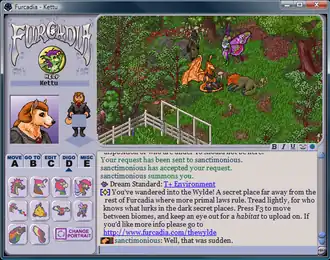 MUD interface for Furcadia (from Role-playing game)
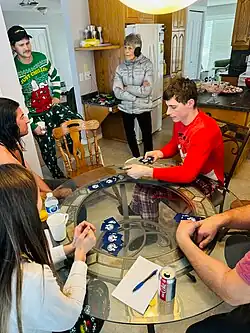 A man dealing cards to the other players before a game (from Card game)

 A person performing a standard riffle shuffle (from Card game)


 The board game Monopoly is licensed in 103 countries and printed in 37 languages. (from Board game)

 A group playing a tabletop RPG. The GM is at left using a cardboard screen to hide dice rolls from the players. (from Role-playing game)
 Visitors at a desktop flight simulator (from Game)
 The modern German board game Catan is printed in 30 languages and sold 15 million by 2009. (from Board game)
 Historically, card games such as whist and contract bridge were opportunities for quiet socializing, as shown in this 1930s magic lantern slide photo taken in Seattle, Washington. (from Card game)
 People playing Magic: The Gathering (from Card game)

 Boys playing soccer in Tirana, Albania (from Game)
 Royal Game of Ur (from Game)


 Happy Families cards (from Card game)
 The Card Players, 17th-century painting by Theodoor Rombouts (from Card game)

 A fantasy LARP group (from Role-playing game)

 Two Qataris playing the traditional board game of damah (from Board game)

 The number of board games published by year (1944–2017), as listed on BoardGameGeek. Expansion sets for existing games are marked in orange. (from Board game)
 An adventurer finds a teleportation portal while exploring a dungeon in the role-playing video game Falcon's Eye. (from Role-playing game)
 Backgammon is a game of skill. Strategy can give players advantages, but there is also an element of chance. (from Game of skill)


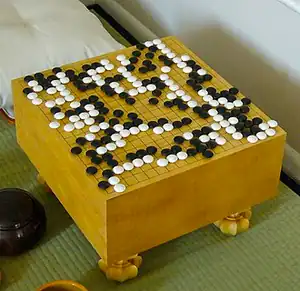 A game of Go in progress (from Game)
- Ancient Egyptian senet game board inscribed for Amenhotep III with separate sliding drawer. Created between 1390 and 1353 BC; made of glazed faience, dimensions: 5.5 × 7.7 × 21 cm. Held in the Brooklyn Museum, (New York City). (from Game)
 A backgammon board from Lebanon. (from Game)
 Charles Nelson Reilly holds a hand of cards (from Card game)
 Playing Cards, by Theodoor Rombouts, 17th century
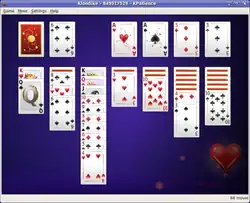 Digital Klondike solitaire (from Card game)
 A person holding Austrian-style tarot cards (from Card game)

 A ball-in-a-maze puzzle requires fine motor skills. (from Game of skill)
 Men Playing Board Games, from The Sougandhika Parinaya Manuscript (from Board game)

Subcategories
Related portals
WikiProjects
- WikiProject Board and table games
- WikiProject Games
- WikiProject Video games
Things to do
 |
Here are some tasks awaiting attention:
|
Selected picture

A riffle shuffle being performed during a game of poker
Associated Wikimedia
The following Wikimedia Foundation sister projects provide more on this subject:
-
 Commons
Free media repository -
 Wikidata
Free knowledge base -
 Wikiquote
Collection of quotations -
 Wikisource
Free-content library -
 Wikiversity
Free learning tools -
 Wiktionary
Dictionary and thesaurus
-
 List of all portals
-

-

-

-

-

-

-

-

-

-
 Random portal
-
 WikiProject Portals