The slender smooth-hound or gollumshark (Gollum attenuatus) is a species of ground shark in the familyPseudotriakidae. It is endemic to the waters around New Zealand, where it is usually found close to the bottom over the continental slope at depths of 300–600m (980–1,970ft). An extremely slim, plain brownish shark reaching 1.1m (3.6ft) in length, the slender smooth-hound can be identified by its broad, flattened head with a long, distinctively bell-shaped snout. Its mouth is angular with short furrows at the corners, and contains a very high number of tooth rows in both jaws. Its two dorsal fins are roughly equal in size.
The diet of the slender smooth-hound is diverse, but dominated by small, benthicbony fishes and decapodcrustaceans. It exhibits a specialised form of aplacental viviparity with oophagy: the females produce a single capsule in each uterus that contains 30–80 ova, of which one ovum develops into an embryo that consumes the rest of the ova and stores the yolk material in its external yolk sac. The growing embryo is mainly sustained by this yolk sac during gestation, though it may be additionally supplied with histotroph ("uterine milk") produced by the mother. The typical litter size is two pups, one per uterus. The International Union for Conservation of Nature (IUCN) has assessed the slender smooth-hound as Least Concern; it is taken as fisherybycatch but not in great numbers, and furthermore large portions of its range see minimal fishing activity. (Full article...)
Image 3
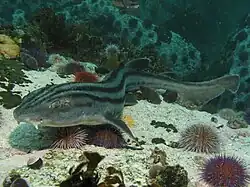
The pyjama shark or striped catshark (Poroderma africanum) is a species of catshark, and part of the familyScyliorhinidae, endemic to the coastal waters of South Africa. This abundant, bottom-dwelling species can be found from the intertidal zone to a depth of around 100m (330ft), particularly over rocky reefs and kelp beds. With a series of thick, parallel, dark stripes running along its stout body, the pyjama shark has an unmistakable appearance. It is additionally characterized by a short head and snout with a pair of slender barbels that do not reach the mouth, and two dorsal fins that are placed far back on the body. It can grow up to a length of 1.1m (3.6ft) long.
The pyjama shark is primarily nocturnal, spending most of the day lying motionless and hidden in a cave or crevice or among vegetation. It often forms groups, particularly during summer. This species is an opportunistic predator that feeds on a wide variety of fishes and invertebrates; it favors cephalopods and frequents the spawning grounds of the chokka squid (Loligo reynaudi). When threatened, it curls into a circle with its tail covering its head. Reproduction is oviparous, with females laying rectangular, dark brown egg cases two at a time year-round. This small and harmless shark adapts well to captivity and is commonly displayed in public aquariums. It is often caught as a bycatch of commercial and recreational fisheries. Many are killed by fishers who regard them as pests. However, there is no data suggesting its numbers have declined, so the International Union for Conservation of Nature (IUCN) has assessed the pyjama shark as least concern. (Full article...)
Image 4
The smalltail shark (Carcharhinus porosus) is a species of requiem shark, and part of the family Carcharhinidae. It is found in the western Atlantic Ocean, from the northern Gulf of Mexico to southern Brazil. It inhabits shallow waters close to shore, particularly over muddy bottoms around estuaries. It tends to swim low in the water column and forms large aggregations segregated by sex. A slim species generally not exceeding 1.1m (3.6ft) in length, the smalltail shark has a rather long, pointed snout, a broad, triangular first dorsal fin, and a second dorsal fin that originates over the midpoint of the anal fin base. It is plain gray in color, without prominent markings on its fins.
The horn shark (Heterodontus francisci) is a species of bullhead shark, in the family Heterodontidae. It is endemic to the coastal waters off the western coast of North America, from California to the Gulf of California. Young sharks are segregated spatially from the adults, with the former preferring deeper sandy flats and the latter preferring shallower rocky reefs or algal beds. A small species typically measuring 1m (3.3ft) in length, the horn shark can be recognized by a short, blunt head with ridges over its eyes, two high dorsal fins with large spines, and a brown or gray coloration with many small dark spots.
Slow-moving, generally solitary predators, horn sharks hunt at night inside small home ranges and retreat to a favored shelter during the day. Their daily activity cycles are controlled by environmental light levels. Adult sharks prey mainly on hard-shelled molluscs, echinoderms, and crustaceans, which they crush between powerful jaws and molar-like teeth, while also feeding opportunistically on a wide variety of other invertebrates and small bony fishes. Juveniles prefer softer-bodied prey such as polychaete worms and sea anemones. The shark extracts its prey from the substrate using suction and, if necessary, levering motions with its body. Reproduction is oviparous, with females laying up to 24 eggs from February to April. After laying, the female picks up the auger-shaped egg cases and wedges them into crevices to protect them from predators. (Full article...)
It is found widely along coastlines in the Indo-Pacific, preferring reefs, sandy flats, and seagrass beds from very shallow water to a depth of 70m (230ft). With a cylindrical body and a broad, flattened head, the tawny nurse shark is quite similar in appearance to the nurse shark (Ginglymostoma cirratum) of the Atlantic and East Pacific, from which it can be distinguished by its pointed-tipped dorsal fins and narrow, sickle-shaped pectoral fins. The maximum recorded length of the tawny nurse shark is 3.2m (10ft). (Full article...)
Image 7
The spinner shark (Carcharhinus brevipinna) is a type of requiem shark, in the family Carcharhinidae, named for the spinning leaps it makes as a part of its feeding strategy. This species occurs in tropical and warm temperate waters worldwide, except for in the eastern Pacific Ocean. It is found from coastal to offshore habitats to a depth of 100m (330ft), though it prefers shallow water. The spinner shark resembles a larger version of the blacktip shark (C. limbatus), with a slender body, long snout, and black-marked fins. This species can be distinguished from the blacktip shark by the first dorsal fin, which has a different shape and is placed further back, and by the black tip on the anal fin (in adults only). It attains a maximum length of 3m (9.8ft).
Spinner sharks are swift and gregarious predators that feed on a wide variety of small bony fishes and cephalopods. When feeding on schools of forage fish, they speed vertically through the school while spinning on their axis, erupting from the water at the end. Like other members of its family, the spinner shark is viviparous, with females bearing litters of three to 20 young every other year. The young are born in shallow nursery areas near the coast, and are relatively fast-growing. This species is not usually dangerous to humans, but may become belligerent when excited by food. Spinner sharks are valued by commercial fisheries across their range for their meat, fins, liver oil, and skin. They are also esteemed as strong fighters by recreational fishers. The International Union for Conservation of Nature has assessed this species as Vulnerable worldwide. (Full article...)
The blacktip reef shark (Carcharhinus melanopterus) is a species of requiem shark, in the family Carcharhinidae, which can be easily identified by the prominent black tips on its fins (especially on the first dorsal fin and its caudal fin). Among the most abundant sharks inhabiting the tropicalcoral reefs of the Indian and Pacific Oceans, this species prefers shallow, inshore waters. Its exposed first dorsal fin is a common sight in the region. The blacktip reef shark is usually found over reef ledges and sandy flats, though it has also been known to enter brackish and freshwater environments. It typically attains a length of 1.6m (5.2ft). Like other sharks, the females are larger than the males.
The blacktip reef shark has extremely small home ranges and exhibits strong site fidelity, remaining within the same local area for up to several years at a time. It is an active predator of small bony fish, cephalopods, and crustaceans, and has also been known to feed on sea snakes and seabirds. Accounts of the blacktip reef shark's life history have been variable and sometimes contradictory, in part reflecting geographical differences within the species. Like other members of its family, this shark is viviparous, with females giving birth to two to five young on a biennial, annual, or possibly biannual cycle. Reports of the gestation period range from 7–9, through 10–11, to possibly 16 months. Mating is preceded by the male following closely behind the female, likely attracted by her chemical signals. Newborn sharks are found further inshore and in shallower water than adults, frequently roaming in large groups over areas flooded by high tide. (Full article...)
Image 9
The bluespotted ribbontail ray (Taeniura lymma) is a species of stingray in the family Dasyatidae. Found from the intertidal zone to a depth of 30m (100ft), this species is common throughout the tropical Indian and western Pacific Oceans in nearshore, coral reef–associated habitats. It is a fairly small ray, not exceeding 35cm (14in) in width, with a mostly smooth, oval pectoral fin disc, large protruding eyes, and a relatively short and thick tail with a deep fin fold underneath. It can be easily identified by its striking color pattern of many electric blue spots on a yellowish background, with a pair of blue stripes on the tail.
At night, small groups of bluespotted ribbontail rays follow the rising tide onto sandy flats to root for small benthic invertebrates and bony fishes in the sediment. When the tide recedes, the rays separate and withdraw to shelters on the reef. Reproduction is Ovoviviparity. With the females giving birth to litters of up to seven young. This ray is capable of injuring humans with its venomous tail spines, though it prefers to flee if threatened. Because of its beauty and size, the bluespotted ribbontail ray is popular with private aquarists despite being poorly suited to captivity. (Full article...)
The ruddy bowfin (Amia calva) is a ray-finned fish native to North America. Common names include mudfish, mud pike, dogfish, grindle, grinnel, swamp trout, and choupique. It is regarded as a relict, being one of only two surviving species of the Halecomorphi, a group of fish that first appeared during the Early Triassic, around 250million years ago. The bowfin is often considered a "living fossil" because it has retained some morphological characteristics of its early ancestors. It is one of two species in the genus Amia, along with Amia ocellicauda, the eyespot bowfin. The closest living relatives of bowfins are gars, with the two groups being united in the clade Holostei.
Bowfins are demersal, freshwater piscivores, commonly found throughout much of the Eastern United States, and southern Ontario and Quebec. Fossil deposits indicate the Amiiformes were once widespread in both freshwater and marine environments across North and South America, Europe, Asia, and Africa. Now, their range is limited to much of the Eastern United States and adjacent southern Canada, including the drainage basins of the Mississippi River, Great Lakes, and various rivers exiting in the Eastern Seaboard or Gulf of Mexico. Their preferred habitat includes vegetated sloughs, lowland rivers and lakes, swamps, and backwater areas; they are also occasionally found in brackish water. They are stalking, ambush predators known to move into the shallows at night to prey on fish and aquatic invertebrates such as crawfish, mollusks, and aquatic insects. (Full article...)
Image 11
The bluntnose stingray or Say's stingray (Hypanus say, often misspelled sayi) is a species of stingray in the familyDasyatidae, native to the coastal waters of the western Atlantic Ocean from the U.S. state of Massachusetts to Venezuela. It is a bottom-dwelling species that prefers sandy or muddy habitats 1–10m (3.3–32.8ft) deep, and is migratory in the northern portion of its range. Typically growing to 78cm (31in) across, the bluntnose stingray is characterized by a rhomboid pectoral fin disc with broadly rounded outer corners and an obtuse-angled snout. It has a whip-like tail with both an upper keel and a lower fin fold, and a line of small tubercles along the middle of its back.
The sharptooth houndshark or spotted gully shark (Triakis megalopterus) is a species of houndshark in the family Triakidae found in shallow inshore waters from southern Angola to South Africa. Favoring sandy areas near rocky reefs and gullies, it is an active-swimming species that usually stays close to the bottom. This robust shark reaches 2m (6.6ft) in length and has characteristically large, rounded fins; the pectoral fins in particular are broad and sickle-shaped in adults. It also has a short, blunt snout and long furrows around its mouth. This species is gray or bronze in color above, with variable amounts of black spotting.
Mainly active at night, the sharptooth houndshark feeds mostly on crustaceans, bony fishes, and cephalopods. It has been observed gathering in groups in shallow water during summertime, possibly for reproductive purposes. This species is aplacental viviparous, meaning that the unborn young are sustained mainly by yolk. Females give birth to 6–12 pups between late May and August, on a 2- or 3-year cycle. The sharptooth houndshark is often hooked by recreational anglers, and some are also captured on commercial bottom longlines. Because of its small range and low growth and reproductive rates, it is very vulnerable to overfishing. The International Union for Conservation of Nature has listed this species as least concern. (Full article...)
Image 13
Holotype and paratype teeth of Cardabiodon venator from the Fairport Member of the Carlile Shale in Mosby, Montana.
One of the largest sharks of its time, Cardabiodon has been estimated to measure up to 5.5 metres (18ft) in length. It may have been an apex predator in its ecosystem and likely used its large, robust teeth and fast swimming capabilities to prey on a variety of marine animals including plesiosaurs, ichthyosaurs, and other large fish. Cardabiodon also had a very heavy and stocky body. Scientists have been partially successful in calculating the life history of the shark. At birth, Cardabiodon individuals measured between 41–76 centimetres (16–30in) in length and reached sexual maturity at around five to seven years of age, but no conclusive estimates on the maximum lifespan of Cardabiodon have been made. (Full article...)
Image 14
The pigeye shark or Java shark (Carcharhinus amboinensis) is an uncommon species of requiem shark, in the family Carcharhinidae, found in the warm coastal waters of the eastern Atlantic and western Indo-Pacific. It prefers shallow, murky environments with soft bottoms, and tends to roam within a fairly localized area. With its bulky grey body, small eyes, and short, blunt snout, the pigeye shark looks almost identical to (and is often confused with) the better-known bull shark (C. leucas). The two species differ in vertebral count, the relative sizes of the dorsal fins, and other subtle traits. This shark typically reaches lengths of 1.9–2.5m (6.2–8.2ft).
The pigeye shark is an apex predator that mostly hunts low in the water column. It has a varied diet, consisting mainly of bony and cartilaginous fishes and also including crustaceans, molluscs, sea snakes, and cetaceans. This species gives birth to live young, with the developing embryos sustained to term via a placental connection to their mother. Litters of three to thirteen pups are born after a gestation period of nine or twelve months. Young sharks spend their first few years of life in sheltered inshore habitats such as bays, where their movements follow tidal and seasonal patterns. The pigeye shark's size and dentition make it potentially dangerous, though it has not been known to attack humans. The shark is infrequently caught in shark nets protecting beaches and by fisheries, which use it for meat and fins. The IUCN presently assesses this species as vulnerable. (Full article...)
Image 15
The onefin electric ray or Cape numbfish (Narke capensis) is a common but little-known species of electric ray in the familyNarkidae, native to South Africa and Namibia. It is a benthic fish found in shallow coastal bays over sandy or muddy bottoms. This small species reaches 38cm (15in) in length, and has a nearly circular pectoral fin disc and a short, muscular tail that supports a large caudal fin. It can be identified by its single dorsal fin, which is located over the large pelvic fins. Its dorsal coloration is yellowish to dusky brown.
The American shad has been described as "the fish that fed the (American) nation's founders". Adult shad weigh between 1.5 and 3.5kg (3 and 8lb), and they have a delicate flavor when cooked. It is considered flavorful enough not to require sauces, herbs, or spices. It can be boiled, filleted and fried in butter, or baked. Traditionally, a little vinegar is sprinkled over it on the plate. In the Eastern United States, roe shads (females) are prized because the eggs are considered a delicacy. (Full article...)
Image 7The giant whale shark, another resident of the ocean epipelagic zone, filter feeds on plankton, and periodically dives deep into the mesopelagic zone. (from Pelagic fish)
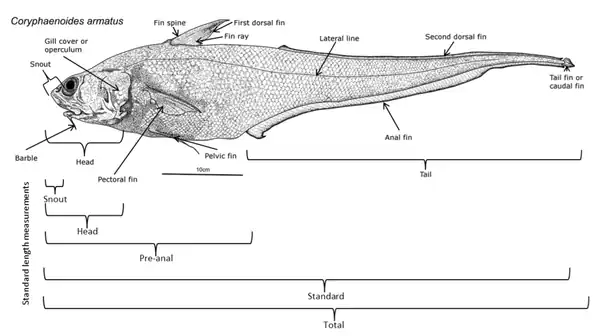
Image 8The rattail Coryphaenoides armatus (abyssal grenadier) on the Davidson Seamount at a depth of 2,253 metres (7,392ft). (from Deep-sea fish)
Image 9An annotated diagram of the basic external features of an abyssal grenadier and standard length measurements. (from Deep-sea fish)
Image 13Scale diagram of the layers of the pelagic zone (from Pelagic fish)
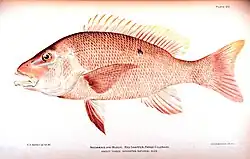
Image 14Red snapper, are generalized reef feeders with standard jaw and mouth structures that allow them to eat almost anything, though they prefer small fish and crustaceans. (from Coral reef fish)
Image 20Areas of upwelling in red (from Pelagic fish)
Image 21Humans seldom encounter frilled sharks alive, so they pose little danger (though scientists have accidentally cut themselves examining their teeth). (from Deep-sea fish)
Image 22Areas of upwelling in red (from Coastal fish)
Image 23Oceanic fish inhabit the oceanic zone, which is the deep open water which lies beyond the continental shelves. (from Pelagic fish)
Image 24Many bristlemouth species, such as the "spark anglemouth" above, are also bathypelagic ambush predators that can swallow prey larger than themselves. They are among the most abundant of all vertebrate families. (from Pelagic fish)
Image 27Long-snouted lancetfish. Lancetfish are ambush predators which spend all their time in the mesopelagic zone. They are among the largest mesopelagic fishes (up to 2m (6.6ft). (from Deep-sea fish)
Image 29Coral reefs support flourishing ecosystems, paradoxically in clear, low nutrient waters, along tropical continental coasts and around volcanic islands. Coral reef fish are numerous and diverse. (from Coastal fish)
Image 30Young, red flabby whalefish make nightly vertical migrations into the lower mesopelagic zone to feed on copepods. When males mature into adults, they develop a massive liver and then their jaws fuse shut. They no longer eat, but continue to metabolise the energy stored in their liver. (from Pelagic fish)
Image 31Herring reflectors are nearly vertical for camouflage from the side. (from Pelagic fish)
Image 34The stoplight loosejaw has a lower jaw one-quarter as long as its body. The jaw has no floor and is attached only by a hinge and a modified tongue bone. Large fang-like teeth in the front are followed by many small barbed teeth. (from Deep-sea fish)
Image 35In the foreground is an orange-lined triggerfish displaying spines. Triggerfish have mouths that crush shells. Orange-lined triggerfish are particularly aggressive. The black and white fish are three-stripe damselfish and the unstriped fish are blue-green chromis damselfish. If the triggerfish attacks, the damselfish will hide in the nearby cauliflower coral. If the triggerfish wants to hide, it will squeeze into a coral crevice and lock itself in place with its spines. (from Coral reef fish)
Image 38Demersal fish output in 2005 (from Demersal fish)
Image 39Most of the rest of the mesopelagic fishes are ambush predators, such as this sabertooth fish. The sabertooth uses its telescopic, upward-pointing eyes to pick out prey silhouetted against the gloom above. Their recurved teeth prevent a captured fish from backing out. (from Pelagic fish)
Image 41World distribution of plankton (from Coastal fish)
Image 42Cod-like fishes, like this morid cod have a barbel (fleshy filament) on their lower jaw which they use to detect prey buried in the sand or mud. (from Coastal fish)
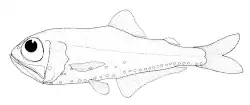
Image 46Lanternfish are partial residents of the ocean epipelagic zone During the day they hide in deep waters, but at night they migrate up to surface waters to feed. (from Pelagic fish)
Image 47Some flatfish can camouflage themselves on the ocean floor (from Demersal fish)
A sketch of a longnose sawshark (Pristiophorus cirratus), a species of sawshark found in the eastern Indian Ocean around southern Australia on the continental shelf at depths of between 40 and 310m (130 and 1,020ft). It is a medium-sized shark with a saw-like flattened snout which measures up to thirty percent of its body size.
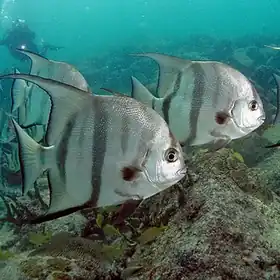
The Atlantic spadefish is a species of marine fish endemic to the shallow waters off the coast of the southeastern United States and in the Caribbean Sea. They are similar in appearance to fresh waterangelfish, but much larger, reaching up to three feet (0.9 m) in length. Due to their reputation as strong fighters, they are popular game fish, especially during the summer months when they are most active.
A plate with fossils of Pseudostacus sp. (lobster, left) and Diplomystus birdii (fish, right), from the Hakel paleontological formation in Lebanon. The paleontological sites of Lebanon contain deposits of some of the best-preserved fossils in the world, and include some species found nowhere else. The most famous of these is the Lebanese lagerstätten of the Late Cretaceous age.
The leopard shark (Triakis semifasciata) is a species of hound shark found along the Pacific coast of North America from the U.S. state of Oregon to Mazatlán in Mexico. Typically measuring 1.2–1.5 m (3.9–4.9 ft) long, this slender-bodied shark is characterized by black saddle-like markings and large spots over its back.
An Atlantic salmon (Salmo salar) egg hatching. The Alevin (larva) has grown around the remains of the yolk sac - visible are the arteries spinning around the yolk and little oildrops, also the gut, the spine, the main caudalblood vessel, the bladder and the arcs of the gills. In about 24 hours it will be a fry without yolk sac.
Icefish are a type of Antarctic fish belonging to various families, including the Channichthyidae family. They have no haemoglobin and their blood is transparent. They feed on krill, copepods, and other fish. Icefish rely on well-oxygenated water and absorb oxygen directly through the skin as they lack red blood cells.
The flying gurnard is a fish of tropical to warm temperate waters on both sides of the Atlantic Ocean. When excited, it spreads its "wings", semi-transparent appendages tipped with a phosphorescent bright blue coloration which are used to frighten predators.
The giant grouper (Epinephelus lanceolatus), shown here with a school of golden trevally, is the largest bony fish found in coral reefs, and the aquatic emblem of Queensland, Australia. The species can grow as large as 2.7 meters (9ft) long, weighing up to 400 kg (880lb). They are fairly common in shallow waters and feed on a variety of marine life, including small sharks and juvenile sea turtles.
Brachysomophis cirrocheilos, the stargazer snake eel, is a marine fish belonging to the family Ophichthidae. It is native to shallow tropical and subtropical waters in the western Indo-Pacific region. It hunts at night for crustaceans and small fish, after which it submerges itself into the sediment tail first and remains there all day, with just its eyes and the top of its head projecting, as seen here in Batangas Bay in the Philippines.
The Oscar (Astronotus ocellatus) is a species of fish from the cichlidfamily. In South America, where the species occurs, they are often found for sale as a food fish in the local markets. The species is also a popular aquarium fish. They have been reported to grow to a length of 45cm (ca. 18in) and a mass of 1.6kg (3.5lb).
Mudskippers, such as this Periophthalmodon septemradiatus, are uniquely adapted to a completely amphibious lifestyle. They are active when out of water, feeding and interacting with one another, as well as defending their territories.
The Mini Edition of the Fish Portal is available for you to use on your wikipedia user page or talk page. It uses minimum space but retains many crucial features of the portal. To use it, place {{Portal:Fish/Mini portal}} on the designated page. See here for an example of the mini portal on a user page.
WikiProjects
WikiProject Fishes
WikiProject Aquarium Fishes
WikiProject Sharks
WikiProject Fishing
See also
For additional lists of marine life-related featured articles and good articles see:
The Fish Quiz is a friendly quiz competition designed to test your general knowledge of fish. The current game is Fish Quiz Tournament X. You can read more and join the game here.
Associated Wikimedia
The following Wikimedia Foundation sister projects provide more on this subject: