Portal:Environment/Selected article
 | This Wikipedia page has been superseded by Portal:Environment and is retained primarily for historical reference. |
 | Note: Article entries are now being transcluded directly on the main portal page. However, this page should be retained for historical reference. |
Usage
The layout design for these subpages is at Portal:Environment/Selected article/Layout.
- Add a new Selected article to the next available subpage.
- Update "max=" to new total for its {{Random portal component}} on the main page.
Selected articles list
Selected article/1 view - talk - edit - history

Climate model projections summarized in the latest IPCC report indicate that the global surface temperature is likely to rise a further 1.1 to 6.4 °C (2.0 to 11.5 °F) during the 21st century. An increase in global temperature will cause sea levels to rise and will change the amount and pattern of precipitation, probably including expansion of subtropical deserts. Warming is expected to be strongest in the Arctic and would be associated with continuing retreat of glaciers, permafrost and sea ice. Other likely effects include changes in the frequency and intensity of extreme weather events, species extinctions, and changes in agricultural yields.
Selected article/2 view - talk - edit - history

Due to variations in the Earth's orbit, the amount of insolation varies with periods of around 21,000, 40,000, 100,000, and 400,000 years. Variations in the amount of solar heating drive changes in the climate of the Earth, and are recognised as a key factor in the timing of initiation and termination of ice ages. Spectral analysis shows that the most powerful climate response is at 100,000‑year period, but the orbital forcing at this period is small.
Selected article/3 view - talk - edit - history
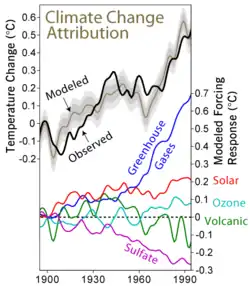
In recent usage, especially in the context of environmental policy, the term "climate change" often refers only to changes in modern climate, including the rise in average surface temperature known as global warming. In some cases, the term is also used with a presumption of human causation, as in the United Nations Framework Convention on Climate Change (UNFCCC). The UNFCCC uses "climate variability" for non-human caused variations.
Selected article/4 view - talk - edit - history

Reducing the amount of food waste has been deemed critical if the UK is to meet international targets on climate change, limiting greenhouse gas emissions, and meet obligations under the European Landfill Directive to reduce biodegradable waste going to landfill. Equally great emphasis has been placed on the reduction of food waste, across all developed countries, as a means of ending the global food crisis that leaves millions worldwide starving and impoverished. In the context of the 2007–2008 world food price crisis, food waste was discussed at the 34th G8 summit in Hokkaidō, Japan. UK prime minister Gordon Brown said of the issue "We must do more to deal with unnecessary demand, such as by all of us doing more to cut our food waste". In June 2009, then Environment Secretary Hilary Benn announced the government's "War on waste", a programme aimed at reducing Britain's food waste.
Selected article/5 view - talk - edit - history

It is thought to have been caused by an increase in particulates such as sulphate aerosols in the atmosphere due to human action. The switch from a "global dimming" trend to a "brightening" trend in 1990 happened just as global aerosol levels started to decline.
Global dimming has interfered with the hydrological cycle by reducing evaporation and may have reduced rainfall in some areas. Global dimming also creates a cooling effect that may have partially masked the effect of greenhouse gases on global warming. Deliberate manipulation of this dimming effect is now being considered as a geoengineering technique to reduce the impact of climate change.
Selected article/6 view - talk - edit - history

Kyoto includes defined "flexible mechanisms" such as Emissions Trading, the Clean Development Mechanism and Joint Implementation to allow Annex I economies to meet their greenhouse gas (GHG) emission limitations by purchasing GHG emission reductions credits from elsewhere, through financial exchanges, projects that reduce emissions in non-Annex I economies, from other Annex I countries, or from Annex I countries with excess allowances. In practice this means that Non-Annex I economies have no GHG emission restrictions, but have financial incentives to develop GHG emission reduction projects to receive "carbon credits" that can then be sold to Annex I buyers, encouraging sustainable development. In addition, the flexible mechanisms allow Annex I nations with efficient, low GHG-emitting industries, and high prevailing environmental standards to purchase carbon credits on the world market instead of reducing greenhouse gas emissions domestically. Annex I entities typically will want to acquire carbon credits as cheaply as possible, while Non-Annex I entities want to maximize the value of carbon credits generated from their domestic Greenhouse Gas Projects.
Selected article/7 view - talk - edit - history

The four pavilions, which cost $7 million, were designed in January 2001; construction began in January 2004. The South Pavilions were completed and opened in July 2004, while the North Pavilions were completed in November 2004, with a grand opening on April 30, 2005. The North Pavilions have received the Leadership in Energy and Environmental Design (LEED) silver rating from the United States Green Building Council, as well as an award from the American Society of Heating, Refrigerating and Air-Conditioning Engineers (ASHRAE).
Selected article/8 view - talk - edit - history

Monthly rainfall is greater downwind of cities, partially due to the UHI. Increases in heat within urban centres increases the length of growing seasons, and decreases the occurrence of weak tornadoes. The UHI decreases air quality by increasing the production of pollutants such as ozone, and decreases water quality as warmer waters flow into area streams, which stresses their ecosystems. Despite concerns raised about its possible contribution to global warming, comparisons between urban and rural areas show that the urban heat island effects have little influence on global mean temperature trends.
UHIs have the potential to directly influence the health and welfare of urban residents. As UHIs are characterized by increased temperature, they can potentially increase the magnitude and duration of heat waves within cities. Research has found that the mortality rate during a heat wave increases exponentially with the maximum temperature, an effect that is exacerbated by the UHI. The nighttime effect of UHIs can be particularly harmful during a heat wave, as it deprives urban residents of the cool relief found in rural areas during the night
Not all cities have a distinct UHI. Mitigation of the urban heat island effect can be accomplished through the use of green roofs and the use of lighter-coloured surfaces in urban areas, which reflect more sunlight and absorb less heat.
Selected article/9 view - talk - edit - history

Scientists propose several mechanisms to explain invasive species, including species-based mechanisms and ecosystem-based mechanisms. It is most likely a combination of several mechanisms that cause an invasive situation to occur, since most introduced plants, biotic and animals do not become invasive.
Selected article/10 view - talk - edit - history

There are some non-technical barriers to the widespread use of renewables, and it is often public policy and political leadership that drive the widespread acceptance of renewable energy technologies. Over 100 countries now have targets for their own renewable energy futures, and have enacted wide-ranging public policies to promote renewables. Climate change concerns are driving increasing growth in the renewable energy industries. Leading renewable energy companies include First Solar, Gamesa, GE Energy, Q-Cells, Sharp Solar, Siemens, SunOpta, Suntech, and Vestas.
Selected article/11 view - talk - edit - history

The Great Barrier Reef's environmental pressures include lowered water quality from runoff including suspended sediment, excess nutrients, pesticides, and fluctuations in salinity. The effects of climate change, including increased temperatures, storms and coral bleaching. Cyclic outbreaks of the crown-of-thorns starfish, overfishing which disrupts food chains, and shipping routes which can result in oil spills or improper ballast discharge also damage the reef.
Selected article/12 view - talk - edit - history

A large number of slow lorises are traded as pets, both locally and internationally. Although it is illegal to import slow lorises for commercial sale, they are popular exotic pets in Japan, the United States, and Europe, largely due to their "cute" appearance. Hundreds of slow lorises have been confiscated at airports, but because they are easy to hide, these numbers are likely to be only a small fraction of the total number being trafficked.
Connected protected areas are important for the conservation of slow lorises because these primates are not suited for traveling long distances on the ground. Training for enforcement officials helps improve identification and the awareness of their legal protection. Sanctuaries and rescue facilities are available to provide both temporary and lifelong care for confiscated slow lorises. Zoos' captive breeding programs saw some successes.
Selected article/13 view - talk - edit - history

Due in part to their vast size, abyssal plains are currently believed to be a major reservoir of biodiversity. The abyss also exerts significant influence upon ocean carbon cycling, dissolution of calcium carbonate and atmospheric CO2 concentrations over timescales of 100–1000 years. The structure and function of abyssal ecosystems are strongly influenced by the rate and composition of food flux to the seafloor. Factors such as climate change, fishing practices, and ocean fertilization are expected to substantially alter primary production patterns in the euphotic zone.
Selected article/14 view - talk - edit - history

Healthy ecosystems and environments provide vital goods and services to humans and other organisms. Moving towards sustainability is also a social challenge that entails international and national law, urban planning and transport, local and individual lifestyles and ethical consumerism. Ways of living more sustainably can take many forms from reorganising living conditions (e.g., ecovillages, eco-municipalities and sustainable cities), reappraising economic sectors (permaculture, green building, sustainable agriculture), or work practices (sustainable architecture), using science to develop new technologies (green technologies, renewable energy), to adjustments in individual lifestyles that conserve natural resources.
Selected article/15 view - talk - edit - history

After several years of public controversy regarding the forced reduction of the elk population in Yellowstone National Park, Udall appointed an advisory board to collect scientific data to inform future wildlife management of the national parks. The committee observed that culling programs at other national parks had been ineffective, and recommended different management of Yellowstone's elk population. In addressing the goals, policies, and methods of managing wildlife in the parks, the report suggested that in addition to protection, wildlife populations should be managed and regulated to prevent habitat degradation. Touching upon predator control, fire ecology, and other issues, the report suggested that the National Park Service (NPS) hire scientists to manage the parks using current scientific research.
The Leopold Report became the first concrete plan to manage park visitors and ecosystems under unified principles.
Selected article/16 view - talk - edit - history

The term "tropical" refers to both the geographic origin of these systems, which form almost exclusively in tropical regions of the globe, and their formation in Maritime Tropical air masses. The term "cyclone" refers to such storms' cyclonic nature, with counterclockwise rotation in the Northern Hemisphere and clockwise rotation in the Southern Hemisphere. Depending on its location and strength, a tropical cyclone is referred to by many other names, such as hurricane, typhoon, tropical storm, cyclonic storm, tropical depression, and simply cyclone.
Selected article/17 view - talk - edit - history Merchants of Doubt is a 2010 book by the American science historians Naomi Oreskes and Erik M. Conway. It identifies parallels between the climate change debate and earlier controversies over tobacco smoking, acid rain and the hole in the ozone layer. Oreskes and Conway write that in each case "keeping the controversy alive" by spreading doubt and confusion after a scientific consensus had been reached, was the basic strategy of those opposing action. In particular, they say that Fred Seitz, Fred Singer, and a few other contrarian scientists joined forces with conservative think tanks and private corporations to challenge the scientific consensus on many contemporary issues.
Most reviewers received it favourably. One reviewer said that Merchants of Doubt is exhaustively researched and documented, and may be one of the most important books of 2010. Another reviewer saw the book as his choice for best science book of the year. Philip Kitcher in Science says Merchants of Doubt is a "fascinating and important study". The book was made into a film, Merchants of Doubt, directed by Robert Kenner, released in 2014.
Selected article/18 view - talk - edit - history

During the Cold War, the project was expanded to include nine nuclear reactors and five large plutonium processing complexes, which produced plutonium for most of the 60,000 weapons in the U.S. nuclear arsenal. Many of the early safety procedures and waste disposal practices were inadequate, and government documents have since confirmed that Hanford's operations released significant amounts of radioactive materials into the air and the Columbia River, which threatened the health of residents and ecosystems. The weapons production reactors were decommissioned at the end of the Cold War, but the manufacturing process left behind 53 million U.S. gallons (204,000 m³) of high-level radioactive waste that remains at the site. This represents two-thirds of the nation's high-level radioactive waste by volume. Today, Hanford is the most contaminated nuclear site in the United States and is the focus of the nation's largest environmental cleanup.
Selected article/19 view - talk - edit - history

The dam body was completed in 2006. Except for a ship lift, the originally planned components of the project were completed on October 30, 2008, when the 26th turbine in the shore plant began commercial operation. Each turbine has a capacity of 700 MW. Six additional turbines in the underground power plant are not expected to become fully operational until 2012. Coupling the dam's thirty-two main turbines with two smaller generators (50 MW each) to power the plant itself, the total electric generating capacity of the dam will eventually reach 22,500 MW.
As well as producing electricity, the dam increases the Yangtze River's shipping capacity, and reduces the potential for floods downstream by providing flood storage space. The Chinese government regards the project as a historic engineering, social and economic success, with the design of state-of-the-art large turbines, and a move toward limiting greenhouse gas emissions. However, the dam flooded archaeological and cultural sites and displaced some 1.3 million people, and is causing significant ecological changes, including an increased risk of landslides. The dam has been a controversial topic both in China and abroad.
Selected article/20 view - talk - edit - history

The degradation of the Everglades became an issue in the United States in the early 1970s after a proposal to construct a jetport in the Big Cypress Swamp. Studies indicated the airport would have destroyed the ecosystem in South Florida and Everglades National Park. After decades of destructive practices, both state and federal agencies are looking for ways to balance the needs of the natural environment in South Florida with urban and agricultural centers that have recently and rapidly grown in and near the Everglades.
Selected article/21 view - talk - edit - history High-level radioactive waste management concerns management and disposal of highly radioactive materials created during production of nuclear power and nuclear warheads. The technical issues in accomplishing this are daunting, due to the extremely long periods radioactive wastes remain deadly to living organisms. Of particular concern are two long-lived fission products, Technetium-99 (half-life 220,000 years) and Iodine-129 (half-life 15.7 million years), which dominate spent nuclear fuel radioactivity after a few thousand years. The most troublesome transuranic elements in spent fuel are Neptunium-237 (half-life two million years) and Plutonium-239 (half-life 24,000 years). Consequently, high-level radioactive waste requires sophisticated treatment and management to successfully isolate it from the biosphere. This usually necessitates treatment, followed by a long-term management strategy involving permanent storage, disposal or transformation of the waste into a non-toxic form.
Governments around the world are considering a range of waste management and disposal options, usually involving deep-geologic placement, although there has been limited progress toward implementing long-term waste management solutions. This is partly because the timeframes in question when dealing with radioactive waste range from 10,000 to millions of years, according to studies based on the effect of estimated radiation doses.
Selected article/22 view - talk - edit - history

Solar power technologies provide electrical generation by means of heat engines or photovoltaics. Once converted its uses are only limited by human ingenuity. A partial list of solar applications includes space heating and cooling through solar architecture, potable water via distillation and disinfection, daylighting, hot water, thermal energy for cooking, and high temperature process heat for industrial purposes.
Solar technologies are broadly characterized as either passive solar or active solar depending on the way they capture, convert and distribute sunlight. Active solar techniques include the use of photovoltaic panels, solar thermal collectors, with electrical or mechanical equipment, to convert sunlight into useful outputs. Passive solar techniques include orienting a building to the Sun, selecting materials with favorable thermal mass or light dispersing properties, and designing spaces that naturally circulate air.
Selected article/23 view - talk - edit - history

The Icelandic government aspires that the nation will be carbon neutral by 2040. The largest obstacles to this are road transport and the fishing industry. (Full article...)
Selected article/24 view - talk - edit - history

The Little Ice Age was a period from about 1550 to 1850 when the world experienced relatively cooler temperatures compared to the present. Subsequently, until about 1940, glaciers around the world retreated as the climate warmed. Glacial retreat slowed and even reversed, in many cases, between 1950 and 1980 as a slight global cooling occurred. However, since 1980 a significant global warming has led to glacier retreat becoming increasingly rapid and ubiquitous, so much so that some glaciers have disappeared altogether, and the existence of a great number of the remaining glaciers of the world is threatened. In locations such as the Andes of South America and Himalayas in Asia, the demise of glaciers in these regions will have potential impact on water supplies. The retreat of mountain glaciers, notably in western North America, Asia, the Alps, Indonesia and Africa, and tropical and subtropical regions of South America, has been used to provide qualitative evidence for the rise in global temperatures since the late 19th century. The recent substantial retreat and an acceleration of the rate of retreat since 1995 of a number of key outlet glaciers of the Greenland and West Antarctic ice sheets, may foreshadow a rise in sea level, having a potentially dramatic effect on coastal regions worldwide.
Selected article/25 view - talk - edit - history The World Without Us is a non-fiction book about what would happen to the natural and built environment if humans suddenly disappeared, written by American journalist Alan Weisman and published by St. Martin's Thomas Dunne Books. It is a book-length expansion of Weisman's own February 2005 Discover article "Earth Without People". Written largely as a thought experiment, it outlines, for example, how cities and houses would deteriorate, how long man-made artifacts would last, and how remaining lifeforms would evolve. Weisman concludes that residential neighborhoods would become forests within 500 years, and that radioactive waste, bronze statues, plastics, and Mount Rushmore would be among the longest lasting evidence of human presence on Earth.
The author of four previous books and numerous articles for magazines, Weisman traveled around the world to interview academics, scientists and other authorities. He used quotations from these interviews to explain the effects of the natural environment and to substantiate predictions. The book has been translated and published in many countries. It was successful in the U.S., reaching #6 on the New York Times Best Seller list and #1 on the San Francisco Chronicle Best-Sellers list in September 2007. It ranked #1 on Time and Entertainment Weekly's top 10 non-fiction books of 2007.
Selected article/26 view - talk - edit - history

Plug-in cars have several benefits compared to conventional internal combustion engine vehicles. They have lower operating and maintenance costs, and produce little or no local air pollution. They reduce dependence on petroleum and may reduce greenhouse gas emissions from the onboard source of power, depending on the fuel and technology used for electricity generation to charge the batteries. Plug-in hybrids capture most of these benefits when they are operating in all-electric mode. Despite their potential benefits, market penetration of plug-in electric vehicles has been slower than expected as adoption faces several hurdles and limitations.
Several national and local governments have established tax credits, subsidies, and other incentives to promote the introduction and adoption in the mass market of plug-in electric vehicles depending on their battery size and all-electric range. As of September 2015, there were almost 70 models of highway legal plug-in electric passenger cars and light-duty utility vans available for retail sales in the world. The Nissan Leaf is the world's all-time top selling highway-capable all-electric car, with global sales of more than 200,000 units by early December 2015.
Over one million highway-capable plug-in electric passenger cars and light utility vehicles have been sold worldwide, with the United States as the market leader with a stock of over 363,000 plug-in electric cars delivered since 2008 through August 2015, representing 36.3% of global sales. As of August 2015, China ranked second with over 157,000 units sold since 2011 (15.7%), followed by Japan with more than 121,000 plug-in units sold since 2009 (12.1%). As of June 2015, over 310,000 light-duty plug-in electric vehicles have been registered in the European market since 2010. In the heavy-duty segment, China is the world's leader, with over 65,000 buses and sanitation vehicles sold through August 2015.
Selected article/27 view - talk - edit - history

As of December 2015, the Nissan Leaf is the world's all-time best selling highway-capable all-electric car. Leaf global sales passed the 200,000 unit milestone by early December 2015, five years after its introduction. As of November 2015, the top markets for Leaf sales are the United States with over 88,000 units sold, followed by Japan with about 57,000 units, and Europe with about 48,000 Leafs. As of September 2015, the European market was led by Norway with almost 15,000 new units, and the UK with about 11,500 units delivered.
As an all-electric car, the Nissan Leaf produces no tailpipe pollution or greenhouse gas emissions at the point of operation, and contributes to reduced dependence on petroleum. Among other awards and recognition, the Nissan Leaf won the 2010 Green Car Vision Award, the 2011 European Car of the Year, the 2011 World Car of the Year, and the 2011–2012 Car of the Year Japan.
Additions
Feel free to add featured, top or high importance articles about Environment to the above list.
Former nominations
- I would like to nominate Renewable energy commercialization, which is a GA now. -- Johnfos 06:12, 19 August 2007 (UTC)
- Added. -- Alan Liefting talk 02:05, 5 September 2007 (UTC)
- I'd be interested in adding Food waste in the United Kingdom, but there are no empty spaces in the above list. Does the Portal need any more selected articles? I've seen more on other Portals, so should I just add #26? MasterOfHisOwnDomain (talk) 20:32, 24 June 2009 (UTC)
- Now added. Johnfos (talk) 02:06, 5 February 2011 (UTC)
- I'd like to nominate Bioplastic and Great Pacific Garbage Patch -- Gwaz (talk) 06:16, 22 November 2009 (UTC)
We currently have 27 selected articles, covering a diverse range of environmental topics. Of those, 6 are now FAs and 14 are now GAs, which means that the quality of the selected articles overall is really quite high. And a more extensive summary of each of the articles has now been provided for readers.
I would suggest that from now on new selected articles should be GA or FA to be considered for inclusion here, in order to maintain and improve the level of quality on this featured portal. Johnfos (talk) 02:06, 5 February 2011 (UTC)