Electronic devices have significantly influenced the development of many aspects of modern society, such as telecommunications, entertainment, education, health care, industry, and security. The main driving force behind the advancement of electronics is the semiconductor industry, which continually produces ever-more sophisticated electronic devices and circuits in response to global demand. The semiconductor industry is one of the global economy's largest and most profitable industries, with annual revenues exceeding $481 billion in 2018. (Full article...)
Good articles -
These are Good articles, which meet a core set of high editorial standards.
Image 1
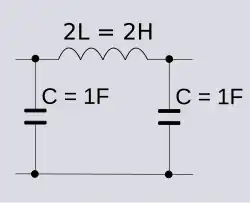
Constant k filters, also k-type filters, are a type of electronic filter designed using the image method. They are the original and simplest filters produced by this methodology and consist of a ladder network of identical sections of passive components. Historically, they are the first filters that could approach the ideal filter frequency response to within any prescribed limit with the addition of a sufficient number of sections. However, they are rarely considered for a modern design, the principles behind them having been superseded by other methodologies which are more accurate in their prediction of filter response. (Full article...)
Image 2
The Nakamichi Dragon is an audio cassette deck that was introduced by Nakamichi in 1982 and marketed until 1994. The Dragon was the first Nakamichi model with bidirectional replay capability and the world's first production tape recorder with an automatic azimuth correction system; this feature, which was invented by Philips engineers and improved by Niro Nakamichi, continuously adjusts the azimuth of the replay head to minimize apparent head skew and correctly reproduce the treble signal present on the tape. The system allows the correct reproduction of mechanically skewed cassettes and recordings made on misaligned decks. Apart from the Dragon, similar systems have only been used in the Nakamichi TD-1200 car cassette player and the Marantz SD-930 cassette deck.
At the time of its introduction, the Dragon had the lowest-ever wow and flutter and the highest-ever dynamic range, losing marginally to the former Nakamichi flagship, the 1000ZXL, in frequency response. Competing models by Sony, Studer, Tandberg and TEAC that were introduced later in the 1980s sometimes surpassed the Dragon in mechanical quality and feature set but none could deliver the same mix of sound quality, flexibility and technological advancement. The Dragon, despite inherent issues with long-term reliability, remained the highest point of compact cassette technology. (Full article...)
Image 3
Air stripline is a form of electrical planar transmission line whereby a conductor in the form of a thin metal strip is suspended between two ground planes. The idea is to make the dielectric essentially air. Mechanical support of the line may be a thin substrate, periodical insulated supports, or the device connectors and other electrical items.
Air stripline is most commonly used at microwave frequencies, especially in the C band. Its advantage over standard stripline and other planar technologies is that its air dielectric avoids dielectric loss. Many useful circuits can be constructed with air stripline and it is also easier to achieve strong coupling between components in this technology than with other planar formats. It was invented by Robert M. Barrett in the 1950s. (Full article...)
Image 4
Staggered tuning is a technique used in the design of multi-stage tuned amplifiers whereby each stage is tuned to a slightly different frequency. In comparison to synchronous tuning (where each stage is tuned identically) it produces a wider bandwidth at the expense of reduced gain. It also produces a sharper transition from the passband to the stopband. Both staggered tuning and synchronous tuning circuits are easier to tune and manufacture than many other filter types.
The function of stagger-tuned circuits can be expressed as a rational function and hence they can be designed to any of the major filter responses such as Butterworth and Chebyshev. The poles of the circuit are easy to manipulate to achieve the desired response because of the amplifier buffering between stages. (Full article...)
Image 5
An antimetric electrical network is an electrical network that exhibits anti-symmetrical electrical properties. The term is often encountered in filter theory, but it applies to general electrical network analysis. Antimetric is the diametrical opposite of symmetric; it does not merely mean "asymmetric" (i.e., "lacking symmetry"). It is possible for networks to be symmetric or antimetric in their electrical properties without being physically or topologically symmetric or antimetric. (Full article...)
Image 6
The Revox B215 is a cassette deck manufactured by Studer from 1985 until around 1990. A professional version with different control layout and audio path electronics was manufactured concurrently as the Studer A721. A later improved version was marketed as the Revox B215S. Because it was expensive compared to other consumer models and had exceptionally good mechanical performance and durability, the B215 was used primarily by professional customers—radio stations, recording studios and real-time cassette duplicators.
The B215 used a proven, reliable four-motor tape transport derived from the earlier B710 model. The B215 differed from the B710 and competing decks of the period in having an unusual, computer-like control panel and elaborate automation performed by three Philipsmicrocontrollers. The deck was equipped with automatic tape calibration, microcontroller-assisted setting of recording levels, and non-volatile memory. (Full article...)
Image 7
The Yamaha NS-10M studio monitor, identifiable by its horizontal lettering and white-coloured mid–bass drive unit The Yamaha NS-10 is a loudspeaker that became a standard nearfield studio monitor in the music industry among rock and pop recording engineers. Launched by Yamaha in 1978, the NS-10 was intended as a hi-fibookshelf speaker for domestic environments. It was received poorly by its intended audience, but became a staple for recording studios and freelance audio engineers due to its perceived ability to reveal poor quality in recordings.
The speaker is known for its exaggerated treble response, which some engineers, such as Bob Clearmountain, sought to dull by hanging tissue paper in front of its tweeter. The NS-10 has been used to monitor a large number of successful recordings by numerous artists, leading Gizmodo to refer to it as "the most important speaker you've never heard of". (Full article...)
Image 8
The Electro-Dynamic Light Company of New York was a lighting and electrical distribution company organized in 1878. The company held the patents for the first practical incandescent electric lamp and electrical distribution system of incandescent electric lighting. They also held a patent for an electric meter to measure the amount of electricity used. The inventions were those of Albon Man and William E. Sawyer. They gave the patent rights to the company, which they had formed with a group of businessmen. It was the first company in the world formally established to provided electric lighting and was the first company organized specifically to manufacture and sell incandescent electric light bulbs.
Man, an attorney from New York City, supplied money for experimentation to Sawyer, an electrical engineer. This partnership developed into the Electro-Dynamic Light Company that brought in other investors that became partners. Sawyer devised a unique electrical distribution system where electrical power could be obtained anywhere in the city from an electrical generator with the turn of a switch to light up electric lamps to produce glowing light like a gas lamp. It was unique in that it produced this power without consumers having to maintain local galvanic batteries and at a fraction of the cost of producing the same lighting as from gas lamps. Other features of the system were that safety devices were built in to prevent the early destroying of the other electric lamps in the circuit should there be a power surge due to a lamp burning up early and leaving the distribution circuit. The patents for the Man and Sawyer system were in place before any other electrical companies had similar systems. (Full article...)
Filters are required to operate at many different frequencies, impedances and bandwidths. The utility of a prototype filter comes from the property that all these other filters can be derived from it by applying a scaling factor to the components of the prototype. The filter design need thus only be carried out once in full, with other filters being obtained by simply applying a scaling factor. (Full article...)
The image method of filter design determines the properties of filter sections by calculating the properties they would have in an infinite chain of identical sections. In this, the analysis parallels transmission line theory on which it is based. Filters designed by this method are called image parameter filters, or just image filters. An important parameter of image filters is their image impedance, the impedance of an infinite chain of identical sections. (Full article...)
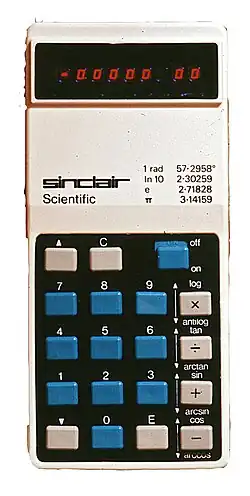
The Sinclair Scientific was a 12-function, pocket-sized scientific calculator introduced in 1974, dramatically undercutting in price other calculators available at the time. The Sinclair Scientific Programmable, released a year later, was advertised as the first budget programmable calculator.
Significant modifications to the algorithms used meant that a chipset intended for a four-function calculator was able to process scientific functions, but at the cost of reduced speed and accuracy. Compared to contemporary scientific calculators, some functions were slow to execute, and others had limited accuracy or gave the wrong answer, but the cost of the Sinclair was a fraction of the cost of competing calculators. (Full article...)
Image 12
Galaxy S III in white
The Samsung Galaxy SIII (unofficially known as the Samsung Galaxy S3) is an Android-based smartphone developed and marketed by Samsung Electronics. Launched in 2012, it had sold more than 80 million units overall, making it the most sold phone in the S series. It is the third smartphone in the Samsung Galaxy S series.
It is distinguished from its predecessor by its larger, higher-resolution screen, higher storage options, a larger battery, and a video camera with stereo audio recording for a spatial effect on headphones and external speakers. While the picture and video resolutions of the camera stayed the same, its launching speed and shutter lag improved. (Full article...)
Image 13
Gold iPhone 5s
The iPhone 5s is a smartphone that was developed and marketed by Apple. It is the seventh generation of the iPhone, succeeding the iPhone 5, and was unveiled in September 2013 alongside the iPhone 5c. It was the last iPhone to have Steve Jobs involved in its design.
The iPhone 5s has almost the same external design as well as the same 4-inch screen as its predecessor, the iPhone 5. The 5s received a new white/gold color scheme in addition to white/silver and space gray/black. The 5s features upgrades mostly in the form of internal hardware; it introduced the Apple A764-bit dual-core system-on-chip, the first 64-bit processor to be used on a smartphone, accompanied by the M7 "motion co-processor". A redesigned home button with Touch ID – a fingerprint recognition system which can be used to unlock the phone and authenticate App Store and iTunes Store purchases – was also introduced. The camera was updated with a larger aperture and a dual-LED flash optimized for different color temperatures. EarPods, which were introduced the year prior and had been shipping with the iPhone 5, were included in the box. (Full article...)
Image 14
Sinclair Executive Type 1
The Sinclair Executive was the world's first "slimline" pocket calculator, and the first to be produced by Clive Sinclair's company Sinclair Radionics. Introduced in 1972, the calculator was produced in at least two versions with different keyboard markings; a variant called the Sinclair Executive Memory was introduced in 1973.
Its small size was made possible by pulsing current to the Texas Instruments TMS1802 "calculator on a chip" integrated circuit, reducing the power consumption more than tenfold. The Executive was highly successful, making £1.8 million of profit for Sinclair and winning a Design Council Award for Electronics. (Full article...)
Image 15
m-derived filters or m-type filters are a type of electronic filter designed using the image method. They were invented by Otto Zobel in the early 1920s. This filter type was originally intended for use with telephone multiplexing in carrier telephony systems and was an improvement on the existing constant k type filter. The main problem being addressed was the need to achieve a better match of the filter into the terminating impedances. In general, all filters designed by the image method fail to give an exact match, but the m-type filter is a big improvement with suitable choice of the parameter m. The m-type filter section has a further advantage in that there is a rapid transition from the cut-off frequency of the passband to a pole of attenuation just inside the stopband. Despite these advantages, there is a drawback with m-type filters; at frequencies past the pole of attenuation, the response starts to rise again, and m-types have poor stopband rejection. For this reason, filters designed using m-type sections are often designed as composite filters with a mixture of k-type and m-type sections and different values of m at different points to get the optimum performance from both types. (Full article...)
Selected image
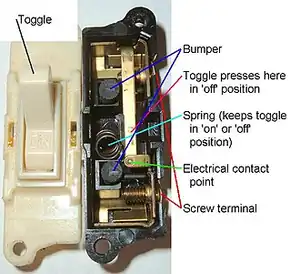
Credit: User:SCEhardt Inside of a common light switch.
Electromagnetism is the physics of the electromagnetic field; a field encompassing all of space which exerts a force on particles that possess the property of electric charge, and is in turn affected by the presence and motion of those particles. The magnetic field is produced by the motion of electric charges, i.e. electric current. The magnetic field causes the magnetic force associated with magnets.
The term "electromagnetism" comes from the fact that electrical and magnetic forces are involved simultaneously. A changing magnetic field produces an electric current (this is the phenomenon of electromagnetic induction, which provides for the operation of electrical generators, induction motors, and transformers). Similarly, a changing electric field generates a magnetic field. Because of this interdependence of the electric and magnetic fields, it makes sense to consider them as a single coherent entity — the electromagnetic field.
Did you know (auto-generated) -
... that the music video for Alan Walker's song "Faded" is the first EDM song to reach 3billion views on YouTube?
... that police investigating rapist Zhenhao Zou had to develop custom computer code to examine more than 9million WeChat messages on his electronic devices?
... that police investigating rapist Zhenhao Zou had to develop custom computer code to examine more than 9million WeChat messages on his electronic devices?
... that Japanese electronic musician Camellia began producing music at the age of ten using his mother's computer?
... that in 2019, Chinese electronics company Xiaomi posted a video of their third-quarterly financial report featuring a parody of the anime song "Renai Circulation"?
An organic light-emitting diode (OLED) is a special type of light-emitting diode in which the emissive layer comprises a thin-film of certain organic compounds. The emissive electroluminescent layer can include a polymeric substance that allows the deposition of suitable organic compounds, for example, in rows and columns on a flat carrier by using a simple "printing" method to create a matrix of pixels which can emit different colored light. Such systems can be used in television screens, computer displays, portable system screens, advertising and information, and indication applications etc. OLEDs can also be used in light sources for general space illumination.









 Commons
 Wikidata
 Wikiquote
 Wikisource
 Wikiversity
 Wiktionary
 List of all portals






 Random portal
 WikiProject Portals