Portal:Devonian

The Devonian Portal

The Devonian (/dəˈvoʊni.ən, dɛ-/ də-VOH-nee-ən, deh-) is a geologic period and system of the Paleozoic era during the Phanerozoic eon, spanning 60.7 million years from the end of the preceding Silurian period at 419.62 million years ago (Ma), to the beginning of the succeeding Carboniferous period at 358.86 Ma. It is the fourth period of both the Paleozoic and the Phanerozoic. It is named after Devon, South West England, where rocks from this period were first studied.
The first significant evolutionary radiation of life on land occurred during the Devonian, as free-sporing land plants (pteridophytes) began to spread across dry land, forming extensive coal forests which covered the continents. By the middle of the Devonian, several groups of vascular plants had evolved leaves and true roots, and by the end of the period the first seed-bearing plants (pteridospermatophytes) appeared. This rapid evolution and colonization process, which had begun during the Silurian, is known as the Silurian-Devonian Terrestrial Revolution. The earliest land animals, predominantly arthropods such as myriapods, arachnids and hexapods, also became well-established early in this period, after beginning their colonization of land at least from the Ordovician Period.
Fish, especially jawed fish, reached substantial diversity during this time, leading the Devonian to be called the Age of Fishes. The armored placoderms began dominating almost every known aquatic environment. In the oceans, cartilaginous fishes such as primitive sharks became more numerous than in the Silurian and Late Ordovician. Tetrapodomorphs, which include the ancestors of all four-limbed vertebrates (i.e. tetrapods), began diverging from freshwater lobe-finned fish as their more robust and muscled pectoral and pelvic fins gradually evolved into forelimbs and hindlimbs, though they were not fully established for life on land until the Late Carboniferous. (Full article...)
Selected Devonian Article
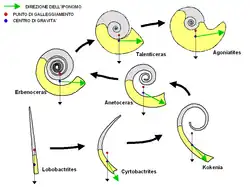
The Bactritida are a small order of more or less straight-shelled (orthoconic) cephalopods that first appeared during the Emsian stage of the Devonian period (407 million years ago) with questionable origins in the Pragian stage before 409 million years ago, and persisted until the Carnian pluvial event in the upper middle Carnian stage of the Triassic period (231 million years ago). They are considered ancestors of the ammonoids, as well as of the coleoids (octopus, squid, cuttlefish, and the extinct belemnites).
Bactritids are distinguished from the more primitive nautiloids by the small size and globular shape of the protoconch, the so-called embryonic shell. Nautiloids have relatively large embryonic shells, and living species lay a few large eggs. In contrast, bactritids and ammonoids produced large numbers of small eggs, each housing a small embryonic shell. (Full article...)
List of selected Devonian articles |
|---|
Selected Devonian land plant article

Sigillaria is a genus of extinct, spore-bearing, arborescent lycophyte, known from the Carboniferous and Permian periods. It is related to the more famous Lepidodendron, and more distantly to modern quillworts. (Full article...)
List of selected Devonian articles |
|---|
Selected Devonian formation

The Windom shale or Windom member is a member of the Moscow formation in New York. It preserves fossils going back to the Givetian stage of the middle Devonian. The Windom shale is widely known for its abundance of trilobite fossils. (Full article...)
List of selected Devonian formation articles |
|---|
Selected Devonian fish article

Ventastega (Venta referring to the Venta River at the Ketleri Formation where Ventastega was discovered) is an extinct genus of stem tetrapod that lived during the Upper Fammenian of the Late Devonian, approximately 372.2 to 358.9 million years ago. Only one species is known that belongs in the genus, Ventastega curonica, which was described in 1996 after fossils were discovered in 1933 and mistakenly associated with a fish called Polyplocodus wenjukovi. ‘Curonica’ in the species name refers to Curonia, the Latin name for Kurzeme, a region in western Latvia. Ventastega curonica was discovered in two localities in Latvia, and was the first stem tetrapod described in Latvia along with being only the 4th Devonian tetrapodomorph known at the time of description. Based on the morphology of both cranial and post-cranial elements discovered (see below), Ventastega is more primitive than other Devonian tetrapodomorphs including Acanthostega and Ichthyostega, and helps further understanding of the fish-tetrapod transition. (Full article...)
Selected Devonian invertebrate
Amphipora is an extinct genus of sponges, and type genus of the extinct family Amphiporaidae. Species are known from the Silurian to Devonian, over much of the northern hemisphere. (Full article...)
List of selected Devonian invertebrates articles |
|---|
Need help?
Do you have a question about Devonian that you can't find the answer to?
Consider asking it at the Wikipedia reference desk.
Subcategories

Related portals
Associated Wikimedia
The following Wikimedia Foundation sister projects provide more on this subject:
-
 Commons
Free media repository -
 Wikidata
Free knowledge base -
 Wikiquote
Collection of quotations -
 Wikisource
Free-content library -
 Wikiversity
Free learning tools -
 Wiktionary
Dictionary and thesaurus
-
 List of all portals
-

-

-

-

-

-

-

-

-

-
 Random portal
-
 WikiProject Portals