Igor Fyodorovich Stravinsky (17 June[O.S. 5 June]1882 – 6 April 1971) was a Russian composer and conductor with French (from 1934) and American citizenship (from 1945). He is widely considered one of the most important and influential composers of the 20th century and a pivotal figure in modernist music.
"The Blue Danube" (German: An der schönen blauen Donau, lit.'By the Beautiful Blue Danube', Op.314) is a waltz by the Austrian composerJohann Strauss II, composed in 1866. Originally performed on 15 February 1867 at a concert of the Wiener Männergesang-Verein (Vienna Men's Choral Association), it has been one of the most consistently popular pieces of music in the classical repertoire. Its initial performance was considered only a mild success, however, and Strauss is reputed to have said, "The devil take the waltz, my only regret is for the coda—I wish that had been a success!"
After the original music was written, the words were added by the Choral Association's poet, Joseph Weyl. Strauss later added more music, and Weyl needed to change some of the words. Strauss adapted it into a purely orchestral version for the 1867 Paris World's Fair, and it became a great success in this form. The instrumental version is by far the most commonly performed today. An alternate text was written by Franz von Gernerth, "Donau so blau" (Danube so blue). "The Blue Danube" premiered in the United States in its instrumental version on 1 July 1867 in New York, and in the UK in its choral version on 21 September 1867 in London at the promenade concerts at Covent Garden. (Full article...)
Image 5
Puccini, 1924
"Nessun dorma" (Italian:[nesˌsunˈdɔrma]; lit.'Let no one sleep') is an aria from the final act of Italian composer Giacomo Puccini's opera Turandot (text by Giuseppe Adami and Renato Simoni) and one of the best-known tenor arias in all opera. It is sung by Calaf, il principe ignoto (the unknown prince), who falls in love at first sight with the beautiful but cold Princess Turandot. Any man who wishes to wed Turandot must first answer her three riddles; if he fails, he will be beheaded. In the aria, Calaf expresses his triumphant assurance that he will win the princess.
Historical instrumentsA musical instrument is a device created or adapted to make musical sounds. In principle, any object that produces sound can be considered a musical instrument—it is through purpose that the object becomes a musical instrument. A person who plays a musical instrument is known as an instrumentalist.
The history of musical instruments dates to the beginnings of human culture. Early musical instruments may have been used for rituals, such as a horn to signal success on the hunt, or a drum in a religious ceremony. Cultures eventually developed composition and performance of melodies for entertainment. Musical instruments evolved in step with changing applications and technologies. (Full article...)
Berlioz wrote semi-autobiographical programme notes for the piece that allude to the romantic sufferings of a gifted artist who has poisoned himself with opium because of his unrequited love for a beautiful and fascinating woman (in real life, the Shakespearean actress Harriet Smithson, who in 1833 married Berlioz). The composer, who revered Beethoven, followed the latter's unusual addition in the Pastoral Symphony of a fifth movement to the normal four of a classical symphony. The artist's reveries take him to a ball and to a pastoral scene in a field, which is interrupted by a hallucinatory march to the scaffold, leading to a grotesque satanic dance (Witches' Sabbath). Within each episode, the artist's passion is represented by a recurring theme called the idée fixe. (Full article...)
Image 9
Dvořák in 1882
Antonín Leopold Dvořák (8September 1841–1May 1904) was a Czech composer. He frequently employed rhythms and other aspects of the folk music of Moravia and his native Bohemia, following the Romantic eranationalist example of his predecessor Bedřich Smetana. Dvořák's style has been described as "the fullest recreation of a national idiom with that of the symphonic tradition, absorbing folk influences and finding effective ways of using them", and Dvořák has been described as "arguably the most versatile... composer of his time".
Dvořák displayed his musical gifts at an early age, being a talented violin student. The first public performances of his works were in Prague in 1872 and, with special success, in 1873, when he was 31 years old. Seeking recognition beyond the Prague area, he submitted scores of works including symphonies to competitions in Germany and Austria. He first won a prize in 1874, with Johannes Brahms on the jury of the Austrian State Competition. In 1877, after his third win, Brahms recommended Dvořák to his publisher, Simrock, who commissioned what became the Slavonic Dances, Op. 46. The sheet music's high sales and critical reception led to his international success. A London performance of Dvořák's Stabat Mater in 1883 led to many other performances in the United Kingdom, the United States, and eventually Russia in March 1890. The Seventh Symphony was written for London in 1885. (Full article...)
Image 10
Macbeth at the Savonlinna Opera Festival in St. Olaf's Castle, Savonlinna, Finland, in 2007 Opera is a form of Western theatre in which music is a fundamental component and dramatic roles are taken by singers. Such a "work" (the literal translation of the Italian word "opera") is typically a collaboration between a composer and a librettist and incorporates a number of the performing arts, such as acting, scenery, costume, and sometimes dance or ballet. The performance is typically given in an opera house, accompanied by an orchestra or smaller musical ensemble, which since the early 19th century has been led by a conductor. Although musical theatre is closely related to opera, the two are considered to be distinct from one another.
Opera is a key part of Western classical music, and Italian tradition in particular. Originally understood as an entirely sung piece, in contrast to a play with songs, opera has come to include, including some that include spoken dialogue such as Singspiel and Opéra comique. In traditional number opera, singers employ two styles of singing: recitative, a speech-inflected style, and self-contained arias. The 19th century saw the rise of the continuous music drama. (Full article...)
The circumstances around the composition of this piece are not known. The extant piece contains four movements: Allegro, Romance, Menuetto, and Finale. However, another movement is now believed to be lost. (Full article...)
Image 12
Facade of the National Conservatory of Music of America (Jeannette Meyers Thurber's) at 47-49 West 25th Street. The National Conservatory of Music of America was an institution for higher education in music founded in 1885 in New York City by Jeannette Meyers Thurber. The conservatory was officially declared defunct by the state of New York in 1952, although for all practical pedagogical purposes, it had ceased to function much earlier than that. Between its founding and about 1920, however, the conservatory played an important part in the education and training of musicians in the United States, and for decades Thurber attempted to turn it into a federally-supported national conservatory in a European style. A number of prominent names are associated with the institution, including that of Victor Herbert and Antonín Dvořák, director of the conservatory from September 27, 1892 to 1895. It was at the conservatory that Dvořák composed his famous E minor Symphony and subtitled it, at Thurber's suggestion, From the New World. (Full article...)
General images –
The following are images from various classical music-related articles on Wikipedia.
Image 11Musicians from 'Procession in honour of Our Lady of Sablon in Brussels.' Early 17th-century Flemish alta cappella. From left to right: bass dulcian, alto shawm, treble cornett, soprano shawm, alto shawm, tenor sackbut. (from Renaissance music)
Image 21A modern string quartet. In the 2000s, string quartets from the Classical era are the core of the chamber music literature. From left to right: violin 1, violin 2, cello, viola. (from Classical period (music))
Image 30Selection of Renaissance instruments (from Renaissance music)
Image 31Portion of Du Fay's setting of Ave maris stella, in fauxbourdon. The top line is a paraphrase of the chant; the middle line, designated "fauxbourdon", (not written) follows the top line but exactly a perfect fourth below. The bottom line is often, but not always, a sixth below the top line; it is embellished, and reaches cadences on the octave.Play (from Renaissance music)
Entries here consist of Good and Featured articles, which meet a core set of high editorial standards.
Image 1
Boulez in 1968 Pierre Louis Joseph Boulez (French:[pjɛʁlwiʒozεfbulɛz]; 26 March 1925–5 January 2016) was a French composer, conductor and writer, and the founder of several musical institutions. He was one of the dominant figures of post-war contemporary classical music.
Born in Montbrison, in the Loire department of France, the son of an engineer, Boulez studied at the Conservatoire de Paris with Olivier Messiaen, and privately with Andrée Vaurabourg and René Leibowitz. He began his professional career in the late 1940s as music director of the Renaud-Barrault theatre company in Paris. He was a leading figure in avant-garde music, playing an important role in the development of integral serialism in the 1950s, controlled chance music in the 1960s and the electronic transformation of instrumental music in real time from the 1970s onwards. His tendency to revise earlier compositions meant that his body of work was relatively small, but it included pieces considered landmarks of twentieth-century music, such as Le Marteau sans maître, Pli selon pli and Répons. His uncompromising commitment to modernism and the trenchant, polemical tone in which he expressed his views on music led some to criticise him as a dogmatist. (Full article...)
Gustav Holst (born Gustavus Theodore von Holst; 21 September 1874– 25 May 1934) was an English composer, arranger and teacher. Best known for his orchestral suite The Planets, he composed many other works across a range of genres, although none achieved comparable success. His distinctive compositional style was the product of many influences, Richard Wagner and Richard Strauss being most crucial early in his development. The subsequent inspiration of the English folksong revival of the early 20th century, and the example of such rising modern composers as Maurice Ravel, led Holst to develop and refine an individual style.
There were professional musicians in the previous three generations of Holst's family, and it was clear from his early years that he would follow the same calling. He hoped to become a pianist, but was prevented by neuritis in his right arm. Despite his father's reservations, he pursued a career as a composer, studying at the Royal College of Music under Charles Villiers Stanford. Unable to support himself by his compositions, he played the trombone professionally and later became a teacher—a great one, according to his colleague Ralph Vaughan Williams. Among other teaching activities he built up a strong tradition of performance at Morley College, where he served as musical director from 1907 until 1924, and pioneered music education for women at St Paul's Girls' School, where he taught from 1905 until his death in 1934. He was the founder of a series of Whitsun music festivals, which ran from 1916 for the remainder of his life. (Full article...)
Image 3
A 1611 woodcut of Josquin des Prez, possibly copied from a now-lost oil painting made during his lifetime. There have been doubts concerning whether this depiction is an accurate likeness, see §Portraits.
Josquin Lebloitte dit des Prez (c.1450 – 1455 – 27 August 1521) was a composer of Renaissance music, who is variously described as French or Franco-Flemish. Considered one of the greatest composers of the Renaissance, he was a central figure of the Franco-Flemish School and had a profound influence on the music of 16th-century Europe. Building on the work of his predecessors like Johannes Ockeghem, he developed a complex style of expressive—and often imitative—movement between independent voices (polyphony) which informs much of his work. He further emphasized the relationship between text and music, and departed from the early Renaissance tendency towards lengthy melismatic lines on a single syllable, preferring to use shorter, repeated motifs between voices. Josquin was a singer, and his compositions are mainly vocal. They include masses, motets and secular chansons.
Josquin's biography has been continually revised by modern scholarship. He was born somewhere in what is now northeastern France or Belgium and by 1477 he was in the choir of René of Anjou, later probably serving under Louis XI of France. In the 1480s Josquin traveled Italy with the Cardinal Ascanio Sforza, may have worked in Vienna for the Hungarian king Matthias Corvinus, and wrote the motet Ave Maria ... Virgo serena, and the popular chansons Adieu mes amours and Que vous ma dame. He served Pope Innocent VIII and Pope Alexander VI in Rome, Louis XII in France, and Ercole I d'Este in Ferrara. Many of his works were printed and published by Ottaviano Petrucci, including the Missa Hercules Dux Ferrariae. In his final years in Condé, Josquin produced some of his most admired works, including the motets Benedicta es, Inviolata, Pater noster–Ave Maria and Praeter rerum seriem, and the chansons Nimphes, nappés and Plus nulz regretz. (Full article...)
Image 4
Map showing the Grand Tour, 1763–1766. Black line shows outward journey to London, 1763–1764. Red line shows homeward journey to Salzburg, 1765–1766. On both outward and homeward journeys the route went from Liege to Paris. Leopold and Anna Maria Mozart took their children Maria Anna (Nannerl) and Wolfgang Theophilus (Wolferl) on a grand tour through western Europe from 1763 to 1766. At the start of the tour the children were aged eleven and seven respectively. Their extraordinary skills had been demonstrated during a visit to Vienna in 1762, when they had played before Empress Maria Theresa at the Imperial Court. Sensing the social and pecuniary opportunities that might accrue from a prolonged trip embracing the capitals and main cultural centres of Europe, Leopold obtained an extended leave of absence from his post as deputy Kapellmeister to the Prince-Archbishopric of Salzburg. Throughout the subsequent tour, the children's Wunderkind status was confirmed as their precocious performances consistently amazed and gratified their audiences.
The first stage of the tour's itinerary took the family, via Munich and Frankfurt, to Brussels and then on to Paris where they stayed for five months. They then departed for London, where during a stay of more than a year Wolfgang made the acquaintance of some of the leading musicians of the day, heard much music, and composed his first symphonies. The family then moved on to the Netherlands, where the schedule of performances was interrupted by the illnesses of both children, although Wolfgang continued to compose prolifically. The homeward phase incorporated a second stop in Paris and a trip through Switzerland, before the family's return to Salzburg in November 1766. (Full article...)
Image 5
Tristano, c. August 1947
Leonard Joseph Tristano (March 19, 1919 – November 18, 1978) was an American jazz pianist, composer, arranger, and teacher of jazz improvisation.
Tristano studied for bachelor's and master's degrees in music in Chicago before moving to New York City in 1946. He played with leading bebop musicians and formed his own small bands, which soon displayed some of his early interests – contrapuntal interaction of instruments, harmonic flexibility, and rhythmic complexity. His quintet in 1949 recorded the first free group improvisations. Tristano's innovations continued in 1951, with the first overdubbed, improvised jazz recordings, and two years later, when he recorded an atonal improvised solo piano piece that was based on the development of motifs rather than on harmonies. He developed further via polyrhythms and chromaticism into the 1960s, but his music was infrequently recorded. (Full article...)
Image 6
Smetana, c.1878
Bedřich Smetana (2 March 1824 – 12 May 1884) was a Czech composer who pioneered the development of a musical style that became closely identified with his people's aspirations to a cultural and political "revival". He has been regarded in his homeland as the father of Czech music. Internationally he is best known for his 1866 opera The Bartered Bride and for the symphonic cycle Má vlast ("My Fatherland"), which portrays the history, legends and landscape of the composer's native Bohemia. It contains the famous symphonic poem "Vltava", also popularly known by its German name "Die Moldau" (in English, "The Moldau").
Smetana was naturally gifted as a composer, and gave his first public performance at the age of six. After conventional schooling, he studied music under Josef Proksch in Prague. His first nationalistic music was written during the 1848 Prague uprising, in which he briefly participated. After failing to establish his career in Prague, he left for Sweden, where he set up as a teacher and choirmaster in Gothenburg, and began to write large-scale orchestral works. (Full article...)
As the only son of a prosperous manufacturer, Poulenc was expected to follow his father into the family firm, and he was not allowed to enrol at a conservatoire. He studied with the pianist Ricardo Viñes, who became his mentor after the composer's parents died. Poulenc also made the acquaintance of Erik Satie, under whose tutelage he became one of a group of young composers known collectively as "Les Six". In his early works Poulenc became known for his high spirits and irreverence. During the 1930s a much more serious side to his nature emerged, particularly in the religious music he composed from 1936 onwards, which he alternated with his more light-hearted works. (Full article...)
Image 9
Erik William Chisholm (4 January 1904 – 8 June 1965) was a Scottish composer, pianist, organist and conductor sometimes known as "Scotland's forgotten composer". According to his biographer, Chisholm "was the first composer to absorb Celtic idioms into his music in form as well as content, his achievement paralleling that of Bartók in its depth of understanding and its daring", which led some to give him the nickname "MacBartók". As composer, performer and impresario, he played an important role in the musical life of Glasgow between the two World Wars and was a founder of the Celtic Ballet and, together with Margaret Morris, created the first full-length Scottish ballet, The Forsaken Mermaid. After World War II he was Professor and Head of the South African College of Music at the University of Cape Town for 19 years until his death. Chisholm founded the South African College of Music opera company in Cape Town and was a vital force in bringing new operas to Scotland, England and South Africa. By the time of his death in 1965, he had composed over a hundred works. (Full article...)
Image 10
Ravel in 1925
Joseph Maurice Ravel (7 March 1875 – 28 December 1937) was a French composer, pianist and conductor. He is often associated with Impressionism along with his elder contemporary Claude Debussy, although both composers rejected the term. In the 1920s and 1930s Ravel was internationally regarded as France's greatest living composer.
Born to a music-loving family, Ravel attended France's premier music college, the Paris Conservatoire; he was not well regarded by its conservative establishment, whose biased treatment of him caused a scandal. After leaving the conservatoire, Ravel found his own way as a composer, developing a style of great clarity and incorporating elements of modernism, baroque, neoclassicism and, in his later works, jazz. He liked to experiment with musical form, as in his best-known work, Boléro (1928), in which repetition takes the place of development. Renowned for his abilities in orchestration, Ravel made some orchestral arrangements of other composers' piano music, of which his 1922 version of Mussorgsky's Pictures at an Exhibition is the best known. (Full article...)
Image 11
Alan Dudley Bush (22 December 1900 – 31 October 1995) was a British composer, pianist, conductor, teacher and political activist. A committed communist, his uncompromising political beliefs were often reflected in his music. He composed prolifically across a range of genres but struggled through his lifetime for recognition from the British musical establishment, which largely ignored his works.
From a prosperous middle-class background, Bush enjoyed considerable success as a student at the Royal Academy of Music (RAM) in the early 1920s and spent much of the decade furthering his compositional and piano-playing skills under distinguished tutors. A two-year period in Berlin from 1929 to 1931, early in the Nazi Party's rise to power, cemented Bush's political convictions and moved him from the mainstream Labour Party to the Communist Party of Great Britain, which he joined in 1935. He wrote several large-scale works in the 1930s and was heavily involved with workers' choirs, for whom he composed pageants, choruses and songs. His pro-Soviet stance led to the BBC temporarily banning his music in the early years of the Second World War, and his refusal to modify his position in the postwar Cold War era led to a more prolonged semi-ostracism of his music. As a result, the four major operas he wrote between 1950 and 1970 were all premiered in East Germany. (Full article...)
Egardus (fl.1400; also Engardus or Johannes Echgaerd) was a European Medieval composer of ars subtilior. Almost no information survives about his life, and only three of his works are known. A certain "Johannes Ecghaerd", who held chaplaincies in Bruges and Diksmuide, may be a possible match for Egardus. The extant works—a canon and two Glorias—appear to be less complex than music by mid-century composers, possibly because they date from either very early or very late in Egardus' career. (Full article...)
Rimsky-Korsakov believed in developing a nationalistic style of classical music, employing Russian folk song and lore along with exotic harmonic, melodic and rhythmic elements in a practice known as musical orientalism, and eschewing traditional Western compositional methods. Rimsky-Korsakov appreciated Western musical techniques after he became a professor of musical composition, harmony, and orchestration at the Saint Petersburg Conservatory in 1871. He undertook a rigorous three-year program of self-education and became a master of Western methods, incorporating them alongside the influences of Mikhail Glinka and fellow members of The Five. Rimsky-Korsakov's techniques of composition and orchestration were further enriched by his exposure to the works of Richard Wagner. (Full article...)
Image 15
Guto Pryderi Puw (2018)
Guto Pryderi Puw (born 1971) is a Welsh composer, university lecturer and conductor. He is considered to be one of the most prominent Welsh composers of his generation and a key figure in current Welsh music. Puw's music has been broadcast on BBC Radio 3 and been featured on television programmes for the BBC and S4C. He has twice been awarded the Composer's Medal at the National Eisteddfod.
Puw's works include pieces for unusual combinations of instruments, such as a tuba quartet or a trio consisting of harp, cello and double-bass, as well as more traditional forces such as solo baritone and piano, choir or orchestra. He was associated with the BBC National Orchestra of Wales as its Resident Composer, the first holder of this title, from 2006 to 2010. Puw's own Welsh identity is a recurrent theme in his music: some of his pieces set Welsh-language poetry to music and one of his pieces, Reservoirs, is written about the flooding of Welsh valleys to provide water for England. (Full article...)
Did you know (auto-generated) –
... that opera singer Charles Holland spent much of his career in Europe as opportunities in classical music for African Americans were limited?
... that WFMT classical music radio host Don Tait owned such a large collection of recordings that he had to buy a house and have its floor reinforced to accommodate the weight?
The Royal Albert Hall is a concert hall, seating a maximum of 5,272, on the northern edge of South Kensington, London. Constructed beginning in 1867, the hall was inaugurated on 29 March 1871. Since 1941 it has held The Proms, an eight-week summer season of daily orchestral classical music concerts and other events.
Billy Strayhorn (November29, 1915– May31, 1967) was an American jazz composer, pianist, lyricist, and arranger, best remembered for his long-time collaboration with bandleader and composer Duke Ellington that lasted nearly three decades. Though classical music was Strayhorn's first love, his ambition to become a classical composer went unrealized because of the harsh reality of a black man trying to make his way in the world of classical music, which at that time was almost completely white. He was introduced to the music of pianists like Art Tatum and Teddy Wilson at age19, and the artistic influence of these musicians guided him into the realm of jazz, where he remained for the rest of his life. This photograph of Strayhorn was taken by William P. Gottlieb in the 1940s.
Image 3
Stradivarius is one of the violins, violas, cellos and other string instruments built by members of the Italian Stradivari family, particularly Antonio Stradivari.
Sheet music for the Polonaise in A-flat major, Op. 53, a solo piano piece written by Frédéric Chopin in 1842. This work is one of Chopin's most admired compositions and has long been a favorite of the classical piano repertoire. The piece, which is very difficult, requires exceptional pianistic skills and great virtuosity to be interpreted. A typical performance of the polonaise lasts seven minutes.
Photograph credit: Eugène Pirou; restored by Adam Cuerden
Jules Massenet (12May1842– 13August1912) was a French composer of the Romantic era, best known for his operas. Between 1867 and his death, he wrote more than forty stage works in a wide variety of styles, from opéra comique to grand depictions of classical myths, romantic comedies and lyric dramas, as well as oratorios, cantatas and ballets. Massenet had a good sense of the theatre and of what would succeed with the Parisian public. Despite some miscalculations, he produced a series of successes that made him the leading opera composer in France in the late 19th and early 20thcenturies. By the time of his death, he was regarded as old-fashioned; his works, however, began to be favourably reassessed during the mid-20thcentury, and many have since been staged and recorded. This photograph of Massenet was taken by French photographer Eugène Pirou in 1875.
The anatomy of a Périnet piston valve, this one taken from a B♭trumpet. When depressed, the valve diverts the air stream through additional tubing, thus lengthening the instrument and lowering the harmonic series on which the instrument is vibrating (i.e., it lowers the pitch). Trumpets generally use three valves, with some variations, such as a piccolo trumpet, having four. When used singly or in combination, the valves make the instrument fully chromatic, or capable of playing all twelve pitches of classical music. Trumpets may also use rotary valves instead.
Johann Christian Bach (5 September 1735 – 1 January 1782) was a composer of the Classical era, the eighteenth child of Johann Sebastian Bach, and the youngest of his eleven sons. Bach was taught by his father and then, after the latter's death, by his half-brother C. P. E. Bach. Bach moved to Italy in 1754, and then to London in 1762, where he became known as the "London Bach". Bach's compositions include eleven operas, as well as chamber music, orchestral music and compositions for keyboard music. In 1764 Bach met Wolfgang Amadeus Mozart, who was eight at the time, and spent five months teaching him composition. He had considerable influence on Mozart, and was later described by scholars as his "only, true teacher".


 The opening bars of the Commendatore's aria in Mozart's opera Don Giovanni. The orchestra starts with a dissonant diminished seventh chord (G# dim7 with a B in the bass) moving to a dominant seventh chord (A7 with a C# in the bass) before resolving to the tonic chord (D minor) at the singer's entrance. (from Classical period (music))
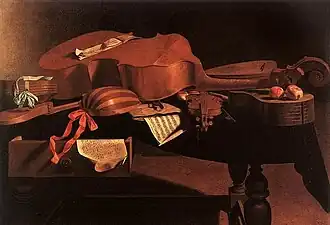 Painting by Evaristo Baschenis of Baroque instruments, including a cittern, viola da gamba, violin, and two lutes (from Baroque music)
 Wanderer above the Sea of Fog, by Caspar David Friedrich, is an example of Romantic painting. (from Romantic music)
 Bernhard Crusell, a Swedish-Finnish composer and clarinetist, in 1826 (from Classical period (music))

 Portrait of Beethoven, 1820 (from Classical period (music))
 Gustav Mahler, photographed in 1907 by Moritz Nähr at the end of his period as director of the Vienna Hofoper (from Romantic music)
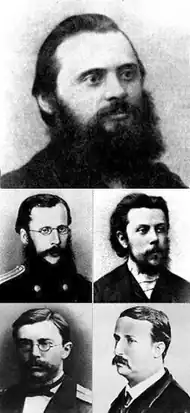 Balakirev (top), Cui (upper left), Mussorgsky (upper right), Rimsky-Korsakov (lower left), and Borodin (lower right). (from Romantic music)
 Richard Wagner in Paris, 1861
 Musicians from 'Procession in honour of Our Lady of Sablon in Brussels.' Early 17th-century Flemish alta cappella. From left to right: bass dulcian, alto shawm, treble cornett, soprano shawm, alto shawm, tenor sackbut. (from Renaissance music)
 Fortepiano by Paul McNulty after Walter & Sohn, c. 1805 (from Classical period (music))
 View of Vienna in 1758, by Bernardo Bellotto (from Classical period (music))
 1875 oil painting of Franz Schubert by Wilhelm August Rieder, after his own 1825 watercolor portrait (from Classical period (music))
 Haydn portrait by Thomas Hardy, 1792 (from Classical period (music))
 Claudio Monteverdi in 1640 (from Baroque music)
 A large instrumental ensemble's performance in the lavish Teatro Argentina, as depicted by Panini (1747) (from Baroque music)

 Gluck, detail of Portrait of Christoph Willibald Gluck by Joseph Duplessis, dated 1775 (Kunsthistorisches Museum, Vienna) (from Classical period (music))

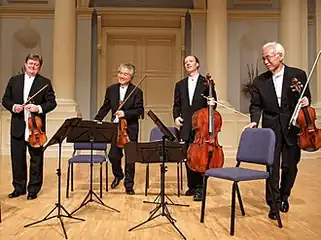 A modern string quartet. In the 2000s, string quartets from the Classical era are the core of the chamber music literature. From left to right: violin 1, violin 2, cello, viola. (from Classical period (music))

 Franz Liszt in 1858, by Franz Hanfstaengl (from Romantic music)
 Wolfgang Amadeus Mozart, a representative composer of the Classical period, seated at a keyboard (from Classical period (music))
 Hummel in 1814 (from Classical period (music))
 Gerard van Honthorst, The Concert (1623), National Gallery of Art, Washington D.C. (from Renaissance music)
 Josef Danhauser's 1840 painting Liszt at the Piano featuring Franz Liszt at the piano surrounded by (from left to right) Alexandre Dumas, Hector Berlioz, George Sand, Niccolò Paganini, Gioachino Rossini and Marie d'Agoult, with a bust of Ludwig van Beethoven on the piano (from Romantic music)
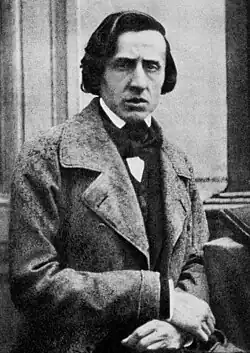 Daguerreotype of Chopin, c. 1849 (from Romantic music)
 Portrait of the Mozart Family, dated 1780–81 (from Classical period (music))
 Selection of Renaissance instruments (from Renaissance music)
 Portion of Du Fay's setting of Ave maris stella, in fauxbourdon. The top line is a paraphrase of the chant; the middle line, designated "fauxbourdon", (not written) follows the top line but exactly a perfect fourth below. The bottom line is often, but not always, a sixth below the top line; it is embellished, and reaches cadences on the octave.Play (from Renaissance music)

 Wolfgang Amadeus Mozart, posthumous painting by Barbara Krafft in 1819 (from Classical period (music))
 An example of a guitar from the classical period (from Classical period (music))
 Bizet photographed by Étienne Carjat (1875) (from Romantic music)




 Selected composers –


 Photograph: David IliffThe Royal Albert Hall is a concert hall, seating a maximum of 5,272, on the northern edge of South Kensington, London. Constructed beginning in 1867, the hall was inaugurated on 29 March 1871. Since 1941 it has held The Proms, an eight-week summer season of daily orchestral classical music concerts and other events.
 Photograph credit: William P. Gottlieb; restored by Adam CuerdenBilly Strayhorn (November 29, 1915 – May 31, 1967) was an American jazz composer, pianist, lyricist, and arranger, best remembered for his long-time collaboration with bandleader and composer Duke Ellington that lasted nearly three decades. Though classical music was Strayhorn's first love, his ambition to become a classical composer went unrealized because of the harsh reality of a black man trying to make his way in the world of classical music, which at that time was almost completely white. He was introduced to the music of pianists like Art Tatum and Teddy Wilson at age 19, and the artistic influence of these musicians guided him into the realm of jazz, where he remained for the rest of his life. This photograph of Strayhorn was taken by William P. Gottlieb in the 1940s.
 Stradivarius is one of the violins, violas, cellos and other string instruments built by members of the Italian Stradivari family, particularly Antonio Stradivari.
 Ballet is a formalized form of dance with its origins in the French court, further developed in France and Russia as a concert dance form.
 Sheet music for the Polonaise in A-flat major, Op. 53, a solo piano piece written by Frédéric Chopin in 1842. This work is one of Chopin's most admired compositions and has long been a favorite of the classical piano repertoire. The piece, which is very difficult, requires exceptional pianistic skills and great virtuosity to be interpreted. A typical performance of the polonaise lasts seven minutes.
 Photograph credit: Eugène Pirou; restored by Adam CuerdenJules Massenet (12 May 1842 – 13 August 1912) was a French composer of the Romantic era, best known for his operas. Between 1867 and his death, he wrote more than forty stage works in a wide variety of styles, from opéra comique to grand depictions of classical myths, romantic comedies and lyric dramas, as well as oratorios, cantatas and ballets. Massenet had a good sense of the theatre and of what would succeed with the Parisian public. Despite some miscalculations, he produced a series of successes that made him the leading opera composer in France in the late 19th and early 20th centuries. By the time of his death, he was regarded as old-fashioned; his works, however, began to be favourably reassessed during the mid-20th century, and many have since been staged and recorded. This photograph of Massenet was taken by French photographer Eugène Pirou in 1875.
 The Teatro alla Scala (or La Scala, as it is known), in Milan, Italy, is one of the world's most famous opera houses. The theatre was inaugurated on 3 August 1778, under the name Nuovo Regio Ducal Teatro alla Scala with Salieri's Europa riconosciuta.
 Photo: Guillaume PiolleThe anatomy of a Périnet piston valve, this one taken from a B♭ trumpet. When depressed, the valve diverts the air stream through additional tubing, thus lengthening the instrument and lowering the harmonic series on which the instrument is vibrating (i.e., it lowers the pitch). Trumpets generally use three valves, with some variations, such as a piccolo trumpet, having four. When used singly or in combination, the valves make the instrument fully chromatic, or capable of playing all twelve pitches of classical music. Trumpets may also use rotary valves instead.
 Photo: W. J. Mayer; Restoration: Lise BroerA bust of the German composer and pianist Ludwig van Beethoven (1770–1827), made from his death mask. He was a crucial figure in the transitional period between the Classical and Romantic eras in Western classical music, and remains one of the most acclaimed and influential composers of all time. Born in Bonn, of the Electorate of Cologne and a part of the Holy Roman Empire of the German Nation in present-day Germany, he moved to Vienna in his early twenties and settled there, studying with Joseph Haydn and quickly gaining a reputation as a virtuoso pianist. His hearing began to deteriorate in the late 1790s, yet he continued to compose, conduct, and perform, even after becoming completely deaf.

 Painting: Thomas GainsboroughJohann Christian Bach (5 September 1735 – 1 January 1782) was a composer of the Classical era, the eighteenth child of Johann Sebastian Bach, and the youngest of his eleven sons. Bach was taught by his father and then, after the latter's death, by his half-brother C. P. E. Bach. Bach moved to Italy in 1754, and then to London in 1762, where he became known as the "London Bach". Bach's compositions include eleven operas, as well as chamber music, orchestral music and compositions for keyboard music. In 1764 Bach met Wolfgang Amadeus Mozart, who was eight at the time, and spent five months teaching him composition. He had considerable influence on Mozart, and was later described by scholars as his "only, true teacher".


 Commons
 Wikidata
 Wikiquote
 Wikisource
 Wikiversity
 Wiktionary
 List of all portals






 Random portal
 WikiProject Portals