Portal:Cartoon

The Cartoon Portal

A cartoon is a type of visual art that is typically drawn, frequently animated, in an unrealistic or semi-realistic style. The specific meaning has evolved, but the modern usage usually refers to either: an image or series of images intended for satire, caricature, or humor; or a motion picture that relies on a sequence of illustrations for its animation. Someone who creates cartoons in the first sense is called a cartoonist, and in the second sense they are usually called an animator.
This article covers "static" cartoons; for moving ones see animation.
The concept originated in the Middle Ages, and first described a preparatory drawing for a piece of art, such as a painting, fresco, tapestry, or stained glass window. In the 19th century, beginning in Punch magazine in 1843, cartoon came to refer – ironically at first – to humorous artworks in magazines and newspapers. Then it also was used for political cartoons and comic strips. When the medium developed, in the early 20th century, it began to refer to animated films that resembled print cartoons. (Full article...)
In print media, a cartoon is a drawing or series of drawings, usually humorous in intent. This usage dates from 1843, when Punch magazine applied the term to satirical drawings in its pages,[1] particularly sketches by John Leech.[2] The first of these parodied the preparatory cartoons for grand historical frescoes in the then-new Palace of Westminster in London.[3]
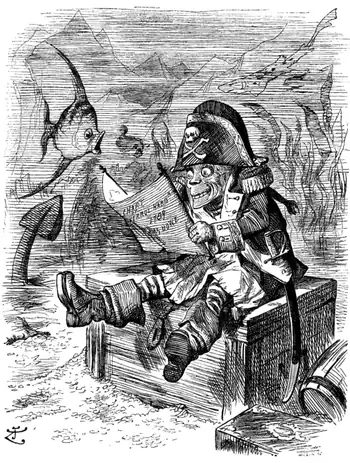
Sir John Tenniel—illustrator of Alice's Adventures in Wonderland—joined Punch in 1850, and over 50 years contributed over two thousand cartoons.[4]


Selected article -

"A Rugrats Chanukah" is a special episode of Nickelodeon's animated television series Rugrats. The first episode of the show's fourth season, it tells the story of the Jewish holiday Chanukah through the eyes of the Rugrats, who imagine themselves as the main characters. The idea of a Rugrats Chanukah special was pitched by Nickelodeon executives in 1992, but the concept was revised and became the 1995 special, "A Rugrats Passover". After production of the Passover episode wrapped, the crew returned to the Chanukah idea. Nickelodeon broadcast "A Rugrats Chanukah" on December 4, 1996; the episode received a Nielsen rating of 7.9 and positive reviews from television critics. Along with other Rugrats episodes featuring Grandpa Boris and his wife, the special attracted controversy when the Anti-Defamation League compared the character designs to anti-Semitic drawings from a 1930s Nazi newspaper.
Selected character -

Bugs Bunny is a funny animal cartoon character, best remembered for his starring roles in the Looney Tunes and Merrie Melodies series of theatrical shorts produced by Warner Bros. during the Golden Age of American animation. His popularity during this era led to his becoming a corporate mascot of Warner Bros. Entertainment. Bugs is an anthropomorphic gray hare or rabbit and is famous for his flippant, insouciant personality, a pronounced New York accent, his portrayal as a trickster, and his catch phrase "Eh... What's up, doc?" (usually said while chewing a carrot). Bugs has appeared in more films than any other cartoon character and is the ninth most portrayed film personality in the world. In reality, he was brought to life by the animators and staff of Leon Schlesinger Productions (later Warner Bros. Cartoons): including Tex Avery, who directed Bugs' "official" debut short A Wild Hare (1940); Robert McKimson, who created Bugs' definitive character design; and Mel Blanc, who originated the voice of Bugs.
Did you know... -

- ...that publication of comics in Hungary largely stopped during World War II due to Nazi pressure?
- ...that the Simpsons short Good Night aired April 19, 1987 on The Tracey Ullman Show and was the first ever appearance of the Simpson family on television?
- ...that Morning Funnies was a fruit-flavored breakfast cereal featuring comic strip characters including Dennis the Menace, Hägar the Horrible, and Funky Winkerbean on the box?
- ...that The World of Strawberry Shortcake, the first television special to feature American Greetings' popular character, was rejected by the major U.S. networks and premiered in syndication instead?
Selected list -

The episodes of The Simpsons, an American animated sitcom, created by Matt Groening (pictured) for the Fox Broadcasting Company. The series is a satirical parody of a middle class American lifestyle epitomized by its eponymous family, which consists of Homer, Marge, Bart, Lisa, and Maggie. The show is set in the fictional town of Springfield, and lampoons American culture, society and television, and many aspects of the human condition. Groening created a dysfunctional family and named the characters after members of his own family, substituting Bart for his own name. Since its debut on December 17, 1989, The Simpsons has broadcast 809 episodes. The Simpsons holds several American television longevity records. It is the longest-running prime time animated series and longest-running sitcom in the United States. The series has surpassed Gunsmoke in seasons to claim the spot as the longest-running American prime-time scripted television series.
General images -
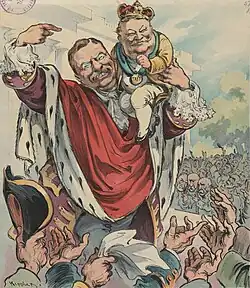 U.S. President Theodore Roosevelt introduces Taft as his crown prince: Puck magazine cover, 1906. (from Political cartoon)
 An editorial cartoon of Andrew Johnson and Abraham Lincoln, 1865, entitled The Rail Splitter at Work Repairing the Union. The caption reads: (Johnson): "Take it quietly Uncle Abe and I will draw it closer than ever!!" (Lincoln): "A few more stitches Andy and the good old Union will be mended!" (from Political cartoon)
 1903 political cartoon. The U.S.'s intentions to influence the area (especially the Panama Canal construction and control) led to the separation of Panama from Colombia. (from Political cartoon)
 Benjamin Franklin's Join, or Die (May 9, 1754), credited as the first cartoon published in an American newspaper (from Cartoonist)
 1942 political cartoon by Dr. Seuss. This cartoon depicts Japanese Americans as a "fifth column," lending support to Japan during its war against the United States. Bigotry against Japanese people was common among Americans at this time. (from Political cartoon)
 A Rake's Progress, Plate 8, 1735, and retouched by William Hogarth in 1763 by adding the Britannia emblem (from Political cartoon)
 Sir John Tenniel, chief cartoonist for Punch (from 1864) and the illustrator of Alice in Wonderland, was the first cartoonist to be knighted (from Cartoonist)
- John Leech, Substance and Shadow (1843), published as Cartoon, No. 1 in Punch, the first use of the word cartoon to refer to a satirical drawing (from Cartoon)
 Stop-motion animated character from 20 Million Miles to Earth (1957) (from Animator)
 Thomas Nast depicts the Tweed Ring: "Who stole the people's money?" / "'Twas him." (from Political cartoon)
 1899 cartoon showing Uncle Sam lecturing four children labeled Philippines, Hawaii, Puerto Rico, and Cuba. The caption reads: "School Begins. Uncle Sam (to his new class in Civilization)!" (from Political cartoon)
 James Gillray's The Plumb-pudding in Danger (1805). The world being carved up into spheres of influence between Pitt and Napoleon. According to Martin Rowson, it is "probably the most famous political cartoon of all time—it has been stolen over and over and over again by cartoonists ever since." (from Political cartoon)
- Nast depicts the Tweed Ring: "Who stole the people's money?" / "'Twas him."
Selected biography -

Lat is a Malaysian cartoonist whose work earned him the honorific title of datuk. He was born on 5 March 1951 in a village in Perak, Malaysia, and started supplementing his family's income at the age of nine by submitting his comics to magazines and newspapers. Four years later, he published his first comic book. In 1970, Lat left school and became a crime reporter while continuing his cartooning sideline. His comic about the Bersunat—a circumcision ceremony all Malaysian boys of the Islamic faith have to undergo—made a great impression on his newspaper's editor-in-chief. As a result, Lat became an editorial cartoonist. As he gained popularity through his cartoons in Malaysia, he published his autobiography in the form of two graphic novels—The Kampung Boy and Town Boy. The Kampung Boy was a huge success and gained him international renown. It is published in various countries around the world in several languages. Lat's cartoons provide an unbiased and humorous insight on the lives and culture of Malaysians, who consider him one of their most trustworthy citizens. His admirers include American cartoonists Sergio Aragonés and Matt Groening.
Subcategories

WikiProjects
- Main projects
- Arts • Animation • Comics • Entertainment • Visual arts

- Related Projects
- Anime and manga • Biography • Film • Fictional characters • Media franchises • Music • Television • Video games
Selected quote -
Topics
- Comic book
- Comic strip
- Digital comics
- Graphic novel
- Mobile comic
- Motion comics
- Trade paperback
- Webcomic
- Animator
- Animation director
- Animation studios
- Animation film festivals
- Feature-length films
- Short films
- Television series
- Computer-animated films
- Stop-motion films
- Traditional animation
- Limited animation
- Rotoscoping
- Stop Motion
- Clay
- Cutout
- Graphic
- Model
- Object
- Pixilation
- Puppetoon
- Computer animation
- Flash animation
- PowerPoint animation
- SVG animation
- Cel-shaded animation
- Crowd simulation
- Morph target animation
- Motion capture
- Non-photorealistic rendering
- Skeletal animation
Things you can do

- Requested articles: Fenwick (comics), Khimaera (comics), Mutant Underground Support Engine, Bruce J. Hawker, Marc Dacier, Hultrasson, Frankenstein Comics, Dave Johnson (comics), Paco Medina, Dappere Dodo, New Adventures of the Space Explorers, Habatales, Musical Box, Foo-Foo (TV series), Bonne nuit les petits, The Adventures of Lariat Sam, More...
- Images and photos needed: Request images that are needed from Wikipedia requested images of comics and animation to included in each articles.
- Stubs: Work on stubs in articles in Comics and Animation stubs.
- Infobox: Add infobox that are needed from Category:Comics articles without infoboxes and Category:Animation articles needing infoboxes in articles.
- Deletion sorting: Please see the collection of discussions on the deletion of articles related to comics and animation - compiled by WikiProject Deletion sorting
Related portals
Associated Wikimedia
The following Wikimedia Foundation sister projects provide more on this subject:
-
 Commons
Free media repository -
 Wikidata
Free knowledge base -
 Wikiquote
Collection of quotations -
 Wikisource
Free-content library -
 Wikiversity
Free learning tools -
 Wiktionary
Dictionary and thesaurus
More portals
-
 List of all portals
-

-

-

-

-

-

-

-

-

-
 Random portal
-
 WikiProject Portals
Sources
- ↑ Punch.co.uk. "History of the Cartoon". Archived from the original on 2007-11-11. Retrieved 2007-11-01.
- ↑ Adler & Hill 2008, p. 30.
- ↑ "Substance and Shadow: Original Editorial Accompanying "Cartoon, No. I"". Victorian web.org. Archived from the original on 29 October 2023. Retrieved 29 October 2023.
- ↑ "Sir John Tenniel". National Portrait Gallery. Archived from the original on 22 April 2023. Retrieved 26 August 2022.