Portal:Business/Selected economy/12
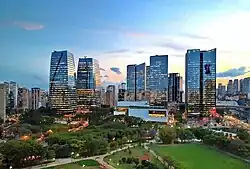
Brazil has a diversified mixed economy. It is the largest in Latin America, the Southern Hemisphere and the second in Americas, in nominal terms. As of 2026, it is an upper-middle income and developing economy with the second largest GDP in the Americas in nominal and purchasing power parity terms. It is ranked as the tenth largest economy in the world in nominal terms, and the 8th largest in PPP terms. In 2024, according to Forbes, Brazil was the 7th largest country in the world by number of billionaires. Brazil is one of the ten chief industrial states in the world according to International Labour Organization. According to the International Monetary Fund (IMF), Brazil's nominal GDP was US$2.642 trillion; the country has a long history of being among the largest economies in the world and the GDP per capita was US$12,313 per capita.
The country is rich in natural resources. From 2000 to 2012, Brazil was one of the fastest-growing major economies in the world, with an average annual GDP growth rate of over 5%. Its GDP surpassed that of the United Kingdom in 2012, temporarily making Brazil the world's sixth-largest economy. However, Brazil's economic growth decelerated in 2013 and the country entered a recession in 2014. The economy started to recover in 2017, with a 1% growth in the first quarter, followed by a 0.3% growth in the second quarter compared to the same period of the previous year. It officially exited the recession. According to data released on 3 March 2026 by the Brazilian Institute of Geography and Statistics (IBGE), Brazil's economy grew by 3.4% in 2024 and 2.3% in 2025, indicating robust growth in the last two years. In the fourth quarter of 2025, gross domestic product (GDP) increased by 0.1% compared with the third quarter, when it had also recorded growth of 0.1%, reflecting relative stability in quarterly performance. (Full article...)