Portal:Birds

The Birds Portal

Birds are a group of warm-blooded vertebrate animals constituting the class Aves, characterised by feathers, toothless beaked jaws, the laying of hard-shelled eggs, a high metabolic rate, a four-chambered heart, and a strong yet lightweight skeleton that retains dinosaur-like characteristics. Birds live worldwide and range in size from the 5.5 cm (2.2 in) bee hummingbird to the 2.8 m (9 ft 2 in) common ostrich. There are over 11,000 living species and they are split into 44 orders. More than half of the world's bird species are passerine or "perching" birds. Nearly all birds have wings whose development varies according to the life style of each species. Wings, which are modified forelimbs, gave birds the ability to fly, although further evolution has led to the loss of flight in some birds, including ratites, penguins, and diverse endemic island species. The only known groups without wings are the extinct moa and elephant birds. Birds are the only extant members of Dinosauria, and are a type of paravian theropods. The digestive and respiratory systems of birds are also uniquely adapted for flight. Some bird species of aquatic environments, particularly seabirds and some waterbirds, have further evolved for swimming. The study of birds is called ornithology.
Birds evolved from earlier theropods, and thus constitute the only known living dinosaurs. Whilst traditional Linnaean taxonomy placed birds in their own class (owing to their unique morphology and being the only group of animals other than mammals where all its species are warm-blooded), birds are considered reptiles in the modern cladistic sense of the term. Their closest living relatives are the crocodilians, both forming a clade known as archosaurs. Birds are descendants of the primitive avialans (whose members include Archaeopteryx) which first appeared during the Late Jurassic. According to some estimates, modern birds (Neornithes) evolved in the Late Cretaceous or between the Early and Late Cretaceous (100 Ma) and diversified dramatically around the time of the Cretaceous–Paleogene extinction event 66 million years ago, which killed off the pterosaurs and all non-ornithuran dinosaurs.
Many social species preserve knowledge across generations (culture). Birds are social, communicating with visual signals, calls, and songs, and participating in such behaviour as cooperative breeding and hunting, flocking, and mobbing of predators. The vast majority of bird species are socially (but not necessarily sexually) monogamous, usually for one breeding season at a time, sometimes for years, and rarely for life. Other species have breeding systems that are polygynous (one male with many females) or, rarely, polyandrous (one female with many males). Birds produce offspring by laying eggs which are fertilised through sexual reproduction. They are usually laid in a nest and incubated by the parents. Most birds have an extended period of parental care after hatching.
Many species of birds are economically important as food for human consumption and raw material in manufacturing, with domesticated and undomesticated birds being important sources of eggs, meat, and feathers. Songbirds, parrots, and other species are popular as pets. Guano (bird excrement) is harvested for use as a fertiliser. Birds figure throughout human culture. About 120 to 130 species have become extinct due to human activity since the 17th century, and hundreds more before then. Human activity threatens about 1,200 bird species with extinction, though efforts are underway to protect them. Recreational birdwatching is an important part of the ecotourism industry. (Full article...)
Featured articles

The Sind sparrow (Passer pyrrhonotus) is a passerine bird of the sparrow family, Passeridae, found around the Indus valley region in South Asia. Its name refers to the province of Sindh, and it is also known as the jungle, Sind jungle, or rufous-backed sparrow. Very similar to the related house sparrow, it is smaller and has distinguishing plumage features. As in the house sparrow, the male has brighter plumage than female and young birds, including black markings and a grey crown. Distinctively, the male has a chestnut stripe running down its head behind the eye, and the female has a darker head than other sparrow species. Its main vocalisations are soft chirping calls that are extended into longer songs with other sounds interspersed by breeding males. Historically, this species was thought to be very closely related to the house sparrow, but its closest evolutionary affinities may lie elsewhere. The species was discovered around 1840, but went undetected for several decades afterwards.
Within its Indus valley breeding range in Pakistan and western India, the Sind sparrow is patchily distributed in riverine and wetland habitats with thorny scrub and tall grass. During the non-breeding season, some birds enter drier habitats as they disperse short distances from their breeding habitat, or migrate into western Pakistan and the extreme east of Iran. Since this species is fairly common and expanding its range, it is assessed as least concern on the IUCN Red List. The Sind sparrow is social while feeding and gathers in small groups both while breeding and during winter dispersal. It feeds mostly on seeds and less often on insects, foraging close to the ground. Nests are made in the branches of thorny trees, and are untidy globular masses constructed from grass or other plant matter and lined with softer material. Both sexes are involved in building the nest and caring for the young, and usually raise two clutches of three to five young each breeding season. (Full article...)
The Cape sparrow (Passer melanurus), or mossie, is a bird of the sparrow family Passeridae found in southern Africa. A medium-sized sparrow at 14–16 centimetres (5.5–6.3 in), it has distinctive plumage, including large pale head stripes in both sexes. Its plumage is mostly grey, brown, and chestnut, and the male has some bold black and white markings on its head and neck. The species inhabits semi-arid savannah, cultivated areas, and towns, and ranges from the central coast of Angola to eastern South Africa and Eswatini. Three subspecies are distinguished in different parts of its range.
Cape sparrows primarily eat seeds, and also eat soft plant parts and insects. They typically breed in colonies, and when not breeding they gather in large nomadic flocks to move around in search of food. The nest can be constructed in a tree, a bush, a cavity, or a disused nest of another species. A typical clutch contains three or four eggs, and both parents are involved in breeding, from nest building to feeding young. The Cape sparrow is common in most of its range and coexists successfully in urban habitats with two of its relatives, the native southern grey-headed sparrow and the house sparrow, an introduced species. The Cape sparrow's population has not been recorded decreasing significantly, and it is not seriously threatened by human activities, so it is assessed as a species of least concern by the International Union for Conservation of Nature (IUCN). (Full article...)
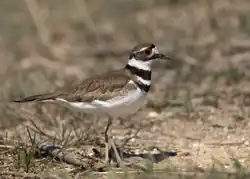
The killdeer (Charadrius vociferus) is a large plover found in the Americas. Its shrill, two-syllable call is often heard, sounding like "kill deer". It was described and given its current scientific name in 1758 by Carl Linnaeus in the 10th edition of his Systema Naturae. Three subspecies are described. Its upperparts are mostly brown with rufous fringes, the head has patches of white and black, and two black bands cross the breast. The belly and the rest of the breast are white. The nominate (or originally described) subspecies breeds from southeastern Alaska and southern Canada to Mexico. It is seen year-round in the southern half of its breeding range; the subspecies C. v. ternominatus is resident in the West Indies, and C. v. peruvianus inhabits Peru and surrounding South American countries throughout the year. North American breeders winter from their resident range south to Central America, the West Indies, and the northernmost portions of South America.
The nonbreeding habitat of the killdeer includes coastal wetlands, beach habitats, and coastal fields. Its breeding grounds are generally open fields with short vegetation (but locations such as rooftops are sometimes used); although it is a shorebird, it does not necessarily nest close to water. The nest itself is a scrape lined with vegetation and white material, such as pebbles or seashell fragments. This bird lays a clutch of four to six buff to beige eggs with dark markings. The breeding season (starting with egg-laying) occurs from mid-March to August, with later timing of egg-laying in the northern portion of the range. Both parents incubate the eggs for 22 to 28 days typically. The young stay in the nest until the day after being hatched, when they are led by their parents to a feeding territory (generally with dense vegetation where hiding spots are abundant), where the chicks feed themselves. The young then fledge about 31 days after hatching, and breeding first occurs after one year of age.
The killdeer primarily feeds on insects, although other invertebrates and seeds are eaten. It forages almost exclusively in fields, especially those with short vegetation and with cattle and standing water. It primarily forages during the day, but in the nonbreeding season, when the moon is full or close to full, it forages at night, likely because of increased insect abundance and reduced predation during the night. Predators of the killdeer include various birds and mammals. Its multiple responses to predation range from calling to the "ungulate display", which can be fatal for the performing individual. The killdeer was formerly considered a least-concern species by the IUCN due to its large range and population, but is now considered a near-threatened species due to its population decline, though the decline is not rapid enough to warrant uplisting the killdeer to a vulnerable species. It is protected by the American Migratory Bird Treaty Act of 1918 and the Canadian Migratory Birds Convention Act. (Full article...)
The white-breasted nuthatch (Sitta carolinensis) is a species of bird in the nuthatch family Sittidae. It is a medium-sized nuthatch, measuring approximately 15.5 cm (6.1 in) in length. Coloration varies somewhat along the species' range, but the upperparts are light blue-gray, with a black crown and nape in males, while females have a dark gray crown. The underparts are whitish, with a reddish tinge on the lower abdomen. Despite not being closely related, the white-breasted nuthatch and the white wagtail are very similar in plumage.
The white-breasted nuthatch is a chatty bird. It has a nasal voice and often utters little cries or vocalizations, often composed of repetitions of small invariant whistles. In summer, it is an exclusively insectivorous bird, consuming a wide range of arthropods, but in winter its diet consists mainly of seeds. The nest is located in the cavity of a tree. The clutch consists of five to nine eggs, incubated for two weeks by the female, who is fed by the male. The two adults then feed the young until they fledge, and for a few weeks after that.
The white-breasted nuthatch breeds throughout much of North America, except in the cooler and drier areas. It is mainly found at low elevations, in deciduous forests or in mixed woodlands. Seven to nine subspecies are generally distinguished by their slightly distinct distributions, vocalizations, and coloration. The species was once thought to be related to the white-cheeked nuthatch (S leucopsis) and Przewalski's nuthatch (S. przewalskii), two species from southern Asia, but is actually more closely related to the giant nuthatch (S. magna), also from Southeast Asia. (Full article...)
The Rodrigues solitaire (Pezophaps solitaria) is an extinct flightless bird that was endemic to the island of Rodrigues, east of Madagascar in the Indian Ocean. A member of the family of pigeons and doves, it was most closely related to the also extinct dodo of the nearby island Mauritius, the two forming the subfamily Raphinae. The Nicobar pigeon is their closest living genetic relative.
Rodrigues solitaires grew to the size of swans, and demonstrated pronounced sexual dimorphism. Males were much larger than females and measured up to 75.7–90 centimetres (30–35 inches) in height and 28 kilograms (62 pounds) in weight, contrasting with 63.8–70 centimetres (25–28 in) and 17 kilograms (37 lb) for females. Its plumage was grey and brown; the female was paler than the male. It had a black band at the base of its slightly hooked beak, and its neck and legs were long. Gizzard stones helped digest its food, which included fruit and seeds. Both sexes were highly territorial, with large bony knobs on their wings that were used in combat, probably due to competition for the limited resources on the island. The Rodrigues solitaire laid a single egg that was incubated in turn by both sexes.
First mentioned during the 17th century, the Rodrigues solitaire was described in detail by François Leguat, the leader of a group of French Huguenot refugees who were marooned on Rodrigues in 1691–1693. It was hunted by humans and introduced animals, and was extinct by the late 18th century. Apart from Leguat's account and drawing, and a few other contemporary descriptions, nothing was known about the bird until a few subfossil bones were found in a cave in 1786. Thousands of bones have subsequently been excavated. It is the only extinct bird with a former constellation named after it, Turdus Solitarius. (Full article...)
The spotted green pigeon or Liverpool pigeon (Caloenas maculata) is a species of pigeon which is most likely extinct. It was first mentioned and described in 1783 by John Latham, who had seen two specimens of unknown provenance and a drawing depicting the bird. The taxonomic relationships of the bird were long obscure, and early writers suggested many different possibilities, though the idea that it was related to the Nicobar pigeon (C. nicobarica) prevailed, and it was therefore placed in the same genus, Caloenas. Today, the species is only known from a specimen kept in World Museum, Liverpool. Overlooked for much of the 20th century, it was recognised as a valid extinct species by the IUCN Red List only in 2008. It may have been native to an island somewhere in the South Pacific Ocean or the Indian Ocean, and it has been suggested that a bird referred to as titi by Tahitian islanders was this bird. In 2014, a genetic study confirmed it as a distinct species related to the Nicobar pigeon, and showed that the two were the closest relatives of the extinct dodo and Rodrigues solitaire.
The surviving specimen is 32 cm (13 in) long, and has very dark, brownish plumage with a green gloss. The neck feathers are elongated, and most of the feathers on the upperparts and wings have a yellowish spot on their tips. It has a black bill with a yellow tip, and the end of the tail has a pale band. It has relatively short legs and long wings. It has been suggested it had a knob on its bill, but there is no evidence for this. Unlike the Nicobar pigeon, which is mainly terrestrial, the physical features of the spotted green pigeon suggest it was mainly arboreal, and fed on fruit. The spotted green pigeon may have been close to extinction by the time Europeans arrived in its native area, and may have disappeared due to over-hunting and predation by introduced animals around the 1820s. (Full article...)
The barn swallow (Hirundo rustica) is the most widespread species of swallow in the world, occurring on all continents, with vagrants reported even in Antarctica. It is a distinctive passerine bird with blue upperparts and a long, deeply forked tail. In Anglophone Europe, it is just called the swallow; in northern Europe, it is the only member of family Hirundinidae called a "swallow" rather than a "martin".
There are eight subspecies of barn swallow, which breed across the Northern Hemisphere. Two subspecies (H. r. savignii and H. r. transitiva) have fairly restricted ranges in the Nile valley and eastern Mediterranean, respectively. The other six are more widespread, with winter ranges covering much of the Southern Hemisphere.
The barn swallow is a bird of open country that normally nests in man-made structures and consequently has spread with human expansion. It builds a cup nest from mud pellets in barns or similar structures and feeds on insects caught in flight. This species lives in close association with humans, and its insect-eating habits mean that it is tolerated by humans; this acceptance was reinforced in the past by superstitions regarding the bird and its nest. There are frequent cultural references to the barn swallow in literary and religious works due to both its living in close proximity to humans and its annual migration. The barn swallow is the national bird of Austria and Estonia. (Full article...)
Illustrations of the Family of Psittacidae, or Parrots is an 1832 book containing 42 hand-coloured lithographs by Edward Lear. He produced 175 copies for sale to subscribers as a part-publication, which were later bound as a book. Lear started painting parrots in 1830 when he was 18 years old, and to get material for his book he studied live birds at the London Zoo and in private collections. The latter included those of Edward Smith Stanley, later 13th Earl of Derby, who had a large menagerie at Knowsley Hall, and Benjamin Leadbeater, a taxidermist and trader in specimens. Lear drew onto lithographic plates for printing by Charles Joseph Hullmandel, who was known for the quality of his reproductions of fine art.
Although the book was a financial failure, Lear's paintings of parrots established his reputation as one of the best natural history artists of his time. It found him work with John Gould, Stanley and other leading contemporary naturalists, and the young Queen Victoria engaged him to help her with her painting technique. Parrots was a forerunner to the major volumes of bird paintings by Gould, and Lear's serious work has influenced bird specialists like William T. Cooper, Elizabeth Butterworth, and Walton Ford.
Lear continued with his nature painting for some years, but from about 1835 he became concerned about his failing eyesight, and increasingly concentrated on his nonsense works and landscape painting, although he may have contributed to the illustrations for Charles Darwin's Voyage of the Beagle. (Full article...)
Emma Louisa Turner or E L Turner FLS, FZS, HMBOU (9 June 1867 – 13 August 1940) was an English ornithologist and pioneering bird photographer. Turner took up photography at age 34, after meeting the wildlife photographer Richard Kearton. She joined the Royal Photographic Society (RPS) in 1901, and by 1904 she had started to give talks illustrated with her own photographic slides; by 1908, when aged 41, she was established as a professional lecturer.
Turner spent part of each year in Norfolk, and her 1911 image of a nestling bittern in Norfolk was the first evidence of the species' return to the United Kingdom as a breeding bird after its local extinction in the late 19th century. She also travelled widely in the United Kingdom and abroad photographing birds.
Turner wrote eight books and many journal and magazine articles, and her picture of a great crested grebe led to her being awarded the Gold Medal of the RPS. She was one of the first women to be elected to fellowship of the Linnaean Society and the first female honorary member of the British Ornithologists' Union. Though not a graduate, she was also an honorary member of the British Federation of University Women. She lost her sight two years before her death. (Full article...)
The masked shrike (Lanius nubicus) is a species of bird in the shrike family, Laniidae. It breeds in southeastern Europe and at the eastern end of the Mediterranean, with a separate population in eastern Iraq and western Iran. It is migratory, wintering mainly in northeast Africa. Although it is a short-range migrant, vagrants have occurred widely elsewhere, including northern and western Europe. It is the smallest member of its genus, long-tailed and with a hooked bill. The male has mainly black upperparts, with white on its crown, forehead and supercilium and large white patches on the shoulders and wings. The throat, neck sides and underparts are white, with orange flanks and breast. The female is a duller version of the male, with brownish black upperparts and a grey or buff tone to the shoulders and underparts. The juvenile has grey-brown upperparts with a paler forehead and barring from the head to rump, barred off-white underparts and brown wings аpart from the white primary patches. The species' calls are short and grating, but the song has melodic warbler-like components.
The masked shrike's preferred habitat is open woodland with bushes and some large trees. It is less conspicuous than its relatives, avoiding very open country and often perching in less exposed locations. The nest is a neat cup built in a tree by both adults, and the clutch is normally 4–6 eggs, which are incubated by the female for 14–16 days until hatching. The chicks are fed by both parents until they fledge 18–20 days later, and remain dependent on the adults for about 3–4 weeks after leaving the nest. The masked shrike eats mainly large insects, occasionally small vertebrates; it sometimes impales its prey on thorns or barbed wire. Populations are decreasing in parts of the European range, but not rapidly enough to raise serious conservation concerns, and the species is therefore classified by the International Union for Conservation of Nature as being of least concern. (Full article...)
The Perijá tapaculo (Scytalopus perijanus) is a species of passerine bird in the family Rhinocryptidae (tapaculos). Endemic to the Serranía del Perijá mountain range on the Colombia–Venezuela border, the Perijá tapaculo is found at altitudes of 1,600–3,225 metres (5,200–10,600 feet). Its body is 10 to 12 centimetres (3.9 to 4.7 inches) long and its tail is about 4 cm (1.6 in) long. Specimens have long been stored in museums, but the species was described only in 2015 based on sixteen specimens found between July 2008 and February 2009. It is considered vulnerable to extinction.
Adults have neutral grey heads, brown necks, brown-sepia striped backs, and grey-white bellies, breasts, and throats. Males have some buff markings on their breasts, and less sharp brown spots on their napes than females. The Perijá tapaculo is a secretive bird and therefore difficult to observe; as a result its ecology is poorly known. It feeds on insects and reproduces between April and July. Its range is partially within Chamicero de Perijá Bird Reserve in Colombia and the Sierra de Perijá National Park in Venezuela. (Full article...)
The Puerto Rican amazon (Amazona vittata), also known as the Puerto Rican parrot (Spanish: cotorra puertorriqueña) or iguaca (Taíno), is the only extant parrot endemic to Puerto Rico. Measuring 28–30 cm (11.0–11.8 in), the bird is a predominantly green parrot with a red forehead and white rings around the eyes. Belonging to the Neotropical genus Amazona, its closest relatives are believed to be the Cuban amazon (Amazona leucocephala) and the Hispaniolan amazon (Amazona ventralis).
The Puerto Rican amazon reaches sexual maturity at between three and four years of age. It reproduces once a year and is a cavity nester. Once the female lays eggs she will remain in the nest and continuously incubate them until hatching. The chicks are fed by both parents and will fledge 60 to 65 days after hatching. This parrot's diet is varied and consists of flowers, fruits, leaves, bark and nectar obtained from the forest canopy.
The species is the only remaining native parrot to Puerto Rico and has been listed as critically endangered by the World Conservation Union since 1994. Once widespread and abundant, the population declined drastically in the 19th and early 20th centuries with the removal of most of its native habitat; the species has completely vanished from Vieques and Mona Island. Conservation efforts commenced in 1968 to save the bird from extinction. (Full article...)
The nuthatches (/ˈnʌthætʃ/) constitute a genus, Sitta, of small passerine birds belonging to the family Sittidae. Characterised by large heads, short tails, and powerful bills and feet, nuthatches advertise their territory using loud, simple songs. Most species exhibit grey or bluish upper parts and a black eye stripe.
Most nuthatches breed in the temperate or montane woodlands of the Northern Hemisphere, although two species have adapted to rocky habitats in the warmer and drier regions of Eurasia. However, the greatest diversity is in Southern Asia, and similarities between the species have made it difficult to identify distinct species. All members of this genus nest in holes or crevices. Most species are non-migratory and live in their habitat year-round, although the North American red-breasted nuthatch migrates to warmer regions during the winter. A few nuthatch species have restricted ranges and face threats from deforestation.
Nuthatches are omnivorous, eating mostly insects, nuts, and seeds. They forage for insects hidden in or under bark by climbing along tree trunks and branches, sometimes upside-down. They forage within their territories when breeding, but they may join mixed feeding flocks at other times. (Full article...)
The large rock martin (Ptyonoprogne fuligula), also known as the southern crag-martin, is a small passerine bird in the swallow family that is resident in southern Africa. It was formerly considered to be conspecific with the red-throated rock martin. It breeds mainly in the mountains, but also at lower altitudes, especially in rocky areas and around towns, and, unlike most swallows, it is often found far from water. It is 12–15 cm (4.7–5.9 in) long, with mainly brown plumage, paler-toned on the upper breast and underwing coverts, and with white "windows" on the spread tail in flight. The sexes are similar in appearance, but juveniles have pale fringes to the upperparts and flight feathers. The former northern subspecies are smaller, paler, and whiter-throated than southern African forms, and are now usually split as a separate species, the pale crag martin. The large rock martin hunts along cliff faces for flying insects using a slow flight with much gliding. Its call is a soft twitter.
The large rock martin builds a deep bowl nest on a sheltered horizontal surface, or a neat quarter-sphere against a vertical rock face or wall. The nest is constructed with mud pellets and lined with grass or feathers, and may be built on natural sites under cliff overhangs or on man-made structures such as buildings, dam walls, culverts and bridges. It is often reused for subsequent broods or in later years. The large rock martin is a solitary breeder, and is not gregarious, but small groups may breed close together in suitable locations. The two or three eggs of a typical clutch are white with brown and grey blotches, and are incubated by both adults for 16–19 days prior to hatching. Both parents then feed the chicks. Fledging takes another 22–24 days, but the young birds will return to the nest to roost for a few days after the first flight.
The large rock martin is often predated on by several fast and agile species of falcon, such as the hobby, and it sometimes carries parasites. Because it is common within its large range with an apparently stable population, it is assessed as a least-concern species on the IUCN Red List. (Full article...)
A cockatoo is any of the 22 species of parrots belonging to the family Cacatuidae, the only family in the superfamily Cacatuoidea, native to Australasia. Along with the Psittacoidea (true parrots), they make up the order Psittaciformes. The family has a mainly Australasian distribution, ranging from the Philippines and the eastern Indonesian islands of Wallacea to New Guinea, the Solomon Islands and Australia.
Cockatoos are recognisable by their prominent crests and curved bills. Their plumage is generally less colourful than that of other parrots, being mainly white, grey, or black and often with coloured features in the crest, cheeks, or tail. On average, they are larger than other parrots; however, the cockatiel, the smallest cockatoo species, is medium-sized. The phylogenetic position of the cockatiel remains unresolved, except that it is one of the earliest offshoots of the cockatoo lineage. The remaining species are in two main clades. The five large black-coloured cockatoos of the genus Calyptorhynchus form one branch. The second and larger branch is formed by the genus Cacatua, comprising 12 species of white-plumaged cockatoos and three monotypic genera that branched off earlier, namely the pink and grey galah, the mainly grey gang-gang cockatoo and the large black-plumaged palm cockatoo.
Cockatoos prefer to eat seeds, tubers, corms, fruit, flowers, and insects. They often feed in large flocks, particularly when ground-feeding. Cockatoos are monogamous and nest in tree hollows. Some cockatoo species have been adversely affected by habitat loss, particularly from a shortage of suitable nesting hollows after large, mature trees are cleared; conversely, some species have adapted well to human changes and are considered agricultural pests. (Full article...)
The ruff (Calidris pugnax) is a medium-sized wading bird that breeds in marshes and wet meadows across northern Eurasia. This highly gregarious sandpiper is migratory and sometimes forms huge flocks in its winter grounds, which include southern and western Europe, Africa, southern Asia and Australia.
The ruff is a long-necked, pot-bellied bird. This species shows marked sexual dimorphism; the male is much larger than the female (the reeve), and has a breeding plumage that includes brightly coloured head tufts, bare orange facial skin, extensive black on the breast, and the large collar of ornamental feathers that inspired this bird's English name. The female and the non-breeding male have grey-brown upperparts and mainly white underparts. Three differently plumaged types of male, including a rare form that mimics the female, use a variety of strategies to obtain mating opportunities at a lek, and the colourful head and neck feathers are erected as part of the elaborate main courting display. The female has one brood per year and lays four eggs in a well-hidden ground nest, incubating the eggs and rearing the chicks, which are mobile soon after hatching, on her own. Predators of wader chicks and eggs include mammals such as foxes, feral cats and stoats, and birds such as large gulls, crows and skuas.
The ruff forages in wet grassland and soft mud, probing or searching by sight for edible items. It primarily feeds on insects, especially in the breeding season, but it will consume plant material, including rice and maize, on migration and in winter. Classified as "least concern" on the IUCN Red List criteria, the global conservation concerns are relatively low because of the large numbers that breed in Scandinavia and the Arctic. However, the range in much of Europe is contracting because of land drainage, increased fertiliser use, the loss of mown or grazed breeding sites, and over-hunting. This decline has seen it listed in the Agreement on the Conservation of African-Eurasian Migratory Waterbirds (AEWA). (Full article...)
Pittas are a family, Pittidae, of passerine birds found in Asia, Australasia and Africa. There are 46 species of pittas, all similar in general appearance and habits. The pittas are suboscines from the Old World, and their closest relatives among other birds are in the genera Smithornis and Calyptomena. Initially placed in a single genus, as of 2009 they have been split into three genera: Pitta, Erythropitta and Hydrornis. Pittas are medium-sized by passerine standards, at 15 to 25 cm (6–10 in) in length, and stocky, with strong, longish legs and long feet. They have very short tails and stout, slightly decurved bills. Many have brightly coloured plumage.
Most pitta species are tropical; a few species can be found in temperate climates. They are mostly found in forests, but some live in scrub and mangroves. They are highly terrestrial and mostly solitary, and usually forage on wet forest floors in areas with good ground cover. They eat earthworms, snails, insects and similar invertebrate prey, as well as small vertebrates. Pittas are monogamous and females lay up to six eggs in a large domed nest in a tree or shrub, or sometimes on the ground. Both parents care for the young. Four species of pittas are fully migratory, and several more are partially so, though their migrations are poorly understood.
Four species of pitta are listed as endangered by the International Union for Conservation of Nature; a further nine species are listed as vulnerable and several more are near-threatened. The main threat to pittas is habitat loss in the form of rapid deforestation, but they are also targeted by the cage-bird trade. They are popular with birdwatchers because of their bright plumage and the difficulty in seeing them. (Full article...)
The horned sungem (Heliactin bilophus) is a species of hummingbird native to much of central Brazil and parts of Bolivia and Suriname. It prefers open habitats such as savanna and grassland and readily occupies human-created habitats such as gardens. It recently expanded its range into southern Amazonas and Espírito Santo, probably as a result of deforestation; few other hummingbird species have recently expanded their range. The horned sungem is a small hummingbird with a long tail and a comparatively short, black bill. The sexes differ markedly in appearance, with males sporting two feather tufts ("horns") above the eyes that are shiny red, golden, and green. Males also have a shiny blue head crest and a black throat with a pointed "beard". The female is plainer and has a brown or yellow-buff throat. The species is the only one within its genus, Heliactin.
The horned sungem is a nomadic species, moving between areas in response to the seasonal flowering of the plants on which it feeds. It relies on a broad variety of flowering plants for nectar. If the shape of the flower is incompatible with the bird's comparatively short bill, it may rob the nectar through a little hole at the base of the flower. The sungem does also consume small insects. Only the female builds the nest, incubates the eggs, and rears the chicks. She lays two white eggs in a small cup nest which are incubated for about 13 days. The chicks are naked and black after hatching, and can fly when 20 to 22 days old. The horned sungem has been reported to readily defend territories both against members of its own species and against subordinate hummingbird species. The species is currently classified as least concern by the International Union for Conservation of Nature, and its population is thought to be increasing. (Full article...)
RSPB Dearne Valley Old Moor is an 89-hectare (220-acre) wetlands nature reserve in the Dearne Valley near Barnsley, South Yorkshire, run by the Royal Society for the Protection of Birds (RSPB). It lies on the junction of the A633 and A6195 roads and is bordered by the Trans Pennine Trail long-distance path. Following the end of coal mining locally, the Dearne Valley had become a derelict post-industrial area, and the removal of soil to cover an adjacent polluted site enabled the creation of the wetlands at Old Moor.
Old Moor is managed to benefit bitterns, breeding waders such as lapwings, redshanks and avocets, and wintering golden plovers. A calling male little bittern was present in the summers of 2015 and 2016.
Barnsley Metropolitan Borough Council created the reserve, which opened in 1998, but the RSPB took over management of the site in 2003 and developed it further, with funding from several sources including the National Lottery Heritage Fund. The reserve, along with others nearby, forms part of a landscape-scale project to create wildlife habitat in the Dearne Valley. It is an 'Urban Gateway' site with facilities intended to attract visitors, particularly families. In 2018, the reserve had about 100,000 visits. The reserve may benefit in the future from new habitat creation beyond the reserve and improved accessibility, although there is also a potential threat to the reserve from climate change and flooding. (Full article...)
The ring ouzel (Turdus torquatus) is a mainly European member of the thrush family Turdidae. It is a medium-sized thrush, 23–24 centimetres (9.1–9.4 in) in length and weighing 90–138 grams (3.2–4.9 oz). The male is predominantly black with a conspicuous white crescent across its breast. Females are browner and duller than males, and young birds may lack the pale chest markings altogether. In all but the northernmost part of its range, this is a high-altitude species, with three subspecies breeding in mountains from Ireland east to Iran. It breeds in open mountain areas with some trees or shrubs, the latter often including juniper and other treeline conifers, rowan, bilberry, heather, and hairy alpenrose. It is a migratory bird, leaving the breeding areas to winter in southern Europe, North Africa and Turkey, typically in mountains with junipers. The typical clutch is 3–6 brown-flecked pale blue or greenish-blue eggs. They are incubated almost entirely by the female, with hatching normally occurring after 13 days. The altricial, downy chicks fledge in another 14 days and are dependent on their parents for about 12 days after fledging.
The ring ouzel is omnivorous, eating invertebrates, particularly insects and earthworms, some small vertebrates, and a wide range of fruit. Most animal prey is caught on the ground. During spring migration and the breeding season, invertebrates dominate the adult's diet and are also fed to the chicks. Later in the year, fruit becomes more important, particularly the common juniper.
With an extensive range and a large population, the ring ouzel is evaluated as least concern by the International Union for Conservation of Nature (IUCN). There are significant declines in several countries; suspected causes include climate change, human disturbance, hunting and outdoor leisure activities. Loss of junipers may also be a factor in some areas. Natural hazards include predation by mammalian carnivores and birds of prey, and locally there may also be competition from other large thrushes such as the common blackbird, mistle thrush and fieldfare. (Full article...)




Selected general bird topic
Bird vocalization includes both bird calls and bird songs. In non-technical use, bird songs (often simply birdsong) are the sounds produced by birds that are melodious to the human ear. In ornithology and birding, songs (relatively complex vocalizations) are distinguished by function from calls (relatively simple vocalizations). (Full article...)
Selected taxon

The manakins are a family, Pipridae, of small suboscine passerine birds. The group contains 55 species distributed through the American tropics. The name is from Middle Dutch mannekijn "little man" (also the source of the different bird name mannikin). (Full article...)
Topics
Anatomy: Anatomy • Skeleton • Flight • Eggs • Feathers • Plumage
Evolution and extinction: Evolution • Archaeopteryx • Hybridisation • Late Quaternary prehistoric birds • Fossils • Taxonomy • Extinction
Behaviour: Singing • Intelligence • Migration • Reproduction • Nesting • Incubation • Brood parasites
Bird orders: Struthioniformes • Tinamiformes • Anseriformes • Accipitriformes • Galliformes • Gaviiformes • Podicipediformes • Procellariiformes • Sphenisciformes • Pelecaniformes • Ciconiiformes • Phoenicopteriformes • Falconiformes • Gruiformes • Charadriiformes • Pteroclidiformes • Columbiformes • Psittaciformes • Cuculiformes • Strigiformes • Caprimulgiformes • Apodiformes • Coraciiformes • Piciformes • Trogoniformes • Coliiformes • Passeriformes
Bird lists: Families and orders • Lists by region
Birds and humans: Ringing • Ornithology • Bird collections • Birdwatching • Birdfeeding • Conservation • Aviculture
Quotes
Resources
Free online resources:
- SORA: The Searchable Online Research Archive (SORA) has decades worth of archives of the following journals: The Auk, The Condor, Journal of Field Ornithology, North American Bird Bander, Studies in Avian Biology, Pacific Coast Avifauna, and The Wilson Bulletin. Coverage ends around 2000. The ability to search all journals or browse exists on the front page.
- Notornis: The Journal of the Ornithological Society of New Zealand covers New Zealand and the South Pacific.
- New Zealand Journal of Ecology: This journal often publishes bird-related articles. Like Notornis, this journal is concerned with New Zealand and surrounding areas.
- Marine Ornithology: Published by the numerous seabird research groups, Marine Ornithology is specific and goes back many years.
- BirdLife International: The Data Zone has species accounts for every species, although threatened species and some key groups have greater detail with others only having status and evaluation.
- Author Index: This is a good source for binomial authorities for taxoboxes.
There is also Birds of North America, Cornell University's massive project collecting information on every breeding bird in the ABA area. It is available for US$40 a year.
For more sources, including printed sources, see WikiProject Birds.
WikiProjects

- WikiProject Birds
- WikiProject Science
- WikiProject History of Science
- WikiProject Tree of Life
- WikiProject Biology
- WikiProject Ecology
- WikiProject Extinction
Selected images
 Chinese goose head at List of goose breeds
 Photo: JJ HarrisonThe Eastern Great Egret (Ardea alba modesta) is a subspecies of the Great Egret found throughout Asia and Oceania. Measuring 83–103 cm (33–41 in) in length and weighing 0.7–1.2 kg (1.5–2.6 lb), the Eastern Great Egret is a large heron with all-white plumage. Its bill is yellow in the breeding season and black at other times, and its long legs are red or black. It can be distinguished from other white egrets and herons in its range by its very long neck, one and a half times as long as its own body.
 Photograph credit: Charles James SharpThe village weaver (Ploceus cucullatus) is a species of bird in the family Ploceidae, found in much of sub-Saharan Africa. This often abundant species occurs in a wide range of open or semi-open habitats, and frequently forms large, noisy colonies in towns, villages and hotel grounds. This male, of the subspecies P. c. bohndorffi, was photographed building a nest in Queen Elizabeth National Park, Uganda. Male birds make elaborate nests, each incorporating about 300 strips of palm or grass leaves that they have torn off the plant and transported individually. These are woven together to form roofed, dangling structures with the entrance at the bottom. The only involvement of the female is in the creation of the lining of the egg-laying cup.
 Photograph credit: John HarrisonThe Pacific reef heron (Egretta sacra) is a species of heron found throughout southern Asia and Oceania. About 60 cm (24 in) in length, this species has two distinct colour morphs, charcoal-grey (as seen here) and pure white. The bird's diet consists mainly of fish, crustaceans and molluscs. This Pacific reef heron was photographed at Boat Harbour, in New South Wales, Australia.
 Photo credit: Wolfgang WanderThe Eastern Screech Owl (Megascops asio) is a small owl native to eastern North America. Usually solitary, they nest in a tree cavity, either natural or excavated by a woodpecker; they will also use nesting boxes. They are strictly nocturnal, roosting during the day in cavities or next to tree trunks. They mainly eat large insects and small rodents, as well as small birds. They are active at night or near dusk, using their excellent hearing and night vision to locate prey.
 Photo: Simon Pierre BarretteThe Pine Siskin (Carduelis pinus) is a finch native to northern North America. The plumage is drab, being brown on the upperparts and pale on the underparts, with heavy streaking throughout. They have yellow patches in their wings and tail, which are not always visible. They grow to 11–14 cm (4.3–5.5 in) in length and typically weigh 12–18 g (0.4–0.6 oz).
 Photo: Wolfgang WanderA female Calliope Hummingbird (Stellula calliope), the smallest bird found in Canada and the United States, feeding insects to chicks. Found mostly in western North America (although vagrants have been found in New York and Connecticut), it is migratory and winters in southwestern Mexico.
 Photo credit: Leon BojarczukA pair of Bananaquits (Coereba flaveola), small passerine birds averaging 11 cm (4.3 in) in length native to tropical South America, Central America, and the Caribbean. Its curved beak is adapted to taking nectar from flowers, but they will also eat fruit and insects.


 Photograph credit: LaitcheThe Daurian redstart (Phoenicurus auroreus) is a small passerine bird from temperate Asia. The adult male has a grey crown and nape, a black face and chin, brownish mantle and wings and a large white wing patch; the chest, lower back and rump are orange, and the tail is black with orange sides. The female is brown above and paler brown below, with an orange rump and tail sides, and a large white wing patch similar to the male's. The species grows to a length of about 15 cm (6 in), and breeds in Manchuria, southeastern Russia, northeastern Mongolia, central China and Korea. A common migratory species, it is not considered to be a threatened species by the International Union for Conservation of Nature.
This picture shows a male Daurian redstart photographed at Daisen Park in Osaka, Japan, in midwinter. Canada goose
 Photograph credit: Antonios TsaknakisThe red-backed shrike (Lanius collurio) is a carnivorous passerine bird and a member of the shrike family, Laniidae. It breeds in a range stretching from western Europe eastwards to central Russia, and it overwinters in the eastern areas of tropical and southern Africa. About 17 centimetres (7 inches) in length, it feeds on large insects, small birds, frogs, rodents and lizards. Like other shrikes, it hunts from prominent perches, and impales corpses on thorns or barbed wire as a "larder". This male red-backed shrike was photographed at Lake Kerkini in northern Greece.
 Bald eagle at Bird of prey
 Photo: Michael GäblerA pair of ruddy shelducks (Tadorna ferruginea) in Springe, Hanover. This shelduck species lives in the open country and is usually found in pairs, though large groups may form moulting and wintering gatherings.
 Female mallard in mid-flight at Flying and gliding animals
 Photo credit: Noodle snacksA Eurasian Coot (Fulica atra) foraging for food. This member of the rail and crake family Rallidae occurs and breeds in Europe, Asia, Australia and Africa, and has recently expanded its range into New Zealand.


 Photograph: JJ HarrisonThe Australian white ibis (Threskiornis moluccus) is a wading bird of the ibis family, Threskiornithidae. Found in much of Australia, the species has become increasingly urban since the 1970s; this specimen was photographed in Perth.
 Photograph credit: Charles James SharpThe Palestine sunbird (Cinnyris osea) is a small passerine bird of the sunbird family, Nectariniidae, found in parts of the Middle East and sub-Saharan Africa. Its long, downward-curving beak and the brush-tipped tongue are adapted for sipping nectar from flowers. The Palestinian Authority adopted the species as a national bird in 2015. This male Palestine sunbird in breeding plumage was photographed in the Dana Biosphere Reserve in Jordan.

 Photo: Andreas TrepteThe bar-tailed godwit (Limosa lapponica) is a large wader in the family Scolopacidae. Its migration is the longest known non-stop flight of any bird; in 2007, godwits tagged in New Zealand were tracked to the Yellow Sea in China, with one specimen continuing on to Alaska, then returning to New Zealand in a non-stop trip.

 Malurus cyaneus cyanochlamys, juvenile
 Photo: Fir0002The Nankeen Kestrel (Falco cenchroides), native to Australia, New Guinea, and nearby islands, is one of the smallest species of falcon (about 31 to 35 cm (12 to 14 in) in length). Unlike other raptors, it does not rely on speed to catch its prey. Instead, it simply perches in an exposed position, but it also has a distinctive technique of hovering over crop and grasslands.


 The prothonotary warbler (Protonotaria citrea) is a small songbird of the New World warbler family. It breeds in hardwood swamps in southern Canada and the eastern United States and winters in the West Indies, Central America and northern South America.
 Rooster at Chicken
Selected bird anatomy topic
The pessulus is a delicate bar of cartilage connecting the dorsal and ventral extremities of the first pair of bronchial cartilages in the syrinx of birds. In some birds such as Anas platyrhynchos the pessulus may be ossified. (Full article...)
Selected species

Did you know
- ...that the blue-throated piping-guan is a South American bird similar to a turkey?
- ...that despite only being eight inches tall, the tiny hawk, a raptor found throughout much of the central Neotropics, successfully hunts hummingbirds?
- ...that the blue-faced honeyeater of eastern and northern Australia is also known as the "bananabird" for its fondness for that fruit?
Categories

Related portals
Things you can do
Create requested articles (WikiProject Birds – Article requests):

|
|
|
|
- Attend to bird articles needing attention
Do these tasks:
|
|
Here are some tasks awaiting attention:
|
More outstanding tasks at the project's cleanup listing, Category:Birds articles needing attention, and Wikipedia:WikiProject Birds/Todo.
Taxonomy of Aves
| Class Aves, divided into superorders, orders, suborders (where indicated), and families. | ||||
|---|---|---|---|---|
|
Associated Wikimedia
The following Wikimedia Foundation sister projects provide more on this subject:
-
 Commons
Free media repository -
 Wikidata
Free knowledge base -
 Wikiquote
Collection of quotations -
 Wikisource
Free-content library -
 Wikispecies
Directory of species -
 Wikiversity
Free learning tools -
 Wikivoyage
Free travel guide -
 Wiktionary
Dictionary and thesaurus
Sources
- ↑ Marberger, M. (1995). Application of Newer Forms of Therapeutic Energy in Urology. International Society of Urology reports. Taylor & Francis. p. 15. ISBN 978-1-899066-12-4. Retrieved February 7, 2020.
-
 List of all portals
-

-

-

-

-

-

-

-

-

-
 Random portal
-
 WikiProject Portals