This portal is not manually maintained. However, please contactGazampwhen you plan to make significant changes.
This portal has a single page layout. It is possible that any subpages may no longer be needed.
Please take care when editing, especially if using automated editing software, and seek consensus before making major changes.Learn how to update the maintenance information here.
Deposits placed with non-bank fintech (financial technology) companies are not protected by the FDIC against failure of the fintech company. If the company places the money in an FDIC-insured bank account consumers are protected only under some conditions. (Full article...)
Image 2
A community development bank (CDB) or Community Development Financial Institution (CDFI) is a development bank or credit union that focus on serving people who have been locked out of the traditional financial systems such as the unbanked or underbanked in deprived local communities. They emphasize the long term development of communities and provide loans such as micro-finance or venture capital.
In the United States these became popular after 1994 when the US Congress created community development banks and allowed them to get funding at very low rates from the US treasury. (Full article...)
Islamic banking, Islamic finance (Arabic: مصرفية إسلاميةmasrifiyya 'islamia), or Sharia-compliant finance is banking or financing activity that complies with Sharia (Islamic law) and its practical application through the development of Islamic economics. Some of the modes of Islamic finance include mudarabah (profit-sharing and loss-bearing), wadiah (safekeeping), musharaka (joint venture), murabahah (cost-plus), and ijarah (leasing).
Sharia prohibits riba, or usury, generally defined as interest paid on all loans of money (although some Muslims dispute whether there is a consensus that interest is equivalent to riba). Investment in businesses that provide goods or services considered contrary to Islamic principles (e.g. pork or alcohol) is also haram ("sinful and prohibited"). (Full article...)
The street was originally known in Dutch as Het Cingel ("the Belt") when it was part of New Amsterdam during the 17th century. An actual city wall existed on the street from 1653 to 1699. During the 18th century, the location served as a slave market and securities trading site, and from 1703 onward, as the location of New York's city hall, which became Federal Hall. In the early 19th century, both residences and businesses occupied the area, but increasingly the latter predominated, and New York's financial industry became centered on Wall Street. During the 20th century, several early skyscrapers were built on Wall Street, including 40 Wall Street, once the world's tallest building. The street is near multiple subway stations and ferry terminals. (Full article...)
The 100 point system applies to individuals opening new financial accounts in Australia, including bank accounts or betting accounts. Points are allocated to the types of documentary proof of identity that the person can produce, and they must have at least 100 points of identification to be able to operate an account. The system now also applies to the establishment of a number of official identity documents, such as an Australian passport and driving licence. (Full article...)
Image 6
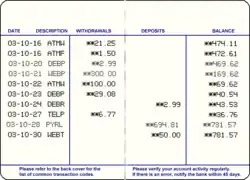
The passbook was the traditional record of savings account transactions before the use of the internet.
A savings account is a bank account at a retail bank. Common features include a limited number of withdrawals, a lack of checks and linked debit card facilities, limited transfer options and the inability to be overdrawn. Traditionally, transactions on savings accounts were widely recorded in a passbook, and were sometimes called passbook savings accounts, and bank statements were not provided; however, currently such transactions are commonly recorded electronically and accessible online.
People deposit funds in savings account for a variety of reasons, including a safe place to hold their cash. Savings accounts normally pay interest as well: almost all of them accrue compound interest over time. Several countries require savings accounts to be protected by deposit insurance and some countries provide a government guarantee for at least a portion of the account balance. (Full article...)
A direct bank (sometimes called a branch-less bank or virtual bank) is a bank that offers its services only via the Internet, mobile app, email, and other electronic means, often including telephone, online chat, and mobile check deposit. A direct bank has no branch network. It may offer access to an independent banking agent network and may also provide access via ATMs (often through interbank network alliances), and bank by mail. Direct banks eliminate the costs of maintaining a branch network while offering convenience to customers who prefer digital technology. Direct banks provide some but not all of the services offered by physical banks.
Direct bank transactions are conducted entirely online. Direct banks are not the same as "online banking". Online banking is an Internet-based option offered by regular banks. (Full article...)
During the 1990s, the U.S. Congress had passed legislation that intended to expand affordable housing through looser financing rules, and in 1999, parts of the 1933 Banking Act (Glass–Steagall Act) were repealed, enabling institutions to mix low-risk operations, such as commercial banking and insurance, with higher-risk operations such as investment banking and proprietary trading. As the Fed lowered the federal funds rate from 2000 to 2003, institutions increasingly targeted low-income homebuyers, largely belonging to racial minorities, with high-risk loans; this development went unattended by regulators. As interest rates rose from 2004 to 2006, the cost of mortgages rose and the demand for housing fell; in early 2007, as more U.S. subprime mortgage holders began defaulting on their repayments, lenders went bankrupt, culminating in the bankruptcy of New Century Financial in April. As demand and prices continued to fall, the financial contagion spread to global credit markets by August 2007, and central banks began injecting liquidity. In March 2008, Bear Stearns, the fifth-largest U.S. investment bank, was sold to JPMorgan Chase in a "fire sale" backed by Fed financing. (Full article...)
Image 10
UML class diagram depicting retail banking Retail banking, also known as consumer banking or personal banking, is the provision of services by a bank to the general public, rather than to companies, corporations or other banks, which are often described as wholesale banking (corporate banking).
Crédit Agricole Group (French:[kʁediaɡʁikɔl]), sometimes called La banque verte (pronounced[labɑ̃kvɛʁt], lit.'The green bank', due to its historical ties to farming), is a French international banking group and the world's largest cooperative financial institution. In 2025, Crédit Agricole is the tenth-largest bank in the world in terms of assets, and the second-largest in France after BNP Paribas. According to S&P Global's April 2026 report, it is also Europe's 3rd largest bank by assets, with $3.149 trillion in assets. It consists of a network of Crédit Agricole local banks, 39 Crédit Agricole regional banks and a central institute, the Crédit Agricole S.A.. It is listed through Crédit Agricole S.A., as an intermediate holding company, on Euronext Paris' first market and is part of the CAC 40 stock market index. Local banks of the group owned the regional banks, in turn the regional banks majority owned the S.A. via a holding company, and in turn the S.A. owned part of the subsidiaries of the group, such as LCL, the Italian network and the CIB unit. It is considered to be a systemically important bank by the Financial Stability Board.
Following aggressive international expansion, ABN AMRO was acquired and broken up in 2007–2008 by a consortium of European banks, including Fortis which intended to take over its formed operations in the Benelux region. Fortis came under stress in the autumn of 2008, and was in turn broken up into separate national entities; the Dutch operations, namely Fortis Bank Nederland and the former ABN AMRO activities that Fortis had planned to absorb, were nationalized, restructured, and renamed ABN AMRO in mid-2010. On 20 November 2015, the Dutch government publicly re-listed the company through an IPO and sold 20 percent of the shares to the public. (Full article...)
Credit Suisse was founded in 1856 to fund the development of Switzerland's rail system. It issued loans that helped create Switzerland's electrical grid and the European rail system. In the 1900s, it began shifting to retail banking in response to the elevation of the middle class and competition from fellow Swiss banks UBS and Julius Bär. Credit Suisse partnered with First Boston in 1978 before buying a controlling share of the bank in 1988. From 1990 to 2000, the company purchased institutions such as Winterthur Group, Swiss Volksbank, Swiss American Securities Inc. (SASI), and Bank Leu. (Full article...)
Image 4
The Laurentian Bank of Canada (LBC; French: Banque Laurentienne du Canada) is a Schedule 1 bank that operates primarily in the province of Quebec, with commercial and business banking offices located in Ontario, Alberta, British Columbia, and Nova Scotia. LBC's Institution Number (or routing number) is 039.
The institution was established as the Montreal City and District Savings Bank in 1846. The bank's shares were publicly listed on the Montreal Stock Exchange in 1965 and the Toronto Stock Exchange in 1983. In 1987, the institution was renamed the Laurentian Bank of Canada. (Full article...)
Image 5
Mitsubishi UFJ Financial Group, Inc. (MUFG; 株式会社三菱UFJフィナンシャル・グループ, Kabushiki gaisha Mitsubishi Yūefujei Finansharu Gurūpu) is a Japanese bank holding and financial services company headquartered in Chiyoda, Tokyo, Japan. MUFG was created in 2005 by merger between Mitsubishi Tokyo Financial Group (株式会社三菱東京フィナンシャル・グループ, Kabushiki kaisha mitsubishi tōkyō finansharu gurūpu) and UFJ Holdings (株式会社UFJホールディングス; kabushikigaisha yūefujei hōrudingusu). These two groups in turn brought together multiple predecessor banks including Mitsubishi Bank (est. 1880), Yokohama Specie Bank (est. 1880 as a policy bank, reorganized after World War II as Bank of Tokyo), Sanwa Bank (est. 1933 by merger of prior institutions), and Tokai Bank (est. 1941 by merger).
Barclays traces its origins to the goldsmith banking business established in the City of London in 1690 by Quakers John Freame and Thomas Gould. James Barclay became a partner in the business in 1736. In 1896, twelve banks in London and the English provinces, including Goslings Bank, Backhouse's Bank and Gurney, Peckover and Company, united as a joint-stock bank under the name Barclays and Co. Over the following decades, Barclays expanded to become a nationwide bank. In 1967, Barclays deployed the world's first cash dispenser. Barclays has made numerous corporate acquisitions, including of London, Provincial and South Western Bank in 1918, British Linen Bank in 1919, Mercantile Credit in 1975, the Woolwich in 2000 and the North American operations of Lehman Brothers in 2008. (Full article...)
Image 8
UniCredit S.p.A. (formerly UniCredito Italiano S.p.A.) is an Italian multinational banking group headquartered in Milan. It is one of the two largest banking groups in Italy, alongside Intesa Sanpaolo. As of 2025, it was the world's 44th largest bank by assets. It was formed through the merger of Credito Italiano and Unicredito in 1998 but has a corporate identity stretching back to its first foundation in 1870 as Banca di Genova. UniCredit is listed on the Borsa Italiana and Frankfurt Stock Exchange and is a constituent stock of the Euro Stoxx 50 index of leading shares.
Image 43Statesman Jan van den Brink was instrumental in the merger of Amsterdamsche Bank and Rotterdamsche Bank in 1964, and remained on the bank's board until 1978 (from AMRO Bank)
Image 44Sealing of the Bank of England Charter (1694), by Lady Jane Lindsay, 1905. (from Bank)