The pinnacle of ancient Egyptian power was achieved during the New Kingdom, which extended its rule to much of Nubia and a considerable portion of the Levant. After this period, Egypt entered an era of slow decline. Over the course of its history, it was invaded or conquered by a number of foreign civilizations, including the Hyksos, the Kushites, the Assyrians, the Persians, and the Greeks and then the Romans. The end of ancient Egypt is variously defined as occurring with the end of the Late Period during the Wars of Alexander the Great in 332 BC or with the end of the Greek-ruled Ptolemaic Kingdom during the Roman conquest of Egypt in 30 BC. In AD 642, the Arab conquest of Egypt brought an end to the region's millennium-long Greco-Roman period.
The success of ancient Egyptian civilization came partly from its ability to adapt to the Nile's conditions for agriculture. The predictable flooding of the Nile and controlled irrigation of its fertile valley produced surplus crops which supported a more dense population and thereby substantial social and cultural development. With resources to spare, the administration sponsored the mineral exploitation of the valley and its surrounding desert regions, the early development of an independent writing system, the organization of collective construction and agricultural projects, trade with other civilizations, and a military to assert Egyptian dominance throughout the Near East. Motivating and organizing these activities was a bureaucracy of elite scribes, religious leaders, and administrators under the control of the reigning pharaoh, who ensured the cooperation and unity of the Egyptian people in the context of an elaborate system of religious beliefs.[1]
It is a wadi sitting on the west bank of the Nile, opposite Thebes (modern-day Luxor) and within the heart of the Theban Necropolis. There are two main sections: the East Valley, where the majority of the royal tombs are situated; and the West Valley, otherwise known as the Valley of the Monkeys. (Full article...)
Akhenaten (pronounced /ˌækəˈnɑːtən/ ), also spelled Akhenaton, Echnaton, and Khuenaten (Ancient Egyptian: ꜣḫ-n-jtnʾŪḫə-nə-yātəy, pronounced[ˈʔuːχəʔnəˈjaːtəj]ⓘ, meaning 'Effective for the Aten'), was an ancient Egyptianpharaoh reigning c.1353–1336 or 1351–1334 BC, the tenth ruler of the Eighteenth Dynasty. Originally named Amenhotep IV (Ancient Egyptian: jmn-ḥtp, meaning "Amun is satisfied", Hellenized as Amenophis IV), in the fifth year of his reign he adopted the name "Akhenaten".
As a pharaoh, Akhenaten is noted for abandoning the traditional, polytheistic ancient Egyptian religion, and introducing Atenism, or worship centered around Aten. The views of Egyptologists differ as to whether the religious policy was absolutely monotheistic, or whether it was monolatristic, syncretistic, or henotheistic. This culture shift away from traditional religion was reversed after his death. Akhenaten's monuments were dismantled and hidden, his statues were destroyed, and his name excluded from lists of rulers compiled by later pharaohs. Traditional religious practice was gradually restored, notably under his close successor Tutankhamun, who changed his name from Tutankhaten early in his reign. When, some dozen years later, rulers without clear rights of succession from the Eighteenth Dynasty founded a new dynasty, they discredited Akhenaten and his immediate successors and referred to Akhenaten as "the enemy of Akhetaten", "the enemy" or "that criminal" in archival records. (Full article...)
Image 9Possible prisoners and wounded men of the Buto-Maadi culture devoured by animals, while one is led by a man in long dress, probably an Egyptian official (fragment, top right corner). Battlefield Palette. (from Prehistoric Egypt)
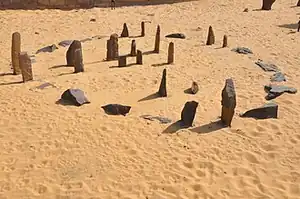
Image 10Megaliths from Nabta Playa displayed in Aswan, Upper Egypt (from History of ancient Egypt)
Image 20E1b1b is the most common paternal haplogroup across much of Africa, including Egypt, "Haplogroup E is defined by the M96 SNP (and others), for which a cautious reading of all of the evidence would indicate an eastern tropical African origin (Cruciani, 2007; Gomes et al., 2010; Trombetta et al., 2015)". (from Prehistoric Egypt)
Image 21A guardian statue which reflects the facial features of the reigning king, probably Amenemhat II or Senwosret II, and which functioned as a divine guardian for the imiut. Made of cedar wood and plaster c. 1919–1885 BC (from History of ancient Egypt)
Image 22Naqada figure of a woman interpreted to represent the goddess Bat with her inward curving horns. Another hypothesis is that the raised arms symbolize wings and that the figure is an early version of the white vulture goddess Nekhbet, c. 3500–3400 B.C.E. terracotta, painted, 11+1⁄2in ×5+1⁄2in ×2+1⁄4in (29.2cm ×14.0cm ×5.7cm), Brooklyn Museum (from Prehistoric Egypt)
Image 29Ancient Badarian mortuary figurine of a woman, held at the Louvre (from Prehistoric Egypt)
Image 30Facial reconstruction and depiction created from the Nuwayrat Early Dynastic individual, carbon dated to 2855–2570 BCE, soon after the end of the Neolithic period. (from Prehistoric Egypt)
Image 31Nazlet Khater skeleton, Upper Paleolithic, 35,000 before present; National Museum of Egyptian Civilization, Cairo (from Prehistoric Egypt)
Image 32Chronology of state formation in Ancient Egypt. (from Prehistoric Egypt)
This is a list of recognized content, updated weekly by JL-Bot (talk·contribs) (typically on Saturdays). There is no need to edit the list yourself. If an article is missing from the list, make sure it is tagged(e.g. {{WikiProject Ancient Egypt}})or categorized correctly and wait for the next update. See WP:RECOG for configuration options.