Portal:American football

The American Football Portal

American football evolved in the United States, originating from the sports of soccer and rugby. The first American football game was played on November 6, 1869, between two college teams, Rutgers and Princeton, using rules based on the rules of soccer at the time; by 1875, the sport had adopted rules similar to rugby union. A set of rule changes drawn up from 1880 onward by Walter Camp, the "Father of American Football", established concepts that would define the sport, among them the snap, the line of scrimmage, eleven-player teams, and the concept of downs. Later rule changes legalized the forward pass, created the neutral zone, and specified the size and shape of the football. The modern sport is closely related to Canadian football, which evolved in parallel with and at the same time as the American game; the two sports are considered the primary variants of gridiron football.
American football is the most popular sport in the United States; the most popular forms of the game are professional and college football, with the other major levels being high school and youth football. Over a million Americans played college or high school football in 2022, and the National Football League (NFL) has one of the highest average attendance of any professional sports league in the world. Its championship game, the Super Bowl, ranks among the most-watched club sporting events globally. Other professional and amateur leagues exist worldwide, but the sport does not have the international popularity of other American sports like baseball or basketball; the sport maintains a growing following in the rest of North America, Europe, Brazil, and Japan. Flag football, a variant of the sport, will be played at the 2028 Summer Olympics. (Full article...) Recognized content -


From 1895 to 1899, William Wurtenburg served as the head coach of the Dartmouth football program, which represented Dartmouth College in collegiate football competitions. Dartmouth had adopted football as a school sport in 1881 when the team went 1–0–1. Prior to Wurtenburg's hiring, the team had won two consecutive Triangular Football League championships under coach Wallace Moyle. Wurtenburg had been a highly successful player at Yale, where he had played at quarterback on teams that went 46–1–1 in a four-year span. He had graduated from the school in 1893 and coached the Navy Midshipmen football program for a year before his hiring by Dartmouth.
During Wurtenburg's five year coaching tenure, Dartmouth went 8–2 in conference contests and won four consecutive Triangular Football League championships. The 1895 season was made up of thirteen games, a record-setting amount for a Dartmouth team. It included the closest loss to rival Harvard up to that point. The 1896 was the most successful season of Wurtenburg's, in terms of winning percentage; the squad went 5–2–1, the tenth-best record among major teams, for a .688 win percentage. The fewest games played in a season under Wurtenburg were seven in 1897. That team managed a 4–3 record, which included a three-game scoreless streak. The 1898 squad finished the season with a losing record, 5–6, but managed to outscore its opponents 205–137. Wurtenburg's final season as Dartmouth's head coach was his worst. The team had a 2–7 overall record and went 0–2 in conference play. The season was also marked by several of the largest blowouts of Dartmouth in years. (Full article...)
General images
 An Arena Football field in comparison to a standard American Football size. (from Arena football)
 High school football stadium in Manhattan, Kansas (from History of American football)
 Hanged U-shaped Continental Indoor Football League goalpost (from Arena football)
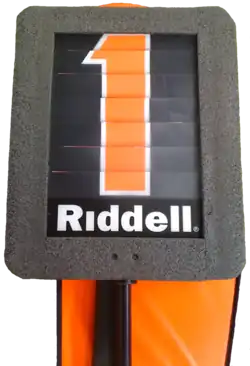 A modern down indicator box is mounted on a pole and is used to mark the current line of scrimmage. The number on the marker is changed using a dial. (from Canadian football)
 Colorado's first football team in 1890 (from History of American football)
 Indoor Football League (from Arena football)
 Jim Thorpe was the first president of the NFL. (from History of American football)

 An early American football team, from the turn of the twentieth century (from History of American football)
 Sewanee's 1899 "Iron Men" (from History of American football)

 Diagram of a Canadian football field (from Canadian football)
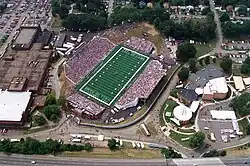 Tom Benson Hall of Fame Stadium with the Hall of Fame in lower right (from Pro Football Hall of Fame)
 A game between the 4th Canadian Armoured Division Atoms and First Canadian Army Red and Blue Bombers, in Utrecht, Netherlands, October 1945 (from Canadian football)
 An arena football goalpost structure featuring the rebound nets on either side of the uprights. (from Arena football)

 Edmonton's Commonwealth Stadium, originally built for the 1978 Commonwealth Games, pictured in 2005. (from Canadian football)
 Original entrance to the Pro Football Hall of Fame (from Pro Football Hall of Fame)
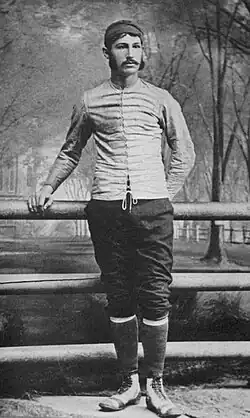 Walter Camp, the "Father of American Football", pictured here in 1878 as the captain of the Yale University football team (from History of American football)
 Inside the original structure in 2008 (from Pro Football Hall of Fame)
 A football signed by the 1974 Pro Football Hall of Fame enshrinement class (from Pro Football Hall of Fame)
 A Native American college football team (from History of American football)
 The Hall is made up of several sections with display of the inductees at its heart (from Pro Football Hall of Fame)
 Montreal Alouettes quarterback Anthony Calvillo looks down field with the ball during the 93rd Grey Cup game at BC Place (November 2005) (from Canadian football)
 Lehigh Valley Steelhawks (gold jerseys with black accents) vs. Triangle Torch (black jerseys with red and yellow accents) play an American Indoor Football game at Dorton Arena in Raleigh, North Carolina, March 25, 2016 (from Arena football)
 Tom Davies of Pittsburgh runs against undefeated and unscored upon Georgia Tech in the 1918 game at Forbes Field (from History of American football)
 A moment of the second game between Tufts and Harvard at College Hill, October 1875 (from History of American football)
 Morgan Athletic Club (pictured c. 1900), predecessor of the Arizona Cardinals (from History of American football)
 Touchdown monument outside the Canadian Football Hall of Fame in Hamilton, Ontario (from Canadian football)
 1897 Latrobe Athletic Association football team: The first entirely professional team to play an entire season. (from History of American football)
 A college football game between Colorado State University and the Air Force Academy (from History of American football)
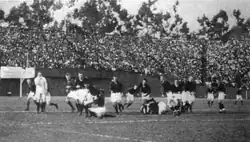 The Big Game between Stanford and California was played as rugby union from 1906 to 1914 (from History of American football)
 1902 football game between the University of Minnesota and the University of Michigan (from History of American football)
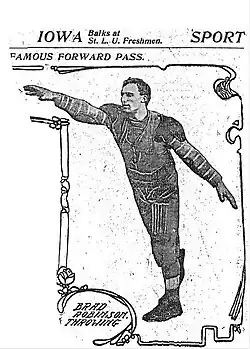 1906 St. Louis Post-Dispatch photograph of Brad Robinson, who threw the first legal forward pass and was the sport's first triple threat (from History of American football)

 Don Hutson in 1940. (from History of American football)
 Sign at the old entrance to the Pro Football Hall of Fame (from Pro Football Hall of Fame)
Selected image

Selected biography -

Leslie Horvath (October 12, 1921 – November 14, 1995) was an American football quarterback who won the Heisman Trophy while playing for the Ohio State Buckeyes in 1944. Horvath was the first Ohio State player to win the Heisman, an award given to the best college football player in the United States. The school retired his jersey number 22 in October 2000.
Horvath grew up in Parma, Ohio, a suburb of Cleveland and became a standout high school athlete despite his small stature. He entered Ohio State in 1939 on a work scholarship, but tried out for and made the football team the following year. He played as a reserve halfback on the 1942 team coached by Paul Brown that won Ohio State's first-ever national championship. Horvath graduated that year and moved to Ohio State's dental school. In 1944, however, acting Ohio State football coach Carroll Widdoes asked Horvath to rejoin the team, taking advantage of a World War II-era rule allowing graduate students with remaining eligibility to play. Horvath agreed, and helped lead the Buckeyes to a 9–0 record and a second-place showing in the AP poll. He won the Heisman and was named an All-American at the end of the season. (Full article...)
Calendar
| Jan 8 | College Football National Championship: #1 Michigan vs #2 Washington | |
| Jan 13-15 | NFL: Wild Cards | |
| Jan 20-21 | NFL: Divisional games | |
| Jan 28 | NFL: Conference games | |
| Feb 4 | NFL: Pro Bowl Games | |
| Feb 11 | NFL: Super Bowl LVIII | |
| 2023 season: NFL • NCAA FBS (Bowl games) | ||
|---|---|---|
Selected quote
| “ | You can call it a miracle or a legend or whatever you want to. I just know that on that day, Brett Favre was larger than life. | ” |
| — Gene Stallings former University of Alabama coach on Favre after he led the University of Southern Mississippi to a victory over Stalling's Alabama team. Less than six weeks earlier Favre underwent surgery to remove 30 inches of his small intestine. |
Did you know...

- ...that the Sacramento Sirens are the only professional women's full-tackle team ever to have won four consecutive league championships, having captured the Women's American Football Conference title in 2001 and that of the Independent Women's Football League in 2002, 2003, and 2004?
- ...that the 2002 and 2003 winners of the Pete Dawkins Trophy as most valuable player of the high school U.S. Army All-American Bowl, quarterbacks Vince Young (pictured) and Chris Leak, were subsequently the offensive most valuable players, respectively, of the 2005 and 2006 BCS National Championship Games?
- ...that since the 1970 merger between the American and National Football Leagues, the Minnesota Vikings have in the regular season won more games than all save five teams but have never won a Super Bowl?
Subcategories

- Select [►] to view subcategories
Things you can do
 |
|
Lists
- List of NFL champions
- List of college football national champions
- List of Pro Football Hall of Fame inductees
- List of first overall NFL draft picks
- List of second overall NFL draft picks
- List of NFL head coaches
- List of NFL rushing champions
- List of college football coaches with 200 career wins
- List of current NFL team rosters
- National Football League 1940s All-Decade Team
- National Football League 1960s All-Decade Team
- National Football League 1970s All-Decade Team
- National Football League 1980s All-Decade Team
- National Football League 1990s All-Decade Team
- List of NFL franchise post-season droughts
WikiProjects
- WikiProject Sports
- WikiProject American football
- WikiProject American Football League
- WikiProject Arena Football League
- WikiProject College football
- WikiProject National Football League
- WikiProject Pittsburgh Steelers
- WikiProject Chicago Bears
- WikiProject Green Bay Packers
- WikiProject New England Patriots
- WikiProject San Francisco 49ers
- WikiProject Los Angeles Rams
- WikiProject Canadian football
- WikiProject European League of Football
- WikiProject American football
Sports portals
Associated Wikimedia
The following Wikimedia Foundation sister projects provide more on this subject:
-
 Commons
Free media repository -
 Wikidata
Free knowledge base -
 Wikiquote
Collection of quotations -
 Wikisource
Free-content library -
 Wikiversity
Free learning tools -
 Wiktionary
Dictionary and thesaurus
-
 List of all portals
-

-

-

-

-

-

-

-

-

-
 Random portal
-
 WikiProject Portals