This portal's subpages have been checked by an editor, and are needed.
Please take care when editing, especially if using automated editing software.Learn how to update the maintenance information here.
The 1950s Portal
Top, L-R: U.S. Marines engaged in street fighting during the Korean War, circa late September 1950; The first polio vaccine is developed by Jonas Salk.
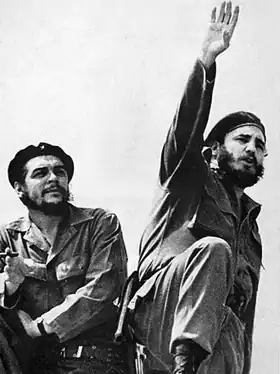
Centre, L-R: US tests its first thermonuclear bomb with code name Ivy Mike in 1952. A 1954 thermonuclear test, code named Castle Romeo, is shown here; In 1959, Fidel Castro overthrows Fulgencio Batista in the Cuban Revolution, resulting in the creation of the first communist government in the Western hemisphere; Elvis Presley becomes the leading figure of rock and roll in the mid-1950s.
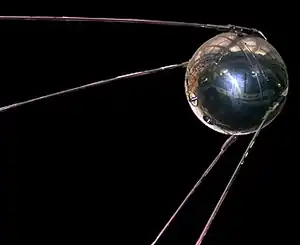
Bottom, L-R: Smoke rises from oil tanks on Port Said following the invasion of Egypt as part of the Suez Crisis in late 1956; The Hungarian flag with the Communist coat of arms cut out during the Hungarian Revolution, 1957; The Soviet Union launches Sputnik 1, the first artificial satellite to orbit the earth, in October 1957.
The 1950s (pronounced nineteen-fifties; commonly abbreviated as the "Fifties" or the "'50s") (among other variants) was a decade that began on 1 January 1950, and ended on 31 December 1959.
The 1952 Winter Olympics, officially known as the VI Olympic Winter Games (Norwegian: De 6. olympiske vinterleker; Nynorsk: Dei 6. olympiske vinterleikane) and commonly known as Oslo 1952, were a winter multi-sport event held from 14 to 25February 1952 in Oslo, the capital of Norway.
Discussions about Oslo hosting the Winter Olympic Games began as early as 1935; the city was keen to host the 1948 Winter Olympics, but that was made impossible by World War II. Instead, Oslo won the right to host the 1952 Games in a contest that included Cortina d'Ampezzo in Italy and Lake Placid in the United States. All of the Olympic venues were in Oslo's metropolitan area, except for the alpine skiing events, which were held at Norefjell, 113km (70mi) from the capital. A new hotel was built for the press and dignitaries, along with three dormitories to house athletes and coaches, creating the first modern athlete's village. Oslo bore the financial burden of hosting the Games in return for the revenue they generated. The 1952 Winter Olympics was the first of the two consecutive Olympics to be held in Northern Europe, preceding the 1952 Summer Olympics in Helsinki, Finland. (Full article...)
... that Alan Choe was tasked with developing Queenstown, Singapore's first satellite town, after its British architects left the country in the mid-1950s?
Production began after the success of Mayabazar (1957), with M. S. Chalapathi Rao and Jagannadham the film's executive producers. Marcus Bartley was the director of photography. S. Rajeswara Rao composed the soundtrack and background score. G. Kalyanasundaram and K. Radhakrishna edited the film, and Madhavapeddi Gokhale and Kaladhar were its art directors. The film is shown almost entirely in black and white, with the exception of a dance sequence filmed in Gevacolor. (Full article...)
Pelli Chesi Choodu deals with the negative effects of the dowry system in India through the marital life of Venkata Ramana (Rama Rao) and Ammadu (Varalakshmi). The film's production began after the release of Vijaya Productions' Pathala Bhairavi (1951). Marcus Bartley was recruited as the cinematographer and the film was edited by C. P. Jambulingam and M. S. Money. Ghantasala composed the film's music. (Full article...)
Image 3
Madhumati is a 1958 Indian Hindi-language paranormal romance film directed and produced by Bimal Roy, with a story and screenplay written by Ritwik Ghatak. The film stars Vyjayanthimala and Dilip Kumar in the lead roles, with Pran and Johnny Walker in supporting roles. The plot focuses on Anand, a modern man who falls in love with a tribal woman named Madhumati. However, they face challenges in their relationship finally leading to a paranormal consequence. The film was ranked 11th in the Outlook Magazine's 25 leading Indian directors' poll for selecting Bollywood's greatest films in 2003.
Fellini described La Strada as "a complete catalogue of my entire mythological world, a dangerous representation of my identity that was undertaken with no precedent whatsoever". As a result, the film demanded more time and effort than any of his other works, before or later. The development process was long and tortuous; there were problems during production, including insecure financial backing, problematic casting, and numerous delays. Finally, just before the production completed shooting, Fellini suffered a nervous breakdown that required medical treatment so that he could complete principal photography. Initial critical reaction was harsh, and the film's screening at the Venice Film Festival was the occasion of a bitter controversy that escalated into a public brawl between Fellini's supporters and detractors. (Full article...)
The film concerns three astronauts who have been launched into space aboard a single-stage-to-orbit rocket designed by Professor Quatermass. It crashlands with only one of its original crew, Victor Carroon (Wordsworth), still aboard. He begins mutating into an alien organism, which, if it spawns, will engulf the Earth and destroy humanity. After Carroon escapes from custody Quatermass and Inspector Lomax (Warner) of Scotland Yard have just hours to track him/it down and prevent a catastrophe. (Full article...)
Godzilla entered production after a Japanese-Indonesian co-production collapsed. Tsuburaya originally proposed a giant octopus before the filmmakers decided on a dinosaur-inspired creature. Godzilla pioneered a form of special effects called suitmation in which a stunt performer wearing a suit interacts with miniature sets. Principal photography ran 51 days, and special effects photography ran 71 days. (Full article...)
Pathala Bhairavi is based on Kasi Majili Kathalu, written by Madhira Subbanna Deekshitulu, though it was also partially inspired by the story of Aladdin. As the film is shot as a bilingual, production lasted for a whole year starting from 5 February 1950 until 8 February 1951. Ghantasala composed the film's music and Marcus Bartley served as the cinematographer. The film was edited by the duo C. P. Jambulingam and M. S. Money, while Madhavapeddi Gokhale and Kaladhar were the film's art directors. (Full article...)
In 1955, Edmund Goldman acquired the 1954 film from Toho and enlisted the aid of Paul Schreibman, Harold Ross, Richard Kay, and Joseph E. Levine to produce a revised version for American audiences. This version dubbed most of the Japanese dialogue into English, and altered and removed key plot points and themes. New footage was produced with Burr interacting with body doubles and Japanese-American actors in an attempt to make it seem like Burr was part of the original Japanese production. (Full article...)
Image 9
Missamma (transl.Miss madam) is a 1955 Indian Telugu-language romantic comedy film directed by L. V. Prasad. It was produced by Nagi Reddi and Chakrapani on Vijaya Productions banner. The film stars N. T. Rama Rao, Savitri, Akkineni Nageswara Rao and Jamuna. The script was adapted by Chakrapani from Rabindranath Maitra's Bengali play Manmoyee Girls' School. It revolves around two unemployed people— M. T. Rao and Mary— who pose as a married couple to obtain employment in a high school founded by Gopalam, a zamindar. As Rao and Mary fall in love, Gopalam's nephew A. K. Raju learns that Mary is Gopalam's missing elder daughter Mahalakshmi; she is unaware of her true identity.
Production began in early 1954 with P. Bhanumathi cast as the female lead, though she would eventually be replaced by Savitri. The film was simultaneously shot in Tamil as Missiamma, with an altered cast. Principal photography ended that December; filming was delayed because of Bhanumathi's exit after filming a few reels, and the difficulty of managing two casts simultaneously. C. P. Jambulingam and Kalyanam edited the film; Marcus Bartley was the cinematographer, and S. Rajeswara Rao composed the music. Missamma focused on social issues such as unemployment, corruption, and freedom of worship. (Full article...)
Image 10
Tiga Dara (Indonesian for Three Maidens) is a 1957 Indonesian musicaldrama film starring Chitra Dewi, Mieke Wijaya, and Indriati Iskak. Directed by Usmar Ismail for Perfini, the film follows three sisters who live with their father and grandmother. When the eldest sister, Nunung, shows no interest in marrying, her family tries unsuccessfully to find a husband for her. Nunung initially rejects the advances of a young man named Toto, who instead dates her younger sister. However, when he becomes jealous and travels from Jakarta to Bandung to profess his love, she agrees to marry him.
Produced using government credit and written in an attempt to cover Perfini's outstanding debts, Tiga Dara was intended to be commercial despite Ismail's disapproval of such works. After it was released on 24 August 1957, the film was an immense popular success, launching the careers of its stars, earning the highest box office returns of any Perfini film, and being screened in first-class cinemas. However, even though Tiga Dara was shown at the 1959 Venice Film Festival and received Best Musical Arrangement at the 1960 Indonesian Film Week, Ismail considered it a compromise of his initial vision for Perfini. (Full article...)
Image 11
Night of the Blood Beast is a 1958 American science-fictionhorror film about a team of scientists who are stalked by an alien creature, which implants its embryos in an astronaut's body during a space flight. Produced by exploitation filmmaker Roger Corman and his brother Gene, it was one of the first films directed by Bernard L. Kowalski and was written by first-time screenwriter Martin Varno, who was 21 years old. It starred several actors who had regularly worked with Roger Corman, including Michael Emmet, Ed Nelson, Steve Dunlap, Georgianna Carter and Tyler McVey. Blood Beast was distributed on September 8, 1958 by American International Pictures in the Texas area as a double feature with Corman's She Gods of Shark Reef (1958). The same double feature went into wider release on December 5, 1958 in other markets.
The film's story concerns Quatermass's investigation of reports of hundreds of meteorites landing only in the Winnerden Flats area of the UK. His inquiries lead him to a huge industrial complex, strikingly similar to his own plans for a Moon colony. This top-secret facility is in fact the centre of a conspiracy involving the alien infiltration of the highest echelons of the British Government. Quatermass and his allies must now do whatever is necessary to defeat the alien threat before it is too late. (Full article...)
Image 13
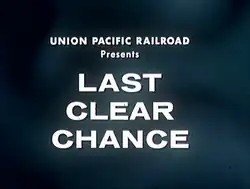
Title card
Last Clear Chance is a 1959 American short film produced and directed by Robert Carlisle. Sponsored by the Union Pacific Railroad, Last Clear Chance is a safety film intended to warn young drivers to be careful at railroad crossings. The film's cast consists of William Boyett, Harold Agee, Mrs. Harold Agee, Tim Bosworth, William Agee, Christine Lynch, and Lou Spraker. Written by Leland Baxter, the film was shot in parts of Idaho. Wondsel, Carlisle & Dunphy Inc, based in New York City, served as the film's production company.
The film centers on the Dixon family, in particular Alan Dixon, who has recently received his driver's license and is eager to begin driving a car. When Idaho State Trooper Hal Jackson visits the Dixons and learns that Alan's license has arrived, he sits down and tells Alan ways to drive safely and avoid getting into accidents. Although the film is fictional, it was inspired by a real family who experienced a scenario similar to the film. During production, assistance was provided by staff of the National Safety Council, along with the Idaho State Police and the Colorado State Patrol. (Full article...)
The film is loosely based on the story of Veerapandiya Kattabomman, an 18th-century king who rebelled against the East India Company. It was an adaptation of the play of the same name by Sakthi T. K. Krishnasamy which featured Sivaji Ganesan as the title character, and premiered in August 1957. Principal photography began in October the same year, and took place mainly in Jaipur and Madras (now Chennai) until late 1958. This was the first full-length Tamil film released in Technicolor. (Full article...)
Image 15
Theatrical release poster
The Incredible Shrinking Man is a 1957 American science fiction film directed by Jack Arnold, based on Richard Matheson's 1956 novel, The Shrinking Man. The film stars Grant Williams as Scott and Randy Stuart as Scott's wife, Louise. While relaxing on a boat, Scott is enveloped by a strange fog. Months later, he discovers that he appears to be shrinking. By the time Scott has reached the height of a small boy, his condition becomes known to the public. When he learns there is no cure for his condition, he lashes out at his wife. As Scott shrinks to the point where he can fit into a dollhouse, he has a battle with his family cat, leaving him lost and alone in his basement, where he is now smaller than the average insect.
The film's storyline was expanded by Matheson after he had sold the story to Universal-International Pictures Co., Inc. He also completed the novel upon which the film is based while production was underway. Matheson's script was initially written in flashbacks, and Richard Alan Simmons rewrote it using a more conventional narrative structure. Director Jack Arnold initially wanted Dan O'Herlihy to play Scott, but O'Herlihy turned down the role, leading Universal to sign Williams as the lead. Filming began on May 31, 1956. Scenes involving special effects were shot throughout production, while others used the large sets of Universal's backlot. Production went over budget, and filming had to be extended; certain special effects shots required reshooting. Williams was constantly being injured on set. (Full article...)
Image 5Presidents Eduardo Lonardi and Pedro Aramburu, the first and second leader of the "Revolución Libertadora" dictatorship in Argentina. (from 1950s)
Image 17Castle Bravo: A 15 megaton hydrogen bomb experiment conducted by the United States in 1954. Photographed 78 miles (125 kilometers) from the explosion epicenter. (from 1950s)
Image 18Elvis Presley was the best-selling musical artist of the decade. He is considered as the leading figure of the rock and roll and rockabilly movement of the 1950s. (from 1950s)
Image 19Israeli troops preparing for combat in the Sinai peninsula during the Suez Crisis. (from 1950s)
... that Alan Choe was tasked with developing Queenstown, Singapore's first satellite town, after its British architects left the country in the mid-1950s?
... that Sandra Caron changed her name to avoid associations with a woman once described as "the most highly paid woman in British show business in the 1950s and 1960s"?
... that a group of 25 women disfigured by the atomic bombing of Hiroshima traveled to the United States in the 1950s to receive reconstructive surgery?
... that in the 1950s Michel Klein opened one of the first veterinary practices in Paris?
... that Nicolae Moromete, who tortured prisoners of the Romanian communist regime in the 1950s, fought the Soviet Union in World WarII?
Wikiprojects
You are invited to participate in WikiProject Years, a WikiProject dedicated to developing and improving articles about years, decades, centuries, and millennia.














 Commons
 Wikidata
 Wikiquote
 Wikisource
 Wikiversity
 Wiktionary
 List of all portals






 Random portal
 WikiProject Portals