Portal:Physics

The Physics Portal


Physics is the scientific study of matter, its fundamental constituents, its motion and behavior through space and time, and the related entities of energy and force. It is one of the most fundamental scientific disciplines. A scientist who specializes in the field of physics is called a physicist.
Physics is one of the oldest academic disciplines. Over much of the past two millennia, physics, chemistry, biology, and certain branches of mathematics were part of natural philosophy, but during the Scientific Revolution in the 17th century, these natural sciences branched into separate research endeavors. Physics intersects with many interdisciplinary areas of research, such as biophysics and quantum chemistry, and the boundaries of physics are not rigidly defined. New ideas in physics often explain the fundamental mechanisms studied by other sciences and suggest new avenues of research in these and other academic disciplines, such as mathematics and philosophy.
Advances in physics often enable new technologies. For example, advances in the understanding of electromagnetism, solid-state physics, and nuclear physics led directly to the development of technologies that have transformed modern society, such as television, computers, domestic appliances, and nuclear weapons; advances in thermodynamics led to the development of industrialization; and advances in mechanics inspired the development of calculus. (Full article...)
 Featured article -
In physics, M-theory is a theory that unifies all consistent versions of superstring theory. Edward Witten first conjectured the existence of such a theory at a string theory conference at the University of Southern California in 1995. Witten's announcement initiated a flurry of research activity known as the second superstring revolution. Prior to Witten's announcement, string theorists had identified five versions of superstring theory. Although these theories initially appeared to be very different, work by many physicists showed that the theories were related in intricate and nontrivial ways. Physicists found that apparently distinct theories could be unified by mathematical transformations called S-duality and T-duality. Witten's conjecture was based in part on the existence of these dualities and in part on the relationship of the string theories to a field theory called eleven-dimensional supergravity.
Although a complete formulation of M-theory is not known, such a formulation should describe two- and five-dimensional objects called branes and should be approximated by eleven-dimensional supergravity at low energies. Modern attempts to formulate M-theory are typically based on matrix theory or the AdS/CFT correspondence. According to Witten, the M should stand for "magic", "mystery" or "membrane" (according to one's taste), and the true meaning of the title should be decided when a more fundamental formulation of the theory is known. (Full article...)
Did you know -

- ... that lasers can be used to separate two isotopes very efficiently?
- ... that your feet are slightly younger than your head, because time runs slow at a lower Gravitational Potential. This is a consequence of Gravitational Time Dilation
- ...that Max Planck created a system of measurement based solely on natural units?
Selected image -

Plasma lamps are a type of electrodeless gas-discharge lamp energized by radio frequency (RF) power. They are distinct from the novelty plasma lamps that were popular in the 1980s.
The internal-electrodeless lamp was invented by Nikola Tesla after his experimentation with high-frequency currents in evacuated glass tubes for the purposes of lighting and the study of high voltage phenomena. The first practical plasma lamps were the sulfur lamps manufactured by Fusion Lighting. This lamp suffered several practical problems and did not prosper commercially. Plasma lamps with an internal phosphor coating are called external electrode fluorescent lamps (EEFL); these external electrodes or terminal conductors provide the radio frequency electric field. (Full article...)
Related portals
 Good articles -

Frederick Reines (/ˈraɪnəs/ RY-nəs; March 16, 1918 – August 26, 1998) was an American physicist. He was awarded the 1995 Nobel Prize in Physics for his co-detection of the neutrino with Clyde Cowan in the neutrino experiment. He may be the only scientist in history "so intimately associated with the discovery of an elementary particle and the subsequent thorough investigation of its fundamental properties."
A graduate of Stevens Institute of Technology and New York University, Reines joined the Manhattan Project's Los Alamos Laboratory in 1944, working in the Theoretical Division in Richard Feynman's group. He became a group leader there in 1946. He participated in a number of nuclear tests, culminating in his becoming the director of the Operation Greenhouse test series in the Pacific in 1951. (Full article...)- Flerovium is a synthetic chemical element; it has symbol Fl and atomic number 114. It is an extremely radioactive, superheavy element, named after the Flerov Laboratory of Nuclear Reactions of the Joint Institute for Nuclear Research in Dubna, Russia, where the element was discovered in 1999. The lab's name, in turn, honours Russian physicist Georgy Flyorov (Флёров in Cyrillic, hence the transliteration of "yo" to "e"). IUPAC adopted the name on 30 May 2012. The name and symbol had previously been proposed for element 102 (nobelium) but were not accepted by IUPAC at that time.
It is a transactinide in the p-block of the periodic table. It is in period 7 and is the heaviest known member of the carbon group. Initial chemical studies in 2007–2008 indicated that flerovium was unexpectedly volatile for a group 14 element. More recent results show that flerovium's reaction with gold is similar to that of copernicium, showing it is very volatile and may even be gaseous at standard temperature and pressure. Nonetheless, it also seems to show some metallic properties, consistent with it being the heavier homologue of lead. (Full article...) 
Rendering of the LIFE.1 fusion power plant. The fusion system is in the large cylindrical containment building in the center.
LIFE, short for Laser Inertial Fusion Energy, was a fusion energy effort run at Lawrence Livermore National Laboratory between 2008 and 2013. LIFE aimed to develop the technologies necessary to convert the laser-driven inertial confinement fusion concept being developed in the National Ignition Facility (NIF) into a practical commercial power plant, a concept known generally as inertial fusion energy (IFE). LIFE used the same basic concepts as NIF, but aimed to lower costs using mass-produced fuel elements, simplified maintenance, and diode lasers with higher electrical efficiency.
Two designs were considered, operated as either a pure fusion or hybrid fusion-fission system. In the former, the energy generated by the fusion reactions is used directly. In the latter, the neutrons given off by the fusion reactions are used to cause fission reactions in a surrounding blanket of uranium or other nuclear fuel, and those fission events are responsible for most of the energy release. In both cases, conventional steam turbine systems are used to extract the heat and produce electricity. (Full article...)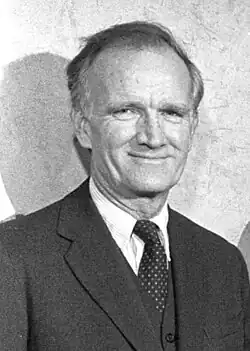
Val Logsdon Fitch (March 10, 1923 – February 5, 2015) was an American nuclear physicist who, with co-researcher James Cronin, was awarded the 1980 Nobel Prize in Physics for a 1964 experiment using the Alternating Gradient Synchrotron at Brookhaven National Laboratory that proved that certain subatomic reactions do not adhere to fundamental symmetry principles. Specifically, they proved, by examining the decay of K-mesons, that a reaction run in reverse does not retrace the path of the original reaction, which showed that the reactions of subatomic particles are not indifferent to time. Thus the phenomenon of CP violation was discovered. This demolished the faith that physicists had that natural laws were governed by symmetry.
Born on a cattle ranch near Merriman, Nebraska, Fitch was drafted into the U.S. Army during World War II, and worked on the Manhattan Project at the Los Alamos Laboratory in New Mexico. He later graduated from McGill University, and completed his PhD in physics in 1954 at Columbia University. He was a member of the faculty at Princeton University from 1954 until his retirement in 2005. (Full article...)
Robert Rathbun Wilson (March 4, 1914 – January 16, 2000) was an American physicist known for his work on the Manhattan Project during World War II, as a sculptor, and as an architect of the Fermi National Accelerator Laboratory (Fermilab), where he was the first director from 1967 to 1978.
A graduate of the University of California, Berkeley, Wilson received his doctorate under the supervision of Ernest Lawrence for his work on the development of the cyclotron at the Berkeley Radiation Laboratory. He subsequently went to Princeton University to work with Henry DeWolf Smyth on electromagnetic separation of the isotopes of uranium. In 1943, Wilson and many of his colleagues joined the Manhattan Project's Los Alamos Laboratory, where Wilson became the head of its Cyclotron Group (R-1), and later its Research (R) Division. (Full article...)- An antimetric electrical network is an electrical network that exhibits anti-symmetrical electrical properties. The term is often encountered in filter theory, but it applies to general electrical network analysis. Antimetric is the diametrical opposite of symmetric; it does not merely mean "asymmetric" (i.e., "lacking symmetry"). It is possible for networks to be symmetric or antimetric in their electrical properties without being physically or topologically symmetric or antimetric. (Full article...)

Noctilucent clouds (NLCs), or night shining clouds, are tenuous cloud-like phenomena in the upper atmosphere. When viewed from space, they are called polar mesospheric clouds (PMCs), detectable as a diffuse scattering layer of water ice crystals near the summer polar mesopause. They consist of ice crystals and from the ground are only visible during astronomical twilight. Noctilucent roughly means "night shining" in Latin. They are most often observed during the summer months from latitudes between ±50° and ±70°. Too faint to be seen in daylight, they are visible only when the observer and the lower layers of the atmosphere are in Earth's shadow while these very high clouds are still in sunlight. Recent studies suggest that increased atmospheric methane emissions produce additional water vapour through chemical reactions once the methane molecules reach the mesosphere – creating, or reinforcing existing, noctilucent clouds. (Full article...)
Philip Morrison (November 7, 1915 – April 22, 2005) was an American professor of physics at the Massachusetts Institute of Technology (MIT). He is known for his work on the Manhattan Project during World War II, and for his later work in quantum physics, nuclear physics, high energy astrophysics, and SETI.
A graduate of Carnegie Tech, Morrison became interested in physics, which he studied at the University of California, Berkeley, under the supervision of J. Robert Oppenheimer. He also joined the Communist Party. During World War II he joined the Manhattan Project's Metallurgical Laboratory at the University of Chicago, where he worked with Eugene Wigner on the design of nuclear reactors. (Full article...)
Floating Clouds (sometimes called Flying Saucers by the artist) is a work of art by American sculptor Alexander Calder, located in the Aula Magna of the University City of Caracas in Venezuela. The 1953 work comprises many 'cloud' panels that are renowned both artistically and acoustically. The piece is seen as "one of Calder's most truly monumental works" and the prime example of the urban-artistic theory of campus architect Carlos Raúl Villanueva.
Originally intended as only an art piece, the panels were moved inside the Aula Magna to resolve the poor acoustics caused by the hall's design; the hall has since been said to have some of the best acoustics in the world. The Floating Clouds are named specifically in the UNESCO listing of the campus as a World Heritage Site, and are greatly renowned in Venezuela. (Full article...)
Experiments on European robins, which are migratory, suggest their magnetic sense makes use of the quantum radical pair mechanism.
Magnetoreception is a sense which allows an organism to detect the Earth's magnetic field. Animals with this sense include some arthropods, molluscs, and vertebrates (fish, amphibians, reptiles, birds, and mammals). The sense is mainly used for orientation and navigation, but it may help some animals to form regional maps. Experiments on migratory birds provide evidence that they make use of a cryptochrome protein in the eye, relying on the quantum radical pair mechanism to perceive magnetic fields. This effect is extremely sensitive to weak magnetic fields, and readily disturbed by radio-frequency interference, unlike a conventional iron compass. Some bacteria orient passively using magnetite crystals; the mechanism has not been reliably detected in eukaryotes.
Cartilaginous fish including sharks and stingrays can detect small variations in electric potential with their electroreceptive organs, the ampullae of Lorenzini. These appear to be able to detect magnetic fields by induction. There is some evidence that these fish use magnetic fields in navigation. (Full article...)
Alvin Cushman Graves (November 4, 1909 – July 28, 1965) was an American nuclear physicist who served at the Manhattan Project's Metallurgical Laboratory and the Los Alamos Laboratory during World War II. After the war, he became the head of the J (Test) Division at Los Alamos and was director or assistant director of numerous nuclear weapons tests during the 1940s and 1950s. Graves was severely injured in the 1946 laboratory criticality accident in Los Alamos that killed Louis Slotin, but recovered. (Full article...)- The Ames Project was a research and development project that was part of the larger Manhattan Project to build the first atomic bombs during World War II. It was founded by Frank Spedding from Iowa State College in Ames, Iowa as an offshoot of the Metallurgical Laboratory at the University of Chicago devoted to chemistry and metallurgy, but became a separate project in its own right. The Ames Project developed the Ames Process, a method for preparing pure uranium metal that the Manhattan Project needed for its atomic bombs and nuclear reactors. Between 1942 and 1945, it produced over 1,000 short tons (910 t) of uranium metal. It also developed methods of preparing and casting thorium, cerium and beryllium. In October 1945 Iowa State College received the Army-Navy "E" Award for Excellence in Production, an award usually only given to industrial organizations. In 1947 it became the Ames Laboratory, a national laboratory under the Atomic Energy Commission. (Full article...)

Calutron Girls photographed by Ed Westcott at their calutron control panels at Y-12
The Calutron Girls were a group of young women—mostly high school graduates—who had joined the Manhattan Project at the Y-12 National Security Complex located at Oak Ridge, Tennessee, from 1943 to 1945. Although they were not allowed to know at the time, they were monitoring dials and watching meters for calutrons, mass spectrometers adapted for separation of uranium isotopes for the development of nuclear weapons for use during World War II. The enriched uranium was used to make the "Little Boy" atomic bomb for the Hiroshima nuclear bombing on August 6, 1945. (Full article...)
Klaus Emil Julius Fuchs (29 December 1911 – 28 January 1988) was a German theoretical physicist, atomic spy, and communist who supplied information from the American, British, and Canadian Manhattan Project to the Soviet Union during and shortly after World War II. While at the Los Alamos Laboratory, Fuchs was responsible for many significant theoretical calculations relating to the first nuclear weapons and, later, early models of the hydrogen bomb. After his conviction in 1950, he served nine years in prison in the United Kingdom, then migrated to East Germany where he resumed his career as a physicist and scientific leader.
The son of a Lutheran pastor, Fuchs attended the University of Leipzig, where his father was a professor of theology, and became involved in student politics, joining the student branch of the Social Democratic Party of Germany (SPD), and the Reichsbanner Schwarz-Rot-Gold, an SPD-allied paramilitary organisation. He was expelled from the SPD in 1932, and joined the Communist Party of Germany (KPD). He went into hiding after the 1933 Reichstag fire and the subsequent persecution of communists in Nazi Germany, and fled to the United Kingdom, where he received his PhD from the University of Bristol under the supervision of Nevill Francis Mott, and his DSc from the University of Edinburgh, where he worked as an assistant to Max Born. (Full article...)- In modern cosmological theory, diffusion damping, also called photon diffusion damping, is a physical process which reduced density inequalities (anisotropies) in the early universe, making the universe itself and the cosmic microwave background radiation (CMB) more uniform. Around 300,000 years after the Big Bang, during the epoch of recombination, diffusing photons travelled from hot regions of space to cold ones, equalising the temperatures of these regions. This effect is responsible, along with baryon acoustic oscillations, the Doppler effect, and the effects of gravity on electromagnetic radiation, for the eventual formation of galaxies and galaxy clusters, these being the dominant large scale structures which are observed in the universe. It is a damping by diffusion, not of diffusion.
The strength of diffusion damping is calculated by a mathematical expression for the damping factor, which figures into the Boltzmann equation, an equation which describes the amplitude of perturbations in the CMB. The strength of the diffusion damping is chiefly governed by the distance photons travel before being scattered (diffusion length). The primary effects on the diffusion length are from the properties of the plasma in question: different sorts of plasma may experience different sorts of diffusion damping. The evolution of a plasma may also affect the damping process. The scale on which diffusion damping works is called the Silk scale and its value corresponds to the size of galaxies of the present day. The mass contained within the Silk scale is called the Silk mass and it corresponds to the mass of the galaxies. (Full article...)


August anniversaries
- 2 August 1932 – The positron is discovered by Carl D. Anderson.
- 2 August 1939 – Einstein and Leó Szilárd urge Franklin D. Roosevelt to begin the Manhattan Project.
- 3 August 1958 – USS Nautilus under the Arctic ice cap.
- 3 August 1972 – U.S. Senate ratifies Anti-Ballistic Missile Treaty.
Birthdays
- 1820 - John Tyndall 2 August
- 1871 - Ernest Rutherford 30 August
- 1887 - Erwin Schrödinger 12 August
- 1902 - Paul Dirac 8 August
- 1931 – Roger Penrose 8 August
- 1934 - Valery Bykovsky 2 August
- 1951 - Edward Witten 26 August
- 1959 – Koichi Tanaka 3 August
- 1776 - Amedeo Avogadro. 9 August
Deaths
- 2 August 1922 – Alexander Graham Bell
- 3 August 1942 – Richard Willstätter, Nobel laureate
- 28 August 2006 - Melvin Schwartz, Nobel laureate
General images
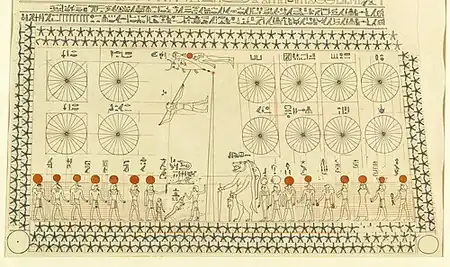 Ancient Egyptian astronomy is evident in monuments like the ceiling of Senemut's tomb from the Eighteenth Dynasty of Egypt. (from History of physics)
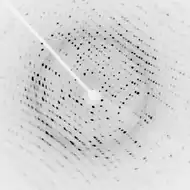 Image of X-ray diffraction pattern from a protein crystal (from Condensed matter physics)
 Sir Isaac Newton (1642–1727) (from History of physics)
 Composite montage comparing Jupiter (left) and its four Galilean moons (from top: Io, Europa, Ganymede, Callisto) (from History of physics)

 Albert Einstein (1879–1955), ca. 1905 (from History of physics)
 One possible signature of a Higgs boson from a simulated proton–proton collision. It decays almost immediately into two jets of hadrons and two electrons, visible as lines. (from History of physics)
 Marie Skłodowska-Curie
(1867–1934) received Nobel prizes in physics (1903) and chemistry (1911). (from History of physics) Heike Kamerlingh Onnes and Johannes van der Waals with the helium liquefactor at Leiden in 1908 (from Condensed matter physics)
 Magdeburg hemispheres, an experiment by Otto von Guericke where two metal hemispheres are held together by vacuum and cannot be separated even if large forces are applied. (from History of physics)
 An engraving of Benjamin Franklin's kite experiment used to study lightning. (from History of physics)
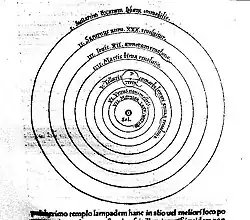
 The Hindu-Arabic numeral system. The inscriptions on the edicts of Ashoka (3rd century BCE) display this number system being used by the Imperial Mauryas. (from History of physics)
 Maxwell's demon, thought experiment by James Clerk Maxwell to describe the kinetic theory of gases and describe how a microscopic creature could lead to violations of the second law of thermodynamics. (from History of physics)
 Christiaan Huygens (1629–1695) (from History of physics)
 Galileo Galilei (1564–1642), early proponent of the modern scientific worldview and method (from History of physics)
 Classical physics (Rayleigh–Jeans law, black line) failed to explain black-body radiation – the so-called ultraviolet catastrophe. The quantum description (Planck's law, colored lines) is said to be modern physics. (from Modern physics)
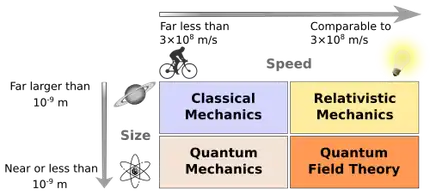 Classical physics is usually concerned with everyday conditions: speeds are much lower than the speed of light, sizes are much greater than that of atoms, yet very small in astronomical terms. Modern physics, however, is concerned with high velocities, small distances, and very large energies. (from Modern physics)
 A Feynman diagram representing (left to right) the production of a photon (blue sine wave) from the annihilation of an electron and its complementary antiparticle, the positron. The photon becomes a quark–antiquark pair and a gluon (green spiral) is released. (from History of physics)

 Crookes tube used to study cathode rays. It led to the discovery of the electron by J. J. Thomson. (from History of physics)
 The ancient Greek mathematician Archimedes, developer of ideas regarding fluid mechanics and buoyancy. (from History of physics)
 Chien-Shiung Wu worked on parity violation in 1956 and announced her results in January 1957. (from History of physics)
 Johannes Kepler's first law of planetary motion states that planets move in elliptical orbits about the Sun. (from History of physics)
 Einstein proposed that gravitation results from masses (or their equivalent energies) curving ("bending") the spacetime in which they exist, altering the paths they follow within it. (from History of physics)
 Computer simulation of nanogears made of fullerene molecules. It is hoped that advances in nanoscience will lead to machines working on the molecular scale. (from Condensed matter physics)


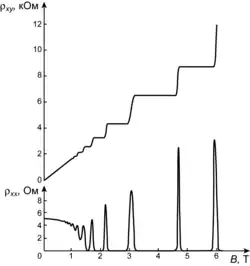 The quantum Hall effect: Components of the Hall resistivity as a function of the external magnetic field (from Condensed matter physics)
 A magnet levitating above a high-temperature superconductor. Today some physicists are working to understand high-temperature superconductivity using the AdS/CFT correspondence. (from Condensed matter physics)
 The Voltaic pile, the first battery was invented by Alessandro Volta in 1800 (from History of physics)

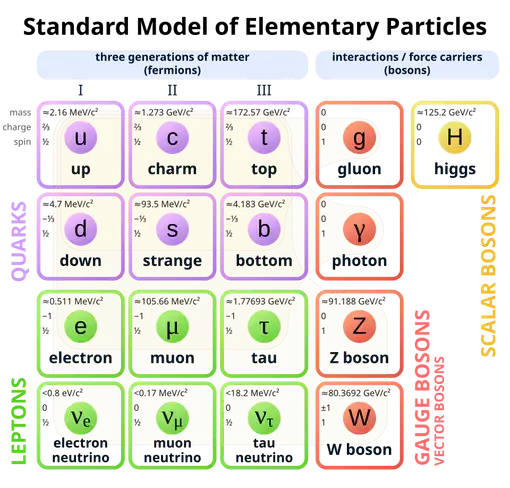 The Standard Model (from History of physics)
 James Prescott Joule's apparatus for measuring the mechanical equivalent of heat which the "work" of the falling weight is converted into the "heat" of agitation in the water. (from History of physics)
 Leonardo da Vinci (from History of physics)
 Richard Feynman's Los Alamos ID badge (from History of physics)
 Torricelli's experiment (from History of physics)
 The first Bose–Einstein condensate observed in a gas of ultracold rubidium atoms. The blue and white areas represent higher density. (from Condensed matter physics)
 1927 Solvay Conference included prominent physicists Albert Einstein, Werner Heisenberg, Max Planck, Hendrik Lorentz, Niels Bohr, Marie Curie, Erwin Schrödinger, Paul Dirac (from History of physics)
 Hydrogen emission spectrum is discrete (here in log scale). The lines can only be explained with quantum mechanics. (from History of physics)
 Star maps by the 11th century Chinese polymath Su Song are the oldest known woodblock-printed star maps to have survived to the present day. This example, dated 1092, employs the cylindricalequirectangular projection. (from History of physics)
 Newton's cannonball, a though experiment by Newton relating the motion of a projectile and orbiting of planets. (from History of physics)
Categories

Fundamentals: Concepts in physics | Constants | Physical quantities | Units of measure | Mass | Length | Time | Space | Energy | Matter | Force | Gravity | Electricity | Magnetism | Waves
Basic physics: Mechanics | Electromagnetism | Statistical mechanics | Thermodynamics | Quantum mechanics | Theory of relativity | Optics | Acoustics
Specific fields: Acoustics | Astrophysics | Atomic physics | Molecular physics | Optical physics | Computational physics | Condensed matter physics | Nuclear physics | Particle physics | Plasma physics
Tools: Detectors | Interferometry | Measurement | Radiometry | Spectroscopy | Transducers
Background: Physicists | History of physics | Philosophy of physics | Physics education | Physics journals | Physics organizations
Other: Fiction about physics | Physics lists | Physics software | Physics stubs
Physics topics
Classical physics traditionally includes the fields of mechanics, optics, electricity, magnetism, acoustics and thermodynamics. The term Modern physics is normally used for fields which rely heavily on quantum theory, including quantum mechanics, atomic physics, nuclear physics, particle physics and condensed matter physics. General and special relativity are usually considered to be part of modern physics as well.
More recognized content

Associated Wikimedia
The following Wikimedia Foundation sister projects provide more on this subject:
-
 Commons
Free media repository -
 Wikidata
Free knowledge base -
 Wikiquote
Collection of quotations -
 Wikisource
Free-content library -
 Wikiversity
Free learning tools -
 Wikivoyage
Free travel guide -
 Wiktionary
Dictionary and thesaurus
Sources
Portals on Wikipedia
-
 List of all portals
-

-

-

-

-

-

-

-

-

-
 Random portal
-
 WikiProject Portals