Odegal basadi
| Odegal basadi | |
|---|---|
 Odegal Basadi | |
| Religion | |
| Affiliation | Jainism |
| Deity | Rishabhanatha, Neminatha, Shantinatha |
| Festival | Mahavir Jayanti |
| Location | |
| Location | Shravana Belgola, Hassan, Karnataka |
Interactive map of Odegal basadi | |
| Coordinates | 12°51′18″N 76°29′06″E / 12.85500°N 76.48500°E |
| Architecture | |
| Style | Dravidian architecture |
| Established | 14th century |
Odegal basadi or Vadegal basadi is the largest basadi located on the Vindhyagiri Hill in Shravanabelagola in the Indian state of Karnataka.
About temple
Odegal basadi is a granite temple built in 14th century and is the largest temple on the Vindhyagiri Hill.[1][2] The temple derives its name from 'Odega', i.e., soapstone used for strengthening the walls of the temple.[3] The name refers more specifically to the stone supports or props placed against the basement walls of the structure. These supports are a distinctive feature of the exterior of the temple.[2] The temple has three cells facing different directions, giving the name Trirukta Basadi or trikuta Basadi.[4] 'The three sanctuaries are arranged around a common hall, making Odegal Basadi the principal trikuta, or triple-shrine, Jain temple on Vindhyagiri. The temple has splended structure with non-ornate exterior.[5] The temple houses image of Rishabhanatha, Neminatha and Shantinatha made out of dark coloured schist.[1][6]
The three Jina images correspond to the three sanctuaries of the trikuta plan. Rishabhanatha, also known as Adinatha, occupies the principal shrine, while the other sanctuaries contain images of Neminatha and Shantinatha.[2] Unlike many of the more elaborately decorated Jain monuments at Shravanabelagola, the exterior of Odegal Basadi is comparatively plain, with the architectural emphasis placed on the massive granite construction and triple-shrine arrangement.
The Gommateshwara statue, Siddhara basti, Chennanna basti, and Chauvisa Tirthankara basti are the important temple near Odegal basadi.[7]
Architecture
Odegal Basadi is constructed principally of large granite blocks. Its plan consists of three sanctuaries facing different directions and connected through a common hall. The triple-sanctuary arrangement accounts for the alternative name Trikuta Basadi.[2] The temple is distinguished externally by the stone props placed against the basement walls. These structural supports gave rise to the name Odegal or Vadegal Basadi.[5] The relatively austere exterior contrasts with the dark schist images of the three Tirthankaras housed within the temple.[6]
Inscriptions
A group of inscriptions survives on the exposed rock outside the first entrance of Odegal Basadi. The Mysore Gazetteer records ten inscriptions at this location and describes their characters as older than those of the earliest inscription previously known from Vindhyagiri Hill. These records form part of the much larger corpus of inscriptions at Shravanabelagola, which provides evidence fo the long history of Jain religious activity and patronage at the site. The inscriptions around Odegal Basadi should be distinguished chronologically from the present temple structure: the inscriptions on the surrounding rock include material predating the 14th-century temple.[8]
Protection
The Archaeological Survey of India has listed Odegal Basadi as part of the group of monuments at Shravanabelagola included under the Adarsh Smarak scheme.[9][10]
Gallery
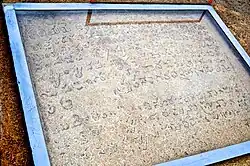 Kannada inscription
 Adinatha statue
 Shantinatha statue
 Neminatha statue
See also
References
Citations
- 1 2 Deccan Herald 2020.
- 1 2 3 4 Raman 1994, p. 57.
- ↑ Settar 1989, p. 269.
- ↑ Menon 2018.
- 1 2 Sangave 1981, p. 14.
- 1 2 Knapp 2008, p. 496.
- ↑ Rao 2020, pp. 14–15.
- ↑ Mysore Gazetteer 1930, p. 64.
- ↑ ASI.
- ↑ "Adarsh Smarak Monument". Archaeological Survey of India. Archived from the original on 2 May 2021. Retrieved 19 July 2021.
Sources
- Mysore Gazetteer (PDF). Bangalore: Government Press. 1930. p. 64.
- Knapp, Stephen (2008), Seeing Spiritual India, iUniverse, ISBN 9780595614523
- Raman, Afried (1994), Bangalore - Mysore, Bangalore: Orient Blackswan, ISBN 9780863114311
- Sangave, Vilas Adinath (1981), The Sacred ʹSravaṇa-Beḷagoḷa: A Socio-religious Study, Murtidevī granthamālā, vol. 8, Mumbai: Bhartiya Jnanpith, ISBN 9789326355599
- Settar, S. (1989), Inviting Death: Indian Attitude Towards the Ritual Death, Monographs and Theoretical Studies in Sociology and Anthropogy, vol. 28, Mumbai: Brill Publishers, ISBN 9789004087903
- "Architecture of serenity in the hills". Deccan Herald. 23 August 2010. Retrieved 23 December 2020.
- Menon, Srikumar M. (12 February 2018). "Rite sacred bath". Deccan Herald. Retrieved 23 December 2020.
- Rao, Nalini (2020). "New Perspectives on Jain Architecture and Sculpture at Shravanabelagola". Shawnee State University. Buddhist Studies Commons, Hindu Studies Commons, History of Religions of Eastern Origins Commons. 2 (3).
- "Adarsh Smarak Monuments". Archaeological Survey of India, Bengaluru Circle. ASI Bengaluru Circle. Archived from the original on 2 May 2021. Retrieved 22 December 2013.
External links
 Media related to Odegal Basadi at Wikimedia Commons
See also : Jain temples in North America and Jain temples in Pakistan | |
| Bihar | |
| Delhi | |
| Gujarat | |
| Jharkhand | |
| Karnataka | |
| Kerala | |
| Madhya Pradesh | |
| Maharashtra | |
| Nagaland | |
| Odisha | |
| Rajasthan | |
| Tamil Nadu | |
| Telangana | |
| Uttar Pradesh | |
| West Bengal | |


| Gods | |||||
|---|---|---|---|---|---|
| Philosophy | |||||
| Branches |
| ||||
| Practices | |||||
| Literature | |||||
| Symbols | |||||
| Ascetics | |||||
| Scholars | |||||
| Community |
| ||||
| Jainism in |
| ||||
| Jainism and | |||||
| Dynasties and empires | |||||
| Related | |||||
| Lists | |||||
| Navboxes |
| ||||