Neptunyl(V) oxalate
 | |
| Names | |
|---|---|
| IUPAC name
Dioxoneptunium(V) oxalate | |
| Identifiers | |
3D model (JSmol) |
|
| |
| |
| Properties | |
| (NpO2)2C2O4 | |
| Molar mass | 626 g·mol−1 |
Except where otherwise noted, data are given for materials in their standard state (at 25 °C [77 °F], 100 kPa).
Infobox references | |
Neptunyl(V) oxalate, or neptunium(V) oxalate, is a compound consisting of neptunyl and oxalate ions with formula (NpO2)2C2O4. It is known to form several hydrates with compositions (NpO2)2C2O4·xH2O, where x is between 4 and 6.[1][2][3] It also forms several coordination complexes, such as Na2NpO2(C2O4)OH·H2O or Na4(NpO2)2(C2O4)3·6H2O,[1] which are sometimes referred to as neptunium(V) oxalates as well.[4] Neptunyl(V) oxalate and its complexes have been investigated in the study of cation-cation interactions, a type of bonding that frequently occurs between neptunyl cations.[5]
Synthesis
A simple method for the preparation of neptunyl(V) oxalate is the reaction of neptunyl(V) nitrate (NpO2NO3) with either sodium oxalate (Na2C2O4), potassium oxalate (K2C2O4), or ammonium oxalate ((NH4)2C2O4). When they react in stoichiometric quantities, neptunyl(V) oxalate hydrates are precipitated:[6]
- 6 H2O + 2 NpO2NO3 + M2C2O4 → (NpO2)2C2O4·6H2O + 2 MNO3 (M=Na, K, NH4)
It is also formed when neptunyl(V) ions (NpO+2) interact with oxalopolyperoxouranylate nanoclusters at high neptunyl concentrations,[7] and when neptunium(IV) oxalate decomposes in air.[8]
Properties
Neptunyl(V) oxalate forms several hydrates with composition (NpO2)2C2O4·xH2O, where x=4, 5, or 6. The compounds (NpO2)2C2O4·4H2O and (NpO2)2C2O4·5H2O have been studied for their magnetic properties. (NpO2)2C2O4·5H2O was determined to have a magnetic moment of 2.560 μB per neptunium atom as part of a broader study of neptunyl-containing compounds. (NpO2)2C2O4·4H2O has been found to undergo a metamagnetic transition at 11.6 K.[6][2][3]
Structure
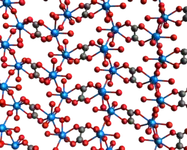
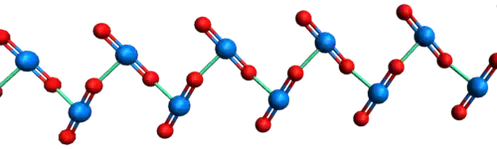
The structure of the hexahydrate, (NpO2)2C2O4·6H2O, has been characterized as part of the study of cation-cation interactions. In it, neptunyl ions are linked through these bonds to form zigzag chains, and are further linked into layers by bridging oxalate groups. Each neptunium atom in the neptunyl ions has a coordination geometry of pentagonal bipyramidal, and is bonded to two water molecules, two oxygen atoms from an oxalate group, and one oxygen atom from a neighboring neptunyl group. The oxalate groups are bidentate (bonding in two spots) to each bonding neptunyl atom, and bond with it side-on. Four water molecules lie between these layers per formula unit, and link these layers through hydrogen bonding.[5][1]
This chain-like structure leads to (NpO2)2C2O4·6H2O's low solubility of 0.62 g/L.[5][6]
Complexes
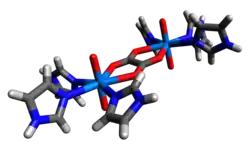
Neptunyl(V) oxalate is known to form a complex with imidazole, (NpO2)2C2O4(Im)6·5Im·H2O (Im=imidazole), which was one of the first known examples of a compound where imidazole directly binds with an actinide atom. The (NpO2)2C2O4(Im)6 complex is made up of two neptunyl groups bridged by an oxalate group which bonds with them side-on, as well as six imidazole groups, three bonding to each neptunium atom.[9][1]
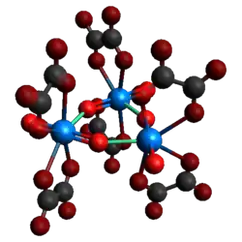
Many monooxalate ([NpO2]+:[C2O4]2− ratio = 1:1) complexes are known, with general formula MNpO2C2O4·xH2O (M=Na, K, Cs, NH4, x=1–3).[10] The compounds CsNpO2C2O4·xH2O and NH4NpO2C2O4·xH2O adopt similar structures, both being made out of cyclic neptunyl trimers. In these trimers, neptunyl ions are linked through cation-cation interactions, with each donating one cation-cation interaction and accepting another. These trimers are linked to each other via oxalate groups, each neptunium atom bonding side-on with two oxalate groups, and each oxalate group bonding side-on with two neptunyl groups, creating a neptunyl oxalate framework.[11][1] The sodium member of this series, NaNpO2C2O4·3H2O, adopts a different structure. Neptunium atoms have a coordination geometry of pentagonal bipyramidal, being coordinated to one water molecule and two bidentate (bonding in two spots) oxalate groups. Oxalate groups connect neptunyl groups together to form one-dimensional infinite chains.[4] These monooxalate compounds often decompose upon prolonged storage due to conversion to (NpO2)2C2O4·6H2O.[5]
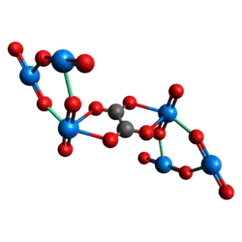
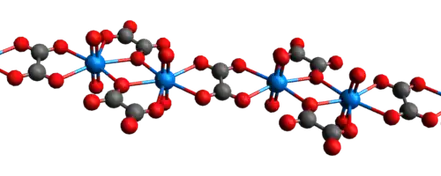
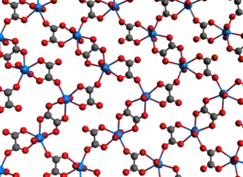
Neptunyl(V) oxalate compounds with [NpO2]+:[C2O4]2− ratios greater than 1:1 are also known, such as Na4(NpO2)2(C2O4)3·xH2O (x=2, 6) and Co(NH3)6NpO2(C2O4)2·xH2O (x=1.5, 3, 4, 5).[1] The compounds Na4(NpO2)2(C2O4)3·2H2O and Na4(NpO2)2(C2O4)3·6H2O have a [NpO2]+:[C2O4]2− of 2:3, and can be called sesquioxalates.[12][13] Na4(NpO2)2(C2O4)3·2H2O has a chain structure, made up of dimers (groups of two) of neptunyl ions which are joined together through bridging oxalate ions. Neptunium has a coordination geometry of pentagonal bipyramidal; the equator is made up of five oxygen atoms from three oxalate groups. The neptunyl groups in dimers are connected by oxygen atoms coming from oxalate.[12][1] On the contrary, Na4(NpO2)2(C2O4)3·6H2O adopts a sheet structure. Like Na4(NpO2)2(C2O4)3·2H2O, neptunyl groups are pentagonal bipyramidal with the equator made up of five oxygen atoms from three oxalate groups. Each oxalate group bridges the neptunyl group to a different neptunyl group, connecting the neptunyl ions together; two oxalate groups are bidentate while the third one is monodentate (bonding in one spot).[13][1]
The Co(NH3)6NpO2(C2O4)2·xH2O compounds can be called dioxalate complexes.[14] In aqueous solution, dioxalate complexes can exist as NpO2(C2O4)2(H2O)3−. The oxalate groups in this ion can undergo rapid ligand exchange with other oxalate groups:
- [NpO2(C2O4)1(C2O4)2(H2O)]3− + [(C2O4)3]2− → [NpO2(C2O4)1(C2O4)3(H2O)]3− + [(C2O4)2]2−
Where superscripts denote individual oxalate ions.[15] This ion can be isolated from solution in the form of these Co(NH3)6NpO2(C2O4)2·xH2O compounds. The structures of both Co(NH3)6NpO2(C2O4)2·1.5H2O and Co(NH3)6NpO2(C2O4)2·3H2O contain dimers of composition [(NpO2)2(C2O4)4]6−, hexaamminecobalt(III) (Co(NH3)3+6) ions, and waters of crystallization. Again, neptunyl ions are pentagonal bipyramidal, with five oxygen atoms coming from three oxalates, and the neptunyl ions forming dimers are linked by oxalate oxygen atoms. Each of the four oxalate groups bonds with one neptunyl group to form a 5-membered ring, but two of them additionally form a bond to the other neptunyl group. While they both are made out of the same components, they have a different packing. On the contrary, Co(NH3)6NpO2(C2O4)2·4H2O adopts a chained structure instead. While it again has neptunyl in a pentagonal bipyramidal fashion, with five oxygen atoms from three oxalate groups, two of these oxalate groups bridge to neighboring neptunyl groups, one oxalate being bidentate and one monodentate, and the third oxalate is bidentate, attaching to the side of the chain. The structure of the pentahydrate, Co(NH3)6NpO2(C2O4)2·5H2O, is unknown, though it is possible that some water molecules bond directly to neptunium atoms. It is believed that neptunium atoms have a coordination geometry of hexagonal bipyramidal.[14][1] Isostructural compounds containing plutonium instead of neptunium (plutonyl(V) oxalates) are also known.[14]
2(C2O4)4)(-6).png)
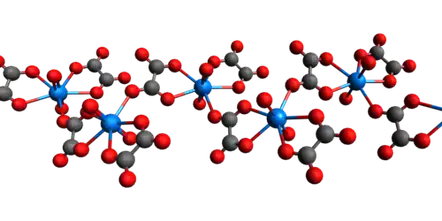

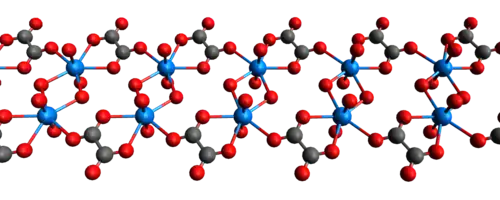
A neptunium(V) oxalate compound containing hydroxide ions, Na2NpO2(C2O4)OH·H2O, is also known. It has been formed by the hydrothermal reaction between a neptunium(V) stock solution, oxalic acid, calcium chloride, sodium hydroxide, and hydrogen chloride. Its structure consists of chains of composition [NpO2(C2O4)OH2−]n separated by sodium ions and water molecules. The chains contain neptunyl dimers which are held together by bridging hydroxide groups. These dimers are bonded with neighboring dimers via oxalate groups, which bond monodentate to one neptunyl group and bidentate to another.[4][1]
References
- 1 2 3 4 5 6 7 8 9 10 Gilson, Sara E.; Burns, Peter C. (2021). "The crystal and coordination chemistry of neptunium in all its oxidation states: An expanded structural hierarchy of neptunium compounds". Coordination Chemistry Reviews. 445 213994. doi:10.1016/j.ccr.2021.213994. OSTI 1815048.
- 1 2 Hilaire, S.; Guillaumont, D.; Gutierrez, F.; Wastin, F.; Colineau, E.; Gouder, T.; Berthet, JC.; Meyer, D.; Simoni, E. Actinyl electronic structure investigation using a combined theoretical and experimental approach. Advances for future nuclear fuel cycles. Nimes, France.
- 1 2 Jones, E. R.; Stone, J. A. (1972). "Metamagnetism in Neptunium(V) Oxalate". The Journal of Chemical Physics. 56 (3): 1343–1347. Bibcode:1972JChPh..56.1343J. doi:10.1063/1.1677368.
- 1 2 3 Bean, Amanda C.; Garcia, Eduardo; Scott, Brian L.; Runde, Wolfgang (2004). "Structural Variability in Neptunium(V) Oxalate Compounds: Synthesis and Structural Characterization of Na2NpO2(C2O4)OH·H2O" (PDF). Inorganic Chemistry. 43 (20): 6145–6147. doi:10.1021/ic0492082. PMID 15446857.
- 1 2 3 4 Krot, Nikolai N.; Grigoriev, Mikhail S. (2004). "Cation–cation interaction in crystalline actinide compounds". Russian Chemical Reviews. 73 (1): 89–100. Bibcode:2004RuCRv..73...89K. doi:10.1070/RC2004v073n01ABEH000852.
- 1 2 3 Zubarev, V. G.; Krot, N. N. (1981). "Investigation of composition and properties of some neptunium (5) oxalate compounds". pp. 857–861.
- ↑ Smith, Kyson R.; Ilavsky, Jan; Hixon, Amy E. (2023). "Crystallization of a Neptunyl Oxalate Hydrate from Solutions Containing NpV and the Uranyl Peroxide Nanocluster U60Ox30". Chemistry – A European Journal. 29 (19) e202203814. Bibcode:2023ChEuJ..29R3814S. doi:10.1002/chem.202203814. OSTI 1907559. PMID 36598408.
- ↑ Karelin, A. I.; Krot, N. N.; Kozlova, R. D.; Lobas, O. P.; Matukha, V. A. (1990). "Thermal decomposition of Np(IV) and Pu(III, IV) oxalates". Journal of Radioanalytical and Nuclear Chemistry Articles. 143 (1): 241–252. Bibcode:1990JRNC..143..241K. doi:10.1007/BF02117565.
- ↑ Andreev, Grigory B.; Budantseva, Nina A.; Tananaev, Ivan G.; Myasoedov, Boris F. (2009). "Interaction of Transuranium Elements with Biologically Important Molecules: Structural and Spectroscopic Study of Np(V) Complexes with Imidazole". Inorganic Chemistry. 48 (3): 1232–1235. doi:10.1021/ic801882p. PMID 19166371.
- ↑ Spitsyn, V.I. (1971). "The development of coordination chemistry in the Soviet Union" (PDF). Pure and Applied Chemistry. 27 (1–2): 193–225. Bibcode:1971PApCh..27..193S. doi:10.1351/pac197127010193.
- ↑ Charushnikova, I. A.; Krot, N. N.; Polyakova, I. N. (2006). "Synthesis and crystal structure of double Np(V) cesium oxalate CsNpO2C2O4 · nH2O". Radiochemistry. 48 (3): 223–226. doi:10.1134/S1066362206030039.
- 1 2 Charushnikova, I. A.; Krot, N. N.; Polyakova, I. N. (2007). "Crystal structure of a Np(V) sesquioxalate, Na4(NpO2)2(C2O4)3·2H2O". Radiochemistry. 49 (2): 112–116. doi:10.1134/S1066362207020026.
- 1 2 Charushnikova, I. A.; Krot, N. N.; Polyakova, I. N. (2006). "Synthesis and crystal structure of a new Np(V) oxalate, Na4(NpO2)2(C2O4)3·6H2O". Radiochemistry. 48: 1–5. doi:10.1134/S1066362206010012.
- 1 2 3 Charushnikova, I. A.; Krot, N. N.; Polyakova, I. N. (2005). "Crystal Structure of a Double Oxalate of Np(V) and Co(NH3) 6 3+ , Co(NH3)6NpO2(C2O4)2·1.5H2O". Radiochemistry. 47 (6): 540–544. doi:10.1007/s11137-006-0003-7.
- ↑ Pilgrim, Corey D.; Mason, Harris E.; Zavarin, Mavrik; Casey, William H. (2018). "Rates of Ligand Exchange around the Bis-Oxalato Complex [NpO2(C2O4)2]3− Measured by Using Multinuclear NMR Spectroscopy under Neutral to Semi-Alkaline Conditions". ChemPlusChem. 83 (7): 590–596. doi:10.1002/cplu.201800025. OSTI 1423490. PMID 31950642.