Mohammad Akhtar (pilot)
Mohammad Akhtar | |
|---|---|
| محمد اختر | |
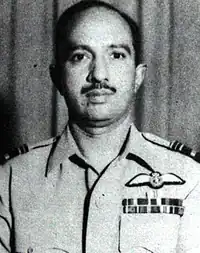 Portrait, c. 1965 | |
| 5th Commandant PAF Staff College | |
| In office 13 September 1968 – June 1969 | |
| Preceded by | Abdur Rahim Khan |
| President of Pakistan International Airlines and Chief Administrator Civil Aviation & Tourism | |
| In office 7 May 1968[a] – 12 September 1968 | |
| Preceded by | Asghar Khan |
| Succeeded by | Shakirullah Durrani |
| 1st Deputy Chief of Air Staff Pakistan Air Force | |
| In office 26 November 1964 – 8 April 1966 | |
| Preceded by | M. A. Rahman (as Chief of Staff) |
| Succeeded by | S. A. Yusuf |
| Commander-in-Chief | Air Marshal Asghar Khan (1957-1965) Air Marshal Nur Khan (1965-1969) |
| Commanding Officer No. 9 Squadron RIAF | |
| In office 1 November 1946 – 14 August 1947 | |
| Preceded by | Asghar Khan |
| Personal details | |
| Born | 10 July 1921 |
| Died | 26 May 1983 (aged 61) |
| Education | Government College, Lahore RAF Staff College, Andover |
| Military service | |
| Branch/service |  Royal Indian Air Force (1941-1947)  Pakistan Air Force (1947-1969) |
Years of service | 1941-1969 |
| Rank | Air Vice Marshal |
| Commands | |
| Battles/wars | |
| Awards | Sitara-e-Khidmat (1964) Sitara-e-Quaid-e-Azam (1967) |
Mohammad Akhtar[b] (10 July 1921 — 26 May 1983) also known as M Akhtar, was a Pakistani former two-star rank air officer and airline executive, who served as the first Deputy Chief of Air Staff of the Pakistan Air Force from November 1964 to April 1966. He also briefly served as the President of the Pakistan International Airlines from May 1968 to September 1968.
Early life
Mohammad Akhtar was born on 10 July 1921.[2] He graduated from the Government College, Lahore.[3]
Service years
Royal Indian Air Force (1941-1947)
He was commissioned into the Royal Indian Air Force on 6 January 1941.[2] During the war, he served in Burma with No. 9 Sqn.[3] He commanded the Squadron from 1 November 1946 to 14 August 1947.[4]
Pakistan Air Force (1947-1969)

Pictured at a reception held in Khan's honor in Washington, D.C., after the announcement of his appointment as Chief of the Air Force. Circa 21 April – May 1957
After the Partition of British India in August 1947, Akhtar transferred his service to the Royal Pakistan Air Force (RPAF).[2] In September 1948, he was promoted to Wing Commander and appointed Commander of RPAF Station Peshawar.[5]
In August 1951, Group Captain Akhtar was appointed as the first Assistant Chief of Air Staff (Admin).[5] In the mid-1950s, he served as the Air Adviser to High Commissioner for Pakistan to the United Kingdom.[6] He was appointed as Assistant Chief of Air Staff (Maintenance) in November 1956.[5]
In 1958, Flight reported that Akhtar was the Air Officer Commanding of No. 2 Group PAF, which was stationed at Station Drigh Road and responsible for maintenance and supply.[7] He briefly served as the acting Commander-in-Chief from 3 January to 21 January 1961, while Air Marshal Asghar Khan was on an overseas visit.
Air Commodore Akhtar was appointed Assistant Chief of Air Staff (Operations) in June 1963.[5] He was awarded the Sitara-e-Khidmat in 1964.[3] Akhtar succeeded Air Vice Marshal M. A. Rahman, the outgoing Chief of Staff, as the office was renamed to Deputy Chief of Air Staff on 26 November 1964.[8]
During the India–Pakistan war of 1965, Air Commodore Akhtar was the most senior officer in the Command Operations Center and was in charge of Air Operations when the Air Chief was away or resting. He was the first to inform President Ayub Khan of the Indian offensive at around 0430 Hrs and told him that the country was under attack on the Lahore front. Air Commodore Sajad Haider wrote: "Ayub Khan was totally rattled by the news".[9]
On 1 November 1965, the PAF Operational Command was formed with Air Vice Marshal Akhtar appointed as its first Air Officer Commanding.[10]
Following the Tashkent Declaration which was signed by India and Pakistan to resolve the India–Pakistan war of 1965, United States Ambassador to Pakistan Walter P. McConaughy wrote in a confidential telegram sent on 18 January 1966:
In long individual conversations with PAF second in Command Air Vice Marshal Akhtar, and Air Commodores Masrur Hosain and Khyber Khan, gained clear impression that PAF has accepted Tashkent Declaration, but only as relatively unimportant step in continuing struggle for Kashmir. None considered affirmation of adherence to UN Charter as no war pact. All assumed some private Ayub-Shastri understanding which jeopardized or lost altogether with Shastri death. No apparent disaffection with Ayub regime as each subscribed to Ayub's Jan 14 speech. Assume Akhtar reaction most closely (MAAG again isolated, unable provide useful info on Nur or PAF reaction).*
Akhtar basically believes Tashkent exercise unimportant. Expressed opinion that war would be resumed and Pakistan would ultimately win: termed September military results "Inconclusive". (This may have been only for my consumption since later he urged no aid be resumed to India since even food could free other resources for military purposes and US should withhold all to pressure India to come to terms: otherwise, he implied, renewed war inevitable.)
Akhtar does not trust "Hindus" to honor even withdrawal pledge. Stated entire Moslem nation, including Moslem (UPGG PQUTVHN) (AS RECD.) fighting for survival, might as well die on battlefield as submit to Hindus. Said any Govt of Pakistan, including present Govt, must realize this. Cmmt: Akhtar seemed somewhat embarrassed by the last remark as though the reference to a future govt revealed disaffection with Ayub. Tone of rest of conversation, however, indicated he felt Ayub Govt essentially on right track. Can only surmise that apparently inadvertent reference reflects his projected thinking in case Ayub should back away from commitment to Kashmiri Moslems. Akhtar's outlook remains virtually unaffected by results Ayub-Johnson meeting and Tashkent conference; his remarks were almost same during December 5 discussion.[11]
Air Vice Marshal Mohammad Akhtar was appointed General Manager and Senior Vice President of Pakistan International Airlines (PIA) in April 1967.[1] The Government of Pakistan announced Akhtar's appointment as President and Managing Director of the airline in April 1968, as well as Chief Administrator of Civil Aviation and Tourism,[12] when Asghar Khan went on leave on 7 May, in preparation for his retirement following the completion of his three-year term on 23 July 1968.[13][14]
The Government nationalised PIA with Shakirullah Durrani succeeding Akhtar as the new managing director on 13 September 1968.[15]
Pakistani trade unionist Tufail Abbas wrote in his memoirs:
Air Vice Marshal Akhtar, a close associate of Asghar Khan, replaced him as leader of PIA. Akhtar had his very unique way of working: he wanted to run the airline without the union, and at the same time wanted to get close to workers. Perhaps this was a government trick, a way to break a principled alliance between the administration and the union. While it didn't feel like it in those days, after all these years it certainly looks like a conspiracy. Akhtar lasted only a few months in PIA, however. After removing AVM Akhtar, the Ayub regime launched a new web of conspiracies in PIA, and sent Shakirullah Durrani as Managing Director.[16]
Akhtar returned to the Air Force and was appointed as the Commandant of the PAF Staff College on 13 September 1968.[17][18] He served until his retirement in June 1969.[19]
Later life and death
Mohammad Akhtar had suffered from a glandular condition for several years and died on 26 May 1983. Retired Air Marshal Asghar Khan, who was under house arrest at the time, noted in his diary that his wife Amina had visited Akhtar a month earlier at CMH Rawalpindi to check on his health. Khan reflected on their long standing friendship, recalling how they had joined the Royal Indian Air Force together and served in various areas over the years and in the same squadron during World War II in Burma. Khan described him as a "very nice man and a good friend" and was saddened by his death. He expressed regret that, due to his house arrest under General Zia-ul-Haq's dictatorship, he was unable to attend the funeral or offer condolences in person.[20]
Awards and decorations
 Sitara-e-Khidmat, 1964[21]
Notes
References
- 1 2 PIA. Vol. 115. Aeroplane and Commercial Aviation News. 1968. p. 25.
"Air Marshal M. Asghar Khan is set to retire as president/managing director of Pakistan International Airlines and chief admini-strator of civil aviation and tourism on July 23. He will in fact leave the airline on May 7 to go on leave before his retire-ment takes effect. He will be succeeded by Air Vice-Marshal Mohammad Akhtar, who has been general manager and senior vp of PIA since April 1967.
- 1 2 3 "Service Record for Air Vice Marshal Mohammad Akhtar 1654 GD(P)". Bharat Rakshak. Retrieved 30 June 2026.
- 1 2 3 Aero News. Vol. 19. 1967. p. 7.
Air Vice Marshal Mohammad Akhtar has been appointed General Manager & Senior Vice President of Pakistan International Airlines Corporation . In this capacity he will be responsible to the President PIAC , for the overall co - ordination and operation of the Airline. Immediately before taking up his present assign- ment, Air Vice Marshal Moham-mad Akhtar held the post of Air Officer Commanding, P.A.F. Opera- tional Command . Having been born at Sialkot , on July 10 , 1921 , Air Vice Marshal Mohammad Akhtar graduated from Government College , Lahore and was commissioned as a Pilot Officer in the Royal Indian Air Force in 1941 . During World War II , Air Vice Marshal Mohammad Akhtar saw active service in Burma with No. 9 Royal Indian Air Force Squadron, which he later commanded . Since Independence he has held various important command and staff app- ointments in the Pakistan Air Force , such as Station Commander P.A.F. Peshawar , Director of Training , Assistant Chief of Air Staff ( Admi- nistration ) , Assistant Chief of Air Staff ( Maintenance ) , Assistant Chief of Air Staff ( Operations ) and Deputy Chief of Air Staff at Air Headquar- ters . He also held the appointments of Air Officer Commanding No. 1 Group , Air Officer Commanding No. 2 Group and Air Officer Com- manding Air Defence . Air Vice Marshal Mohammad Akhtar is a graduate of the Royal Air Force Staff College , And over , U.K. He was awarded Sitarai-Khid-mat in 1964.
- ↑ "Commanding Officers No. 9 Squadron". Bharat Rakshak. Retrieved 30 June 2026.
- 1 2 3 4 The Story Of The Pakistan Air Force: A Saga Of Courage And Honour. Shaheen Foundation, Pakistan. 1988. p. 671, 676. OCLC 20823183.
- ↑ Monthly Air Force List. 1954.
- ↑ Flight: The Aircraft Engineer. Vol. 73. 1958. p. 43, 246.
- ↑ Syed Shabbir Hussain; M. Tariq Qureshi (1982). "26.11.64" History of the Pakistan Air Force, 1947-1982. Pakistan Air Force. p. 222. ISBN 978-0-19-648045-9.
Air Vice Marshal (then Air Commodore) M Akhtar 26.11.64-8.4.66
- ↑ Sajad Haider (2010). Flight of the Falcon- Demolishing Myths of Indo Pak Wars 1965-1971 (3rd ed.). Vanguard Books. ISBN 978-969-402-526-1.
- ↑ Anwar Shamim (2010). Cutting edge PAF: Reminiscences. Vanguard Books. p. 139. ISBN 978-969-402-540-7.
After the war the PAF High Command decided to establish Operational Command to ensure high state of readiness at all time. Heretofore, the Principal Staff Officers at Air Head Quarters had dual function that is formulating policies and planning as well as ensuring implementation of policies; and ensuring war readiness of base. That earlier set up was adequate for a small size force but due to induction of American military aid the PAF had grown to a good size to warrant bifurcation of duties. Therefore, on Ist November 1965 Operational Command was created. Air Vice Marshal M Akhtar was appointed as the first Air Officer Commanding of Operational Command; Group Captain Saeedullah Khan became second-in-command.
- ↑ Roedad Khan (1999). The American Papers: Secret and Confidential India-Pakistan-Bangladesh Documents, 1965-1973. Oxford University Press. pp. 121–122. ISBN 978-0-19-579190-7.
- ↑ "News in Brief". Pakistan Affairs. Vol. XXI, no. 4. April 1968. p. 2.
- ↑ Air-Vice Marshal M. Akhtar. Trade and Industry. 7 March 1968.
- ↑ PIA's New President. Flight International. 1968. p. 400.
- ↑ "News In Brief". Pakistan Affairs. Vol. XXI, no. 13. 18 September 1968. p. 2.
- ↑ Tufail Abbas; translated by Asma Abbas. Struggles For Freedom After Freedom (PDF).
- ↑ Air Transportation. 13 September 1968. p. 74.
- ↑ Pakistan International Airlines. Flight International. 13 September 1968. p. 40.
- ↑ "AWCI Leadership Over the Years". PAF Air War College. Archived from the original on 22 May 2024.
- ↑ Asghar Khan (2008). My Political Struggle. Oxford University Press. p. 304. ISBN 978-0-19-547620-0.
Air Vice Marshal Akhtar died in hospital on Thursday, 26 May. Amina had called on him in CMH Rawalpindi about a month ago. Akhtar and I had joined the air force together and had served together in different places over a long period. We were in the same squadron in Burma during the Second World War. He had had some kind of glandular trouble for some years. He was a very nice man. A good friend whose death is a very sad event. I am sorry that I was unable to attend his funeral and cannot even go to offer my condolences.
- 1 2 "Pakistani Post". The Japan Times. 15 April 1968.
Further reading
"From The Past Pages Of Dawn: 1968: Fifty Years Ago: Police worry over 'dumba'". Dawn. 10 July 2018.
- 1921 births
- 1983 deaths
- Pakistani Muslims
- Government College University, Lahore alumni
- Aviators from British India
- Indian World War II pilots
- Pakistan Air Force officers
- Pakistani military aviators
- Air attachés for Pakistan
- Military personnel of the India–Pakistan war of 1965
- Pakistani chief executives in the airline industry
- Pakistan International Airlines people