List of palaces in Iran

This is a list of palaces in Iran.
A palace is a grand residence, especially a royal residence, or the home of a head of state or some other high-ranking dignitary, such as a bishop or archbishop.[1] The word is derived from the Latin name palātium, for Palatine Hill in Rome which housed the Imperial residences.[1] Most European languages have a version of the term (palais, palazzo, palacio, etc.), and many use it for a wider range of buildings than English.
In many parts of Europe, the equivalent term is also applied to large private houses in cities, especially of the aristocracy; often the term for a large country house is different. Many historic palaces are now put to other uses such as parliaments, museums, hotels, or office buildings. The word is also sometimes used to describe a lavishly ornate building used for public entertainment or exhibitions,[1] such as a movie palace.
List of palaces in Iran
| Name | Location | Picture | Notes |
|---|---|---|---|
| Ahmad Shahi Pavilion | Tehran |  |
It was built in the 1910s as Ahmad Shah's dwelling in Niavaran Garden.[2][3][4] |
| Ali Qapu | Isfahan | |
It is a Safavid imperial palace located on the western side of the Naqsh-e Jahan Square, opposite to Sheikh Lotfollah Mosque. Built in the 16th–17th centuries, it was a portal entrance to the imperial estates which stretched from the Naqsh-e Jahan Square to the Chahar Baq Boulevard. UNESCO inscribed the Palace and the Square as a World Heritage Site in 1979. The palace is 48 meters high and has 6 floors. |
| Ali Qapu | Tabriz |  |
It was initially built in the 16th century, during the Safavid era. In the 19th century, during the Qajar era,[5] a palace named Shams-ol-Emareh was constructed on its site.[6] In the 1940s, following a period of neglect, it was demolished during the Pahlavi era. The East Azerbaijan Governor's Office was built on its site, alongside the Tabriz Municipality building and the Central National Bank's branch complex.[7] |
| Arg of Karim Khan | Shiraz |  |
Karim Khan Zand , influenced by Safavid architecture and Isfahan's Naqsh-e Jahan Square, built a square in northern Shiraz to the west of which is the Arg citadel. After the conquest of Shiraz by Agha Mohammad Khan Qajar, he demolished Karim Khan's buildings in a hostility to Karim Khan.[8] |
| Baharestan Palace | Tehran |  |
It was originally built by Mirza Hosein Khan Sepahsalar, a Qajar era prime minister, as his private residence. Thereafter, it was owned by Naser al-Din Shah Qajar. During the Persian Constitutional Revolution, it became the Iranian parliament building. It was bombarded in 1908 by the forces of Mohammad Ali Shah Qajar leading to the Minor Tyranny.
It remained the location for the lower house of the parliament (the Senate had moved to a new building) until the 1979 Iranian Revolution. Afterwards, the parliament became unicameral and met at the Senate building, and to a newly built building in Baharestan in 2004. |
| Baqcheh Jooq Palace | Maku |  |
It is located between the border towns of Maku and Bazargan in West Azerbaijan province. It is situated in a vast garden covering about 11 hectares (27 acres). It was completed at the end of the Qajar era under the orders of Mortezaqoli Eqbal al-Saltaneh Makui, the last Khan of Maku. |
| Bardak Siah Palace | Temukan |  |
It is an ancient Achaemenid Persian palace situated in the ancient city of Temukan near the township of Borazjan, Bushehr province. The site was unearthed in 1977 by Iranian archeologists headed by Esmaeil Yaghmaei.[9][10] |
| Behistun Palace | Bisotun |  |
It is a ruined Sasanian palace facing a cliff with the much older Behistun Inscription and rock relief. Traditionally, it has been regarded as a residence of Shirin, queen of Khosrow II (r. 590–628). This is first documented, in surviving records, by early Islamic geographers,[11] and is elaborated in later stories and myths, as a fictionalized Shirin became a heroine of later Persian literature, such as the Shahnameh.[12] It is included in the UNESCO World Heritage Site of Bisotun. |
| Chehel Sotoun | Isfahan |  |
The name, meaning "Forty Columns" in Persian, was inspired by its twenty columns which, when reflected in the waters of the fountain, are said to appear to be forty.[13] As with Ali Qapu, the palace contains many frescoes and paintings on ceramic. Many of the ceramic panels have been dispersed and are now in major museums in the west. They depict specific historical scenes such as the infamous Battle of Chaldiran against the Ottoman Sultan Selim I, the reception of an Uzbek King in 1646, when the palace had just been completed; the welcome extended to the Mughal Emperor, Humayun who took refuge in Iran in 1544; the battle of Taher-Abad in 1510 where the Safavid Shah Ismail I vanquished and killed the Uzbek king. A more recent painting depicts Nader Shah's victory against the Indian Army at Karnal in 1739. There are also less historical, but even more aesthetic compositions in the traditional miniature style celebrating the joy of life and love.[14] |
| Chehel Sotun | Qazvin |  |
Its construction is attributed to Tahmasp I, who transferred Iran's capital from Tabriz to Qazvin in 1555–56. In the Qajar era, it was repaired and remodeled by Mohammad Bagher Sa'd as-Saltaneh, the governor of Qazvin.[15] |
| East Azerbaijan Governance Palace | Tabriz |  |
In 1946, Governor Ali Mansur demolished the remaining parts of the Shams-ol-Emareh Palace, which had been destroyed in a fire and a flood, and a new marble building was constructed instead, which has served as the office of the provincial governor till now. In 2013, a museum titled East Azerbaijan Governorship was established in the building.[16][17] |
| Ferdows Garden | Tehran | 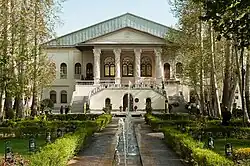 |
Also known as Rašk-e Behešt (Envy of Heaven), its origins date back to Mohammad Shah (r. 1834–1848) of the Qajar dynasty, who ordered the construction of a mansion named Mohammadieh in Tajrish.[18][19] Over the years, it was leased to various ministries. After the 1979 Iranian Revolution, until 2002, it served as a training center for filmmaking. Since 2002, it houses the Cinema Museum. |
| Golestan Palace | Tehran |  |
Tehran's arg ("citadel") was built during the reign of Tahmasp I (r. 1524–1576) of the Safavid dynasty, and was later renovated by Karim Khan (r. 1751–1779) of the Zand dynasty. Agha Mohammad Khan (r. 1789–1797) of the Qajar dynasty chose Tehran as his capital. The arg became the seat of the Qajars (1794–1925). The palace was rebuilt to its current form in 1865 by Haji Ab ol Hasan Mimar Navai. |
| Hasht Behesht | Isfahan |  |
As indicated on its name (eight heavens), the two-story pavilion of Hasht Behesht was built on the hasht-behesht plan, that is a type of floor plan consisting of a central hall surrounded by eight rooms.[20] The building is of an octagonal shape,[20] and has two main entrances. Four larger sides of it feature large balconies (iwans), under which some tall and thin wooden columns are raised. The pavilion is decorated with mural paintings, perforated woodwork, ayeneh-kari, tilework, and plasterwork.[21][22] |
| Hasht Behesht | Tabriz |  |
Its construction was started by the Aq Qoyunlu ruler Uzun Hasan and completed by his son Yaqub Beg in 1483–1486.[23][24] The Palace was destroyed by the Ottoman Jafar Pasha in 1585, and replaced by the Castle of Jafar Pasha.[25][26] Nevertheless, it was influential in the creation of other buildings, such as the Hasht Behesht in Isfahan, and contributed to the "Hasht Bihisht" model of architecture.[27][28] |
| Jahan Nama Palace | Farahabad |  |
It is located in Farahabad, Mazandaran province and is part of the Farahabad Complex. The Palace was built during the reign of Abbas the Great and was destroyed by the Cossacks.[29] |
| Khosrow Palace | Qasr-e Shirin |  |
It was built on the order of Khosrow II for his Christian wife, Shirin.[30] |
| Marble Palace | Tehran |  |
It was built by Reza Shah in 1933. The palace is covered by a huge dome that is a replica of the Sheikh Lotfollah mosque in Isfahan.[31][32] |
| Masoudieh Mansion | Tehran |  |
It was built as a residence for the Qajar prince Mass'oud Mirza Zell-e Soltan in 1878.[33] During the Persian Constitutional Revolution, it became a revolutionary foothold. In 1908, a bomb exploded under Mohammad Ali Shah's carriage nearby, causing him to initiate the 1908 bombardment of the parliament.[34][35] The first national library and the first National Museum of Iran were established here.[36][37] |
| Naseri Palace | Sharestanak |  |
Also known as Shahrestanak Palace, it was commissioned by Naser al-Din Shah and built in 1878–1881 as a retreat along the mountain route from Tehran to Mazandaran.[38][39] Following a long period of abandonment, it was largely revitalised in 2021–2026 to serve as a boutique hotel, restaurant, art gallery, and cultural tourism hub.[40][41] |
| Negarestan Palace | Tehran |  |
It was built as a summer residence by the order of Fath-Ali Shah Qajar in 1807.[42][43] |
| Niavaran Complex | Tehran |  |
It is a complex in northern Tehran from the Qajar and Pahlavi eras. It includes the Sahebgharaniyeh Palace, the Ahmad Shahi Pavilion, and the Niavaran Palace. |
| Niavaran Palace | Tehran |  |
It is a royal palace, museum, and former residence of the Pahlavi dynasty. The palace was completed in 1967 for Shah Mohammad Reza Pahlavi and his family.[44] |
| Palace of Ardashir | Firuzabad |  |
The structure contains three domes, among other features, making it slightly larger and more magnificent than its predecessor, the nearby castle of Dezh Dokhtar. However, it seems that the compound was designed to display the royal image of Ardashir I, rather than being a fortified structure for defensive purposes. Therefore, perhaps it would be best to refer to the structure as a "palace" rather than a "castle", even though it has huge walls on the perimeters (twice as thick as Ghal'eh Dokhtar), and is a contained structure. From the architectural design, it seems the palace was more of a place of social gathering where guests would be introduced to the imperial throne. |
| Palace of Darius in Susa | Susa |  |
Its construction was begun by the Achaemenid king Darius the Great in his favorite capital, Susa. It was captured and plundered by the invading Macedonians under Alexander the Great in December 330 BC.[45] |
| Pearl Palace | Karaj |  |
Built in the early 1970s, it was designed by Taliesin Associated Architects (Frank Lloyd Wright Foundation)[46] on instructions from Princess Shams Pahlavi, elder sister of Mohammad Reza Pahlavi, the last Shah of Iran. |
| Qajar Palace | Tehran |  |
It was built in the early reign of Fath-Ali Shah Qajar just outside Tehran. In the 1920s, it was demolished by Reza Shah to be replaced by the Qasr prison.[47] The only remnant of the complex is a small pavilion.[48] |
| Qasr-e Abunasr | Shiraz |  |
Also known as Takht-e Sulayman, it is an ancient settlement in Shiraz. According to archaeological studies the fortress was built during the Parthian era, and was an important and strategic location in the Sasanian Empire. Archaeologists have found various artifacts and coins belonging to various historical periods, such as the Achaemenid, Seleucid, Parthian, and Sasanian. When the Muslims conquered Iran, they called this palace "Father of Victory" (Qaṣr-i-Abu Naṣr)[49] |
| Ramsar Palace | Ramsar |  |
It was established on a land of 60,000 square meters in 1937.[50][51] The area was a historical garden in Ramsar.[52] The palace was used as a summer residence by Reza Shah and then by his son, Mohammad Reza Pahlavi.[53] Mohammad Reza Pahlavi and his second spouse Sorayya Esfendiari spent their honeymoon in the palace.[54] |
| Ruby Palace | Tehran |  |
Located in eastern Tehran, it was built in 1883 as a residence for Naser al-Din Shah Qajar.[55] |
| Sa'dabad Complex | Tehran |  |
The complex was initially built and inhabited by the Qajar dynasty in the 19th century. After extensive expansions, Reza Shah of the Pahlavi dynasty resided there in the 1920s. His son, Shah Mohammad Reza Pahlavi, moved there in the 1970s. After the 1979 Revolution, the complex became a public museum. |
| Sabet Pasal Palace | Tehran |  |
It is Tehran's largest historic house.[56] It belonged to Habibollah Sabet (also known as Sabet Pasal), a rich Iranian businessman and the founder of Iran's first television station. |
| Safi Abad Palace | Behshahr |  |
Built during the reign of Shah Abbas the Great (r. 1587–1629), the palace was expanded later on and, after suffering extensive damage due to a fire in the early 20th century, was repaired during the Pahlavi era (1925–1979). |
| Sahebgharaniyeh Palace | Tehran |  |
It was built in 1850 by the order of Naser ed-Din Shah Qajar.[57] On 28 May 1901, Mozaffar ad-Din Shah Qajar signed the D'Arcy Concession here. Later, on 5 August 1906, he also issued the firman proclaiming the constitutional monarchy in this palace. |
| Sarvestan Palace | Sarvestan |  |
It is a Sasanian era building built in the 7th century AD, and was either a gubernatorial residence or a Zoroastrian fire temple. It is designated as one of the eight UNESCO World Heritage Sites in the Sassanid Archaeological Landscape of Fars Region. |
| Shams-ol-Emareh | Tehran | 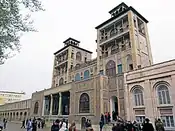 |
Before his visit to Europe, Naser al-Din Shah Qajar wanted to build a mansion in his capital to compete with Isfahan's Ālī Qāpū. A tall building from which he could see the entirety of Tehran. By his order, the construction of Shams-ol-Emareh began in 1865 and was finished in 2 years. Naser al-Din Shah took his guests to the roof of this building to see the capital. Building's designer was Moayer al Mamalek and the architecture was Ali Mohammed Kashi. The style of this building is a combination of traditional Iranian and European architecture.[58] |
| Soleymaniyeh Palace | Karaj |  |
It is a Qajar era royal residence notable for its paintings depicting Agha Mohammad Khan Qajar and his brothers and Fath-Ali Shah Qajar and his sons.[59] |
| Sun Palace | Kalat |  |
Built in 1738–1739, it is one of the few buildings built during the reign of Nader Shah. Its construction stopped after his assassination.[60][61] It is currently used as a museum of anthropology.[62] |
| Tachara | Persepolis |  |
The Tachara was the exclusive residence of Darius the Great at Persepolis.[63] |
| Valerian Palace | Bishapur |  |
It is a Sasanian palace built for the Roman Emperor Valerian who had been taken prisoner after the victory of Shapur I in the Battle of Edessa.[64] It was registered in 1310 SH[a] as one of the first national monuments of Iran. It is also listed as part of the Bishapur complex in the UNESCO World Heritage List.[65] |
Notes
- ↑ 1931–1932 in the Gregorian calendar
References
- 1 2 3 American Heritage Dictionary of the English Language (4th ed.). Boston: Houghton Mifflin Company. 2000. ISBN 0-618-08230-1.
- ↑ "Ahmad Shahi Pavilion, unique mansion in Tehran". iranpress.com. April 1, 2023. Retrieved 2026-03-27.
- ↑ کوشک احمدشاهی aftabir.com (Persian language)
- ↑ کوشک(وکاخ)احمد شاهی darioush-shahbazi.com (Persian language)
- ↑ "عالی قاپوی تبریز بنایی کهن بود که در بخش مرکزی تبریز قرار داشت". همگردی (in Persian). Retrieved 2025-12-14.
- ↑ "چه بر سر عالی قاپوی تبریز آمد ؟| پایگاه فرهنگی اطلاع رسانی آناج | Anaj.ir". anaj.ir. Archived from the original on 2012-08-11. Retrieved 2025-12-14.
- ↑ "عالی قاپو یا شمس العماره تبریز". Gozal Tabriz (in Persian). 22 November 2011. Archived from the original on 22 January 2012. Retrieved 4 September 2025.
- ↑ fa.tripyar.com
- ↑ "Expert calls for new study on Achaemenid palace in southern Iran – Tavoos Online | Iran's First Bilingual Art Magazine |". tavoosonline.com.
- ↑ Yaghmaei, Esmaeil (2018). Bardak-Siah Palace (in Persian). Tehran, Iran: Research Institute of Cultural Heritage & Tourism. ISBN 9786008412526.
- ↑ Baum, W., Shirin: Christian Queen Myth of Love: A Woman Of Late Antiquity: Historical Reality And Literary Effect, pp. 61-62, Gorgias Press LLC, 2004, ISBN 1593332823, 9781593332822
- ↑ Baum, later chapters
- ↑ Landor, Arnold Henry Savage (1902). Across Coveted Lands. London: MacMillan and Co., Limited. p. 323.
- ↑ Honarfar, Lotfollah (1966). A Treasure of the Historical Monuments of Isfahan; Honarfar L. Isfahan: Saghafi.
- ↑ Babaie 2003, pp. 41, 27, caption 2.1.
- ↑ "چه بر سر عالی قاپوی تبریز آمد ؟| پایگاه فرهنگی اطلاع رسانی آناج | Anaj.ir". Archived from the original on 2012-08-11. Retrieved 2013-05-26.
- ↑ "موزه استانداری آذربایجان شرقی برای بازدید عموم دایر شد". خبرگزاری ایلنا.
- ↑ Sadeq Dehqan, A Glorious Complex: Bagh-e Ferdows, Iran Daily, Arts & Culture, Thursday 20 July 2006, .
- ↑ Khodadad, Mohammadieh Palace, Bagh-e Ferdows, Picasa Web Albums Archived 2011-05-19 at the Wayback Machine.
- 1 2 Bernardini, Michele (March 20, 2012). "HAŠT BEHEŠT (2)". Encyclopædia Iranica. Vol. XII. pp. 49–51. Archived from the original on January 7, 2019. Retrieved November 3, 2020.
- ↑ Babaie, Sussan; Haug, Robert (April 5, 2012). "Isfahan x. Monuments (2) Palaces". Encyclopædia Iranica. Vol. XIV. pp. 14–20. Archived from the original on May 26, 2020. Retrieved November 3, 2020.
- ↑ "Hasht Behesht Palace". Lonely Planet. Archived from the original on 15 October 2018. Retrieved 15 October 2018.
- ↑ Babaie, Sussan (2022). Isfahan and its Palaces: Statecraft, Shi`ism and the Architecture of Conviviality in Early Modern Iran (CHAPTER 2 Peripatetic Kings and Palaces: From Tabriz to Qazvin in the Sixteenth Century). Edinburgh: Edinburgh University Press. p. 31. ISBN 9780748633760.
Hasht Behesht had been begun by the Aqqoyunlu Sultan Uzun Hasan (1453–78), Romano's Sultan Assambei or Hasan Beg, and completed by his son and successor Yaqub
- ↑ Melville, Charles (1981). Historical Monuments and Earthquakes in Tabriz. p. 170.
The Hasht Bihisht (...) a government palace (daulat-khana) of this name, built in 891/1486 in the Bagh-i Sahibabad by the White Sheep Turkomans, though probably on the site of a building founded by Jahanshah.
- ↑ Melville, Charles (1981). "Historical Monuments and Earthquakes in Tabriz". Iran. 19: 171. doi:10.2307/4299714. ISSN 0578-6967.
- ↑ "Archnet > Site > Bagh-i Sahibabad (MEGT)". www.archnet.org.
- ↑ Cite error: The named reference
RECwas invoked but never defined (see the help page). - ↑ Pfeiffer, Judith (7 November 2013). Politics, Patronage and the Transmission of Knowledge in 13th - 15th Century Tabriz. BRILL. p. 352. ISBN 978-90-04-26257-7.
- ↑ "مجموعه تاریخی فرح آباد ساری". tafarojgah.com. Archived from the original on 10 August 2019. Retrieved 10 August 2019.
- ↑ "Dais of Khosrow Palace discovered". Mehr News Agency. 2006-06-11. Retrieved 2022-02-21.
- ↑ Pamela Karimi (2013). Domesticity and Consumer Culture in Iran: Interior Revolutions of the Modern Era. London: Routledge. p. 54. ISBN 978-1-135-10137-4.
- ↑ Reza Sarhangi (1999). "The Sky Within: Mathematical Aesthetics of Persian Dome Interiors". Nexus Network Journal. 1 (1–2): 87–98. doi:10.1007/s00004-998-0007-z.
- ↑ "عمارت مسعودیه ، یادگاری بی نظیر قاجار". ایسنا (in Persian). 2020-12-30. Retrieved 2021-11-25.
- ↑ ""سلفیبازان"، عمارت مسعودیه را از دست ندهند". ایسنا (in Persian). 2016-03-18. Retrieved 2021-11-25.
- ↑ "سرنوشت عجیب عمارت مسعودیه". Hamshahri Online.
- ↑ "CHN | NEWS, "آتش، آرامش 135 ساله مسعودیه را شکست -خبرگزاری میراث فرهنگی". بایگانیشده از اصلی در ۴ مه ۲۰۰۸. دریافتشده در ۴ مارس ۲۰۱۲". 2008-05-04. Archived from the original on 2008-05-04. Retrieved 2021-11-25.
- ↑ "عمارت تاریخی مسعودیه؛ عروس هزار داماد! | خبرگزاری فارس". www.farsnews.ir. Retrieved 2021-11-25.
- ↑ "Shahrestanak: a gem of nature and history near Tehran". Tehran Times. 2024-09-21. Retrieved 2026-06-02.
- ↑ "Naseri Palace of Shahristan – Walking In Iran". Retrieved 2026-06-02.
- ↑ "Exploitation of historical sites should be handed over to private sector: minister". Tehran Times. 2025-08-08. Retrieved 2026-06-02.
- ↑ "Qajar-era remote residence to be turned into boutique hotel". Tehran Times. 2021-01-02. Retrieved 2026-06-02.
- ↑ "در خانه بمانیم و از باغ نگارستان دیدن کنیم". ایرنا (in Persian). 8 April 2021. Retrieved 4 November 2021.
- ↑ "Negarestan Garden | Paradise in the heart of Tehran". IranInDepth. 9 March 2020. Archived from the original on 4 November 2021. Retrieved 4 November 2021.
- ↑ "Niavaran Royal Palace-Museum". Niavaran Royal Palace-Museum. October 8, 2025. Archived from the original on October 8, 2025. Retrieved March 8, 2026.
- ↑ "SUSA iii. THE ACHAEMENID PERIOD – Encyclopaedia Iranica". iranicaonline.org. Retrieved 2017-07-11.
- ↑ "The Pearl Palace (Morvarid palace)". Contemporary Architecture of Iran. Retrieved 7 April 2021.
- ↑ "Museum of Qasr Prison offers virtual voyages in history and arts". Tehran Times. 2020-11-25. Retrieved 2021-11-29.
- ↑ ""کوشک فتحعلیشاه" را تنها گیر آوردهاند!". ایسنا (in Persian). 2018-07-15. Retrieved 2021-11-29.
- ↑ "سایت تخصصی میراث فرهنگی ، صنایع دستی و گردشگری". Iranchto.ir. Archived from the original on 2011-09-22. Retrieved 2012-06-30.
- ↑ "History of the Ramsar Palace Museum". Cultural Institute of Bonyad Museums. 13 March 2012. Retrieved 28 September 2013.
- ↑ Andrew Burke (15 September 2010). Iran. Lonely Planet. p. 173. ISBN 978-1-74220-349-2. Retrieved 28 September 2013.
- ↑ "Photographer's Note". Trek Earth. Retrieved 28 September 2013.
- ↑ Sam K. Parks-Kia (21 November 2009). "Ramsar, An Iranian Bride to Remember". Iran Review. Retrieved 28 September 2013.
- ↑ Cyrus Kadivar (1 July 2002). "Memories of Soraya". The Middle East. Retrieved 28 September 2013.
- ↑ "قصر "یاقوت" سرخه حصار تهران در فهرست آثار ملی کشور به ثبت رسید". ایرنا (in Persian). 2004-02-08. Retrieved 2021-11-23.
- ↑ Sabet Pasal Protection Prioritized by ICHHTO, Financialtribune.com, 13 June 2017
- ↑ "Quake causes cracks in Tehran's Sahebqaraniyeh Palace". Tehran Times. 2020-05-08. Retrieved 2021-11-27.
- ↑ Sun Building : Shamsolemareh
- ↑ "درهای کاخ سلیمانیه به روی مردم باز شد/ تماشای موزه نقاشیهای دوره قاجار را از دست ندهید". خبرگزاری مهر | اخبار ایران و جهان | Mehr News Agency (in Persian). 2014-07-26. Retrieved 2021-12-02.
- ↑ "کاخی که نادرشاه برای نگهداری غنایم و جواهراتاش بنا کرد". ایسنا (in Persian). 2016-01-24. Retrieved 2021-11-26.
- ↑ "Kalāt-E Nāderi". iranicaonline.org. Archived from the original on 2010-04-10. Retrieved 2021-11-26.
- ↑ "Qasr-e Khorshid: once temporary home to the 'Napoleon of Iran'". Tehran Times. 2020-03-08. Archived from the original on 2021-04-15. Retrieved 2021-11-26.
- ↑ Merrill F. Unger (Jun 1, 2009). "Architecture: Persian". The New Unger's Bible Dictionary. Moody Publishers. ISBN 9781575675008.
- ↑ "Archaeological excavations begin at Valerian Palace". Islamic Republic News Agency. Retrieved 27 September 2025.
- ↑ "Bishapur Events". Sassanid Archaeological Landscape of Fars Region. Retrieved 27 September 2025.
| ||
