Sahebgharaniyeh Palace
| Sahebgharaniyeh Palace | |
|---|---|
کاخ صاحبقرانیه | |
 | |
Interactive map of the Sahebgharaniyeh Palace area | |
Alternative names | Jahan Nama Palace |
General information | |
Architectural style | Qajar style |
| Location | Tehran |
The Sahebgharaniyeh Palace (Persian: کاخ صاحبقرانیه) is a royal palace in Tehran, Iran. Built in 1850 by the order of Naser ed-Din Shah Qajar, it is one of the only Qajar buildings in the Niavaran complex.[1]
History

Naser ed-Din Shah Qajar ordered the construction of the palace in 1850 in two floors, and in the 39th year of his rule he gave himself the title Sahebgharan and gave the name "Sahebgharaniyeh" to the place.[2] On 28 May 1901, Mozaffar ad-Din Shah Qajar signed the D'Arcy Concession here. Later, on 5 August 1906, he also issued the firman proclaiming the constitutional monarchy in this palace.
The palace sits adjacent to Niavaran garden.[3]
During the Pahlavi era, Fawzia of Egypt and Mohammad Reza Pahlavi were scheduled to hold their wedding in this palace. This was cancelled due to cold weather. The palace was also used as the working office of the Shah for several years before the 1979 Iranian revolution.[4]
Parts of Bitter Coffee and Kamalolmolk were filmed here.[5]
Gallery
 New year greeting of Naser ed-Din Shah Qajar
 Jahan nama Hall, featuring Ayeneh-kari decoration
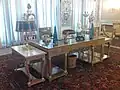 Work table of Mohammad Reza Shah Pahlavi
 Hoz Khaneh by Kamal-ol-molk
 A view of the palace
 Sahebqaraanieh building, 1884
 Jahan nama Hall Decorations
 A view of the palace
See also
References
- ↑ "Quake causes cracks in Tehran's Sahebqaraniyeh Palace". Tehran Times. 2020-05-08. Retrieved 2021-11-27.
- ↑ Askarieh, Fatemeh (2017-09-20). "Sahebqaraniyeh Palace; Recreation Centre Of Iranian Kings". Iran Front Page. Retrieved 2026-03-27.
- ↑ Jayhani, Hamidreza; Ghafarian, Harir (2019). "Study on the Historical Evolution and Authentic Layout of Sahebqeraniyeh Garden in Niavaran". Armanshahr Architecture & Urban Development. 12 (28): 21 – via EBSCO.
- ↑ "چکلیستهای مدیریت بحران در کاخ صاحبقرانیه نیاوران". ایرنا (in Persian). 2021-07-10. Retrieved 2021-11-27.
- ↑ "کاخ صاحبقرانیه نیاوران آسیب جزیی دید". ایرنا (in Persian). 2020-05-08. Retrieved 2021-11-27.
External links

 | ||
