List of odd-toed ungulates by population
| Mammals by population |
|---|
 |

This is a list of odd-toed ungulate species (order Perissodactyla) by estimated global population.
Unless otherwise noted, primary populations given are for number of mature individuals.
| Common name | Binomial name | Population | Status | Trend | Notes | Image |
|---|---|---|---|---|---|---|
| Javan rhinoceros | Rhinoceros sondaicus | 18[1] | CR[1] |  [1] | Total population is estimated to be 68 individuals. Range is entirely restricted to western Java.[1] |  |
| African wild ass | Equus africanus | 23–200[2] | CR[2] |  [2] | Total population is estimated to be 70 - 600 individuals.[2] |  |
| Sumatran rhinoceros | Dicerorhinus sumatrensis | 30[3] | CR[3] | [3] | Total population is estimated to be less than 80 individuals.[3] |  |
| Przewalski's horse | Equus ferus przewalskii | 178[4] | EN[4] |  [4] | Wild population only. Total wild population is estimated to be 387 individuals. Previously extinct in the wild.[4] |  |
| Baird's tapir | Tapirus bairdii | 1,600 - 2,300[5] | EN[5] | [5] | Estimate is derived from regional estimates from Mosquitia and the Maya Forest.[5] |  |
| Grévy's zebra | Equus grevyi | 1,956[6] | EN[6] | [6] | Total population is estimated to be 2,680 individuals.[6] | 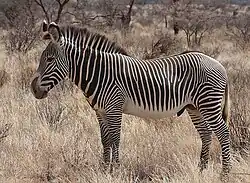 |
| Indian rhinoceros
(Greater one-horned rhino) |
Rhinoceros unicornis | 2,100-2,200[7] | VU[7] | [7] | Total population is estimated to be 3,588 individuals.[7] |  |
| Malayan tapir | Tapirus indicus | 2,499[8] | EN[8] | [8] |  | |
| Mountain tapir | Tapirus pinchaque | 2,500[9] | EN[9] | [9] | Maximum estimate.[9] |  |
| South American tapir
(Lowland tapir) |
Tapirus terrestris | 2,665 - 15,992[10] | VU[11] | [11] |
IUCN assessment does not provide a population estimate.[11] |  |
| Black rhinoceros | Diceros bicornis | 3,142[12] | CR[12] | [12] | Total population is estimated to be 5,630 individuals as of 2018.[12] |  |
| White rhinoceros | Ceratotherium simum | 10,080[13] | NT[13] | [13] | Total population is estimated to be 18,064 individuals.[13] |  |
| Mountain zebra | Equus zebra | 34,979[14] | VU[14] | [14] | Two subspecies: Hartmann's (33,265 mature individuals) & Cape (1,714 - 3,247 mature individuals).[14] |  |
| Asiatic wild ass
(Onager) |
Equus hemionus | 65,000[15] | NT[15] | [15] | Total population is estimated to be 108,300 individuals.[15] |  |
| Kiang | Equus kiang | 60,000–70,000[16] | LC[16] | [16] | Values given are for total population.[16] |  |
| Plains zebra | Equus quagga | 150,000-250,000[17] | NT[17] | [17] | Total population is estimated to be 500,000 individuals.[17] |  |
| Mule | Equus asinus x Equus caballus | 7,700,000[18] | Domesticated | Value given is the 2024 estimate given by the FAO for worldwide population, rounded to nearest hundred thousand.[18] |  | |
| Donkey | Equus africanus asinus | 53,900,000[18] | Domesticated | Value given is the 2024 estimate given by the FAO for worldwide population, rounded to nearest hundred thousand.[18] |  | |
| Horse | Equus ferus caballus | 56,200,000[18] | Domesticated | Value given is the 2024 estimate given by the FAO for worldwide population, rounded to nearest hundred thousand.[18] |  | |
See also
References
- 1 2 3 4 Ellis, S.; Talukdar, B. (2020). "Rhinoceros sondaicus". IUCN Red List of Threatened Species. 2020 e.T19495A18493900. doi:10.2305/IUCN.UK.2020-2.RLTS.T19495A18493900.en. Retrieved 13 November 2021.
- 1 2 3 4 Moehlman, P.D.; Kebede, F.; Yohannes, H. (2015). "Equus africanus". IUCN Red List of Threatened Species. 2015 e.T7949A45170994. doi:10.2305/IUCN.UK.2015-2.RLTS.T7949A45170994.en. Retrieved 2026-01-21.
- 1 2 3 4 Ellis, S.; Talukdar, B. (2020). "Dicerorhinus sumatrensis". IUCN Red List of Threatened Species. 2020 e.T6553A18493355. doi:10.2305/IUCN.UK.2020-2.RLTS.T6553A18493355.en. Retrieved 13 November 2021.
- 1 2 3 4 King, S.R.B.; Boyd, L.; Zimmerman, W.; Kendall, B.E. (2016) [amended version of 2015 assessment]. "Equus ferus". IUCN Red List of Threatened Species. 2016 e.T41763A97204950. Retrieved 2026-01-21.
- 1 2 3 4 Garcìa, M.; Jordan, C.; O'Farril, G.; Poot, C.; Meyer, N.; Estrada, N.; Leonardo, R.; Naranjo, E.; Simons, Á.; Herrera, A.; Urgilés, C.; Schank, C.; Boshoff, L.; Ruiz-Galeano, M. (2016). "Tapirus bairdii". IUCN Red List of Threatened Species. 2016 e.T21471A45173340. doi:10.2305/IUCN.UK.2016-1.RLTS.T21471A45173340.en. Retrieved 13 November 2021.
- 1 2 3 4 Rubenstein, D.; Low Mackey, B.; Davidson, Z.D.; Kebede, F.; King, S.R.B. (2016). "Equus grevyi". IUCN Red List of Threatened Species. 2016 e.T7950A89624491. doi:10.2305/IUCN.UK.2016-3.RLTS.T7950A89624491.en. Retrieved 2026-01-21.
- 1 2 3 4 Ellis, S.; Talukdar, B. (2019). "Rhinoceros unicornis". IUCN Red List of Threatened Species. 2019 e.T19496A18494149. doi:10.2305/IUCN.UK.2019-3.RLTS.T19496A18494149.en. Retrieved 2026-01-21.
- 1 2 3 Traeholt, C.; Novarino, W.; bin Saaban, S.; Shwe, N.M.; Lynam, A.; Zainuddin, Z.; Simpson, B.; bin Mohd, S. (2016). "Tapirus indicus". IUCN Red List of Threatened Species. 2016 e.T21472A45173636. doi:10.2305/IUCN.UK.2016-1.RLTS.T21472A45173636.en.
- 1 2 3 4 Lizcano, D.J.; Amanzo, J.; Castellanos, A.; Tapia, A.; Lopez-Malaga, C.M. (2016). "Tapirus pinchaque". IUCN Red List of Threatened Species. 2016 e.T21473A45173922. doi:10.2305/IUCN.UK.2016-1.RLTS.T21473A45173922.en. Retrieved 13 November 2021.
- ↑ "The distribution and conservation status of Tapirus terrestris in the South American Atlantic Forest". Neotropical Biology and Conservation. 17 (1): 1–19. 2022-01-01. doi:10.3897/neotropical.17.e71867. ISSN 2236-3777.
- 1 2 3 Kevin Flesher (Reserva Ecologica Michelin, Igrapiuna, Bahia, Brasil); Bustos, Soledad de; Chalukian, Silvia; Ayala, G; Cécile Richard-Hansen (ONCFS (Office National de la Chasse et de la Faune Sauvage)); José Cartes (IUCN SSC Deer and Tapir Specialist Groups); Varela, Diego (2018-07-31). "IUCN Red List of Threatened Species: Tapirus terrestris". IUCN Red List of Threatened Species. Archived from the original on 2025-05-05.
{{cite journal}}: CS1 maint: multiple names: authors list (link) - 1 2 3 4 Emslie, R. (2020). "Diceros bicornis". IUCN Red List of Threatened Species. 2020 e.T6557A152728945. doi:10.2305/IUCN.UK.2020-1.RLTS.T6557A152728945.en. Retrieved 13 November 2021.
- 1 2 3 4 Emslie, R. (2020). "Ceratotherium simum". IUCN Red List of Threatened Species. 2020 e.T4185A45813880. doi:10.2305/IUCN.UK.2020-1.RLTS.T4185A45813880.en. Retrieved 13 November 2021.
- 1 2 3 4 Gosling, L.M.; Muntifering, J.; Kolberg, H.; Uiseb, K.; King, S.R.B. (2019). "Equus zebra". IUCN Red List of Threatened Species. 2019 e.T7960A160755590. doi:10.2305/IUCN.UK.2019-1.RLTS.T7960A160755590.en. Retrieved 2026-01-21.
- 1 2 3 4 Kaczensky, P.; King, S.R.B.; Esmaeili, S.; Moehlman, P.D. (2025). "Equus hemionus". IUCN Red List of Threatened Species. 2025 e.T7951A238881740. doi:10.2305/IUCN.UK.2025-1.RLTS.T7951A238881740.en.
- 1 2 3 4 Shah, N.; St. Louis, A.; Qureshi, Q. (2015). "Equus kiang". IUCN Red List of Threatened Species. 2015 e.T7953A45171635. doi:10.2305/IUCN.UK.2015-4.RLTS.T7953A45171635.en. Retrieved 13 November 2021.
- 1 2 3 4 King, S.R.B. & Moehlman, P.D. (2016). "Equus quagga". IUCN Red List of Threatened Species. 2016 e.T41013A45172424. doi:10.2305/IUCN.UK.2016-2.RLTS.T41013A45172424.en.
- 1 2 3 4 5 6 "FAOSTAT". www.fao.org. Retrieved 2026-01-21.