List of bats by population
| Mammals by population |
|---|
 |

This is a list of bat species by global population. While numbers are estimates, they have been made by the experts in their fields. For more information on how these estimates were ascertained, see Wikipedia's articles on population biology and population ecology.
This list is not comprehensive, as not all bats have had their numbers quantified.
| Common name | Binomial name | Population | Status | Trend | Notes | Image |
|---|---|---|---|---|---|---|
| Christmas Island pipistrelle | Pipistrellus murrayi | 0[1] | EX[1] |  [1] | Believed to be extinct after 2009, when the last call of a bat was recorded.[1][2] | |
| Jamaican greater funnel-eared bat | Natalus jamaicensis | 50[3] | CR[3] |  [3] | Only found in the St. Clair Cave in Jamaica. Population estimate was done in 1970.[3] | |
| Seychelles sheath-tailed bat | Coleura seychellensis | 50-100[4] | CR[4] | [4] | Maximum estimate for mature individuals.[4] | |
| Cuban greater funnel-eared bat | Natalus primus | 100[5] | VU[5] | [5] | Maximum estimate. Only found in a single cave.[5] | |
| Bulmer's fruit bat | Aproteles bulmerae | 137-160[6] | CR[6] | [6] | Only one colony is known to exist.[6] | |
| Flat-headed myotis | Myotis planiceps | 240[7] | EN[7] | [7] | Maximum estimate for mature individuals.[7] |  |
| Jamaican flower bat | Phyllonycteris aphylla | 250[8] | CR[8] | [8] | Colonies only at Marta Tick Cave and Stony Hill Cave.[8] | |
| Bonin flying fox | Pteropus pselaphon | 200-250[9] | EN[9] | [9] | Maximum estimate.[9] |  |
| Arnhem leaf-nosed bat | Hipposideros inornatus | 300[10] | VU[10] | [10] | No robust estimates of population size.[10] | |
| New Georgian monkey-faced bat | Pteralopex taki | 100-3,000 (best estimate: 400)[11] | VU[11] | [11] | Estimate is for mature individuals.[11] | |
| Canary long-eared bat | Plecotus teneriffae | 500 – 2,000[12] | CR[12] | [12] | ||
| Livingstone's fruit bat | Pteropus livingstonii | 1,200-1,500[13] | EN[13] | [13] |  | |
| Coastal sheath-tailed bat | Taphozous australis | 9,000-10,000[14][15] | NT[14] | [14] |  | |
| New Caledonia wattled bat | Chalinolobus neocaledonicus | 1,500-2,000[16] | EN[16] | [16] | Maximum estimate from known colonies.[16] | |
| Azores noctule | Nyctalus azoreum | 2,000 – 5,000[17] | VU[17] | [17] |  | |
| Thailand roundleaf bat | Hipposideros halophyllus | 2,500 – 10,000[18] | VU[18] | [18] | ||
| Rodrigues flying fox | Pteropus rodricensis | 20,000[19] | EN[19] |  [19] |  | |
| Kitti's hog-nosed bat | Craseonycteris thonglongyai | 6,600[20] | NT[20] | [20] | In Thailand, it is found in 44 caves with estimated population size of 6,487 individuals. In Myanmar, it is found in 8 caves with estimated population size of 3,770 individuals.[20] |  |
| Ghost bat | Macroderma gigas | 4,000-6,000[21] | VU[21] | [21] | Totals differ between authors, with some suggesting somewhere between 4,000 - 6,000, and the previous IUCN Red List account containing an estimate of 7,000-9,000 - but all agree that there are less than 10,000 individuals in existence.[21] |  |
| Comoro rousette | Rousettus obliviosus | 10,000-20,000[22] | VU[22] | ?[22] | ||
| Giant golden-crowned flying fox | Acerodon jubatus | 10,000[23] | EN[23] | [23] | Rough estimate; probably no more than 20,000.[23] |  |
| Banana bat | Musonycteris harrisoni | 10,000[24] | VU[24] | [24] | ||
| Pemba flying fox | Pteropus voeltzkowi | 19,000[25] | VU[25] | [25] | Increase from a few hundred in the early 1990s.[25] |  |
| Mauritian flying fox | Pteropus niger | 37,700[26] | EN[26] | [26] | Minimum estimate.[26] | 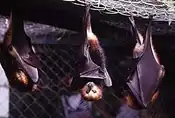 |
| New Zealand lesser short-tailed bat | Mystacina tuberculata | 30,000[27] | VU[27] | [27] | Minimum estimate.[27] |  |
| Madagascan flying fox | Pteropus rufus | 300,000[28] | VU[28] | [28] |  | |
| Grey-headed flying fox | Pteropus poliocephalus | 320,000 - 674,000[29] or 467,000[30] | VU[30] | [30] | Estimates are based on incomplete knowledge of camp location and use.[29] |  |
| Indiana bat | Myotis sodalis | 387,300[31] | NT[31] | [31] | Though numbers are large compared to other bats classified as endangered, this species is listed as such due to a >50% decline over the past decade.[31] | 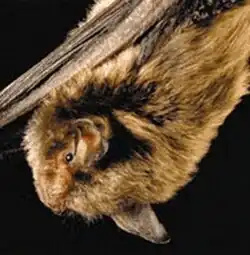 |
| Straw-coloured fruit bat | Eidolon helvum | 1,100,000,000[32] | NT[33] | [33] |
The most heavily harvested bat for bushmeat in West and Central Africa. |  |
| Pallas's long-tongued bat | Glossophaga soricina | 1,030,000,000[32] | LC [34] | [34] |
 | |
| Angolan rousette | Myonycteris angolensis | 823,000,000[32] | LC [35] | [35] |
 | |
| Heller's broad-nosed bat | Platyrrhinus helleri | 733,000,000[32] | LC [36] | [36] |
 | |
| Trident bat | Asellia tridens | 740,000,000[32] | LC [37] | [37] |
 | |
| Great stripe-faced bat | Vampyrodes caraccioli | 664,000,000[32] | LC [38] | ?[38] |  | |
| Franquet's epauletted fruit bat | Epomops franqueti | 609,000,000[32] | LC [39] | [39] |
 | |
| Wahlberg's epauletted fruit bat | Epomophorus wahlbergi' | 597,000,000[32] | LC [40] | [40] |
 | |
| Lesser mouse-tailed bat | Rhinopoma hardwickii | 600,000,000[32] | LC [41] | [41] |
 | |
| Hairy big-eyed bat | Chiroderma villosum | 536,000,000[32] | LC [42] | [42] |
 | |
| Tilda's yellow-shouldered bat | Sturnira tildae | 51,000,000[32] | LC [43] | [43] |
 | |
| Southern red bat | Lasiurus blossevillii | 526,000,000[32] | LC [44] | ?[44] |  | |
| Brown fruit-eating bat | Artibeus concolor | 488,000,000[32] | LC [45] | [45] |
 | |
| Greater bulldog bat | Noctilio leporinus | 511,000,000[32] | LC [46] | |||
| Egyptian slit-faced bat | Nycteris thebaica | 503,000,000[32] | LC [47] | |||
| MacConnell's bat | Mesophylla macconnelli | 473,000,000[32] | LC [48] | |||
| Egyptian fruit bat | Rousettus aegyptiacus | 489,000,000[32] | LC [49] | |||
| Little big-eyed bat | Chiroderma trinitatum | 459,000,000[32] | LC [50] | |||
| Gambian epauletted fruit bat | Epomophorus gambianus | 466,000,000[32] | LC [51] | |||
| Leschenault's rousette | Rousettus leschenaultii | 446,000,000[32] | NT[52] | | Data from across the species range suggests an overall decline of ca 25% over the last 15 years. | |
| Serotine | Eptesicus serotinus | 438,000,000[32] | LC [53] | |||
| Geoffroy's rousette | Rousettus amplexicaudatus | 431,000,000[32] | LC [54] | |||
| Short-headed broad-nosed bat | Platyrrhinus brachycephalus | 406,000,000[32] | LC [55] | |||
| Large-eared slit-faced bat | Nycteris macrotis | 421,000,000[32] | LC [56] | |||
| Hairy slit-faced bat | Nycteris hispida | 401,000,000[32] | LC [57] | | ||
| Greater spear-nosed bat | Phyllostomus hastatus | 402,000,000[32] | LC [58] | |||
| Black myotis | Myotis nigricans | 376,000,000[32] | LC [59] | |||
| Dawn bat | Eonycteris spelaea | 357,000,000[32] | LC [60] | | ||
| Black bonneted bat | Eumops auripendulus | 351,000,000[32] | LC [61] | |||
| Lander's horseshoe bat | Rhinolophus landeri | 346,000,000[32] | LC [62] | |||
| Greater short-nosed fruit bat | Cynopterus sphinx | 341,000,000[32] | LC [63] | |||
| Black mastiff bat | Molossus rufus | 345,000,000[32] | LC [64] | |||
| Lesser long-eared bat | Nyctophilus geoffroyi | 336,000,000[32] | LC [65] | | ||
| Long-tongued nectar bat | Macroglossus minimus | 318,000,000[32] | LC [66] | | ||
| Fischer's little fruit bat | Rhinophylla fischerae | 310,000,000[32] | LC [67] | | ||
| Pale spear-nosed bat | Phyllostomus discolor | 315,000,000[32] | LC [68] | | ||
| White-winged vampire bat | Diaemus youngi | 304,000,000[32] | LC [69] | ? | ||
| Tomes's sword-nosed bat | Lonchorhina aurita | 299,000,000[32] | LC [70] | | ||
| Fringe-lipped bat | Trachops cirrhosus | 293,000,000[32] | LC [71] | | ||
| Broad-eared bat | Nyctinomops laticaudatus | 289,000,000[32] | LC [72] | |||
| Little white-shouldered bat | Ametrida centurio | 273,000,000[32] | LC [73] | |||
| Visored bat | Sphaeronycteris toxophyllum | 265,000,000[32] | LC [74] | |||
| Riparian myotis | Myotis riparius | 276,000,000[32] | LC [75] | | ||
| Lesser dog-like bat | Peropteryx macrotis | 274,000,000[32] | LC [76] | |||
| Southern dog-faced bat | Cynomops planirostris | 272,000,000[32] | LC [77] | |||
| Southern yellow bat | Lasiurus ega | 276,000,000[32] | LC [78] | |||
| African yellow bat | Scotophilus dinganii | 276,000,000[32] | LC [79] | ? | ||
| Rüppell's horseshoe bat | Rhinolophus fumigatus | 255,000,000[32] | LC [80] | ? | ||
| Silver-tipped myotis | Myotis albescens | 246,000,000[32] | LC [81] | | ||
| Brazilian brown bat | Eptesicus brasiliensiss | 249,000,000[32] | LC [82] | |||
| Hammer-headed bat | Hypsignathus monstrosus | 247,000,000[32] | LC [83] | |||
| Greater Asiatic yellow bat | Scotophilus heathii | 246,000,000[32] | LC [84] | |||
| Western mastiff bat | Eumops perotis | 229,000,000[32] | LC [85] | |||
| Lesser Asiatic yellow bat | Scotophilus kuhlii | 229,000,000[32] | LC [86] | |||
| Lesser dog-faced fruit bat | Cynopterus brachyotis | 228,000,000[32] | LC [87] | |||
| Lesser woolly bat | Kerivoula lanosa | 230,000,000[32] | LC [88] | |||
| Wagner's bonneted bat | Eumops glaucinus | 229,000,000[32] | LC [89] | |||
| Variegated butterfly bat | Glauconycteris variegata | 229,000,000[32] | LC [90] | |||
| Noack's roundleaf bat | Hipposideros ruber | 227,000,000[32] | LC [91] | |||
| Velvety free-tailed bat | Molossus molossus | 226,000,000[32] | LC [92] | |||
| Sanborn's bonneted bat | Eumops hansae | 219,000,000[32] | LC [93] | |||
| Kuhl's pipistrelle | Pipistrellus kuhlii | 215,000,000[32] | LC [94] | |||
| Argentine brown bat | Eptesicus furinalis | 213,000,000[32] | LC [95] | |||
| Lesser bulldog bat | Noctilio albiventris | 215,000,000[32] | LC [96] | |||
| Great fruit-eating bat | Artibeus lituratus | 222,000,000[32] | LC [97] | |||
| Yellow-winged bat | Lavia frons | 213,000,000[32] | LC [98] | | ||
| Lesser sac-winged bat | Saccopteryx leptura | 208,000,000[32] | LC [99] | |||
| Seba's short-tailed bat | Carollia perspicillata | 219,000,000[32] | LC [100] | |||
| Northern little yellow-eared bat | Vampyressa thyone | 199,000,000[32] | LC [101] | |||
| Proboscis bat | Rhynchonycteris naso | 208,000,000[32] | LC [102] | |||
| Pale-faced bat | Phylloderma stenops | 219,000,000[32] | LC [103] | |||
| Dark fruit-eating bat | Artibeus obscurus | 217,000,000[32] | LC [104] | |||
| Spix's disk-winged bat | Thyroptera tricolor | 201,000,000[32] | LC [105] | |||
| Coiban mastiff bat | Molossus coibensis | 205,000,000[32] | LC [106] | |||
| Long-legged bat | Macrophyllum macrophyllum | 199,000,000[32] | LC [107] | |||
| Para dog-faced bat | Cynomops paranus | 202,000,000[32] | DD[108] | |||
| Cinnamon dog-faced bat | Cynomops abrasus | 201,000,000[32] | DD[109] | |||
| Northern ghost bat | Diclidurus albus | 195,000,000[32] | LC [110] | |||
| Gould's wattled bat | Chalinolobus gouldii | 193,000,000[32] | LC[111] | | ||
| Lesser mouse-eared bat | Myotis blythii | 191,000,000[32] | LC[112] | | ||
| Common pipistrelle | Pipistrellus pipistrellus | 188,000,000[32] | LC[113] | | ||
| Golden bat | Mimon bennettii | 187,000,000[32] | LC[114] | |||
| Big brown bat | Eptesicus fuscus | 186,000,000[32] | LC[115] | | ||
| Large-eared free-tailed bat | Otomops martiensseni | 186,000,000[32] | NT[116] | | ||
| Thumbless bat | Furipterus horrens | 185,000,000[32] | LC[117] | |||
| Chestnut sac-winged bat | Cormura brevirostris | 182,000,000[32] | LC[118] | |||
| Greater dog-like bat | Peropteryx kappleri | 182,000,000[32] | LC[119] | |||
| Horsfield's fruit bat | Cynopterus horsfieldii | 180,000,000[32] | LC[120] | |||
| Rufous dog-faced bat | Molossops neglectus | 179,000,000[32] | DD[121] | |||
| Little broad-nosed bat | Scotorepens greyii | 177,000,000[32] | LC[122] | |||
| Lesser spear-nosed bat | Phyllostomus elongatus | 176,000,000[32] | LC[123] | |||
| Ethiopian epauletted fruit bat | Epomophorus labiatus | 173,000,000[32] | LC[124] | |||
| Natterer's bat | Myotis nattereri | 172,000,000[32] | LC[125] | | ||
| Geoffroy's tailless bat | Anoura geoffroyi | 171,000,000[32] | LC[126] | |||
| Tricolored big-eared bat | Glyphonycteris sylvestris | 171,000,000[32] | LC[126] | |||
| Mexican free-tailed bat | Tadarida brasiliensis | 168,000,000[32] | LC[127] | |||
| Frosted sac-winged bat | Saccopteryx canescens | 167,000,000[32] | LC[128] | |||
| Silver-haired bat | Lasionycteris noctivagans | 165,000,000[32] | LC[129] | |||
| Greater mouse-tailed bat | Rhinopoma microphyllum | 164,000,000[32] | LC[130] | | ||
| Brown tent-making bat | Uroderma magnirostrum | 164,000,000[32] | LC[131] | |||
| White-bellied big-eared bat | Micronycteris minuta | 162,000,000[32] | LC[132] | |||
| Hoary bat | Lasiurus cinereus | 161,000,000[32] | LC[133] | |||
| Tent-making bat | Uroderma bilobatum | 160,000,000[32] | LC[134] | |||
| Long-tongued fruit bat | Macroglossus sobrinus | 159,000,000[32] | LC[135] | |||
| Nepal myotis | Myotis nipalensis | 159,000,000[32] | LC[136] | |||
| Schmidts's big-eared bat | Micronycteris schmidtorum | 158,000,000[32] | LC[137] | | ||
| Colombian bonneted bat | Eumops trumbulli | 157,000,000[32] | LC[138] | |||
| Mato Grosso dog-faced bat | Neoplatymops mattogrossensis | 157,000,000[32] | LC[139] | |||
| Dwarf dog-faced bat | Molossops temminckii | 157,000,000[32] | LC[140] | |||
| Velvety fruit-eating bat | Enchisthenes hartii | 155,000,000[32] | LC[141] | |||
| White-winged dog-like bat | Peropteryx leucoptera | 154,000,000[32] | LC[142] | |||
| Yellow-bellied sheath-tailed bat | Saccolaimus flaviventris | 154,000,000[32] | LC[143] | | ||
| Little brown bat | Myotis lucifugus | 151,000,000[32] | EN[144] | | The best available evidence as of 2021 conservatively predicts a 99% chance of Little Brown Bat extinction in the northeastern U.S. by at least 2026 due to white-nose syndrome. | |
| Finlayson's cave bat | Vespadelus finlaysoni | 151,000,000[32] | LC[145] | |||
| Pygmy round-eared bat | Lophostoma brasiliense | 149,000,000[32] | LC[146] | | ||
| Pygmy round-eared bat | Scotoecus hirundo | 149,000,000[32] | LC[147] | |||
| Big-eared woolly bat | Chrotopterus auritus | 148,000,000[32] | LC[148] | | ||
| Schlieffen's bat | Nycticeinops schlieffeni | 148,000,000[32] | LC[149] | |||
| Salvin's big-eyed bat | Chiroderma salvini | 145,000,000[32] | LC[150] | |||
| Little collared fruit bat | Myonycteris torquata | 147,000,000[32] | LC[151] | |||
| Little big-eared bat | Micronycteris megalotis | 144,000,000[32] | LC[152] | |||
| Welwitsch's bat | Myotis welwitschii | 144,000,000[32] | LC[153] | |||
| Wagner's mustached bat | Pteronotus personatus | 144,000,000[32] | LC[154] | | ||
| Shaggy bat | Centronycteris maximiliani | 144,000,000[32] | LC[155] | |||
| Short-palated fruit bat | Casinycteris argynnis | 142,000,000[32] | LC[156] | |||
| White-throated round-eared bat | Lophostoma silvicolum | 142,000,000[32] | LC[157] | |||
| Little red flying fox | Pteropus scapulatus | 142,000,000[32] | LC[158] | |||
| Hairy-legged vampire bat | Diphylla ecaudata | 140,000,000[32] | LC[159] | |||
| White-bellied yellow bat | Scotophilus leucogaster | 141,000,000[32] | LC[160] | |||
| Eastern greenish yellow bat | Scotophilus viridis | 139,000,000[32] | LC[161] | |||
| Greater yellow-shouldered bat | Sturnira magna | 139,000,000[32] | LC[162] | |||
| Flat-faced fruit-eating bat | Artibeus planirostris | 138,000,000[32] | LC[163] | |||
| Peters's Epauletted Fruit Bat | Epomophorus crypturus | 138,000,000[32] | LC[164] | |||
| Peters's disk-winged bat | Thyroptera discifera | 135,000,000[32] | LC[165] | |||
| Great woolly horseshoe bat | Rhinolophus luctus | 134,000,000[32] | LC[166] | |||
| Thomas's nectar bat | Lonchophylla thomasi | 131,000,000[32] | LC[167] | |||
| Moloney's mimic bat | Mimetillus moloneyi | 131,000,000[32] | LC[168] | |||
| Large slit-faced bat | Nycteris grandis | 131,000,000[32] | LC[169] | | ||
| Greater horseshoe bat | Rhinolophus ferrumequinum | 130,000,000[32] | LC[170] | |||
| Intermediate roundleaf bat | Hipposideros larvatus | 128,000,000[32] | LC[171] | |||
| Inland broad-nosed bat | Scotorepens balstoni | 128,000,000[32] | LC[172] | | ||
| Dwarf little fruit bat | Rhinophylla pumilio | 125,000,000[32] | LC[173] | |||
| Stripe-headed round-eared bat | Tonatia saurophila | 125,000,000[32] | LC[174] | |||
| Ognev's long-eared bat | Plecotus ognevi | 124,000,000[32] | LC[175] | |||
| Northern bat | Eptesicus nilssonii | 121,000,000[32] | LC[176] | | ||
| Chestnut long-tongued bat | Lionycteris spurrelli | 121,000,000[32] | LC[176] | |||
| Greater dawn bat | Eonycteris major | 119,000,000[32] | NT[177] | |||
| Chestnut short-tailed bat | Carollia castanea | 117,000,000[32] | LC[178] | |||
| Veldkamp's dwarf epauletted fruit bat | Nanonycteris veldkampii | 117,000,000[32] | LC[179] | |||
| Bates's slit-faced bat | Nycteris arge | 115,000,000[32] | LC[180] | | ||
| Brown long-eared bat | Plecotus auritus | 114,000,000[32] | LC[181] | | ||
| Pratt's roundleaf bat | Hipposideros pratti | 113,000,000[32] | LC[182] | |||
| Common blossom bat | Syconycteris australis | 113,000,000[32] | LC[183] | | ||
| Diadem leaf-nosed bat | Hipposideros diadema | 111,000,000[32] | LC[184] | |||
| Ikonnikov's bat | Myotis ikonnikovi | 110,000,000[32] | LC[185] | | ||
| Intermediate horseshoe bat | Rhinolophus affinis | 110,000,000[32] | LC[186] | | ||
| Dusky leaf-nosed bat | Hipposideros ater | 108,000,000[32] | LC[187] | |||
| Rusty pipistrelle | Pipistrellus rusticus | 108,000,000[32] | LC[188] | ? | ||
| Woermann's bat | Megaloglossus woermanni | 106,000,000[32] | LC[189] | |||
| Buettikofer's epauletted fruit bat | Epomops Butikofer | 105,000,000[32] | LC[190] | |||
| Greenhall's dog-faced bat | Cynomops greenhalli | 103,000,000[32] | LC[191] | |||
| Davies's big-eared bat | Glyphonycteris daviesi | 103,000,000[32] | LC[192] | |||
| Wall-roosting mouse-eared bat | Myotis muricola | 102,000,000[32] | LC[193] | |||
| Grey long-eared bat | Plecotus austriacus | 102,000,000[32] | NT[194] | | ||
| Hairy big-eared bat | Micronycteris hirsuta | 100,000,000[32] | LC[195] |
References
- 1 2 3 4 Lumsden, L.F.; Racey, P.A.; Hutson, A.M. (2021) [errata version of 2017 assessment]. "Pipistrellus murrayi". IUCN Red List of Threatened Species. 2017 e.T136769A209549918. doi:10.2305/IUCN.UK.2017-2.RLTS.T136769A209549918.en. Retrieved 23 July 2025.
- ↑ Tim, Flannery (17 November 2012). "Unmourned death of a sole survivor". The Sydney Morning Herald. Retrieved 2012-11-21.
In an attempt to avert it I met Peter Garrett, then the environment minister, and warned him of the impending loss. I had brought offers of assistance and expertise from the Australian Mammal Society to his attention. The society was confident the species could be saved - at a cost of perhaps only a few hundred thousand dollars. But Garrett was convinced by the orthodoxy that ecosystems rather than species should be the focus of the national conservation effort, and I got the message that nothing would be done.
- 1 2 3 4 Solari, S. (2016). "Natalus jamaicensis". IUCN Red List of Threatened Species. 2016 e.T136824A22043871. doi:10.2305/IUCN.UK.2016-1.RLTS.T136824A22043871.en. Retrieved 15 January 2018.
- 1 2 3 4 Bristol, R.; Bouillard, N. (2025). "Coleura seychellensis". IUCN Red List of Threatened Species. 2025 e.T5112A271898609. doi:10.2305/IUCN.UK.2025-1.RLTS.T5112A271898609.en. Retrieved 23 July 2025.
- 1 2 3 4 Mancina, C. (2016). "Natalus primus". IUCN Red List of Threatened Species. 2016 e.T136777A22032828. doi:10.2305/IUCN.UK.2016-1.RLTS.T136777A22032828.en. Retrieved 23 July 2025.
- 1 2 3 4 Aplin, K.; Armstrong, K.N.; Wright, D. (2021) [amended version of 2016 assessment]. "Aproteles bulmerae". IUCN Red List of Threatened Species. 2021 e.T1933A209536462. doi:10.2305/IUCN.UK.2021-3.RLTS.T1933A209536462.en. Retrieved 23 July 2025.
- 1 2 3 4 Arroyo-Cabrales, J.; Ospina-Garces, S. (2016). "Myotis planiceps". IUCN Red List of Threatened Species. 2016 e.T14191A22066742. doi:10.2305/IUCN.UK.2016-1.RLTS.T14191A22066742.en. Retrieved 23 July 2025.
- 1 2 3 4 Koenig, S.; Davalos, L. (2015). "Phyllonycteris aphylla". IUCN Red List of Threatened Species. 2015 e.T17173A22133396. doi:10.2305/IUCN.UK.2015-4.RLTS.T17173A22133396.en. Retrieved 23 July 2025.
- 1 2 3 4 Vincenot, C.E. (2017). "Pteropus pselaphon". IUCN Red List of Threatened Species. 2017 e.T18752A22085351. doi:10.2305/IUCN.UK.2017-2.RLTS.T18752A22085351.en. Retrieved 23 July 2025.
- 1 2 3 4 Milne, D.J. (2020). "Hipposideros inornatus". IUCN Red List of Threatened Species. 2020 e.T136739A22035711. doi:10.2305/IUCN.UK.2020-2.RLTS.T136739A22035711.en. Retrieved 23 July 2025.
- 1 2 3 4 Lavery, T.H. (2017). "Pteralopex taki". IUCN Red List of Threatened Species. 2017 e.T29473A22066155. doi:10.2305/IUCN.UK.2017-2.RLTS.T29473A22066155.en. Retrieved 23 July 2025.
- 1 2 3 Russo, D.; Cistrone, L. (2023). "Plecotus teneriffae". IUCN Red List of Threatened Species. 2023 e.T215482954A211021391. doi:10.2305/IUCN.UK.2023-1.RLTS.T215482954A211021391.en. Retrieved 23 July 2025.
- 1 2 3 Mandl, I.; Houmadi, A.; Mohamed, M.; ibouroi, M.; Doulton, H. (2025). "Pteropus livingstonii". IUCN Red List of Threatened Species. 2025 e.T18732A271898785. doi:10.2305/IUCN.UK.2025-1.RLTS.T18732A271898785.en. Retrieved 24 July 2025.
- 1 2 3 Armstrong, K.N. (2021). "Taphozous australis". IUCN Red List of Threatened Species. 2021 e.T21452A22112046. doi:10.2305/IUCN.UK.2021-1.RLTS.T21452A22112046.en. Retrieved 24 July 2025.
- ↑ Clague, C.; Coles R.; Hall, L.; Richards, G. (1999). "Coastal Sheathtail Bat". The Action Plan for Australian Bats, Environment Australia. Australian Government. ISBN 0-642-54636-3. Archived from the original on 2014-07-29. Retrieved 2014-07-25.
- 1 2 3 4 Brescia, F. (2020). "Chalinolobus neocaledonicus". IUCN Red List of Threatened Species. 2020 e.T4420A21984825. doi:10.2305/IUCN.UK.2020-3.RLTS.T4420A21984825.en. Retrieved 24 July 2025.
- 1 2 3 Russo, D.; Cistrone, L. (2023). "Nyctalus azoreum". IUCN Red List of Threatened Species. 2023 e.T14922A211008291. doi:10.2305/IUCN.UK.2023-1.RLTS.T14922A211008291.en. Retrieved 24 July 2025.
- 1 2 3 Douangboubpha , B.; Soisook, P. (2016). "Hipposideros halophyllus". IUCN Red List of Threatened Species. 2016 e.T10137A22092544. doi:10.2305/IUCN.UK.2016-2.RLTS.T10137A22092544.en. Retrieved 24 July 2025.
- 1 2 3 Tatayah, V.; Jhangeer-Khan, R.; Bégué, J.A.; Jones, C.G. (2017). "Pteropus rodricensis". IUCN Red List of Threatened Species. 2017 e.T18755A22087057. doi:10.2305/IUCN.UK.2017-2.RLTS.T18755A22087057.en. Retrieved 24 July 2025.
- 1 2 3 4 Bates, P.; Bumrungsri, S.; Francis, C. (2019). "Craseonycteris thonglongyai". IUCN Red List of Threatened Species. 2019 e.T5481A22072935. doi:10.2305/IUCN.UK.2019-3.RLTS.T5481A22072935.en. Retrieved 24 July 2025.
- 1 2 3 4 Armstrong, K.N.; Woinarski, J.C.Z.; Hanrahan, N.M.; Burbidge, A.A. (2021) [amended version of 2019 assessment]. "Macroderma gigas". IUCN Red List of Threatened Species. 2021 e.T12590A209530568. doi:10.2305/IUCN.UK.2021-3.RLTS.T12590A209530568.en. Retrieved 24 July 2025.
- 1 2 3 Sewall, B.J. (2020) [amended version of 2016 assessment]. "Rousettus obliviosus". IUCN Red List of Threatened Species. 2020 e.T19757A166527449. doi:10.2305/IUCN.UK.2020-1.RLTS.T19757A166527449.en. Retrieved 24 July 2025.
- 1 2 3 4 Mildenstein, T.; Paguntalan, L. (2016). "Acerodon jubatus". IUCN Red List of Threatened Species. 2016 e.T139A21988328. doi:10.2305/IUCN.UK.2016-2.RLTS.T139A21988328.en. Retrieved 24 July 2025.
- 1 2 3 Arroyo-Cabrales, J.; Ospina-Garces, S. (2015). "Musonycteris harrisoni". IUCN Red List of Threatened Species. 2015 e.T14003A22099002. doi:10.2305/IUCN.UK.2015-4.RLTS.T14003A22099002.en. Retrieved 24 July 2025.
- 1 2 3 4 Entwistle, A.C.; Juma, J. (2016). "Pteropus voeltzkowi". IUCN Red List of Threatened Species. 2016 e.T18768A22089205. doi:10.2305/IUCN.UK.2016-1.RLTS.T18768A22089205.en. Retrieved 24 July 2025.
- 1 2 3 4 Kingston, T.; Florens, F.B.V.; Oleksy, R.; Ruhomaun, K.; Tatayah, V. (2018). "Pteropus niger". IUCN Red List of Threatened Species. 2018 e.T18743A86475525. doi:10.2305/IUCN.UK.2018-1.RLTS.T18743A86475525.en. Retrieved 24 July 2025.
- 1 2 3 4 O'Donnell, C. (2021). "Mystacina tuberculata". IUCN Red List of Threatened Species. 2021 e.T14261A22070543. doi:10.2305/IUCN.UK.2021-2.RLTS.T14261A22070543.en. Retrieved 24 July 2025.
- 1 2 3 Racey, P.A. (2016). "Pteropus rufus". IUCN Red List of Threatened Species. 2016 e.T18756A22087230. doi:10.2305/IUCN.UK.2016-1.RLTS.T18756A22087230.en. Retrieved 24 July 2025.
- 1 2 Department of the Environment (2014). "Pteropus poliocephalus". Species Profile and Threats Database. Department of the Environment, Canberra. Retrieved 2014-07-25.
- 1 2 3 Eby, P.; Roberts, B.; Pennay, M.; Welbergen, J.A. (2021). "Pteropus poliocephalus". IUCN Red List of Threatened Species. 2021 e.T18751A22085511. doi:10.2305/IUCN.UK.2021-3.RLTS.T18751A22085511.en. Retrieved 24 July 2025.
- 1 2 3 4 Arroyo-Cabrales, J.; Ospina-Garces, S. (2016). "Myotis sodalis". IUCN Red List of Threatened Species. 2016 e.T14136A22053184. doi:10.2305/IUCN.UK.2016-1.RLTS.T14136A22053184.en. Retrieved 24 July 2025.
- 1 2 3 4 5 6 7 8 9 10 11 12 13 14 15 16 17 18 19 20 21 22 23 24 25 26 27 28 29 30 31 32 33 34 35 36 37 38 39 40 41 42 43 44 45 46 47 48 49 50 51 52 53 54 55 56 57 58 59 60 61 62 63 64 65 66 67 68 69 70 71 72 73 74 75 76 77 78 79 80 81 82 83 84 85 86 87 88 89 90 91 92 93 94 95 96 97 98 99 100 101 102 103 104 105 106 107 108 109 110 111 112 113 114 115 116 117 118 119 120 121 122 123 124 125 126 127 128 129 130 131 132 133 134 135 136 137 138 139 140 141 142 143 144 145 146 147 148 149 150 151 152 153 154 155 156 157 158 159 160 161 162 163 164 165 "Results/Wild_land_mammal_biomass_inluding_populations.CSV · master · Milo Lab (Public) / Mammal_biomass · GitLab". 26 February 2023.
- 1 2 Cooper-Bohannon, R.; Mickleburgh, S.; Hutson, A.M.; Bergmans, W.; Fahr, J.; Racey, P.A. (2020). "Eidolon helvum". IUCN Red List of Threatened Species. 2020 e.T7084A22028026. doi:10.2305/IUCN.UK.2020-2.RLTS.T7084A22028026.en. Retrieved 23 July 2025.
- 1 2 Barquez, R.; Perez, S.; Miller, B.; Diaz, M. (2015). "Glossophaga soricina". IUCN Red List of Threatened Species. 2015 e.T9277A22107768. doi:10.2305/IUCN.UK.2015-4.RLTS.T9277A22107768.en. Retrieved 25 July 2025.
- 1 2 Bergmans, W.; Hutson, A.M.; Mickleburgh, S.; Monadjem, A. (2017). "Lissonycteris angolensis". IUCN Red List of Threatened Species. 2017 e.T44698A22073874. doi:10.2305/IUCN.UK.2017-2.RLTS.T44698A22073874.en. Retrieved 24 July 2025.
- 1 2 Arroyo-Cabrales, J.; Reid, F. (2016). "Platyrrhinus helleri". IUCN Red List of Threatened Species. 2016 e.T88159886A88159952. doi:10.2305/IUCN.UK.2016-1.RLTS.T88159886A88159952.en. Retrieved 24 July 2025.
- 1 2 Monadjem, A.; Bergmans, W.; Mickleburgh, S.; Kock, D.; Amr, Z.S.S.; Hutson, A.M. (2017). "Asellia tridens". IUCN Red List of Threatened Species. 2017 e.T80221529A21975715. doi:10.2305/IUCN.UK.2017-2.RLTS.T80221529A21975715.en. Retrieved 24 July 2025.
- 1 2 Miller, B.; Reid, F.; Arroyo-Cabrales, J.; Cuarón, A.D.; de Grammont, P.C. (2016). "Vampyrodes caraccioli". IUCN Red List of Threatened Species. 2016 e.T88151904A22060515. doi:10.2305/IUCN.UK.2016-3.RLTS.T88151904A22060515.en. Retrieved 25 July 2025.
- 1 2 Kityo, R.; Nalikka, B. (2020) [amended version of 2016 assessment]. "Epomops franqueti". IUCN Red List of Threatened Species. 2020 e.T7909A166505893. doi:10.2305/IUCN.UK.2020-1.RLTS.T7909A166505893.en. Retrieved 25 July 2025.
- 1 2 Shoeman, C. (2016). "Epomophorus wahlbergi". IUCN Red List of Threatened Species. 2016 e.T7906A22116891. doi:10.2305/IUCN.UK.2016-1.RLTS.T7906A22116891.en. Retrieved 25 July 2025.
- 1 2 Monadjem, A.; Aulagnier, S.; Palmeirim, J.M.; Benda, P. (2017). "Rhinopoma hardwickii". IUCN Red List of Threatened Species. 2017 e.T82345477A21999269. doi:10.2305/IUCN.UK.2017-2.RLTS.T82345477A21999269.en. Retrieved 25 July 2025.
- 1 2 Solari, S. (2015). "Chiroderma villosum". IUCN Red List of Threatened Species. 2015 e.T4668A22037709. doi:10.2305/IUCN.UK.2015-4.RLTS.T4668A22037709.en. Retrieved 25 July 2025.
- 1 2 Sampaio, E.; Lim, B.; Peters, S. (2016). "Sturnira tildae". IUCN Red List of Threatened Species. 2016 e.T20960A22050501. doi:10.2305/IUCN.UK.2016-2.RLTS.T20960A22050501.en. Retrieved 24 July 2025.
- 1 2 Gonzalez, E.; Barquez, R.; Miller, B. (2016). "Lasiurus blossevillii". IUCN Red List of Threatened Species. 2016 e.T88151055A22120040. doi:10.2305/IUCN.UK.2016-1.RLTS.T88151055A22120040.en. Retrieved 24 July 2025.
- 1 2 Sampaio, E.; Lim, B.; Peters, S. (2016). "Artibeus concolor". IUCN Red List of Threatened Species. 2016 e.T2125A21999726. doi:10.2305/IUCN.UK.2016-2.RLTS.T2125A21999726.en. Retrieved 24 July 2025.
- ↑ "Noctilio leporinus". IUCN Red List of Threatened Species. 20 July 2015. 20 July 2015.
- ↑ Monadjem, A.; Fahr, J.; Hutson, A.M.; Mickleburgh, S.; Bergmans, W. (2017). "Nycteris thebaica". IUCN Red List of Threatened Species. 2017 e.T14936A22014183. doi:10.2305/IUCN.UK.2017-2.RLTS.T14936A22014183.en. Retrieved 24 July 2025.
- ↑ "Mesophylla macconnelli". IUCN Red List of Threatened Species. 20 July 2015. 20 July 2015.
- ↑ Korine, Carmi (20 April 2016). "Rousettus aegyptiacus". IUCN Red List of Threatened Species. 20 April 2016.
- ↑ "Chiroderma trinitatum". IUCN Red List of Threatened Species. 2 July 2016. 2 July 2016.
- ↑ Fahr, Jakob; Tanshi, Iroro (20 January 2016). "Epomophorus gambianus". IUCN Red List of Threatened Species. 20 January 2016.
- ↑ Bouillard, N.; Cretan, S.; Waldien, D.L. (2021). "Rousettus leschenaultii". IUCN Red List of Threatened Species. 2021 e.T19756A22001287. doi:10.2305/IUCN.UK.2021-3.RLTS.T19756A22001287.en. Retrieved 23 July 2025.
- ↑ Godlevska, Lena; Gazaryan, Suren; Kruskop, Sergei V. (4 July 2019). "Eptesicus serotinus". IUCN Red List of Threatened Species. 4 July 2019.
- ↑ Waldien, D.L.; Wilson, Z.; Adleson, S.; Abdul Aziz, S.; Bates, P.J.J.; Bumrungsri, S.; Furey, N.; Ingle, N.R.; Mildenstein, T.; Phelps, K.; Tanalgo, K.; Soisook, P.; Thong, V.D.; Wiantoro, S.; Tsang, S.M. (2019). "Rousettus amplexicaudatus". IUCN Red List of Threatened Species. 2019 e.T19754A22001514. doi:10.2305/IUCN.UK.2019-3.RLTS.T19754A22001514.en. Retrieved 24 July 2025.
- ↑ "Platyrrhinus brachycephalus". IUCN Red List of Threatened Species. 20 July 2015. 20 July 2015.
- ↑ Monadjem, A.; Bergmans, W.; Mickleburgh, S.; Hutson, A.M. (2017). "Nycteris macrotis". IUCN Red List of Threatened Species. 2017 e.T14933A22013415. doi:10.2305/IUCN.UK.2017-2.RLTS.T14933A22013415.en. Retrieved 24 July 2025.
- ↑ Monadjem, A.; Bergmans, W.; Mickleburgh, S.; Hutson, A.M. (2017). "Nycteris hispida". IUCN Red List of Threatened Species. 2017 e.T14930A22012843. doi:10.2305/IUCN.UK.2017-2.RLTS.T14930A22012843.en. Retrieved 24 July 2025.
- ↑ "Phyllostomus hastatus". IUCN Red List of Threatened Species. 20 July 2015. 20 July 2015.
- ↑ "Myotis nigricans". IUCN Red List of Threatened Species. 11 February 2019. 11 February 2019.
- ↑ Waldien, D.L.; Adleson, S.; Wilson, Z. (2020). "Eonycteris spelaea". IUCN Red List of Threatened Species. 2020 e.T7787A22128326. doi:10.2305/IUCN.UK.2020-3.RLTS.T7787A22128326.en. Retrieved 24 July 2025.
- ↑ "Eumops auripendulus". IUCN Red List of Threatened Species. 20 July 2015. 20 July 2015.
- ↑ Monadjem, A.; Taylor, P.J.; Jacobs, D.; Cotterill, F.P.D. (2017). "Rhinolophus landeri". IUCN Red List of Threatened Species. 2017 e.T19546A21977797. doi:10.2305/IUCN.UK.2017-2.RLTS.T19546A21977797.en. Retrieved 25 July 2025.
- ↑ "Cynopterus sphinx". IUCN Red List of Threatened Species. 6 July 2019. 6 July 2019.
- ↑ "Molossus rufus". IUCN Red List of Threatened Species. 20 July 2015. 20 July 2015.
- ↑ Lumsden, L.F.; Reardon, T.B.; Broken-brow, J.; Armstrong, K.N. (2021) [amended version of 2020 assessment]. "Nyctophilus geoffroyi". IUCN Red List of Threatened Species. 2021 e.T15003A209533561. doi:10.2305/IUCN.UK.2021-3.RLTS.T15003A209533561.en. Retrieved 25 July 2025.
- ↑ Waldien, D.L.; Dancy, J.; Wortham, G.; Santiago, K. (2021). "Macroglossus minimus". IUCN Red List of Threatened Species. 2021 e.T12594A22027337. doi:10.2305/IUCN.UK.2021-3.RLTS.T12594A22027337.en. Retrieved 24 July 2025.
- ↑ Sampaio, E.; Lim, B.; Peters, S. (2016). "Rhinophylla fischerae". IUCN Red List of Threatened Species. 2016 e.T19592A21998306. doi:10.2305/IUCN.UK.2016-2.RLTS.T19592A21998306.en. Retrieved 24 July 2025.
- ↑ Barquez, R.; Perez, S.; Miller, B.; Diaz, M. (2015). "Phyllostomus discolor". IUCN Red List of Threatened Species. 2015 e.T17216A22136476. doi:10.2305/IUCN.UK.2015-4.RLTS.T17216A22136476.en. Retrieved 24 July 2025.
- ↑ Barquez, R.; Perez, S.; Miller, B.; Diaz, M. (2015). "Diaemus youngi". IUCN Red List of Threatened Species. 2015 e.T6520A21982777. doi:10.2305/IUCN.UK.2015-4.RLTS.T6520A21982777.en. Retrieved 24 July 2025.
- ↑ Solari, S. (2015). "Lonchorhina aurita". IUCN Red List of Threatened Species. 2015 e.T12270A22039503. doi:10.2305/IUCN.UK.2015-4.RLTS.T12270A22039503.en. Retrieved 25 July 2025.
- ↑ Miller, B.; Reid, F.; Arroyo-Cabrales, J.; Cuarón, A.D.; de Grammont, P.C. (2015). "Trachops cirrhosus". IUCN Red List of Threatened Species. 2015 e.T22029A22042903. doi:10.2305/IUCN.UK.2015-4.RLTS.T22029A22042903.en. Retrieved 25 July 2025.
- ↑ "Nyctinomops laticaudatus". IUCN Red List of Threatened Species. 20 July 2015. 20 July 2015.
- ↑ Miller, B.; Reid, F.; Arroyo-Cabrales, J.; Cuarón, A.D.; de Grammont, P.C. (2017) [errata version of 2016 assessment]. "Ametrida centurio". IUCN Red List of Threatened Species. 2016 e.T1137A115055683. doi:10.2305/IUCN.UK.2016-3.RLTS.T1137A22070667.en. Retrieved 25 July 2025.
- ↑ "Sphaeronycteris toxophyllum". IUCN Red List of Threatened Species. 27 October 2017. 27 October 2017.
- ↑ Barquez, R.; Perez, S.; Diaz, M. (2016). "Myotis riparius". IUCN Red List of Threatened Species. 2016 e.T14195A22062950. doi:10.2305/IUCN.UK.2016-1.RLTS.T14195A22062950.en. Retrieved 24 July 2025.
- ↑ "Peropteryx macrotis". IUCN Red List of Threatened Species. 20 July 2015. 20 July 2015.
- ↑ "Cynomops planirostris". IUCN Red List of Threatened Species. 20 July 2015. 20 July 2015.
- ↑ Barquez, R.; Diaz, M. (2016). "Lasiurus ega". IUCN Red List of Threatened Species. 2016 e.T11350A22119259. doi:10.2305/IUCN.UK.2016-3.RLTS.T11350A22119259.en. Retrieved 24 July 2025.
- ↑ Monadjem, A.; Griffin, M. (2017). "Scotophilus dinganii". IUCN Red List of Threatened Species. 2017 e.T20066A22030888. doi:10.2305/IUCN.UK.2017-2.RLTS.T20066A22030888.en. Retrieved 24 July 2025.
- ↑ Monadjem, A.; Griffin, M.; Cotterill, F.P.D.; Jacobs, D.; Taylor, P.J. (2017). "Rhinolophus fumigatus". IUCN Red List of Threatened Species. 2017 e.T19541A21980197. doi:10.2305/IUCN.UK.2017-2.RLTS.T19541A21980197.en. Retrieved 24 July 2025.
- ↑ Barquez, R.; Diaz, M.; Samudio Jr, R.; Arroyo-Cabrales, J. (2016). "Myotis albescens". IUCN Red List of Threatened Species. 2016 e.T14140A22049892. doi:10.2305/IUCN.UK.2016-1.RLTS.T14140A22049892.en. Retrieved 24 July 2025.
- ↑ Barquez, R.; Perez, S.; Miller, B.; Diaz, M. (2016). "Eptesicus brasiliensis". IUCN Red List of Threatened Species. 2016 e.T7916A22114459. doi:10.2305/IUCN.UK.2016-1.RLTS.T7916A22114459.en. Retrieved 24 July 2025.
- ↑ Tanshi, I. (2017) [errata version of 2016 assessment]. "Hypsignathus monstrosus". IUCN Red List of Threatened Species. 2016 e.T10734A115098825. doi:10.2305/IUCN.UK.2016-3.RLTS.T10734A21999919.en. Retrieved 25 July 2025.
- ↑ "Scotophilus heathii". IUCN Red List of Threatened Species. 31 August 2018. 31 August 2018.
- ↑ "Eumops perotis". IUCN Red List of Threatened Species. 20 July 2015. 20 July 2015.
- ↑ "Scotophilus kuhlii". IUCN Red List of Threatened Species. 31 August 2018. 31 August 2018.
- ↑ Csorba, G.; Bumrungsri, S.; Bates, P.; Gumal, M.; Kingston, T.; Molur, S.; Srinivasulu, C. (2019). "Cynopterus brachyotis". IUCN Red List of Threatened Species. 2019 e.T6103A22113381. doi:10.2305/IUCN.UK.2019-3.RLTS.T6103A22113381.en. Retrieved 24 July 2025.
- ↑ Monadjem, A.; Taylor, P.J.; Jacobs, D.; Cotterill, F.P.D. (2017). "Kerivoula lanosa". IUCN Red List of Threatened Species. 2017 e.T10977A22021700. doi:10.2305/IUCN.UK.2017-2.RLTS.T10977A22021700.en. Retrieved 24 July 2025.
- ↑ Barquez, R.; Diaz, M. (2016). "Eumops glaucinus". IUCN Red List of Threatened Species. 2016 e.T87994083A22026467. doi:10.2305/IUCN.UK.2016-3.RLTS.T87994083A22026467.en. Retrieved 24 July 2025.
- ↑ Monadjem, A.; Taylor, P.J.; Jacobs, D.; Cotterill, F.P.D. (2017). "Glauconycteris variegata". IUCN Red List of Threatened Species. 2017 e.T44800A22069727. doi:10.2305/IUCN.UK.2017-2.RLTS.T44800A22069727.en. Retrieved 24 July 2025.
- ↑ Monadjem, A.; Fahr, J.; Hutson, A.M.; Mickleburgh, S.; Bergmans, W. (2017). "Hipposideros ruber". IUCN Red List of Threatened Species. 2017 e.T10157A22102440. doi:10.2305/IUCN.UK.2017-2.RLTS.T10157A22102440.en. Retrieved 24 July 2025.
- ↑ Barquez, R.; Rodriguez, B.; Miller, B.; Diaz, M. (2015). "Molossus molossus". IUCN Red List of Threatened Species. 2015 e.T13648A22106602. doi:10.2305/IUCN.UK.2015-4.RLTS.T13648A22106602.en. Retrieved 24 July 2025.
- ↑ "Eumops hansae". IUCN Red List of Threatened Species. 20 July 2015. 20 July 2015.
- ↑ Juste, J.; Paunović, M. (2016). "Pipistrellus kuhlii". IUCN Red List of Threatened Species. 2016 e.T17314A22132946. doi:10.2305/IUCN.UK.2016-2.RLTS.T17314A22132946.en. Retrieved 25 July 2025.
- ↑ Barquez, R.; Perez, S.; Miller, B.; Diaz, M. (2016). "Eptesicus furinalis". IUCN Red List of Threatened Species. 2016 e.T7927A22118013. doi:10.2305/IUCN.UK.2016-1.RLTS.T7927A22118013.en. Retrieved 24 July 2025.
- ↑ "Noctilio albiventris". IUCN Red List of Threatened Species. 20 July 2015. 20 July 2015.
- ↑ "Artibeus lituratus". IUCN Red List of Threatened Species. 20 July 2015. 20 July 2015.
- ↑ Monadjem, A.; Bergmans, W.; Mickleburgh, S.; Hutson, A.M. (2017). "Lavia frons". IUCN Red List of Threatened Species. 2017 e.T11378A22102877. doi:10.2305/IUCN.UK.2017-2.RLTS.T11378A22102877.en. Retrieved 24 July 2025.
- ↑ "Saccopteryx leptura". IUCN Red List of Threatened Species. 20 July 2015. 20 July 2015.
- ↑ "Carollia perspicillata". IUCN Red List of Threatened Species. 20 July 2015. 20 July 2015.
- ↑ "Vampyressa thyone". IUCN Red List of Threatened Species. 20 July 2015. 20 July 2015.
- ↑ "Rhynchonycteris naso". IUCN Red List of Threatened Species. July 2016. July 2016.
- ↑ "Phylloderma stenops". IUCN Red List of Threatened Species. 20 July 2015. 20 July 2015.
- ↑ Sampaio, E.; Lim, B.; Peters, S. (2016). "Artibeus obscurus". IUCN Red List of Threatened Species. 2016 e.T2137A21998064. doi:10.2305/IUCN.UK.2016-2.RLTS.T2137A21998064.en. Retrieved 24 July 2025.
- ↑ "Thyroptera tricolor". IUCN Red List of Threatened Species. 20 July 2015. 20 July 2015.
- ↑ Sampaio, E.; Lim, B.; Peters, S. (2017). "Molossus coibensis". IUCN Red List of Threatened Species. 2017 e.T102208365A22106904. doi:10.2305/IUCN.UK.2017-2.RLTS.T102208365A22106904.en. Retrieved 24 July 2025.
- ↑ "Macrophyllum macrophyllum". IUCN Red List of Threatened Species. 20 July 2015. 20 July 2015.
- ↑ Barquez, R.; Diaz, M. (2016). "Cynomops paranus". IUCN Red List of Threatened Species. 2016 e.T87993365A87993377. doi:10.2305/IUCN.UK.2016-1.RLTS.T87993365A87993377.en. Retrieved 23 July 2025.
- ↑ Barquez, R.; Diaz, M. (2016). "Cynomops abrasus". IUCN Red List of Threatened Species. 2016 e.T13637A22109417. doi:10.2305/IUCN.UK.2016-2.RLTS.T13637A22109417.en. Retrieved 23 July 2025.
- ↑ Lim, B.; Miller, B.; Reid, F.; Arroyo-Cabrales, J.; Cuarón, A.D.; de Grammont, P.C. (2016). "Diclidurus albus". IUCN Red List of Threatened Species. 2016 e.T6561A21986615. doi:10.2305/IUCN.UK.2016-2.RLTS.T6561A21986615.en. Retrieved 25 July 2025.
- ↑ Lumsden, L.F.; Reardon, T.B.; Armstrong, K.N. (2021) [amended version of 2020 assessment]. "Chalinolobus gouldii". IUCN Red List of Threatened Species. 2021 e.T4417A209548746. doi:10.2305/IUCN.UK.2021-3.RLTS.T4417A209548746.en. Retrieved 25 July 2025.
- ↑ Juste, J.; Paunović, M. (2016). "Myotis blythii". IUCN Red List of Threatened Species. 2016 e.T14124A22053297. doi:10.2305/IUCN.UK.2016-2.RLTS.T14124A22053297.en. Retrieved 25 July 2025.
- ↑ Godlevska, L.; Bücs, S.; Kruskop, S.V.; Gazaryan, S.; Benda, P.; Paunović, M. (2021) [errata version of 2020 assessment]. "Pipistrellus pipistrellus". IUCN Red List of Threatened Species. 2020 e.T85333513A196581936. doi:10.2305/IUCN.UK.2020-2.RLTS.T85333513A196581936.en. Retrieved 24 July 2025.
- ↑ "Mimon bennettii". IUCN Red List of Threatened Species. 29 June 2018. 29 June 2018.
- ↑ Miller, B.; Reid, F.; Arroyo-Cabrales, J.; Cuarón, A.D.; de Grammont, P.C. (2016). "Eptesicus fuscus". IUCN Red List of Threatened Species. 2016 e.T7928A22118197. doi:10.2305/IUCN.UK.2016-3.RLTS.T7928A22118197.en. Retrieved 24 July 2025.
- ↑ Richards, L.R.; Mickleburgh, S.; Hutson, A.M.; Bergmans, W.; Fahr, J.; Taylor, P.J. (2018) [errata version of 2017 assessment]. "Otomops martiensseni". IUCN Red List of Threatened Species. 2017 e.T15648A123791222. doi:10.2305/IUCN.UK.2017-3.RLTS.T15648A22112617.en. Retrieved 24 July 2025.
- ↑ Miller, B.; Reid, F.; Arroyo-Cabrales, J.; Cuarón, A.D.; de Grammont, P.C. (2016). "Furipterus horrens". IUCN Red List of Threatened Species. 2016 e.T8771A21971535. doi:10.2305/IUCN.UK.2016-2.RLTS.T8771A21971535.en. Retrieved 24 July 2025.
- ↑ Sampaio, E.; Lim, B.; Peters, S.; Miller, B.; Cuarón, A.D.; de Grammont, P.C. (2016). "Cormura brevirostris". IUCN Red List of Threatened Species. 2016 e.T41527A22006450. doi:10.2305/IUCN.UK.2016-2.RLTS.T41527A22006450.en. Retrieved 24 July 2025.
- ↑ Davalos, L.; Molinari, J.; Miller, B.; Rodriguez, B. (2018). "Peropteryx kappleri". IUCN Red List of Threatened Species. 2018 e.T16707A22100544. doi:10.2305/IUCN.UK.2018-2.RLTS.T16707A22100544.en. Retrieved 24 July 2025.
- ↑ "Cynopterus horsfieldii". IUCN Red List of Threatened Species. 6 July 2019. 6 July 2019.
- ↑ Barquez, R.; Diaz, M. (2016). "Molossops neglectus". IUCN Red List of Threatened Species. 2016 e.T13641A22108928. doi:10.2305/IUCN.UK.2016-2.RLTS.T13641A22108928.en. Retrieved 23 July 2025.
- ↑ "Scotorepens greyii". IUCN Red List of Threatened Species. July 7, 2019. July 7, 2019.
- ↑ "Phyllostomus elongatus". IUCN Red List of Threatened Species. 20 July 2015. 20 July 2015.
- ↑ "Epomophorus labiatus". IUCN Red List of Threatened Species. 29 December 2015. 29 December 2015.
- ↑ Gazaryan, S.; Kruskop, S.V.; Godlevska, L. (2020). "Myotis nattereri". IUCN Red List of Threatened Species. 2020 e.T85733032A22052584. doi:10.2305/IUCN.UK.2020-2.RLTS.T85733032A22052584.en. Retrieved 24 July 2025.
- 1 2 "Anoura geoffroyi". IUCN Red List of Threatened Species. 16 March 2016. 16 March 2016.
- ↑ "Tadarida brasiliensis". IUCN Red List of Threatened Species. 20 July 2015. 20 July 2015.
- ↑ "Saccopteryx canescens". IUCN Red List of Threatened Species. 20 July 2015. 20 July 2015.
- ↑ "Lasionycteris noctivagans". IUCN Red List of Threatened Species. 15 June 2018. 15 June 2018.
- ↑ Monadjem, A.; Palmeirim, J.M.; Aulagnier, S. (2017). "Rhinopoma microphyllum". IUCN Red List of Threatened Species. 2017 e.T19600A21998943. doi:10.2305/IUCN.UK.2017-2.RLTS.T19600A21998943.en. Retrieved 24 July 2025.
- ↑ "Uroderma magnirostrum". IUCN Red List of Threatened Species. July 20, 2015. July 20, 2015.
- ↑ "Micronycteris minuta". IUCN Red List of Threatened Species. 20 July 2015. 20 July 2015.
- ↑ "Lasiurus cinereus". IUCN Red List of Threatened Species. 20 July 2015. 20 July 2015.
- ↑ "Uroderma bilobatum". IUCN Red List of Threatened Species. 9 February 2019. 9 February 2019.
- ↑ "Macroglossus sobrinus". IUCN Red List of Threatened Species. November 28, 2020. November 28, 2020.
- ↑ "Myotis nipalensis". IUCN Red List of Threatened Species. 31 August 2018. 31 August 2018.
- ↑ Sampaio, E.; Lim, B.; Peters, S. (2016). "Micronycteris schmidtorum". IUCN Red List of Threatened Species. 2016 e.T13383A22124156. doi:10.2305/IUCN.UK.2016-2.RLTS.T13383A22124156.en. Retrieved 24 July 2025.
- ↑ "Eumops trumbulli". IUCN Red List of Threatened Species. 17 March 2018. 17 March 2018.
- ↑ "Molossops mattogrossensis". IUCN Red List of Threatened Species. 19 March 2018. 19 March 2018.
- ↑ Barquez, R.; Diaz, M. (2015). "Molossops temminckii". IUCN Red List of Threatened Species. 2015 e.T13643A22108409. doi:10.2305/IUCN.UK.2015-4.RLTS.T13643A22108409.en. Retrieved 24 July 2025.
- ↑ "Enchisthenes hartii". IUCN Red List of Threatened Species. February 20, 2018. February 20, 2018.
- ↑ "Peropteryx leucoptera". IUCN Red List of Threatened Species. July 20, 2015. July 20, 2015.
- ↑ Armstrong, K.N.; Lumsden, L.F. (2021) [amended version of 2017 assessment]. "Saccolaimus flaviventris". IUCN Red List of Threatened Species. 2021 e.T19799A209538418. doi:10.2305/IUCN.UK.2021-3.RLTS.T19799A209538418.en. Retrieved 25 July 2025.
- ↑ Solari, S. (2021) [amended version of 2018 assessment]. "Myotis lucifugus". IUCN Red List of Threatened Species. 2021 e.T14176A208031565. doi:10.2305/IUCN.UK.2021-3.RLTS.T14176A208031565.en. Retrieved 23 July 2025.
- ↑ "Vespadelus finlaysoni". IUCN Red List of Threatened Species. 22 November 2020. 22 November 2020.
- ↑ Sampaio, E.; Lim, B.; Peters, S.; Miller, B.; Cuarón, A.D.; de Grammont, P.C. (2017) [errata version of 2016 assessment]. "Lophostoma brasiliense". IUCN Red List of Threatened Species. 2016 e.T21984A115164165. doi:10.2305/IUCN.UK.2016-3.RLTS.T21984A21975227.en. Retrieved 24 July 2025.
- ↑ Cotterill, F.P.D.; Jacobs, D.; Monadjem, A.; Taylor, P.J. (2017). "Scotoecus hirundo". IUCN Red List of Threatened Species. 2017 e.T20055A22025420. doi:10.2305/IUCN.UK.2017-2.RLTS.T20055A22025420.en. Retrieved 24 July 2025.
- ↑ Barquez, R.; Perez, S.; Miller, B.; Diaz, M. (2015). "Chrotopterus auritus". IUCN Red List of Threatened Species. 2015 e.T4811A22042605. doi:10.2305/IUCN.UK.2015-4.RLTS.T4811A22042605.en. Retrieved 24 July 2025.
- ↑ Monadjem, A.; Cotterill, F.P.D.; Taylor, P.J.; Jacobs, D. (2017). "Nycticeinops schlieffeni". IUCN Red List of Threatened Species. 2017 e.T41533A22005999. doi:10.2305/IUCN.UK.2017-2.RLTS.T41533A22005999.en. Retrieved 24 July 2025.
- ↑ "Chiroderma salvini". IUCN Red List of Threatened Species. 20 July 2015. 20 July 2015.
- ↑ "Myonycteris torquata". IUCN Red List of Threatened Species. 21 February 2014. 21 February 2014.
- ↑ "Micronycteris megalotis". IUCN Red List of Threatened Species. 20 July 2015. 20 July 2015.
- ↑ Monadjem, A.; Taylor, P.J.; Jacobs, D.; Cotterill, F.P.D. (2017). "Myotis welwitschii". IUCN Red List of Threatened Species. 2017 e.T14211A22068792. doi:10.2305/IUCN.UK.2017-2.RLTS.T14211A22068792.en. Retrieved 24 July 2025.
- ↑ Davalos, L.; Molinari, J.; Mantilla-Meluk, H.; Medina, C.; Pineda, J.; Rodriguez, B. (2017) [errata version of 2016 assessment]. "Pteronotus personatus". IUCN Red List of Threatened Species. 2016 e.T18709A115145223. doi:10.2305/IUCN.UK.2016-3.RLTS.T18709A22076876.en. Retrieved 25 July 2025.
- ↑ Sampaio, E.; Lim, B.; Peters, S. (2016). "Centronycteris maximiliani". IUCN Red List of Threatened Species. 2016 e.T4112A22002444. doi:10.2305/IUCN.UK.2016-2.RLTS.T4112A22002444.en. Retrieved 24 July 2025.
- ↑ Kityo, Robert; Nalikka, Betty; Webala, Paul (February 11, 2014). "Casinycteris argynnis". IUCN Red List of Threatened Species. February 11, 2014.
- ↑ Barquez, R.; Diaz, M.; Pineda, W.; Rodriguez, B. (2016). "Lophostoma silvicolum". IUCN Red List of Threatened Species. 2016 e.T88149202A22041651. doi:10.2305/IUCN.UK.2016-3.RLTS.T88149202A22041651.en. Retrieved 24 July 2025.
- ↑ Eby, P.; Roberts, B. (2016). "Pteropus scapulatus". IUCN Red List of Threatened Species. 2016 e.T18758A22087637. doi:10.2305/IUCN.UK.2016-1.RLTS.T18758A22087637.en. Retrieved 25 July 2025.
- ↑ "Diphylla ecaudata". IUCN Red List of Threatened Species. July 5, 2016. July 5, 2016.
- ↑ "Scotophilus leucogaster". IUCN Red List of Threatened Species. 31 August 2016. 31 August 2016.
- ↑ "Scotophilus viridis". IUCN Red List of Threatened Species. 31 August 2016. 31 August 2016.
- ↑ "Sturnira magna". IUCN Red List of Threatened Species. 20 July 2015. 20 July 2015.
- ↑ "Artibeus planirostris". IUCN Red List of Threatened Species. July 20, 2015. July 20, 2015.
- ↑ "Epomophorus crypturus". IUCN Red List of Threatened Species. 4 November 2015. 4 November 2015.
- ↑ Solari, S.; Villada-Cadavid, T. (2018). "Thyroptera discifera". IUCN Red List of Threatened Species. 2018 e.T21877A21985811. doi:10.2305/IUCN.UK.2018-2.RLTS.T21877A21985811.en. Retrieved 24 July 2025.
- ↑ Thong, V.D.; Thanh, H.T.; Soisook, P.; Csorba, G. (2019). "Rhinolophus luctus". IUCN Red List of Threatened Species. 2019 e.T19548A21977086. doi:10.2305/IUCN.UK.2019-3.RLTS.T19548A21977086.en. Retrieved 24 July 2025.
- ↑ "Lonchophylla thomasi". IUCN Red List of Threatened Species. 20 July 2015. 20 July 2015.
- ↑ "Mimetillus moloneyi". IUCN Red List of Threatened Species. August 31, 2016. August 31, 2016.
- ↑ Monadjem, A.; Bergmans, W.; Mickleburgh, S.; Hutson, A.M. (2017). "Nycteris grandis". IUCN Red List of Threatened Species. 2017 e.T14929A22012638. doi:10.2305/IUCN.UK.2017-2.RLTS.T14929A22012638.en. Retrieved 24 July 2025.
- ↑ "Rhinolophus ferrumequinum". IUCN Red List of Threatened Species. 25 April 2016. 25 April 2016.
- ↑ Srinivasulu, C.; Srinivasulu, A. (2020). "Hipposideros larvatus". IUCN Red List of Threatened Species. 2020 e.T85646564A22091287. doi:10.2305/IUCN.UK.2020-3.RLTS.T85646564A22091287.en. Retrieved 25 July 2025.
- ↑ Lumsden, L.F.; Reardon, T.B.; Armstrong, K.N. (2021) [amended version of 2020 assessment]. "Scotorepens balstoni". IUCN Red List of Threatened Species. 2021 e.T14942A209531194. doi:10.2305/IUCN.UK.2021-3.RLTS.T14942A209531194.en. Retrieved 24 July 2025.
- ↑ "Rhinophylla pumilio". IUCN Red List of Threatened Species. July 20, 2015. July 20, 2015.
- ↑ "Tonatia saurophila". IUCN Red List of Threatened Species. 3 March 2018. 3 March 2018.
- ↑ Kruskop, S.V.; Fukui, D. (2019). "Plecotus ognevi". IUCN Red List of Threatened Species. 2019 e.T136598A21996784. doi:10.2305/IUCN.UK.2019-3.RLTS.T136598A21996784.en. Retrieved 24 July 2025.
- 1 2 Coroiu, I. (2016). "Eptesicus nilssonii". IUCN Red List of Threatened Species. 2016 e.T7910A22116204. doi:10.2305/IUCN.UK.2016-2.RLTS.T7910A22116204.en. Retrieved 24 July 2025.
- ↑ Waldien, D.L.; Mohd-Azlan, J. (2021). "Eonycteris major". IUCN Red List of Threatened Species. 2021 e.T7786A22128071. doi:10.2305/IUCN.UK.2021-1.RLTS.T7786A22128071.en. Retrieved 24 July 2025.
- ↑ "Carollia castanea". IUCN Red List of Threatened Species. 14 March 2016. 14 March 2016.
- ↑ Monadjem, A.; Fahr, J.; Hutson, A.M.; Mickleburgh, S.; Bergmans, W. (2017). "Nanonycteris veldkampii". IUCN Red List of Threatened Species. 2017 e.T14333A22043635. doi:10.2305/IUCN.UK.2017-2.RLTS.T14333A22043635.en. Retrieved 23 July 2025.
- ↑ Monadjem, A.; Fahr, J.; Hutson, A.M.; Mickleburgh, S.; Bergmans, W. (2017). "Nycteris arge". IUCN Red List of Threatened Species. 2017 e.T14926A22016999. doi:10.2305/IUCN.UK.2017-2.RLTS.T14926A22016999.en. Retrieved 23 July 2025.
- ↑ Russo, D.; Cistrone, L. (2023). "Plecotus auritus". IUCN Red List of Threatened Species. 2023 e.T85535522A211015413. doi:10.2305/IUCN.UK.2023-1.RLTS.T85535522A211015413.en. Retrieved 25 July 2025.
- ↑ "Hipposideros pratti". IUCN Red List of Threatened Species. 20 August 2018. 20 August 2018.
- ↑ Aplin, K.; Armstrong, K.N. (2021) [amended version of 2016 assessment]. "Syconycteris australis". IUCN Red List of Threatened Species. 2021 e.T21185A209535645. doi:10.2305/IUCN.UK.2021-3.RLTS.T21185A209535645.en. Retrieved 24 July 2025.
- ↑ "Hipposideros diadema". IUCN Red List of Threatened Species. 30 April 2021. 30 April 2021.
- ↑ Zhigalin, A.; Stubbe, M.; Ariunbold, J.; Buuveibaatar, V.; Dorjderem, S.; Monkhzul, T.; Otgonbaatar, M.; Tsogbadrakh, M. (2020). "Myotis ikonnikovi". IUCN Red List of Threatened Species. 2020 e.T14168A22057122. doi:10.2305/IUCN.UK.2020-3.RLTS.T14168A22057122.en. Retrieved 23 July 2025.
- ↑ Furey, N.; Walston, J.; Kingston, T.; Hutson, A.M. (2020). "Rhinolophus affinis". IUCN Red List of Threatened Species. 2020 e.T19522A21982358. doi:10.2305/IUCN.UK.2020-3.RLTS.T19522A21982358.en. Retrieved 25 July 2025.
- ↑ "Hipposideros ater". IUCN Red List of Threatened Species. 11 December 2020. 11 December 2020.
- ↑ Monadjem, A.; Taylor, P.J.; Jacobs, D.; Cotterill, F.P.D. (2017). "Pipistrellus rusticus". IUCN Red List of Threatened Species. 2017 e.T17362A22124708. doi:10.2305/IUCN.UK.2017-2.RLTS.T17362A22124708.en. Retrieved 25 July 2025.
- ↑ "Megaloglossus woermanni". IUCN Red List of Threatened Species. February 14, 2014. February 14, 2014.
- ↑ "Epomops buettikoferi". IUCN Red List of Threatened Species. 31 January 2014. 31 January 2014.
- ↑ "Cynomops greenhalli". IUCN Red List of Threatened Species. 20 July 2015. 20 July 2015.
- ↑ "Glyphonycteris daviesi". IUCN Red List of Threatened Species. 20 February 2018. 20 February 2018.
- ↑ "Myotis muricola". IUCN Red List of Threatened Species. 31 August 2018. 31 August 2018.
- ↑ Russo, D.; Cistrone, L. (2023). "Plecotus austriacus". IUCN Red List of Threatened Species. 2023 e.T85533333A211018209. doi:10.2305/IUCN.UK.2023-1.RLTS.T85533333A211018209.en. Retrieved 23 July 2025.
- ↑ Sampaio, E.; Lim, B.; Peters, S.; Miller, B.; Cuarón, A.D.; de Grammont, P.C. (2016). "Micronycteris hirsuta". IUCN Red List of Threatened Species. 2016 e.T13378A22124582. doi:10.2305/IUCN.UK.2016-3.RLTS.T13378A22124582.en. Retrieved 23 July 2025.
Categories: