List of birds of Croatia
This is a list of the bird species recorded in Croatia. The avifauna of Croatia include a total of 416 species, of which 3 have been introduced by humans. 23 species are globally threatened.
This list's taxonomic treatment (designation and sequence of orders, families and species) and nomenclature (common and scientific names) follow the conventions of The Clements Checklist of Birds of the World, 2022 edition. The family accounts at the beginning of each heading reflect this taxonomy, as do the species counts found in each family account. Introduced and accidental species are included in the total counts for Croatia.
The following tags have been used to highlight several categories. The commonly occurring native species do not fall into any of these categories.
- (A) Accidental - a species that rarely or accidentally occurs in Croatia
- (I) Introduced - a species introduced to Croatia as a consequence, direct or indirect, of human actions
- (Ex) Extirpated - a species that no longer occurs in Croatia although populations exist elsewhere
Ducks, geese, and waterfowl
Order: Anseriformes Family: Anatidae
Anatidae includes the ducks and most duck-like waterfowl, such as geese and swans. These birds are adapted to an aquatic existence with webbed feet, flattened bills, and feathers that are excellent at shedding water due to an oily coating.
| Common and binomial names | Image | Status in Croatia | Regional IUCN status |
|---|---|---|---|
| Bar-headed goose (Anser indicus) |
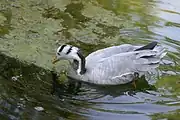 |
(A) Accidental vagrant | LC – least concern (Croatia)[1] |
| Greylag goose (Anser anser) |
 |
Fairly common winter visitor | LC – least concern (Croatia)[2] |
| Greater white-fronted goose (Anser albifrons) |
 |
Regular winter visitor | LC – least concern (Croatia)[3] |
| Lesser white-fronted goose (Anser erythropus) |
 |
(A) Rare accidental vagrant | VU – vulnerable (Croatia)[4] |
| Taiga bean goose (Anser fabalis) |
 |
Scarce winter visitor | LC – least concern (Croatia)[5] |
| Tundra bean goose (Anser serrirostris) |
 |
Scarce winter visitor | LC – least concern (Croatia)[6] |
| Pink-footed goose (Anser brachyrhynchus) |
 |
(A) Accidental vagrant | LC – least concern (Croatia)[7] |
| Brant (Branta bernicla) |
 |
(A) Accidental vagrant | LC – least concern (Croatia)[8] |
| Barnacle goose (Branta leucopsis) |
 |
(A) Accidental vagrant | LC – least concern (Croatia)[9] |
| Canada goose (Branta canadensis) |
 |
(A) Accidental vagrant | LC – least concern (Croatia)[10] |
| Red-breasted goose (Branta ruficollis) |
 |
(A) Rare accidental vagrant | VU – vulnerable (Croatia)[11] |
| Mute swan (Cygnus olor) |
 |
Common breeding resident | LC – least concern (Croatia)[12] |
| Black swan (Cygnus atratus) |
 |
(A) Accidental escapee | LC – least concern (Croatia)[13] |
| Tundra swan (Cygnus columbianus) |
 |
(A) Accidental vagrant | LC – least concern (Croatia)[14] |
| Whooper swan (Cygnus cygnus) |
 |
Scarce winter visitor | LC – least concern (Croatia)[15] |
| Egyptian goose (Alopochen aegyptiaca) |
 |
(A) Accidental vagrant | LC – least concern (Croatia)[16] |
| Ruddy shelduck (Tadorna ferruginea) |
 |
(A) Accidental vagrant | LC – least concern (Croatia)[17] |
| Common shelduck (Tadorna tadorna) |
 |
Regular breeder and migrant | LC – least concern (Croatia)[18] |
| Garganey (Spatula querquedula) |
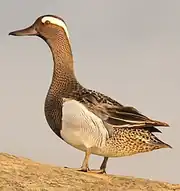 |
Common breeding summer visitor | LC – least concern (Croatia)[19] |
| Northern shoveler (Spatula clypeata) |
 |
Breeding summer visitor | LC – least concern (Croatia)[20] |
| Gadwall (Mareca strepera) |
 |
Breeding summer visitor | LC – least concern (Croatia)[21] |
| Eurasian wigeon (Mareca penelope) |
 |
Winter visitor | LC – least concern (Croatia)[22] |
| Mallard (Anas platyrhynchos) |
 |
Abundant breeding resident | LC – least concern (Croatia)[23] |
| Northern pintail (Anas acuta) |
 |
Scarce winter visitor | LC – least concern (Croatia)[24] |
| Common teal (Anas crecca) |
 |
Common winter visitor | LC – least concern (Croatia)[25] |
| Red-crested pochard (Netta rufina) |
 |
Scarce breeder and migrant | LC – least concern (Croatia)[26] |
| Common pochard (Aythya ferina) |
 |
Scarce breeder and winter visitor | VU – vulnerable (Croatia)[27] |
| Ferruginous duck (Aythya nyroca) |
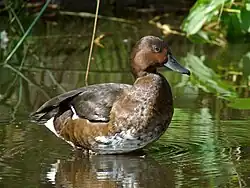 |
Scarce breeder and migrant | NT – near threatened (Croatia)[28] |
| Tufted duck (Aythya fuligula) |
 |
Common winter visitor | LC – least concern (Croatia)[29] |
| Greater scaup (Aythya marila) |
 |
Scarce winter visitor | LC – least concern (Croatia)[30] |
| Common eider (Somateria mollissima) |
 |
(A) Accidental vagrant | LC – least concern (Croatia)[31] |
| Harlequin duck (Histrionicus histrionicus) |
 |
(A) Accidental vagrant | LC – least concern (Croatia)[32] |
| Velvet scoter (Melanitta fusca) |
 |
Scarce winter visitor | VU – vulnerable (Croatia)[33] |
| Common scoter (Melanitta nigra) |
 |
(A) Accidental vagrant | LC – least concern (Croatia)[34] |
| Long-tailed duck (Clangula hyemalis) |
 |
(A) Accidental vagrant | VU – vulnerable (Croatia)[35] |
| Common goldeneye (Bucephala clangula) |
 |
Regular winter visitor | LC – least concern (Croatia)[36] |
| Smew (Mergellus albellus) |
 |
Scarce winter visitor | LC – least concern (Croatia)[37] |
| Common merganser (Mergus merganser) |
 |
Scarce winter visitor | LC – least concern (Croatia)[38] |
| Red-breasted merganser (Mergus serrator) |
 |
Scarce winter visitor | LC – least concern (Croatia)[39] |
| White-headed duck (Oxyura leucocephala) |
 |
(A) Rare accidental vagrant | EN – endangered (Croatia)[40] |
Pheasants, grouse, and allies
Order: Galliformes Family: Phasianidae
The Phasianidae are a family of terrestrial birds. In general, they are plump (although they vary in size) and have broad, relatively short wings.
| Common and binomial names | Image | Status in Croatia | Regional IUCN status |
|---|---|---|---|
| Common quail (Coturnix coturnix) |
 |
Common breeding summer visitor | NT – near threatened (Europe)[41] |
| Rock partridge (Alectoris graeca) |
 |
Localized breeding resident (6,000–10,000 pairs, declining) | NT – near threatened (Europe)[42] |
| Common pheasant (Phasianus colchicus) |
 |
I – Introduced, abundant breeding resident | LC – least concern (Europe)[43] |
| Grey partridge (Perdix perdix) |
 |
Fairly common breeding resident | LC – least concern (Europe)[44] |
| Western capercaillie (Tetrao urogallus) |
 |
Scarce, highly localized breeding resident (50–100 pairs) | VU – vulnerable (Croatia)[45] |
| Black grouse (Lyrurus tetrix) |
 |
Ex – Extirpated; formerly bred in Croatia, now vanished | RE – regionally extinct (Croatia)[46] |
| Hazel grouse (Tetrastes bonasia) |
 |
Scarce localized breeding resident | LC – least concern (Europe)[47] |
Flamingos
Order: Phoenicopteriformes Family: Phoenicopteridae
Flamingos are gregarious wading birds, usually 3 to 5 feet (0.9 to 1.5 m) tall, found in both the Western and Eastern Hemispheres. Flamingos filter-feed on shellfish and algae. Their oddly shaped beaks are specially adapted to separate mud and silt from the food they consume and, uniquely, are used upside-down.
| Common and binomial names | Image | Status in Croatia | Regional IUCN status |
|---|---|---|---|
| Greater flamingo (Phoenicopterus roseus) |
 |
Scarce but increasing visitor, occasional breeder in wetlands | LC – least concern (Croatia)[48] |
Grebes
Order: Podicipediformes Family: Podicipedidae
Grebes are small to medium-large freshwater diving birds. They have lobed toes and are excellent swimmers and divers. However, they have their feet placed far back on the body, making them quite ungainly on land.
| Common and binomial names | Image | Status in Croatia | Regional IUCN status |
|---|---|---|---|
| Little grebe (Tachybaptus ruficollis) |
 |
Common breeding resident in wetlands | LC – least concern (Croatia)[49] |
| Horned grebe (Podiceps auritus) |
 |
Rare winter visitor | VU – vulnerable (Croatia)[50] |
| Red-necked grebe (Podiceps grisegena) |
 |
Scarce winter visitor | LC – least concern (Croatia)[51] |
| Great crested grebe (Podiceps cristatus) |
 |
Common breeding resident in lakes and rivers | LC – least concern (Croatia)[52] |
| Eared grebe (Podiceps nigricollis) |
 |
Scarce breeder and migrant | NT – near threatened (Croatia)[53] |
Pigeons and doves
Order: Columbiformes Family: Columbidae
Pigeons and doves are stout-bodied birds with short necks and short slender bills with a fleshy cere.
| Common and binomial names | Image | Status in Croatia | Regional IUCN status |
|---|---|---|---|
| Rock pigeon (Columba livia) |
 |
Common resident, most populations are feral, uncertain whether wild populations still exist | LC – least concern (Croatia)[54] |
| Stock dove (Columba oenas) |
 |
Scarce breeder in woodlands | LC – least concern (Croatia)[55] |
| Common wood pigeon (Columba palumbus) |
 |
Common breeding resident | LC – least concern (Croatia)[56] |
| European turtle dove (Streptopelia turtur) |
 |
Scarce breeder, declining population | VU – vulnerable (Croatia)[57] |
| Oriental turtle dove (Streptopelia orientalis) |
 |
(A) Accidental vagrant | LC – least concern (Croatia)[58] |
| Eurasian collared dove (Streptopelia decaocto) |
 |
Common breeding resident, widespread in towns and villages | LC – least concern (Croatia)[59] |
Sandgrouse
Order: Pterocliformes Family: Pteroclidae
Sandgrouse have small, pigeon like heads and necks, but sturdy compact bodies. They have long pointed wings and sometimes tails and a fast direct flight. Flocks fly to watering holes at dawn and dusk. Their legs are feathered down to the toes.
| Common and binomial names | Image | Status in Croatia | Regional IUCN status |
|---|---|---|---|
| Pallas's sandgrouse (Syrrhaptes paradoxus) |
 |
(A) Accidental vagrant, extremely rare irruptive visitor | LC – least concern (Croatia)[60] |
Bustards
Order: Otidiformes Family: Otididae
Bustards are large terrestrial birds mainly associated with dry open country and steppes in the Old World. They are omnivorous and nest on the ground. They walk steadily on strong legs and big toes, pecking for food as they go. They have long broad wings with "fingered" wingtips and striking patterns in flight. Many have interesting mating displays.
| Common and binomial names | Image | Status in Croatia | Regional IUCN status |
|---|---|---|---|
| Great bustard (Otis tarda) |
 |
Former breeder, now extirpated in Croatia | RE – regionally extinct (Croatia)[61] |
| Little bustard (Tetrax tetrax) |
 |
(A) Accidental vagrant, formerly bred but now absent | RE – regionally extinct (Croatia)[62] |
Cuckoos
Order: Cuculiformes Family: Cuculidae
The family Cuculidae includes cuckoos, roadrunners and anis. These birds are of variable size with slender bodies, long tails and strong legs.
| Common and binomial names | Image | Status in Croatia | Regional IUCN status |
|---|---|---|---|
| Great spotted cuckoo (Clamator glandarius) |
 |
Rare and localized resident breeder, Scarce summer migrant | LC – least concern (Croatia)[63] |
| Common cuckoo (Cuculus canorus) |
 |
Widespread breeding summer visitor | LC – least concern (Croatia)[64] |
Nightjars and allies
Order: Caprimulgiformes Family: Caprimulgidae
Nightjars are medium-sized nocturnal birds that usually nest on the ground. They have long wings, short legs and very short bills. Most have small feet, of little use for walking, and long pointed wings. Their soft plumage is camouflaged to resemble bark or leaves.
| Common and binomial names | Image | Status in Croatia | Regional IUCN status |
|---|---|---|---|
| Red-necked nightjar (Caprimulgus ruficollis) |
 |
(A) Accidental vagrant | LC – least concern (Croatia)[65] |
| Eurasian nightjar (Caprimulgus europaeus) |
 |
Widespread breeding summer visitor | LC – least concern (Croatia)[66] |
Swifts
Order: Caprimulgiformes Family: Apodidae
Swifts are small birds which spend the majority of their lives flying. These birds have very short legs and never settle voluntarily on the ground, perching instead only on vertical surfaces. Many swifts have long swept-back wings which resemble a crescent or boomerang.
| Common and binomial names | Image | Status in Croatia | Regional IUCN status |
|---|---|---|---|
| Alpine swift (Apus melba) |
 |
Regular breeder in karst cliffs and coastal areas | LC – least concern (Croatia)[67] |
| Common swift (Apus apus) |
 |
Abundant breeding summer visitor in towns and villages | LC – least concern (Croatia)[68] |
| Pallid swift (Apus pallidus) |
 |
Scarce breeder and migrant along Adriatic coast | LC – least concern (Croatia)[69] |
Rails, gallinules, and coots
Order: Gruiformes Family: Rallidae
Rallidae is a large family of small to medium-sized birds which includes the rails, crakes, coots and gallinules. Typically they inhabit dense vegetation in damp environments near lakes, swamps or rivers. In general they are shy and secretive birds, making them difficult to observe. Most species have strong legs and long toes which are well adapted to soft uneven surfaces. They tend to have short, rounded wings and to be weak fliers.
| Common and binomial names | Image | Status in Croatia | Regional IUCN status |
|---|---|---|---|
| Water rail (Rallus aquaticus) |
 |
Widespread but secretive breeding resident | LC – least concern (Croatia)[70] |
| Corn crake (Crex crex) |
 |
Localized breeding summer visitor in meadows | VU – vulnerable (Croatia)[71] |
| Spotted crake (Porzana porzana) |
 |
Scarce breeding summer visitor | NT – near threatened (Croatia)[72] |
| Eurasian moorhen (Gallinula chloropus) |
 |
Common breeding resident in wetlands | LC – least concern (Croatia)[73] |
| Western swamphen (Porphyrio porphyrio) |
 |
(A) Accidental vagrant | LC – least concern (Croatia)[74] |
| Eurasian coot (Fulica atra) |
 |
Abundant breeding resident | LC – least concern (Croatia)[75] |
| Little crake (Zapornia parva) |
 |
Scarce breeding summer visitor | NT – near threatened (Croatia)[76] |
| Baillon's crake (Zapornia pusilla) |
 |
Very rare breeding summer visitor | VU – vulnerable (Croatia)[77] |
Cranes
Order: Gruiformes Family: Gruidae
Cranes are large, long-legged and long-necked birds. Unlike the similar-looking but unrelated herons, cranes fly with necks outstretched, not pulled back. Most have elaborate and noisy courting displays or "dances".
| Common and binomial names | Image | Status in Croatia | Regional IUCN status |
|---|---|---|---|
| Common crane (Grus grus) |
 |
Regular migrant and winter visitor, occasional breeder | LC – least concern (Croatia)[78] |
Thick-knees
Order: Charadriiformes Family: Burhinidae
The thick-knees are a group of largely tropical waders in the family Burhinidae. They are found worldwide within the tropical zone, with some species also breeding in temperate Europe and Australia. They are medium to large waders with strong black or yellow-black bills, large yellow eyes and cryptic plumage. Despite being classed as waders, most species have a preference for arid or semi-arid habitats.
| Common and binomial names | Image | Status in Croatia | Regional IUCN status |
|---|---|---|---|
| Eurasian thick-knee (Burhinus oedicnemus) |
 |
Scarce breeder and migrant in dry open habitats | LC – least concern (Croatia)[79] |
Stilts and avocets
Order: Charadriiformes Family: Recurvirostridae
Recurvirostridae is a family of large wading birds, which includes the avocets and stilts. The avocets have long legs and long up-curved bills. The stilts have extremely long legs and long, thin, straight bills.
| Common and binomial names | Image | Status in Croatia | Regional IUCN status |
|---|---|---|---|
| Black-winged stilt (Himantopus himantopus) |
 |
Regular breeder in wetlands and saltpans | LC – least concern (Croatia)[80] |
| Pied avocet (Recurvirostra avosetta) |
 |
Scarce migrant and occasional breeder | LC – least concern (Croatia)[81] |
Oystercatchers
Order: Charadriiformes Family: Haematopodidae
The oystercatchers are large and noisy plover-like birds, with strong bills used for smashing or prising open molluscs.
| Common and binomial names | Image | Status in Croatia | Regional IUCN status |
|---|---|---|---|
| Eurasian oystercatcher (Haematopus ostralegus) |
 |
Scarce migrant and occasional breeder along Adriatic coast | NT – near threatened (Croatia)[82] |
Plovers and lapwings
Order: Charadriiformes Family: Charadriidae
The family Charadriidae includes the plovers, dotterels and lapwings. They are small to medium-sized birds with compact bodies, short, thick necks and long, usually pointed, wings. They are found in open country worldwide, mostly in habitats near water.
| Common and binomial names | Image | Status in Croatia | Regional IUCN status |
|---|---|---|---|
| Black-bellied plover (Pluvialis squatarola) |
 |
Regular migrant and winter visitor along coasts | LC – least concern (Croatia)[83] |
| European golden plover (Pluvialis apricaria) |
 |
Regular migrant and winter visitor | LC – least concern (Croatia)[84] |
| American golden plover (Pluvialis dominica) |
 |
(A) Accidental vagrant, rare transatlantic visitor | LC – least concern (Croatia)[85] |
| Northern lapwing (Vanellus vanellus) |
 |
Common breeder and migrant, declining population | NT – near threatened (Croatia)[86] |
| Spur-winged lapwing (Vanellus spinosus) |
 |
(A) Accidental vagrant | LC – least concern (Croatia)[87] |
| Red-wattled lapwing (Vanellus indicus) |
 |
(A) Accidental vagrant, Asian species | LC – least concern (Croatia)[88] |
| Kentish plover (Charadrius alexandrinus) |
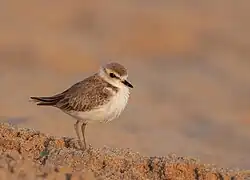 |
Regular breeder along Adriatic coast | NT – near threatened (Croatia)[89] |
| Common ringed plover (Charadrius hiaticula) |
 |
Regular migrant and winter visitor | LC – least concern (Croatia)[90] |
| Little ringed plover (Charadrius dubius) |
 |
Common breeder in inland wetlands | LC – least concern (Croatia)[91] |
| Eurasian dotterel (Charadrius morinellus) |
 |
(A) Accidental vagrant, rare migrant in mountains | LC – least concern (Croatia)[92] |
Sandpipers and allies
Order: Charadriiformes Family: Scolopacidae
Scolopacidae is a large diverse family of small to medium-sized shorebirds including the sandpipers, curlews, godwits, shanks, tattlers, woodcocks, snipes, dowitchers and phalaropes. The majority of these species eat small invertebrates picked out of the mud or soil. Variation in length of legs and bills enables multiple species to feed in the same habitat, particularly on the coast, without direct competition for food.
| Common and binomial names | Image | Status in Croatia | Regional IUCN status |
|---|---|---|---|
| Upland sandpiper (Bartramia longicauda) |
 |
(A) Accidental vagrant, North American species | LC – least concern (Croatia)[93] |
| Whimbrel (Numenius phaeopus) |
 |
Regular migrant, scarce winter visitor | LC – least concern (Croatia)[94] |
| Slender-billed curlew (Numenius tenuirostris) |
 |
(A) Accidental vagrant, formerly regular migrant, now globally extinct | EX – extinct (Croatia)[95] |
| Eurasian curlew (Numenius arquata) |
 |
Regular migrant and winter visitor | NT – near threatened (Croatia)[96] |
| Bar-tailed godwit (Limosa lapponica) |
 |
Scarce migrant | LC – least concern (Croatia)[97] |
| Black-tailed godwit (Limosa limosa) |
 |
Regular migrant, declining | NT – near threatened (Croatia)[98] |
| Ruddy turnstone (Arenaria interpres) |
 |
Scarce migrant | LC – least concern (Croatia)[99] |
| Red knot (Calidris canutus) |
 |
Scarce migrant | NT – near threatened (Croatia)[100] |
| Ruff (Calidris pugnax) |
 |
Common migrant | LC – least concern (Croatia)[101] |
| Broad-billed sandpiper (Calidris falcinellus) |
 |
Scarce migrant | VU – vulnerable (Croatia)[102] |
| Curlew sandpiper (Calidris ferruginea) |
 |
Regular migrant | NT – near threatened (Croatia)[103] |
| Temminck's stint (Calidris temminckii) |
 |
Regular migrant | LC – least concern (Croatia)[104] |
| Sanderling (Calidris alba) |
 |
Scarce migrant | LC – least concern (Croatia)[105] |
| Dunlin (Calidris alpina) |
 |
Common migrant and winter visitor | LC – least concern (Croatia)[106] |
| Purple sandpiper (Calidris maritima) |
 |
(A) Accidental vagrant | LC – least concern (Croatia)[107] |
| Little stint (Calidris minuta) |
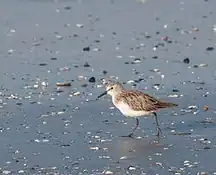 |
Regular migrant | LC – least concern (Croatia)[108] |
| Pectoral sandpiper (Calidris melanotos) |
 |
(A) Accidental vagrant, North American species | LC – least concern (Croatia)[109] |
| Semipalmated sandpiper (Calidris pusilla) |
 |
(A) Accidental vagrant, North American species | LC – least concern (Croatia)[110] |
| Jack snipe (Lymnocryptes minimus) |
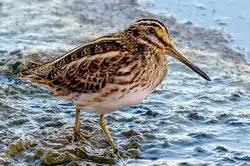 |
Regular winter visitor | LC – least concern (Croatia)[111] |
| Eurasian woodcock (Scolopax rusticola) |
 |
Widespread breeding resident, also migrant | LC – least concern (Croatia)[112] |
| Great snipe (Gallinago media) |
 |
Scarce migrant | NT – near threatened (Croatia)[113] |
| Common snipe (Gallinago gallinago) |
 |
Common migrant and winter visitor | LC – least concern (Croatia)[114] |
| Terek sandpiper (Xenus cinereus) |
 |
(A) Accidental vagrant | LC – least concern (Croatia)[115] |
| Red-necked phalarope (Phalaropus lobatus) |
 |
(A) Accidental vagrant | LC – least concern (Croatia)[116] |
| Red phalarope (Phalaropus fulicarius) |
 |
(A) Accidental vagrant | LC – least concern (Croatia)[117] |
| Common sandpiper (Actitis hypoleucos) |
 |
Common migrant and breeding summer visitor | LC – least concern (Croatia)[118] |
| Green sandpiper (Tringa ochropus) |
 |
Regular migrant and winter visitor | LC – least concern (Croatia)[119] |
| Spotted redshank (Tringa erythropus) |
 |
Scarce migrant | LC – least concern (Croatia)[120] |
| Common greenshank (Tringa nebularia) |
 |
Regular migrant | LC – least concern (Croatia)[121] |
| Marsh sandpiper (Tringa stagnatilis) |
 |
Scarce migrant | LC – least concern (Croatia)[122] |
| Wood sandpiper (Tringa glareola) |
 |
Common migrant | LC – least concern (Croatia)[123] |
| Common redshank (Tringa totanus) |
 |
Regular migrant and scarce breeder | LC – least concern (Croatia)[124] |
Pratincoles and coursers
Order: Charadriiformes Family: Glareolidae
Glareolidae is a family of wading birds comprising the pratincoles, which have short legs, long pointed wings and long forked tails, and the coursers, which have long legs, short wings and long, pointed bills which curve downwards.
| Common and binomial names | Image | Status in Croatia | Regional IUCN status |
|---|---|---|---|
| Cream-colored courser (Cursorius cursor) |
 |
(A) Accidental vagrant, extremely rare visitor | LC – least concern (Croatia)[125] |
| Collared pratincole (Glareola pratincola) |
 |
Scarce breeder and migrant in wetlands | NT – near threatened (Croatia)[126] |
| Black-winged pratincole (Glareola nordmanni) |
 |
(A) Accidental vagrant, rare migrant | VU – vulnerable (Croatia)[127] |
Skuas and jaegers
Order: Charadriiformes Family: Stercorariidae
The family Stercorariidae are, in general, medium to large birds, typically with grey or brown plumage, often with white markings on the wings. They nest on the ground in temperate and arctic regions and are long-distance migrants.
| Common and binomial names | Image | Status in Croatia | Regional IUCN status |
|---|---|---|---|
| Great skua (Stercorarius skua) |
 |
(A) Accidental vagrant, very rare offshore records | LC – least concern (Croatia)[128] |
| Pomarine jaeger (Stercorarius pomarinus) |
 |
(A) Accidental vagrant, rare offshore visitor | LC – least concern (Croatia)[129] |
| Parasitic jaeger (Stercorarius parasiticus) |
 |
(A) Accidental vagrant, occasional records at sea | EN – endangered (Croatia)[130] |
| Long-tailed jaeger (Stercorarius longicaudus) |
 |
(A) Accidental vagrant, very rare pelagic record | LC – least concern (Croatia)[131] |
Auks, murres, and puffins
Order: Charadriiformes Family: Alcidae
Alcids are superficially similar to penguins due to their black-and-white colours, their upright posture and some of their habits, however they are not related to the penguins and differ in being able to fly. Auks live on the open sea, only deliberately coming ashore to nest.
| Common and binomial names | Image | Status in Croatia | Regional IUCN status |
|---|---|---|---|
| Razorbill (Alca torda) |
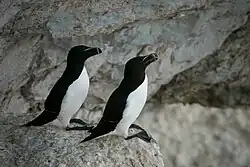 |
(A) Accidental vagrant in the Adriatic | LC – least concern (Croatia)[132] |
| Black guillemot (Cepphus grylle) |
 |
(A) Accidental vagrant | LC – least concern (Croatia)[133] |
| Atlantic puffin (Fratercula arctica) |
 |
(A) Accidental vagrant | LC – least concern (Croatia)[134] |
Gulls, terns, and skimmers
Order: Charadriiformes Family: Laridae
Laridae is a family of medium to large seabirds, the gulls, terns, and skimmers. Gulls are typically grey or white, often with black markings on the head or wings. They have stout, longish bills and webbed feet. Terns are a group of generally medium to large seabirds typically with grey or white plumage, often with black markings on the head. Most terns hunt fish by diving but some pick insects off the surface of fresh water. Terns are generally long-lived birds, with several species known to live in excess of 30 years.
| Common and binomial names | Image | Status in Croatia | Regional IUCN status |
|---|---|---|---|
| Black-legged kittiwake (Rissa tridactyla) |
 |
(A) Accidental vagrant | LC – least concern (Croatia)[135] |
| Slender-billed gull (Chroicocephalus genei) |
 |
(A) Accidental vagrant | LC – least concern (Croatia)[136] |
| Black-headed gull (Chroicocephalus ridibundus) |
 |
Common breeder and winter visitor | LC – least concern (Croatia)[137] |
| Little gull (Hydrocoloeus minutus) |
 |
Regular migrant and winter visitor | LC – least concern (Croatia)[138] |
| Franklin's gull (Leucophaeus pipixcan) |
 |
(A) Accidental vagrant, North American species | LC – least concern (Croatia)[139] |
| Mediterranean gull (Ichthyaetus melanocephalus) |
 |
Regular breeder and migrant | LC – least concern (Croatia)[140] |
| White-eyed gull (Ichthyaetus leucophthalmus) |
 |
(A) Accidental vagrant, Red Sea species | NT – near threatened (Croatia)[141] |
| Pallas's gull (Ichthyaetus ichthyaetus) |
 |
(A) Accidental vagrant | LC – least concern (Croatia)[142] |
| Audouin's gull (Ichthyaetus audouinii) |
 |
Scarce breeder in Adriatic colonies | NT – near threatened (Croatia)[143] |
| Common gull (Larus canus) |
 |
Regular winter visitor | LC – least concern (Croatia)[144] |
| Ring-billed gull (Larus delawarensis) |
 |
(A) Accidental vagrant, North American species | LC – least concern (Croatia)[145] |
| European herring gull (Larus argentatus) |
 |
Regular winter visitor | LC – least concern (Croatia)[146] |
| Yellow-legged gull (Larus michahellis) |
 |
Common breeder along Adriatic coast | LC – least concern (Croatia)[147] |
| Caspian gull (Larus cachinnans) |
 |
Regular winter visitor | LC – least concern (Croatia)[148] |
| Lesser black-backed gull (Larus fuscus) |
 |
Regular winter visitor | LC – least concern (Croatia)[149] |
| Great black-backed gull (Larus marinus) |
 |
(A) Accidental vagrant | LC – least concern (Croatia)[150] |
| Little tern (Sternula albifrons) |
 |
Scarce breeder in wetlands | LC – least concern (Croatia)[151] |
| Gull-billed tern (Gelochelidon nilotica) |
 |
(A) Accidental vagrant | LC – least concern (Croatia)[152] |
| Caspian tern (Hydroprogne caspia) |
 |
(A) Accidental vagrant | LC – least concern (Croatia)[153] |
| Black tern (Chlidonias niger) |
 |
Regular migrant | LC – least concern (Croatia)[154] |
| White-winged tern (Chlidonias leucopterus) |
 |
Regular migrant | LC – least concern (Croatia)[155] |
| Whiskered tern (Chlidonias hybrida) |
 |
Regular breeder in wetlands | LC – least concern (Croatia)[156] |
| Common tern (Sterna hirundo) |
 |
Common breeder and migrant | LC – least concern (Croatia)[157] |
| Arctic tern (Sterna paradisaea) |
 |
(A) Accidental vagrant | LC – least concern (Croatia)[158] |
| Sandwich tern (Thalasseus sandvicensis) |
 |
Regular migrant and winter visitor | LC – least concern (Croatia)[159] |
Loons
Order: Gaviiformes Family: Gaviidae
Loons, known as divers in Europe, are a group of aquatic birds found in many parts of North America and northern Europe. They are the size of a large duck or small goose, which they somewhat resemble when swimming, but to which they are completely unrelated.
| Common and binomial names | Image | Status in Croatia | Regional IUCN status |
|---|---|---|---|
| Red-throated loon (Gavia stellata) |
 |
Scarce winter visitor along the Adriatic coast | LC – least concern (Croatia)[160] |
| Black-throated loon (Gavia arctica) |
 |
Rare winter visitor | LC – least concern (Croatia)[161] |
| Common loon (Gavia immer) |
 |
(A) Accidental vagrant | LC – least concern (Croatia)[162] |
| Yellow-billed loon (Gavia adamsii) |
 |
(A) Accidental vagrant | LC – least concern (Croatia)[163] |
Northern storm-petrels
Order: Procellariiformes Family: Hydrobatidae
The northern storm-petrels are relatives of the petrels and are the smallest seabirds. They feed on planktonic crustaceans and small fish picked from the surface, typically while hovering. The flight is fluttering and sometimes bat-like.
| Common and binomial names | Image | Status in Croatia | Regional IUCN status |
|---|---|---|---|
| European storm-petrel (Hydrobates pelagicus) |
 |
(A) Accidental vagrant in the Adriatic | LC – least concern (Croatia)[164] |
Shearwaters and petrels
Order: Procellariiformes Family: Procellariidae
The procellariids are the main group of medium-sized "true petrels", characterised by united nostrils with medium septum and a long outer functional primary.
| Common and binomial names | Image | Status in Croatia | Regional IUCN status |
|---|---|---|---|
| Northern fulmar (Fulmarus glacialis) |
 |
(A) Accidental vagrant in the Adriatic | LC – least concern (Croatia)[165] |
| Cory's shearwater (Calonectris diomedea) |
 |
Scarce breeder on Adriatic islands | NT – near threatened (Croatia)[166] |
| Yelkouan shearwater (Puffinus yelkouan) |
 |
Localized breeder in the Adriatic | VU – vulnerable (Croatia)[167] |
Storks
Order: Ciconiiformes Family: Ciconiidae
Storks are large, long-legged, long-necked, wading birds with long, stout bills. Storks are mute, but bill-clattering is an important mode of communication at the nest. Their nests can be large and may be reused for many years. Many species are migratory.
| Common and binomial names | Image | Status in Croatia | Regional IUCN status |
|---|---|---|---|
| Black stork (Ciconia nigra) |
 |
Regular migrant and breeding visitor in wetlands and forests | LC – least concern (Croatia)[168] |
| White stork (Ciconia ciconia) |
 |
Common breeding summer visitor, especially in lowland villages | LC – least concern (Croatia)[169] |
Boobies and gannets
Order: Suliformes Family: Sulidae
The sulids comprise the gannets and boobies. Both groups are medium to large coastal seabirds that plunge-dive for fish.
| Common and binomial names | Image | Status in Croatia | Regional IUCN status |
|---|---|---|---|
| Northern gannet (Morus bassanus) |
 |
(A) Accidental vagrant in the Adriatic | LC – least concern (Croatia)[170] |
Cormorants and shags
Order: Suliformes Family: Phalacrocoracidae
Phalacrocoracidae is a family of medium to large coastal, fish-eating seabirds that includes cormorants and shags. Plumage colouration varies, with the majority having mainly dark plumage, some species being black-and-white and a few being colourful.
| Common and binomial names | Image | Status in Croatia | Regional IUCN status |
|---|---|---|---|
| Pygmy cormorant (Microcarbo pygmeus) |
 |
Scarce breeder in lowland wetlands and river valleys | VU – vulnerable (Croatia)[171] |
| Great cormorant (Phalacrocorax carbo) |
 |
Common breeder and winter visitor along coast and inland waters | LC – least concern (Croatia)[172] |
| European shag (Gulosus aristotelis) |
 |
Scarce coastal breeder and regular offshore visitor | LC – least concern (Croatia)[173] |
Pelicans
Order: Pelecaniformes Family: Pelecanidae
Pelicans are large water birds with a distinctive pouch under their beak. As with other members of the order Pelecaniformes, they have webbed feet with four toes.
| Common and binomial names | Image | Status in Croatia | Regional IUCN status |
|---|---|---|---|
| Great white pelican (Pelecanus onocrotalus) |
 |
(A) Accidental vagrant, rare visitor | LC – least concern (Croatia)[174] |
| Dalmatian pelican (Pelecanus crispus) |
 |
(Ex) Former breeder, now locally extinct | RE – regionally extinct (Croatia)[175] |
Herons, egrets, and bitterns
Order: Pelecaniformes Family: Ardeidae
The family Ardeidae contains the bitterns, herons and egrets. Herons and egrets are medium to large wading birds with long necks and legs. Bitterns tend to be shorter necked and more wary. Members of Ardeidae fly with their necks retracted, unlike other long-necked birds such as storks, ibises and spoonbills.
| Common and binomial names | Image | Status in Croatia | Regional IUCN status |
|---|---|---|---|
| Great bittern (Botaurus stellaris) |
 |
Scarce breeder in reedbeds | NT – near threatened (Croatia)[176] |
| Little bittern (Ixobrychus minutus) |
 |
Regular breeder in wetlands | LC – least concern (Croatia)[177] |
| Gray heron (Ardea cinerea) |
 |
Common breeder and resident | LC – least concern (Croatia)[178] |
| Purple heron (Ardea purpurea) |
 |
Regular breeder in wetlands | LC – least concern (Croatia)[179] |
| Great egret (Ardea alba) |
_at_Federsee%252C_Germany)_at_Federsee.jpg) |
Increasing breeder and migrant | LC – least concern (Croatia)[180] |
| Little egret (Egretta garzetta) |
 |
Regular breeder along Adriatic coast | LC – least concern (Croatia)[181] |
| Western reef heron (Egretta gularis) |
 |
(A) Accidental vagrant, rare coastal record | LC – least concern (Croatia)[182] |
| Cattle egret (Bubulcus ibis) |
 |
Scarce breeder and migrant, expanding range | LC – least concern (Croatia)[183] |
| Squacco heron (Ardeola ralloides) |
 |
Regular breeder in wetlands | LC – least concern (Croatia)[184] |
| Black-crowned night heron (Nycticorax nycticorax) |
 |
Regular breeder in wetlands | LC – least concern (Croatia)[185] |
Ibises and spoonbills
Order: Pelecaniformes Family: Threskiornithidae
Threskiornithidae is a family of large terrestrial and wading birds which includes the ibises and spoonbills. They have long, broad wings with 11 primary and about 20 secondary feathers. They are strong fliers and despite their size and weight, very capable soarers.
| Common and binomial names | Image | Status in Croatia | Regional IUCN status |
|---|---|---|---|
| Glossy ibis (Plegadis falcinellus) |
 |
Regular migrant and breeding visitor in wetlands | LC – least concern (Croatia)[186] |
| African sacred ibis (Threskiornis aethiopicus) |
 |
(A) Accidental vagrant, introduced species elsewhere | LC – least concern (Croatia)[187] |
| Northern bald ibis (Geronticus eremita) |
 |
(A) Accidental vagrant, globally endangered | CR – critically endangered (Croatia)[188] |
| Eurasian spoonbill (Platalea leucorodia) |
 |
Regular migrant and breeding visitor in wetlands | LC – least concern (Croatia)[189] |
Osprey
Order: Accipitriformes Family: Pandionidae
The family Pandionidae contains only one species, the osprey. The osprey is a medium-large raptor which is a specialist fish-eater with a worldwide distribution.
| Common and binomial names | Image | Status in Croatia | Regional IUCN status |
|---|---|---|---|
| Osprey (Pandion haliaetus) |
 |
Scarce migrant and occasional winter visitor along coasts and rivers | LC – least concern (Croatia)[190] |
Hawks, eagles, and kites
Order: Accipitriformes Family: Accipitridae
Accipitridae is a family of birds of prey, which includes hawks, eagles, kites, harriers and Old World vultures. These birds have powerful hooked beaks for tearing flesh from their prey, strong legs, powerful talons and keen eyesight.
| Common and binomial names | Image | Status in Croatia | Regional IUCN status |
|---|---|---|---|
| Black-winged kite (Elanus caeruleus) |
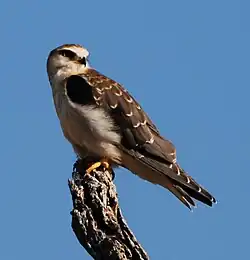 |
(A) Accidental vagrant | LC – least concern (Croatia) |
| Bearded vulture (Gypaetus barbatus) |
 |
(A) Accidental vagrant, formerly bred in Dinaric Alps | RE – regionally extinct (Croatia) |
| Egyptian vulture (Neophron percnopterus) |
 |
(Ex) Former breeder, now extinct in Croatia | RE – regionally extinct (Croatia) |
| European honey buzzard (Pernis apivorus) |
 |
Regular breeder and migrant | LC – least concern (Croatia) |
| Cinereous vulture (Aegypius monachus) |
 |
(A) Accidental vagrant | RE – regionally extinct (Croatia) |
| Eurasian griffon (Gyps fulvus) |
 |
Regular breeder on Adriatic cliffs | NT – near threatened (Croatia) |
| Short-toed snake eagle (Circaetus gallicus) |
 |
Scarce breeder | LC – least concern (Croatia) |
| Lesser spotted eagle (Clanga pomarina) |
 |
Scarce breeder in lowland forests | VU – vulnerable (Croatia) |
| Greater spotted eagle (Clanga clanga) |
 |
Rare migrant | EN – endangered (Croatia) |
| Booted eagle (Hieraaetus pennatus) |
 |
Scarce breeder | LC – least concern (Croatia) |
| Steppe eagle (Aquila nipalensis) |
 |
(A) Accidental vagrant | EN – endangered (Croatia) |
| Imperial eagle (Aquila heliaca) |
 |
Rare breeder, declining | EN – endangered (Croatia) |
| Golden eagle (Aquila chrysaetos) |
 |
Regular breeder in mountains | LC – least concern (Croatia) |
| Bonelli's eagle (Aquila fasciata) |
 |
Scarce breeder in rocky habitats | VU – vulnerable (Croatia) |
| Eurasian marsh harrier (Circus aeruginosus) |
 |
Regular breeder in wetlands | LC – least concern (Croatia) |
| Hen harrier (Circus cyaneus) |
 |
Regular winter visitor | LC – least concern (Croatia) |
| Pallid harrier (Circus macrourus) |
 |
Regular passage migrant and irregular wintering species | NT – near threatened (Croatia) |
| Montagu's harrier (Circus pygargus) |
 |
Scarce breeder in grasslands | VU – vulnerable (Croatia) |
| Levant sparrowhawk (Accipiter brevipes) |
 |
Regular migrant | LC – least concern (Croatia) |
| Eurasian sparrowhawk (Accipiter nisus) |
 |
Common breeder | LC – least concern (Croatia) |
| Eurasian goshawk (Accipiter gentilis) |
 |
Regular breeder in forests | LC – least concern (Croatia) |
| Red kite (Milvus milvus) |
 |
Scarce breeder, telemetry confirmed new nesting records in Croatia[191] | NT – near threatened (Croatia) |
| Black kite (Milvus migrans) |
 |
Regular breeder and migrant[192] | LC – least concern (Croatia) |
| White-tailed eagle (Haliaeetus albicilla) |
 |
Regular breeder in wetlands, stronghold in Kopački Rit[193] | NT – near threatened (Croatia) |
| Rough-legged hawk (Buteo lagopus) |
 |
Rare winter visitor | LC – least concern (Croatia) |
| Common buzzard (Buteo buteo) |
 |
Very common breeder and resident | LC – least concern (Croatia) |
| Long-legged buzzard (Buteo rufinus) |
 |
(A) Accidental vagrant, rare records | LC – least concern (Croatia) |
Barn-owls
Order: Strigiformes Family: Tytonidae
Barn-owls are medium to large owls with large heads and characteristic heart-shaped faces. They have long strong legs with powerful talons.
| Common and binomial names | Image | Status in Croatia | Regional IUCN status |
|---|---|---|---|
| Western barn owl (Tyto alba) |
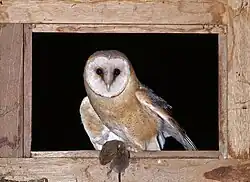 |
Regular breeder in rural areas, often near villages and farmland | LC – least concern (Croatia)[194] |
Owls
Order: Strigiformes Family: Strigidae
The typical owls are small to large solitary nocturnal birds of prey. They have large forward-facing eyes and ears, a hawk-like beak and a conspicuous circle of feathers around each eye called a facial disk.
| Common and binomial names | Image | Status in Croatia | Regional IUCN status |
|---|---|---|---|
| Eurasian scops owl (Otus scops) |
 |
Common breeder in woodlands and rural areas | LC – least concern (Croatia)[195] |
| Eurasian eagle-owl (Bubo bubo) |
 |
Regular breeder in rocky habitats | LC – least concern (Croatia)[196] |
| Eurasian pygmy owl (Glaucidium passerinum) |
 |
Scarce breeder in mountain forests | LC – least concern (Croatia)[197] |
| Little owl (Athene noctua) |
 |
Common breeder in rural areas | LC – least concern (Croatia)[198] |
| Tawny owl (Strix aluco) |
 |
Common breeder in forests | LC – least concern (Croatia)[199] |
| Ural owl (Strix uralensis) |
 |
Scarce breeder in mountain forests | LC – least concern (Croatia)[200] |
| Long-eared owl (Asio otus) |
 |
Common breeder in woodlands and farmland | LC – least concern (Croatia)[201] |
| Short-eared owl (Asio flammeus) |
 |
Scarce breeder and migrant in open habitats | LC – least concern (Croatia)[202] |
| Boreal owl (Aegolius funereus) |
 |
Scarce breeder in mountain conifer forests | LC – least concern (Croatia)[203] |
Hoopoes
Order: Bucerotiformes Family: Upupidae
Hoopoes have black, white and orangey-pink colouring with a large erectile crest on their head.
| Common and binomial names | Image | Status in Croatia | Regional IUCN status |
|---|---|---|---|
| Eurasian hoopoe (Upupa epops) |
 |
Common breeder in open countryside, orchards, and farmland | LC – least concern (Croatia)[204] |
Kingfishers
Order: Coraciiformes Family: Alcedinidae
Kingfishers are medium-sized birds with large heads, long, pointed bills, short legs and stubby tails.
| Common and binomial names | Image | Status in Croatia | Regional IUCN status |
|---|---|---|---|
| Common kingfisher (Alcedo atthis) |
 |
Regular breeder along rivers, lakes, and wetlands | LC – least concern (Croatia)[205] |
Bee-eaters
Order: Coraciiformes Family: Meropidae
The bee-eaters are a group of near passerine birds in the family Meropidae. Most species are found in Africa but others occur in southern Europe, Madagascar, Australia and New Guinea. They are characterised by richly coloured plumage, slender bodies and usually elongated central tail feathers. All are colourful and have long downturned bills and pointed wings, which give them a swallow-like appearance when seen from afar.
| Common and binomial names | Image | Status in Croatia | Regional IUCN status |
|---|---|---|---|
| Blue-cheeked bee-eater (Merops persicus) |
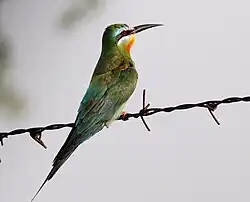 |
(A) Accidental vagrant | LC – least concern (Croatia)[206] |
| European bee-eater (Merops apiaster) |
 |
Common breeding summer visitor | LC – least concern (Croatia)[207] |
Rollers
Order: Coraciiformes Family: Coraciidae
Rollers resemble crows in size and build, but are more closely related to the kingfishers and bee-eaters. They share the colourful appearance of those groups with blues and browns predominating. The two inner front toes are connected, but the outer toe is not.
- European roller, Coracias garrulus
Woodpeckers
Order: Piciformes Family: Picidae
Woodpeckers are small to medium-sized birds with chisel-like beaks, short legs, stiff tails and long tongues used for capturing insects. Some species have feet with two toes pointing forward and two backward, while several species have only three toes. Many woodpeckers have the habit of tapping noisily on tree trunks with their beaks.
- Eurasian wryneck, Jynx torquilla
- Eurasian three-toed woodpecker, Picoides tridactylus
- Middle spotted woodpecker, Dendrocoptes medius
- White-backed woodpecker, Dendrocopos leucotos
- Great spotted woodpecker, Dendrocopos major
- Syrian woodpecker, Dendrocopos syriacus
- Lesser spotted woodpecker, Dryobates minor
- Gray-headed woodpecker, Picus canus
- Eurasian green woodpecker, Picus viridis
- Black woodpecker, Dryocopus martius
Falcons and caracaras
Order: Falconiformes Family: Falconidae
Falconidae is a family of diurnal birds of prey. They differ from hawks, eagles and kites in that they kill with their beaks instead of their talons.
| Common and binomial names | Image | Status in Croatia | Regional IUCN status |
|---|---|---|---|
| Lesser kestrel (Falco naumanni) |
 |
Scarce breeder, declining population | VU – vulnerable (Croatia)[208] |
| Eurasian kestrel (Falco tinnunculus) |
 |
Common breeding resident | LC – least concern (Croatia)[209] |
| Red-footed falcon (Falco vespertinus) |
 |
Scarce breeder and migrant | NT – near threatened (Croatia)[210] |
| Eleonora's falcon (Falco eleonorae) |
 |
Scarce breeder on Adriatic islands | NT – near threatened (Croatia)[211] |
| Merlin (Falco columbarius) |
 |
Rare winter visitor | LC – least concern (Croatia)[212] |
| Eurasian hobby (Falco subbuteo) |
 |
Regular breeder and migrant | LC – least concern (Croatia)[213] |
| Lanner falcon (Falco biarmicus) |
 |
Scarce breeder in rocky habitats | NT – near threatened (Croatia)[214] |
| Saker falcon (Falco cherrug) |
 |
Rare breeder and migrant, declining | EN – endangered (Croatia)[215] |
| Peregrine falcon (Falco peregrinus) |
 |
Regular breeder in cliffs and mountains | LC – least concern (Croatia)[216] |
Old World orioles
Order: Passeriformes Family: Oriolidae
The Old World orioles are colourful passerine birds. They are not related to the New World orioles.
- Eurasian golden oriole, Oriolus oriolus
Shrikes
Order: Passeriformes Family: Laniidae
Shrikes are passerine birds known for their habit of catching other birds and small animals and impaling the uneaten portions of their bodies on thorns. A typical shrike's beak is hooked, like a bird of prey.
- Red-backed shrike, Lanius collurio
- Great gray shrike, Lanius excubitor
- Lesser gray shrike, Lanius minor
- Woodchat shrike, Lanius senator
Crows, jays, and magpies
Order: Passeriformes Family: Corvidae
The family Corvidae includes crows, ravens, jays, choughs, magpies, treepies, nutcrackers and ground jays. Corvids are above average in size among the Passeriformes, and some of the larger species show high levels of intelligence.
| Common and binomial names | Image | Status in Croatia | Regional IUCN status |
|---|---|---|---|
| Eurasian jay (Garrulus glandarius) |
 |
Common breeding resident in woodlands | LC – least concern (Croatia)[217] |
| Eurasian magpie (Pica pica) |
 |
Abundant breeding resident in lowlands and towns | LC – least concern (Croatia)[218] |
| Eurasian nutcracker (Nucifraga caryocatactes) |
 |
Localized breeding resident in coniferous forests | LC – least concern (Croatia)[219] |
| Yellow-billed chough (Pyrrhocorax graculus) |
 |
Scarce localized breeder in alpine habitats | LC – least concern (Croatia)[220] |
| Eurasian jackdaw (Corvus monedula) |
 |
Common breeding resident in towns and farmland | LC – least concern (Croatia)[221] |
| Rook (bird) (Corvus frugilegus) |
 |
Fairly common breeding resident and winter visitor | LC – least concern (Croatia)[222] |
| Carrion crow (Corvus corone) |
 |
Scarce breeder, mainly in NW Croatia | LC – least concern (Croatia)[223] |
| Hooded crow (Corvus cornix) |
 |
Abundant breeding resident across Croatia | LC – least concern (Croatia)[224] |
| Common raven (Corvus corax) |
 |
Widespread breeding resident in uplands and mountains | LC – least concern (Croatia)[225] |
Tits, chickadees, and titmice
Order: Passeriformes Family: Paridae
The Paridae are mainly small stocky woodland species with short stout bills. Some have crests. They are adaptable birds, with a mixed diet including seeds and insects.
| Common and binomial names | Image | Status in Croatia | Regional IUCN status |
|---|---|---|---|
| Coal tit (Periparus ater) |
 |
Common breeding resident in forests | LC – least concern (Croatia)[226] |
| Crested tit (Lophophanes cristatus) |
 |
Regular breeding resident in coniferous forests | LC – least concern (Croatia)[227] |
| Sombre tit (Poecile lugubris) |
 |
Scarce breeder in continental Croatia | NT – near threatened (Croatia)[228] |
| Marsh tit (Poecile palustris) |
 |
Regular breeding resident in woodlands | LC – least concern (Croatia)[229] |
| Willow tit (Poecile montana) |
 |
Scarce breeding resident in northern forests | NT – near threatened (Croatia)[230] |
| Eurasian blue tit (Cyanistes caeruleus) |
 |
Common breeding resident | LC – least concern (Croatia)[231] |
| Azure tit (Cyanistes cyanus) |
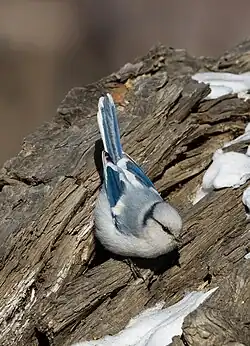 |
(A) Accidental vagrant | LC – least concern (Croatia)[232] |
| Great tit (Parus major) |
 |
Abundant breeding resident | LC – least concern (Croatia)[233] |
Penduline-tits
Order: Passeriformes Family: Remizidae
The penduline-tits are a group of small passerine birds related to the true tits. They are insectivores.
- Eurasian penduline-tit, Remiz pendulinus
Larks
Order: Passeriformes Family: Alaudidae
Larks are small terrestrial birds with often extravagant songs and display flights. Most larks are fairly dull in appearance. Their food is insects and seeds.
- Horned lark, Eremophila alpestris
- Greater short-toed lark, Calandrella brachydactyla
- Calandra lark, Melanocorypha calandra
- Wood lark, Lullula arborea
- Eurasian skylark, Alauda arvensis
- Crested lark, Galerida cristata
Bearded reedling
Order: Passeriformes Family: Panuridae
This species, the only one in its family, is found in reed beds throughout temperate Europe and Asia.
- Bearded reedling, Panurus biarmicus
Cisticolas and allies
Order: Passeriformes Family: Cisticolidae
The Cisticolidae are warblers found mainly in warmer southern regions of the Old World. They are generally very small birds of drab brown or grey appearance found in open country such as grassland or scrub.
- Zitting cisticola, Cisticola juncidis
Reed warblers and allies
Order: Passeriformes Family: Acrocephalidae
The members of this family are usually rather large for "warblers". Most are rather plain olivaceous brown above with much yellow to beige below. They are usually found in open woodland, reedbeds, or tall grass. The family occurs mostly in southern to western Eurasia and surroundings, but it also ranges far into the Pacific, with some species in Africa.
- Booted warbler, Iduna caligata (A)
- Eastern olivaceous warbler, Iduna pallida
- Olive-tree warbler, Hippolais olivetorum
- Melodious warbler, Hippolais polyglotta
- Icterine warbler, Hippolais icterina
- Aquatic warbler, Acrocephalus paludicola (A)
- Moustached warbler, Acrocephalus melanopogon
- Sedge warbler, Acrocephalus schoenobaenus
- Paddyfield warbler, Acrocephalus agricola (A)
- Blyth's reed warbler, Acrocephalus dumetorum (A)
- Marsh warbler, Acrocephalus palustris
- Eurasian reed warbler, Acrocephalus scirpaceus
- Great reed warbler, Acrocephalus arundinaceus
Grassbirds and allies
Order: Passeriformes Family: Locustellidae
Locustellidae are a family of small insectivorous songbirds found mainly in Eurasia, Africa, and the Australian region. They are smallish birds with tails that are usually long and pointed, and tend to be drab brownish or buffy all over.
- River warbler, Locustella fluviatilis
- Savi's warbler, Locustella luscinioides
- Common grasshopper-warbler, Locustella naevia
Swallows
Order: Passeriformes Family: Hirundinidae
The family Hirundinidae is adapted to aerial feeding. They have a slender streamlined body, long pointed wings and a short bill with a wide gape. The feet are adapted to perching rather than walking, and the front toes are partially joined at the base.
| Common and binomial names | Image | Status in Croatia | Regional IUCN status |
|---|---|---|---|
| Sand martin (Riparia riparia) |
 |
Common breeding summer visitor along rivers | LC – least concern (Croatia)[234] |
| Eurasian crag-martin (Ptyonoprogne rupestris) |
 |
Localized breeding resident in cliffs and gorges | LC – least concern (Croatia)[235] |
| Barn swallow (Hirundo rustica) |
 |
Abundant breeding summer visitor | LC – least concern (Croatia)[236] |
| Red-rumped swallow (Cecropis daurica) |
 |
Scarce breeding summer visitor in southern Croatia | LC – least concern (Croatia)[237] |
| Common house-martin (Delichon urbicum) |
 |
Common breeding summer visitor in towns and villages | LC – least concern (Croatia)[238] |
Leaf warblers
Order: Passeriformes Family: Phylloscopidae
Leaf warblers are a family of small insectivorous birds found mostly in Eurasia and ranging into Wallacea and Africa. The species are of various sizes, often green-plumaged above and yellow below, or more subdued with greyish-green to greyish-brown colours.
- Wood warbler, Phylloscopus sibilatrix
- Western Bonelli's warbler, Phylloscopus bonelli
- Eastern Bonelli's warbler, Phylloscopus orientalis
- Yellow-browed warbler, Phylloscopus inornatus (A)
- Pallas's leaf warbler, Phylloscopus proregulus (A)
- Dusky warbler, Phylloscopus fuscatus (A)
- Willow warbler, Phylloscopus trochilus
- Common chiffchaff, Phylloscopus collybita
Bush warblers and allies
Order: Passeriformes Family: Scotocercidae
The members of this family are found throughout Africa, Asia, and Polynesia. Their taxonomy is in flux, and some authorities place some genera in other families.[239]
- Cetti's warbler, Cettia cetti
Long-tailed tits
Order: Passeriformes Family: Aegithalidae
Long-tailed tits are a group of small passerine birds with medium to long tails. They make woven bag nests in trees. Most eat a mixed diet which includes insects.
- Long-tailed tit, Aegithalos caudatus
Sylviid warblers, parrotbills, and allies
Order: Passeriformes Family: Sylviidae
The family Sylviidae is a group of small insectivorous passerine birds. They mainly occur as breeding species, as the common name implies, in Europe, Asia and, to a lesser extent, Africa. Most are of generally undistinguished appearance, but many have distinctive songs.
- Eurasian blackcap, Sylvia atricapilla
- Garden warbler, Sylvia borin
- Barred warbler, Curruca nisoria
- Lesser whitethroat, Curruca curruca
- Eastern Orphean warbler, Curruca crassirostris
- Eastern subalpine warbler, Curruca cantillans
- Sardinian warbler, Curruca melanocephala
- Greater whitethroat, Curruca communis
- Dartford warbler, Curruca undata (A)
Kinglets
Order: Passeriformes Family: Regulidae
The kinglets, also called crests, are a small group of birds often included in the Old World warblers, but frequently given family status because they also resemble the titmice.
- Goldcrest, Regulus regulus
- Common firecrest, Regulus ignicapillus
Wallcreeper
Order: Passeriformes Family: Tichodromidae
The wallcreeper is a small bird related to the nuthatch family, which has stunning crimson, grey and black plumage.
- Wallcreeper, Tichodroma muraria
Nuthatches
Order: Passeriformes Family: Sittidae
Nuthatches are small woodland birds. They have the unusual ability to climb down trees head first, unlike other birds which can only go upwards. Nuthatches have big heads, short tails and powerful bills and feet.
- Eurasian nuthatch, Sitta europaea
- Western rock nuthatch, Sitta neumayer
Treecreepers
Order: Passeriformes Family: Certhiidae
Treecreepers are small woodland birds, brown above and white below. They have thin pointed down-curved bills, which they use to extricate insects from bark. They have stiff tail feathers, like woodpeckers, which they use to support themselves on vertical trees.
- Eurasian treecreeper, Certhia familiaris
- Short-toed treecreeper, Certhia brachydactyla
Wrens
Order: Passeriformes Family: Troglodytidae
The wrens are mainly small and inconspicuous except for their loud songs. These birds have short wings and thin down-turned bills. Several species often hold their tails upright. All are insectivorous.
- Eurasian wren, Troglodytes troglodytes
Dippers
Order: Passeriformes Family: Cinclidae
Dippers are a group of perching birds whose habitat includes aquatic environments in the Americas, Europe and Asia. They are named for their bobbing or dipping movements.
- White-throated dipper, Cinclus cinclus
Starlings
Order: Passeriformes Family: Sturnidae
Starlings are small to medium-sized passerine birds. Their flight is strong and direct and they are very gregarious. Their preferred habitat is fairly open country. They eat insects and fruit. Plumage is typically dark with a metallic sheen.
- European starling, Sturnus vulgaris
- Rosy starling, Pastor roseus
Thrushes and allies
Order: Passeriformes Family: Turdidae
The thrushes are a group of passerine birds that occur mainly in the Old World. They are plump, soft plumaged, small to medium-sized insectivores or sometimes omnivores, often feeding on the ground. Many have attractive songs.
- Mistle thrush, Turdus viscivorus
- Song thrush, Turdus philomelos
- Redwing, Turdus iliacus
- Eurasian blackbird, Turdus merula
- Fieldfare, Turdus pilaris
- Ring ouzel, Turdus torquatus
- Dusky thrush, Turdus eunomus (A)
Old World flycatchers
Order: Passeriformes Family: Muscicapidae
Old World flycatchers are a large group of small passerine birds native to the Old World. They are mainly small arboreal insectivores. The appearance of these birds is highly varied, but they mostly have weak songs and harsh calls.
- Spotted flycatcher, Muscicapa striata
- Rufous-tailed scrub-robin, Cercotrichas galactotes
- European robin, Erithacus rubecula
- Thrush nightingale, Luscinia luscinia
- Common nightingale, Luscinia megarhynchos
- Bluethroat, Luscinia svecica
- Red-breasted flycatcher, Ficedula parva
- Semicollared flycatcher, Ficedula semitorquata (A)
- European pied flycatcher, Ficedula hypoleuca
- Collared flycatcher, Ficedula albicollis
- Common redstart, Phoenicurus phoenicurus
- Black redstart, Phoenicurus ochruros
- Rufous-tailed rock-thrush, Monticola saxatilis
- Blue rock-thrush, Monticola solitarius
- Whinchat, Saxicola rubetra
- European stonechat, Saxicola rubicola
- Northern wheatear, Oenanthe oenanthe
- Pied wheatear, Oenanthe pleschanka (A)
- Western black-eared wheatear, Oenanthe hispanica
- Eastern black-eared wheatear, Oenanthe melanoleuca
Waxwings
Order: Passeriformes Family: Bombycillidae
The waxwings are a group of passerine birds with soft silky plumage and unique red tips to some of the wing feathers. In the Bohemian and cedar waxwings, these tips look like sealing wax and give the group its name. These are arboreal birds of northern forests. They live on insects in summer and berries in winter.
- Bohemian waxwing, Bombycilla garrulus (A)
Weavers and allies
Order: Passeriformes Family: Ploceidae
The weavers are small passerine birds related to the finches. They are seed-eating birds with rounded conical bills. The males of many species are brightly colored, usually in red or yellow and black, though some species show variation in color only in the breeding season.
| Common and binomial names | Image | Status in Croatia | Regional IUCN status |
|---|---|---|---|
| Yellow-crowned bishop (Euplectes afer) |
 |
(A) Accidental vagrant, introduced records | LC – least concern (Croatia)[240] |
Accentors
Order: Passeriformes Family: Prunellidae
The accentors are in the only bird family, Prunellidae, which is completely endemic to the Palearctic. They are small, fairly drab species superficially similar to sparrows.
- Alpine accentor, Prunella collaris
- Black-throated accentor, Prunella atrogularis (A)
- Dunnock, Prunella modularis
Old World sparrows
Order: Passeriformes Family: Passeridae
Old World sparrows are small passerine birds. In general, sparrows tend to be small, plump, brown or grey birds with short tails and short powerful beaks. Sparrows are seed eaters, but they also consume small insects.
| Common and binomial names | Image | Status in Croatia | Regional IUCN status |
|---|---|---|---|
| House sparrow (Passer domesticus) |
 |
Abundant breeding resident in towns and villages | LC – least concern (Croatia)[241] |
| Italian sparrow (Passer italiae) |
 |
(A) Accidental vagrant | LC – least concern (Croatia)[242] |
| Spanish sparrow (Passer hispaniolensis) |
 |
Localized breeder in Dalmatia | LC – least concern (Croatia)[243] |
| Eurasian tree sparrow (Passer montanus) |
 |
Common breeding resident in farmland and villages | LC – least concern (Croatia)[244] |
| Rock sparrow (Petronia petronia) |
 |
(A) Accidental vagrant | LC – least concern (Croatia)[245] |
| White-winged snowfinch (Montifringilla nivalis) |
 |
(A) Accidental vagrant in alpine areas | LC – least concern (Croatia)[246] |
Wagtails and pipits
Order: Passeriformes Family: Motacillidae
Motacillidae is a family of small passerine birds with medium to long tails. They include the wagtails, longclaws and pipits. They are slender, ground feeding insectivores of open country.
- Gray wagtail, Motacilla cinerea
- Western yellow wagtail, Motacilla flava
- Citrine wagtail, Motacilla citreola (A)
- White wagtail, Motacilla alba
- Richard's pipit, Anthus richardi (A)
- Tawny pipit, Anthus campestris
- Meadow pipit, Anthus pratensis
- Tree pipit, Anthus trivialis
- Red-throated pipit, Anthus cervinus
- Water pipit, Anthus spinoletta
- Rock pipit, Anthus petrosus
Finches, euphonias, and allies
Order: Passeriformes Family: Fringillidae
Finches are seed-eating passerine birds, that are small to moderately large and have a strong beak, usually conical and in some species very large. All have twelve tail feathers and nine primaries. These birds have a bouncing flight with alternating bouts of flapping and gliding on closed wings, and most sing well.
- Common chaffinch, Fringilla coelebs
- Brambling, Fringilla montifringilla
- Hawfinch, Coccothraustes coccothraustes
- Common rosefinch, Carpodacus erythrinus (A)
- Eurasian bullfinch, Pyrrhula pyrrhula
- European greenfinch, Chloris chloris
- Twite, Linaria flavirostris (A)
- Eurasian linnet, Linaria cannabina
- Common redpoll, Acanthis flammea
- Hoary redpoll, Acanthis hornemanni (A)
- Parrot crossbill, Loxia pytyopsittacus (A)
- Red crossbill, Loxia curvirostra
- European goldfinch, Carduelis carduelis
- Citril finch, Carduelis citrinella (A)
- European serin, Serinus serinus
- Eurasian siskin, Spinus spinus
Longspurs and snow buntings
Order: Passeriformes Family: Calcariidae
The Calcariidae are a group of passerine birds which had been traditionally grouped with the New World sparrows, but differ in a number of respects and are usually found in open grassy areas.
- Lapland longspur, Calcarius lapponicus (A)
- Snow bunting, Plectrophenax nivalis (A)
Old World buntings
Order: Passeriformes Family: Emberizidae
The emberizids are a large family of passerine birds. They are seed-eating birds with distinctively shaped bills. Many emberizid species have distinctive head patterns.
- Black-headed bunting, Emberiza melanocephala
- Red-headed bunting, Emberiza bruniceps (A)
- Corn bunting, Emberiza calandra
- Rock bunting, Emberiza cia
- Cirl bunting, Emberiza cirlus
- Yellowhammer, Emberiza citrinella
- Pine bunting, Emberiza leucocephalos (A)
- Ortolan bunting, Emberiza hortulana
- Cretzschmar's bunting, Emberiza caesia
- Reed bunting, Emberiza schoeniclus
- Little bunting, Emberiza pusilla (A)
- Rustic bunting, Emberiza rustica (A)
Cardinals and allies
Order: Passeriformes Family: Cardinalidae
The cardinals are a family of robust, seed-eating birds with strong bills. They are typically associated with open woodland. The sexes usually have distinct plumages.
| Common and binomial names | Image | Status in Croatia | Regional IUCN status |
|---|---|---|---|
| Rose-breasted grosbeak (Pheucticus ludovicianus) |
 |
(A) Accidental vagrant, North American species recorded only rarely | LC – least concern (Croatia)[247] |
See also
References
- ↑ Crvena knjiga ptica Hrvatske (in Croatian). DZZP. 2013. p. 34.
- ↑ Crvena knjiga ptica Hrvatske (in Croatian). DZZP. 2013. p. 35.
- ↑ Crvena knjiga ptica Hrvatske (in Croatian). DZZP. 2013. p. 36.
- ↑ Crvena knjiga ptica Hrvatske (in Croatian). DZZP. 2013. p. 37.
- ↑ Crvena knjiga ptica Hrvatske (in Croatian). DZZP. 2013. p. 38.
- ↑ Crvena knjiga ptica Hrvatske (in Croatian). DZZP. 2013. p. 39.
- ↑ Crvena knjiga ptica Hrvatske (in Croatian). DZZP. 2013. p. 40.
- ↑ Crvena knjiga ptica Hrvatske (in Croatian). DZZP. 2013. p. 41.
- ↑ Crvena knjiga ptica Hrvatske (in Croatian). DZZP. 2013. p. 42.
- ↑ Crvena knjiga ptica Hrvatske (in Croatian). DZZP. 2013. p. 43.
- ↑ Crvena knjiga ptica Hrvatske (in Croatian). DZZP. 2013. p. 44.
- ↑ Crvena knjiga ptica Hrvatske (in Croatian). DZZP. 2013. p. 45.
- ↑ Crvena knjiga ptica Hrvatske (in Croatian). DZZP. 2013. p. 46.
- ↑ Crvena knjiga ptica Hrvatske (in Croatian). DZZP. 2013. p. 47.
- ↑ Crvena knjiga ptica Hrvatske (in Croatian). DZZP. 2013. p. 48.
- ↑ Crvena knjiga ptica Hrvatske (in Croatian). DZZP. 2013. p. 49.
- ↑ Crvena knjiga ptica Hrvatske (in Croatian). DZZP. 2013. p. 50.
- ↑ Crvena knjiga ptica Hrvatske (in Croatian). DZZP. 2013. p. 51.
- ↑ Crvena knjiga ptica Hrvatske (in Croatian). DZZP. 2013. p. 52.
- ↑ Crvena knjiga ptica Hrvatske (in Croatian). DZZP. 2013. p. 53.
- ↑ Crvena knjiga ptica Hrvatske (in Croatian). DZZP. 2013. p. 54.
- ↑ Crvena knjiga ptica Hrvatske (in Croatian). DZZP. 2013. p. 55.
- ↑ Crvena knjiga ptica Hrvatske (in Croatian). DZZP. 2013. p. 56.
- ↑ Crvena knjiga ptica Hrvatske (in Croatian). DZZP. 2013. p. 57.
- ↑ Crvena knjiga ptica Hrvatske (in Croatian). DZZP. 2013. p. 58.
- ↑ Crvena knjiga ptica Hrvatske (in Croatian). DZZP. 2013. p. 59.
- ↑ Crvena knjiga ptica Hrvatske (in Croatian). DZZP. 2013. p. 60.
- ↑ Crvena knjiga ptica Hrvatske (in Croatian). DZZP. 2013. p. 61.
- ↑ Crvena knjiga ptica Hrvatske (in Croatian). DZZP. 2013. p. 62.
- ↑ Crvena knjiga ptica Hrvatske (in Croatian). DZZP. 2013. p. 63.
- ↑ Crvena knjiga ptica Hrvatske (in Croatian). DZZP. 2013. p. 64.
- ↑ Crvena knjiga ptica Hrvatske (in Croatian). DZZP. 2013. p. 65.
- ↑ Crvena knjiga ptica Hrvatske (in Croatian). DZZP. 2013. p. 66.
- ↑ Crvena knjiga ptica Hrvatske (in Croatian). DZZP. 2013. p. 67.
- ↑ Crvena knjiga ptica Hrvatske (in Croatian). DZZP. 2013. p. 68.
- ↑ Crvena knjiga ptica Hrvatske (in Croatian). DZZP. 2013. p. 69.
- ↑ Crvena knjiga ptica Hrvatske (in Croatian). DZZP. 2013. p. 70.
- ↑ Crvena knjiga ptica Hrvatske (in Croatian). DZZP. 2013. p. 71.
- ↑ Crvena knjiga ptica Hrvatske (in Croatian). DZZP. 2013. p. 72.
- ↑ Crvena knjiga ptica Hrvatske (in Croatian). DZZP. 2013. p. 73.
- ↑ BirdLife International (2021). "Coturnix coturnix". IUCN Red List of Threatened Species. 2021 e.T22678944A166185991. doi:10.2305/IUCN.UK.2021-3.RLTS.T22678944A166185991.en. Retrieved 14 August 2026.
- ↑ BirdLife International (2020). "Alectoris graeca". IUCN Red List of Threatened Species. 2020 e.T22678684A166203522. doi:10.2305/IUCN.UK.2020-3.RLTS.T22678684A166203522.en. Retrieved 14 August 2026.
- ↑ BirdLife International (2025). "Phasianus colchicus". IUCN Red List of Threatened Species. 2025 e.T45100023A166418837. doi:10.2305/IUCN.UK.2025-3.RLTS.T45100023A166418837.en. Retrieved 14 August 2026.
- ↑ BirdLife International (2024). "Perdix perdix". IUCN Red List of Threatened Species. 2024 e.T22678911A261298405. doi:10.2305/IUCN.UK.2024-2.RLTS.T22678911A261298405.en. Retrieved 14 August 2026.
- ↑ BirdLife International (2021). "Tetrao urogallus". IUCN Red List of Threatened Species. 2021 e.T22679487A261226027. doi:10.2305/IUCN.UK.2021-3.RLTS.T22679487A261226027.en. Retrieved 14 August 2026.
- ↑ BirdLife International (2024). "Lyrurus tetrix". IUCN Red List of Threatened Species. 2024 e.T22679481A189785536. doi:10.2305/IUCN.UK.2024-3.RLTS.T22679481A189785536.en. Retrieved 14 August 2026.
- ↑ BirdLife International (2024). "Tetrastes bonasia". IUCN Red List of Threatened Species. 2024 e.T22679493A261214041. doi:10.2305/IUCN.UK.2024-2.RLTS.T22679493A261214041.en. Retrieved 14 August 2026.
- ↑ Crvena knjiga ptica Hrvatske (in Croatian). Državni zavod za zaštitu prirode. 2013. pp. 186–187. Retrieved 15 August 2026.
- ↑ Crvena knjiga ptica Hrvatske (in Croatian). DZZP. 2013. p. 240.
- ↑ Crvena knjiga ptica Hrvatske (in Croatian). DZZP. 2013. p. 241.
- ↑ Crvena knjiga ptica Hrvatske (in Croatian). DZZP. 2013. p. 242.
- ↑ Crvena knjiga ptica Hrvatske (in Croatian). DZZP. 2013. p. 243.
- ↑ Crvena knjiga ptica Hrvatske (in Croatian). DZZP. 2013. p. 244.
- ↑ Crvena knjiga ptica Hrvatske (in Croatian). DZZP. 2013. p. 245.
- ↑ Crvena knjiga ptica Hrvatske (in Croatian). DZZP. 2013. p. 246.
- ↑ Crvena knjiga ptica Hrvatske (in Croatian). DZZP. 2013. p. 247.
- ↑ Crvena knjiga ptica Hrvatske (in Croatian). DZZP. 2013. p. 248.
- ↑ Crvena knjiga ptica Hrvatske (in Croatian). DZZP. 2013. p. 249.
- ↑ Crvena knjiga ptica Hrvatske (in Croatian). DZZP. 2013. p. 250.
- ↑ Crvena knjiga ptica Hrvatske (in Croatian). DZZP. 2013. p. 251.
- ↑ Crvena knjiga ptica Hrvatske (in Croatian). Državni zavod za zaštitu prirode. 2013. pp. 178–179. Retrieved 15 August 2026.
- ↑ Crvena knjiga ptica Hrvatske (in Croatian). Državni zavod za zaštitu prirode. 2013. pp. 180–181. Retrieved 15 August 2026.
- ↑ Crvena knjiga ptica Hrvatske (in Croatian). Državni zavod za zaštitu prirode. 2013. p. 240. Retrieved 15 August 2026.
- ↑ Crvena knjiga ptica Hrvatske (in Croatian). Državni zavod za zaštitu prirode. 2013. pp. 241–242. Retrieved 15 August 2026.
- ↑ Crvena knjiga ptica Hrvatske (in Croatian). Državni zavod za zaštitu prirode. 2013. p. 222. Retrieved 15 August 2026.
- ↑ Crvena knjiga ptica Hrvatske (in Croatian). Državni zavod za zaštitu prirode. 2013. pp. 223–224. Retrieved 15 August 2026.
- ↑ Crvena knjiga ptica Hrvatske (in Croatian). DZZP. 2013. p. 318.
- ↑ Crvena knjiga ptica Hrvatske (in Croatian). DZZP. 2013. p. 319.
- ↑ Crvena knjiga ptica Hrvatske (in Croatian). DZZP. 2013. p. 320.
- ↑ Crvena knjiga ptica Hrvatske (in Croatian). Državni zavod za zaštitu prirode. 2013. pp. 146–147. Retrieved 14 August 2026.
- ↑ Crvena knjiga ptica Hrvatske (in Croatian). Državni zavod za zaštitu prirode. 2013. pp. 148–149. Retrieved 14 August 2026.
- ↑ Crvena knjiga ptica Hrvatske (in Croatian). Državni zavod za zaštitu prirode. 2013. pp. 150–151. Retrieved 14 August 2026.
- ↑ Crvena knjiga ptica Hrvatske (in Croatian). Državni zavod za zaštitu prirode. 2013. pp. 152–153. Retrieved 14 August 2026.
- ↑ Crvena knjiga ptica Hrvatske (in Croatian). Državni zavod za zaštitu prirode. 2013. p. 154. Retrieved 14 August 2026.
- ↑ Crvena knjiga ptica Hrvatske (in Croatian). Državni zavod za zaštitu prirode. 2013. pp. 155–156. Retrieved 14 August 2026.
- ↑ Crvena knjiga ptica Hrvatske (in Croatian). Državni zavod za zaštitu prirode. 2013. pp. 157–158. Retrieved 14 August 2026.
- ↑ Crvena knjiga ptica Hrvatske (in Croatian). Državni zavod za zaštitu prirode. 2013. pp. 159–160. Retrieved 14 August 2026.
- ↑ Crvena knjiga ptica Hrvatske (in Croatian). DZZP. 2013. p. 239.
- ↑ Crvena knjiga ptica Hrvatske (in Croatian). DZZP. 2013. p. 238.
- ↑ Crvena knjiga ptica Hrvatske (in Croatian). DZZP. 2013. p. 236.
- ↑ Crvena knjiga ptica Hrvatske (in Croatian). DZZP. 2013. p. 237.
- ↑ Crvena knjiga ptica Hrvatske (in Croatian). DZZP. 2013. p. 235.
- ↑ Crvena knjiga ptica Hrvatske (in Croatian). DZZP. 2013. p. 252.
- ↑ Crvena knjiga ptica Hrvatske (in Croatian). DZZP. 2013. p. 253.
- ↑ Crvena knjiga ptica Hrvatske (in Croatian). DZZP. 2013. p. 254.
- ↑ Crvena knjiga ptica Hrvatske (in Croatian). DZZP. 2013. p. 255.
- ↑ Crvena knjiga ptica Hrvatske (in Croatian). DZZP. 2013. p. 256.
- ↑ Crvena knjiga ptica Hrvatske (in Croatian). DZZP. 2013. p. 257.
- ↑ Crvena knjiga ptica Hrvatske (in Croatian). DZZP. 2013. p. 258.
- ↑ Crvena knjiga ptica Hrvatske (in Croatian). DZZP. 2013. p. 259.
- ↑ Crvena knjiga ptica Hrvatske (in Croatian). DZZP. 2013. p. 260.
- ↑ Crvena knjiga ptica Hrvatske (in Croatian). DZZP. 2013. p. 261.
- ↑ Crvena knjiga ptica Hrvatske (in Croatian). DZZP. 2013. p. 144.
- ↑ Crvena knjiga ptica Hrvatske (in Croatian). DZZP. 2013. pp. 145–146.
- ↑ Crvena knjiga ptica Hrvatske (in Croatian). DZZP. 2013. pp. 147–148.
- ↑ Crvena knjiga ptica Hrvatske (in Croatian). DZZP. 2013. pp. 149–150.
- ↑ Crvena knjiga ptica Hrvatske (in Croatian). DZZP. 2013. p. 151.
- ↑ Crvena knjiga ptica Hrvatske (in Croatian). DZZP. 2013. pp. 152–153.
- ↑ Crvena knjiga ptica Hrvatske (in Croatian). DZZP. 2013. p. 154.
- ↑ Crvena knjiga ptica Hrvatske (in Croatian). DZZP. 2013. pp. 155–156.
- ↑ Crvena knjiga ptica Hrvatske (in Croatian). DZZP. 2013. pp. 157–158.
- ↑ Crvena knjiga ptica Hrvatske (in Croatian). DZZP. 2013. p. 159.
- ↑ Crvena knjiga ptica Hrvatske (in Croatian). DZZP. 2013. pp. 160–161.
- ↑ Crvena knjiga ptica Hrvatske (in Croatian). DZZP. 2013. p. 162.
- ↑ Crvena knjiga ptica Hrvatske (in Croatian). DZZP. 2013. p. 163.
- ↑ Crvena knjiga ptica Hrvatske (in Croatian). DZZP. 2013. pp. 164–165.
- ↑ Crvena knjiga ptica Hrvatske (in Croatian). DZZP. 2013. p. 166.
- ↑ Crvena knjiga ptica Hrvatske (in Croatian). DZZP. 2013. pp. 167–168.
- ↑ Crvena knjiga ptica Hrvatske (in Croatian). DZZP. 2013. p. 169.
- ↑ Crvena knjiga ptica Hrvatske (in Croatian). DZZP. 2013. p. 170.
- ↑ Crvena knjiga ptica Hrvatske (in Croatian). DZZP. 2013. pp. 171–172.
- ↑ Crvena knjiga ptica Hrvatske (in Croatian). DZZP. 2013. pp. 173–174.
- ↑ Crvena knjiga ptica Hrvatske (in Croatian). DZZP. 2013. p. 175.
- ↑ Crvena knjiga ptica Hrvatske (in Croatian). DZZP. 2013. pp. 176–177.
- ↑ Crvena knjiga ptica Hrvatske (in Croatian). DZZP. 2013. p. 178.
- ↑ Crvena knjiga ptica Hrvatske (in Croatian). DZZP. 2013. p. 179.
- ↑ Crvena knjiga ptica Hrvatske (in Croatian). DZZP. 2013. p. 180.
- ↑ Crvena knjiga ptica Hrvatske (in Croatian). DZZP. 2013. pp. 181–182.
- ↑ Crvena knjiga ptica Hrvatske (in Croatian). DZZP. 2013. pp. 183–184.
- ↑ Crvena knjiga ptica Hrvatske (in Croatian). DZZP. 2013. p. 185.
- ↑ Crvena knjiga ptica Hrvatske (in Croatian). DZZP. 2013. pp. 186–187.
- ↑ Crvena knjiga ptica Hrvatske (in Croatian). DZZP. 2013. p. 188.
- ↑ Crvena knjiga ptica Hrvatske (in Croatian). DZZP. 2013. pp. 189–190.
- ↑ Crvena knjiga ptica Hrvatske (in Croatian). DZZP. 2013. pp. 191–192.
- ↑ Crvena knjiga ptica Hrvatske (in Croatian). DZZP. 2013. p. 271.
- ↑ Crvena knjiga ptica Hrvatske (in Croatian). DZZP. 2013. p. 272.
- ↑ Crvena knjiga ptica Hrvatske (in Croatian). DZZP. 2013. p. 273.
- ↑ Crvena knjiga ptica Hrvatske (in Croatian). DZZP. 2013. p. 274.
- ↑ Crvena knjiga ptica Hrvatske (in Croatian). DZZP. 2013. p. 275.
- ↑ Crvena knjiga ptica Hrvatske (in Croatian). DZZP. 2013. p. 276.
- ↑ Crvena knjiga ptica Hrvatske (in Croatian). DZZP. 2013. p. 277.
- ↑ Crvena knjiga ptica Hrvatske (in Croatian). Državni zavod za zaštitu prirode. 2013. p. 198. Retrieved 15 August 2026.
- ↑ Crvena knjiga ptica Hrvatske (in Croatian). Državni zavod za zaštitu prirode. 2013. p. 199. Retrieved 15 August 2026.
- ↑ Crvena knjiga ptica Hrvatske (in Croatian). Državni zavod za zaštitu prirode. 2013. p. 200. Retrieved 15 August 2026.
- ↑ Crvena knjiga ptica Hrvatske (in Croatian). DZZP. 2013. p. 210.
- ↑ Crvena knjiga ptica Hrvatske (in Croatian). DZZP. 2013. p. 211.
- ↑ Crvena knjiga ptica Hrvatske (in Croatian). DZZP. 2013. p. 212.
- ↑ Crvena knjiga ptica Hrvatske (in Croatian). DZZP. 2013. p. 213.
- ↑ Crvena knjiga ptica Hrvatske (in Croatian). DZZP. 2013. p. 214.
- ↑ Crvena knjiga ptica Hrvatske (in Croatian). DZZP. 2013. p. 215.
- ↑ Crvena knjiga ptica Hrvatske (in Croatian). DZZP. 2013. p. 216.
- ↑ Crvena knjiga ptica Hrvatske (in Croatian). DZZP. 2013. p. 217.
- ↑ Crvena knjiga ptica Hrvatske (in Croatian). DZZP. 2013. p. 218.
- ↑ Crvena knjiga ptica Hrvatske (in Croatian). DZZP. 2013. p. 219.
- ↑ Crvena knjiga ptica Hrvatske (in Croatian). DZZP. 2013. p. 220.
- ↑ Crvena knjiga ptica Hrvatske (in Croatian). DZZP. 2013. p. 221.
- ↑ Crvena knjiga ptica Hrvatske (in Croatian). DZZP. 2013. p. 222.
- ↑ Crvena knjiga ptica Hrvatske (in Croatian). DZZP. 2013. p. 223.
- ↑ Crvena knjiga ptica Hrvatske (in Croatian). DZZP. 2013. p. 224.
- ↑ Crvena knjiga ptica Hrvatske (in Croatian). DZZP. 2013. p. 225.
- ↑ Crvena knjiga ptica Hrvatske (in Croatian). DZZP. 2013. p. 226.
- ↑ Crvena knjiga ptica Hrvatske (in Croatian). DZZP. 2013. p. 227.
- ↑ Crvena knjiga ptica Hrvatske (in Croatian). DZZP. 2013. p. 228.
- ↑ Crvena knjiga ptica Hrvatske (in Croatian). DZZP. 2013. p. 229.
- ↑ Crvena knjiga ptica Hrvatske (in Croatian). DZZP. 2013. p. 230.
- ↑ Crvena knjiga ptica Hrvatske (in Croatian). DZZP. 2013. p. 231.
- ↑ Crvena knjiga ptica Hrvatske (in Croatian). DZZP. 2013. p. 232.
- ↑ Crvena knjiga ptica Hrvatske (in Croatian). DZZP. 2013. p. 233.
- ↑ Crvena knjiga ptica Hrvatske (in Croatian). DZZP. 2013. p. 234.
- ↑ Crvena knjiga ptica Hrvatske (in Croatian). Državni zavod za zaštitu prirode. 2013. pp. 92–93. Retrieved 14 August 2026.
- ↑ Crvena knjiga ptica Hrvatske (in Croatian). Državni zavod za zaštitu prirode. 2013. pp. 94–95. Retrieved 14 August 2026.
- ↑ Crvena knjiga ptica Hrvatske (in Croatian). Državni zavod za zaštitu prirode. 2013. p. 96. Retrieved 14 August 2026.
- ↑ Crvena knjiga ptica Hrvatske (in Croatian). Državni zavod za zaštitu prirode. 2013. p. 97. Retrieved 14 August 2026.
- ↑ Crvena knjiga ptica Hrvatske (in Croatian). Državni zavod za zaštitu prirode. 2013. p. 202. Retrieved 16 August 2026.
- ↑ Crvena knjiga ptica Hrvatske (in Croatian). Državni zavod za zaštitu prirode. 2013. p. 210. Retrieved 14 August 2026.
- ↑ Crvena knjiga ptica Hrvatske (in Croatian). Državni zavod za zaštitu prirode. 2013. pp. 211–212. Retrieved 14 August 2026.
- ↑ Crvena knjiga ptica Hrvatske (in Croatian). Državni zavod za zaštitu prirode. 2013. pp. 213–214. Retrieved 14 August 2026.
- ↑ Crvena knjiga ptica Hrvatske (in Croatian). Državni zavod za zaštitu prirode. 2013. pp. 203–204. Retrieved 16 August 2026.
- ↑ Crvena knjiga ptica Hrvatske (in Croatian). Državni zavod za zaštitu prirode. 2013. pp. 205–206. Retrieved 16 August 2026.
- ↑ Crvena knjiga ptica Hrvatske (in Croatian). Državni zavod za zaštitu prirode. 2013. p. 194. Retrieved 16 August 2026.
- ↑ Crvena knjiga ptica Hrvatske (in Croatian). DZZP. 2013. p. 278.
- ↑ Crvena knjiga ptica Hrvatske (in Croatian). DZZP. 2013. p. 279.
- ↑ Crvena knjiga ptica Hrvatske (in Croatian). DZZP. 2013. p. 280.
- ↑ Crvena knjiga ptica Hrvatske (in Croatian). DZZP. 2013. p. 281.
- ↑ Crvena knjiga ptica Hrvatske (in Croatian). DZZP. 2013. p. 282.
- ↑ Crvena knjiga ptica Hrvatske (in Croatian). DZZP. 2013. p. 283.
- ↑ Crvena knjiga ptica Hrvatske (in Croatian). DZZP. 2013. p. 284.
- ↑ Crvena knjiga ptica Hrvatske (in Croatian). DZZP. 2013. p. 285.
- ↑ Crvena knjiga ptica Hrvatske (in Croatian). DZZP. 2013. p. 286.
- ↑ Crvena knjiga ptica Hrvatske (in Croatian). DZZP. 2013. p. 287.
- ↑ Crvena knjiga ptica Hrvatske (in Croatian). DZZP. 2013. p. 288.
- ↑ Crvena knjiga ptica Hrvatske (in Croatian). DZZP. 2013. p. 289.
- ↑ Crvena knjiga ptica Hrvatske (in Croatian). DZZP. 2013. p. 290.
- ↑ Crvena knjiga ptica Hrvatske (in Croatian). DZZP. 2013. p. 291.
- ↑ Crvena knjiga ptica Hrvatske (in Croatian). DZZP. 2013. p. 292.
- ↑ Crvena knjiga ptica Hrvatske (in Croatian). Državni zavod za zaštitu prirode. 2013. pp. 195–196. Retrieved 16 August 2026.
- ↑ Crvena knjiga ptica Hrvatske (in Croatian). DZZP. 2013. p. 197.
- ↑ Crvena knjiga ptica Hrvatske (in Croatian). DZZP. 2013. p. 198.
- ↑ Crvena knjiga ptica Hrvatske (in Croatian). DZZP. 2013. pp. 199–200.
- ↑ Crvena knjiga ptica Hrvatske (in Croatian). Državni zavod za zaštitu prirode. 2013. p. 201. Retrieved 16 August 2026.
- ↑ "Status of the Red Kite Milvus milvus in Croatia". Larus: 7–22. 2019. doi:10.21857/mjrl3uxnq9.
- ↑ "Black Kite Milvus migrans Species Factsheet". BirdLife International. 2021.
- ↑ "White-tailed eagle of Kopački Rit". Endangered Landscapes Programme. 2025.
{{cite web}}: Missing or empty|url=(help) - ↑ Crvena knjiga ptica Hrvatske (in Croatian). DZZP. 2013. p. 293.
- ↑ Crvena knjiga ptica Hrvatske (in Croatian). DZZP. 2013. p. 294.
- ↑ Crvena knjiga ptica Hrvatske (in Croatian). DZZP. 2013. p. 295.
- ↑ Crvena knjiga ptica Hrvatske (in Croatian). DZZP. 2013. p. 296.
- ↑ Crvena knjiga ptica Hrvatske (in Croatian). DZZP. 2013. p. 297.
- ↑ Crvena knjiga ptica Hrvatske (in Croatian). DZZP. 2013. p. 298.
- ↑ Crvena knjiga ptica Hrvatske (in Croatian). DZZP. 2013. p. 299.
- ↑ Crvena knjiga ptica Hrvatske (in Croatian). DZZP. 2013. p. 300.
- ↑ Crvena knjiga ptica Hrvatske (in Croatian). DZZP. 2013. p. 301.
- ↑ Crvena knjiga ptica Hrvatske (in Croatian). DZZP. 2013. p. 302.
- ↑ Crvena knjiga ptica Hrvatske (in Croatian). DZZP. 2013. p. 303.
- ↑ Crvena knjiga ptica Hrvatske (in Croatian). DZZP. 2013. p. 304.
- ↑ Crvena knjiga ptica Hrvatske (in Croatian). Državni zavod za zaštitu prirode. 2013. p. 236. Retrieved 15 August 2026.
- ↑ Crvena knjiga ptica Hrvatske (in Croatian). Državni zavod za zaštitu prirode. 2013. pp. 237–238. Retrieved 15 August 2026.
- ↑ Crvena knjiga ptica Hrvatske (in Croatian). DZZP. 2013. p. 262.
- ↑ Crvena knjiga ptica Hrvatske (in Croatian). DZZP. 2013. p. 263.
- ↑ Crvena knjiga ptica Hrvatske (in Croatian). DZZP. 2013. p. 264.
- ↑ Crvena knjiga ptica Hrvatske (in Croatian). DZZP. 2013. p. 265.
- ↑ Crvena knjiga ptica Hrvatske (in Croatian). DZZP. 2013. p. 266.
- ↑ Crvena knjiga ptica Hrvatske (in Croatian). DZZP. 2013. p. 267.
- ↑ Crvena knjiga ptica Hrvatske (in Croatian). DZZP. 2013. p. 268.
- ↑ Crvena knjiga ptica Hrvatske (in Croatian). DZZP. 2013. p. 269.
- ↑ Crvena knjiga ptica Hrvatske (in Croatian). DZZP. 2013. p. 270.
- ↑ Crvena knjiga ptica Hrvatske (in Croatian). Državni zavod za zaštitu prirode. 2013. pp. 262–263. Retrieved 15 August 2026.
- ↑ Crvena knjiga ptica Hrvatske (in Croatian). Državni zavod za zaštitu prirode. 2013. pp. 264–265. Retrieved 15 August 2026.
- ↑ Crvena knjiga ptica Hrvatske (in Croatian). Državni zavod za zaštitu prirode. 2013. pp. 266–267. Retrieved 15 August 2026.
- ↑ Crvena knjiga ptica Hrvatske (in Croatian). Državni zavod za zaštitu prirode. 2013. pp. 268–269. Retrieved 15 August 2026.
- ↑ Crvena knjiga ptica Hrvatske (in Croatian). Državni zavod za zaštitu prirode. 2013. pp. 270–271. Retrieved 15 August 2026.
- ↑ Crvena knjiga ptica Hrvatske (in Croatian). Državni zavod za zaštitu prirode. 2013. pp. 272–273. Retrieved 15 August 2026.
- ↑ Crvena knjiga ptica Hrvatske (in Croatian). Državni zavod za zaštitu prirode. 2013. pp. 274–275. Retrieved 15 August 2026.
- ↑ Crvena knjiga ptica Hrvatske (in Croatian). Državni zavod za zaštitu prirode. 2013. pp. 276–277. Retrieved 15 August 2026.
- ↑ Crvena knjiga ptica Hrvatske (in Croatian). Državni zavod za zaštitu prirode. 2013. pp. 278–279. Retrieved 15 August 2026.
- ↑ Crvena knjiga ptica Hrvatske (in Croatian). DZZP. 2013. p. 310.
- ↑ Crvena knjiga ptica Hrvatske (in Croatian). DZZP. 2013. p. 311.
- ↑ Crvena knjiga ptica Hrvatske (in Croatian). DZZP. 2013. p. 312.
- ↑ Crvena knjiga ptica Hrvatske (in Croatian). DZZP. 2013. p. 313.
- ↑ Crvena knjiga ptica Hrvatske (in Croatian). DZZP. 2013. p. 314.
- ↑ Crvena knjiga ptica Hrvatske (in Croatian). DZZP. 2013. p. 315.
- ↑ Crvena knjiga ptica Hrvatske (in Croatian). DZZP. 2013. p. 316.
- ↑ Crvena knjiga ptica Hrvatske (in Croatian). DZZP. 2013. p. 317.
- ↑ Crvena knjiga ptica Hrvatske (in Croatian). Državni zavod za zaštitu prirode. 2013. pp. 228–229. Retrieved 15 August 2026.
- ↑ Crvena knjiga ptica Hrvatske (in Croatian). Državni zavod za zaštitu prirode. 2013. pp. 230–231. Retrieved 15 August 2026.
- ↑ Crvena knjiga ptica Hrvatske (in Croatian). Državni zavod za zaštitu prirode. 2013. pp. 232–233. Retrieved 15 August 2026.
- ↑ Crvena knjiga ptica Hrvatske (in Croatian). Državni zavod za zaštitu prirode. 2013. pp. 234–235. Retrieved 15 August 2026.
- ↑ Crvena knjiga ptica Hrvatske (in Croatian). Državni zavod za zaštitu prirode. 2013. pp. 236–237. Retrieved 15 August 2026.
- ↑ Gill, F. and D. Donsker (Eds). 2019. IOC World Bird List (v 9.2). doi:10.14344/IOC.ML.9.2. http://www.worldbirdnames.org/ retrieved 22 June 2019.
- ↑ Crvena knjiga ptica Hrvatske (in Croatian). Državni zavod za zaštitu prirode. 2013. p. 340. Retrieved 15 August 2026.
- ↑ Crvena knjiga ptica Hrvatske (in Croatian). Državni zavod za zaštitu prirode. 2013. pp. 310–311. Retrieved 15 August 2026.
- ↑ Crvena knjiga ptica Hrvatske (in Croatian). Državni zavod za zaštitu prirode. 2013. p. 312. Retrieved 15 August 2026.
- ↑ Crvena knjiga ptica Hrvatske (in Croatian). Državni zavod za zaštitu prirode. 2013. pp. 313–314. Retrieved 15 August 2026.
- ↑ Crvena knjiga ptica Hrvatske (in Croatian). Državni zavod za zaštitu prirode. 2013. pp. 315–316. Retrieved 15 August 2026.
- ↑ Crvena knjiga ptica Hrvatske (in Croatian). Državni zavod za zaštitu prirode. 2013. p. 317. Retrieved 15 August 2026.
- ↑ Crvena knjiga ptica Hrvatske (in Croatian). Državni zavod za zaštitu prirode. 2013. p. 318. Retrieved 15 August 2026.
- ↑ Crvena knjiga ptica Hrvatske (in Croatian). Državni zavod za zaštitu prirode. 2013. p. 342. Retrieved 15 August 2026.
- Barišić, Sanja; Kralj, Jelena; Jurinović, Luka (2016). "Rare birds in Croatia. The fourth report of the Croatian Birds Rarities Committee". Larus: Godišnjak Zavoda za Ornitologiju Hrvatske Akademije Znanosti i Umjetnosti. 51. Institute of Ornithology CASA: 38–65. doi:10.21857/ypn4oc6vr9. Retrieved May 25, 2019.
- "Avibase - Bird Checklists of the World Croatia". Denis Lepage. Retrieved 17 July 2018.
- "Wild Canary is a new species in avifauna of Croatia" (PDF). Berkut Journal. Archived from the original (PDF) on 14 December 2013. Retrieved 8 December 2013.
- "Popis ptica Hrvatske/ List of birds of Croatia". Hrvatsko ornitološko društvo/ Croatian Ornithological Society. Archived from the original on 17 October 2011. Retrieved 17 December 2012.
- Lepage, Denis. "Checklist of Birds of Croatia". Bird Checklists of the World. Avibase. Retrieved 26 April 2020.
- Clements, James F. (2000). Birds of the World: A Checklist. Cornell University Press. p. 880. ISBN 0-934797-16-1.