Brachypteryx
| Brachypteryx | |
|---|---|
 | |
| White-browed shortwing, (Brachypteryx montana) | |
Scientific classification  | |
| Kingdom: | Animalia |
| Phylum: | Chordata |
| Class: | Aves |
| Order: | Passeriformes |
| Family: | Muscicapidae |
| Subfamily: | Saxicolinae |
| Genus: | Brachypteryx Horsfield, 1821 |
| Type species | |
| Brachypteryx montana[1] Horsfield, 1821 | |
Brachypteryx is a genus of passerine birds in the family Muscicapidae containing ten species known as shortwings, that occurs in southeast Asia.
Shortwings are small birds with long legs, finely pointed bills, short tails and short rounded wings. They are shy elusive ground-dwellers that generally prefer the cover of dense undergrowth.[2]
Taxonomy
The genus Brachypteryx was introduced by the American naturalist Thomas Horsfield in 1821. Horsfield listed several species in the new genus but did not specify a type species.[3] In 1855 the English zoologist George Gray designated the type as Brachypteryx montana Horsfield, the Javan shortwing.[4][5] The genus name comes from the classical Greek brakhus mean "short" and pterux meaning "wing".[6] The genus was previously placed in the thrush family Turdidae but in 2010 two separate molecular phylogenetic studies found that species in the genus were more closely related to members of the Old World flycatcher family Muscicapidae.[7][8]
The genus contains the following ten species:[9]
| Image | Common name | Scientific name | Distribution |
|---|---|---|---|
 | Himalayan shortwing | Brachypteryx cruralis | eastern Himalayas, southern China and Indochina |
 | Chinese shortwing | Brachypteryx sinensis | South China |
 | Taiwan shortwing | Brachypteryx goodfellowi | Taiwan |
 | Rusty-bellied shortwing | Brachypteryx hyperythra | Sikkim, Northeast-India and Yunnan |
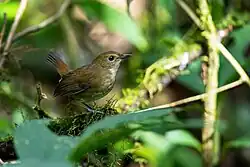 | Lesser shortwing | Brachypteryx leucophris | Eastern Himalaya, southern China and Southeast Asia |
 | Philippine shortwing | Brachypteryx poliogyna | Philippines |
| - | Bornean shortwing | Brachypteryx erythrogyna | montane Borneo |
| - | Sumatran shortwing | Brachypteryx saturata | montane Sumatra |
 | Javan shortwing | Brachypteryx montana | montane Java |
| - | Flores shortwing | Brachypteryx floris | Flores |
Whilst the Javan and rusty-bellied shortwings show strong sexual plumage dimorphism, the lesser shortwing is sexually monomorphic.
Three other species were formerly placed in Brachypteryx:
- Great shortwing, Heinrichia calligyna
- Nilgiri blue robin or Nilgiri shortwing Myiomela major
- Gould's shortwing, Heteroxenicus stellata
References
- ↑ "Muscicapidae". aviansystematics.org. The Trust for Avian Systematics. Retrieved 2023-07-15.
- ↑ Clement, Peter (2016). Robins and Chats. Helm Identification Guides. London: Bloomsbury. p. 182. ISBN 978-1-4081-5596-7.
- ↑ Horsfield, Thomas (1821). "Systematic arrangement and description of birds from the island of Java". Transactions of the Linnean Society of London (in Latin and English). 13 (1): 133–200 [157]. doi:10.1111/j.1095-8339.1821.tb00061.x. The paper was first read in April 1820. The title page is dated 1822.
- ↑ Gray, George Robert (1855). Catalogue of the Genera and Subgenera of Birds Contained in the British Museum. London: British Museum. p. 41.
- ↑ Mayr, Ernst; Paynter, Raymond A. Jr, eds. (1964). Check-List of Birds of the World. Vol. 10. Cambridge, Massachusetts: Museum of Comparative Zoology. p. 14.
- ↑ Jobling, James A. (2010). The Helm Dictionary of Scientific Bird Names. London: Christopher Helm. p. 76. ISBN 978-1-4081-2501-4.
- ↑ Sangster, G.; Alström, P.; Forsmark, E.; Olsson, U. (2010). "Multi-locus phylogenetic analysis of Old World chats and flycatchers reveals extensive paraphyly at family, subfamily and genus level (Aves: Muscicapidae)". Molecular Phylogenetics and Evolution. 57 (1): 380–392. Bibcode:2010MolPE..57..380S. doi:10.1016/j.ympev.2010.07.008. PMID 20656044.
- ↑ Zuccon, D.; Ericson, P.G.P. (2010). "A multi-gene phylogeny disentangles the chat-flycatcher complex (Aves: Muscicapidae)". Zoologica Scripta. 39 (3): 213–224. doi:10.1111/j.1463-6409.2010.00423.x. S2CID 85963319.
- ↑ Gill, Frank; Donsker, David; Rasmussen, Pamela, eds. (January 2023). "Chats, Old World flycatchers". IOC World Bird List Version 13.1. International Ornithologists' Union. Retrieved 6 February 2023.