Khunjerab National Park
| Khunjerab National Park | |
|---|---|
 | |
Interactive map of Khunjerab National Park | |
| Location | Hunza District, Karakoram, Gilgit-Baltistan, Pakistan |
| Coordinates | 36°35′13.21″N 75°23′59.5″E / 36.5870028°N 75.399861°E |
| Area | 2,269.13 km2 (876.12 sq mi) |
| Elevation | 17,000 ft (5,200 m) |
| Established | 1975 |
| Visitors | 250000 |
Khunjerab National Park (Urdu: خنجراب نیشنل پارک) is a national park in Gilgit Baltistan, Pakistan. Khunjerab National Park is Pakistan's third largest national park, and is adjacent to the Taxkorgan Natural Reserve in China.[1][2][3][4]
Etymology
Khun means "blood" and jerav means "to stream" in Wakhi, the native language of the region.[5]
History
Khunjerab National Park was established primarily as a means to protect the Marco Polo sheep (as well as snow leopards and bharal) living in the area.[6][7] The borders of the park were mapped by George Schaller of the Wildlife Conservation Society in 1974, after a short field survey. The park was formally established on 29 April 1975 by Prime Minister of Pakistan Zulfikar Ali Bhutto, who said that "it must become a world famous park".[8]

Despite being listed as a category 2 national park, banning human activities including agriculture and hunting, the park was poorly managed, meaning that illegal hunting of the Marco Polo sheep continued. Because of this, the International Union for Conservation of Nature commissioned Norwegian biologist Per Wegge to do a wildlife survey of the park in 1988.[9] Wegge found that there was no evidence of competition between the domestic sheep being illegally grazed and the wild Marco Polo sheep, and that most of the illegal hunting was not being done by local Wakhi residents.[9] He therefore proposed that the park be reclassified, allowing grazing and commercial hunting, with the profits going to local residents. However, the government overlooked Wegge's suggestions, instead drawing up a new management plan, which both the IUCN and the World Wildlife Fund supported as a means to preserve the park and protect the wildlife. Wegge was critical of the government scheme, claiming that it was based on financial considerations, with the Pakistani government hoping to attract tourists to the area. The IUCN agreed with this, and has since distanced itself from the national park.[10] To help protect the animals from poaching, the WWF has created the Khunzerav Village Organization, which relies on people living in the area to report poaching or endangered animal sightings.[11] This park was created on 29 April 1975 on the recommendation of wildlife biologist Dr. George Schaller. Over half of the park is above 4,000 m. Khunjerab Pass, the gateway to China via the Karakoram Highway, is at 4,934 m.

There is an ATM considered as the world's highest ATM at a height of 4,693 metres (15,397 ft) above sea level, installed by National Bank of Pakistan is located near the China-Pakistan border crossing at Khunjerab Pass.[12]
Wildlife
The primary purpose of this park was to provide protection to the endangered Marco Polo sheep, which is only found in this area in Pakistan. According to the Mir of Hunza, the population of sheep was around 400 but had dropped to below 180 by the time of the completion of the Karakoram Highway. A herd of almost 75 Marco Polo sheep was recorded in the spring of 1984 and park staff saw at least 50 crossing the pass in May 1989. In 2012, the population count was further down to 41, all being immigrant population from China.[13]
The park is also home to snow leopards,[14] containing one of their highest density in the Himalayan ecosystem, which is the natural habitat of these cats. Over 1,000 Siberian ibex, widely distributed in the park, are also present here.[15] In Shimshal area, 1,692 blue sheep were counted in a 2025 survey by the Government of Gilgit-Baltistan.[16]
Feral or semi-feral animals especially domestic yaks can be seen roaming in the park.[17]
Mammals
Total species: 17. Mammals in the park include:[18][19][7][20]
| Name of animal | Scientific name | Status | Pictures |
|---|---|---|---|
| Common pipistrelle | Pipistrellus pipistrellus | Least concern |  |
| Grey long-eared bat | Plecotus austriacus | Near Threatened | 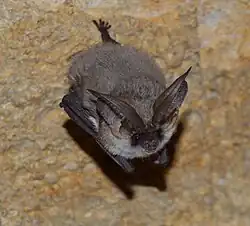 |
| Indian wolf | Canis lupus pallipes | Endangered |  |
| Hill fox | Vulpes vulpes montana | Data Deficient |  |
| Himalayan brown bear | Ursus arctos isabellinus | Critically Endangered |  |
| Snow leopard | Panthera uncia | Critically Endangered | 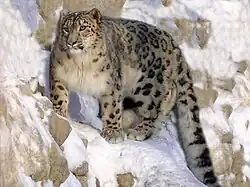 |
| Himalayan ibex | Capra sibirica | Near Threatened |  |
| Bharal | Pseudois nayaur | Endangered (Shimshal area only) |  |
| Marco Polo sheep | Ovis ammon polii | Critically Endangered |  |
| Kiang | equus kiang | Least concern |  |
| Cape hare | Lepus capensis | Vulnerable |  |
| Large-eared pika | Ochotona macrotis | Least Concern |  |
| Long-tailed marmot | Marmota caudata | Least Concern |  |
| Kashmir field mouse | Apodemus rusiges | Least concern | |
| Grey dwarf hamster | Nothocricetulus migratorius | Least concern |  |
Birds
45 avian species are found in the Khunjerab National Park.[18][19]
| Name of bird | Scientific name | Pictures |
|---|---|---|
| Black Redstart | Phoenicurus ochruros |  |
| White-capped redstart | Phoenicurus leucocephalus |  |
| Güldenstädt's redstart | Phoenicurus erythrogastrus |  |
| Blue whistling thrush | Myophonus caeruleus |  |
| Blue rock thrush | Monticola solitarius |  |
| Desert wheatear | Oenanthe deserti |  |
| Red-fronted serin | Serinus pusillus |  |
| Common rosefinch | Carpodacus erythrinus |  |
| Great rosefinch | Carpodacus rubicilla |  |
| Plain mountain finch | Leucosticte nemoricola |  |
| Grey wagtail | Motacilla cinerea |  |
| Masked wagtail | Motacilla alba personata |  |
| Citrine wagtail | Motacilla citreola |  |
| White wagtail | Motacilla alba |  |
| Red-billed chough | Pyrrhocorax pyrrhocorax |  |
| Alpine chough | Pyrrhocorax graculus | 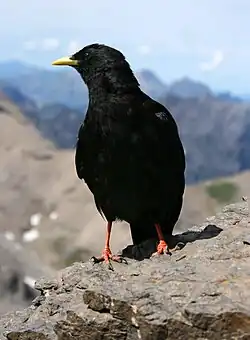 |
| Common raven | Corvus corax |  |
| Eurasian golden oriole | Oriolus oriolus |  |
| Lesser whitethroat | Curruca curruca |  |
| Brown dipper | Cinclus pallasii |  |
| Common chiffchaff | Phylloscopus collybita |  |
| Greenish warbler | Phylloscopus trochiloides |  |
| Horned lark | Eremophila alpestris |  |
| House sparrow | Passer domesticus |  |
| Rock bunting | Emberiza cia |  |
| Wallcreeper | Tichodroma muraria |  |
| Brown accentor | Prunella fulvescens |  |
| Radde's accentor | Prunella ocularis |  |
| Long-tailed shrike | Lanius schach |  |
| White-eared bulbul | Pycnonotus leucotis |  |
| Bearded vulture | Gypaetus barbatus |  |
| Himalayan vulture | Gyps himalayensis |  |
| Eurasian sparrowhawk | Accipiter nisus |  |
| Common kestrel | Falco tinnunculus |  |
| Golden eagle | Aquila chrysaetos |  |
| Chukar partridge | Alectoris chukar |  |
| Himalayan snowcock | Tetraogallus himalayensis |  |
| Snow pigeon | Columba leuconota |  |
| European turtle dove | Streptopelia turtur |  |
| Common sandpiper | Actitis hypoleucos |  |
| Little stint | Calidris minuta |  |
| Common cuckoo | Cuculus canorus |  |
| Common hawk-cuckoo | Hierococcyx varius |  |
| Eurasian hoopoe | Upupa epops |  |
| Common moorhen | Gallinula chloropus |  |
Reptiles
Two species of reptiles are found here:[18][19]
| Name of animal | Scientific name | Status | Pictures |
|---|---|---|---|
| Himalayan agama | Paralaudakia himalayana | Common |  |
| Pakistani agama | Laudakia pakistanica | Common |
See also
References
- ↑ Bessarabov, G.Dmitriyevich; Allan, Nigel John Roger (18 October 2024). "Karakoram Range". Encyclopedia Britannica. Retrieved 12 November 2024.
- ↑ "Step into serenity: Unveiling new ecotourism sites in northern Pakistan". iucn.org. IUCN. 10 June 2024. Retrieved 11 November 2024.
- ↑ "Khunjerab National Park" (PDF). icimod.org. International Centre for Integrated Mountain Development. Retrieved 11 November 2024.
- ↑ Ashiq Ahmad Khan
- ↑ "Khunjerab Pass". tourismdept.gbit.gov.pk. Tourism, Sports, Culture, Archaeology & Museums Department. Archived from the original on 26 December 2024. Retrieved 12 November 2024.
- ↑ Kemf 1993, p. 141
- 1 2 "Khunjerab National Park". fweb.gov.pk. Forest, Wildlife & Environment Department Government of Gilgit-Baltistan. 20 January 2022. Retrieved 12 November 2024.
- ↑ Kalland & Bruun 1995, p. 108
- 1 2 Kalland & Bruun 1995, p. 109
- ↑ Kalland & Bruun 1995, p. 110
- ↑ Khan 2008
- ↑ Imtiaz, Ayesha (4 October 2022). "The world's highest ATM: Pakistan's mountaintop bank machine". BBC. Retrieved 12 November 2024.
- ↑ Haider, Jibran; Khan, Muhammad Zafar; Anwer, Maqsood; Ali, Shaukat; Ali, Hussain (2018). "Population status and migration trends of Marco Polo argali (Ovis ammon polii) in Pakistan". Mammalia. 82 (5): 481–485. doi:10.1515/mammalia-2017-0121. ISSN 1864-1547.
- ↑ "Rare footage of snow leopard cubs spotted in Khunjerab Park released". Dawn. 24 October 2021. Retrieved 12 November 2024.
- ↑ Ahmad, Shahid; Khan, Tauheed Ullah; Hacker, Charlotte; Yang, Li; Nabi, Ghulam; Ullah, Sami; Wanghe, Kunyuan; Shah, Sher; Chen, Minhao; Saeed, Sajjad; Luan, Xiaofeng (2020). "Critical assessment of Asiatic ibex (Capra ibex sibirica) for sustainable harvesting in northern areas of Pakistan". Global Ecology and Conservation. 22 e00907. doi:10.1016/j.gecco.2020.e00907. ISSN 2351-9894.
- ↑ Ali, Hussain; Faizan Dukhi; Abbas, Khadim (2025). "Himalayan ibex and blue sheep in Gilgit-Baltistan". Rut Season Survey Report 2024-25. Parks & Wildlife Department, Government of Gilgit-Baltistan. doi:10.13140/RG.2.2.10401.47207.
- ↑ Knudsen 1999
- 1 2 3 Qureshi, Rahmatullah (April 30, 2011). "FIRST REPORT ON THE BIODIVERSITY OF KHUNJERAB NATIONAL PARK, PAKISTAN". Researchgate.net. Pakistan Journal of Botany. Retrieved April 5, 2024.
- 1 2 3 Mir, Shabbir (April 8, 2013). "Protecting wildlife: Khunjerab National Park's management plan reviewed". tribune.com.pk. Tribune. Retrieved April 5, 2024.
- ↑ "(PDF) Equus kiang (Perissodactyla: Equidae)". ResearchGate. Archived from the original on 2022-12-09. Retrieved 2026-02-21.
Works cited
- Ashiq Ahmad Khan. "Khunjerab National Park". World Wildlife Fund. Archived from the original on February 4, 2012. Retrieved May 5, 2012.
- Kalland, Arne; Bruun, Ole (1995), Asian perceptions of nature: a critical approach, Surrey: Curzon, ISBN 0-7007-0290-3
- Kemf, Elizabeth (1993), The Law of the Mother: Protecting Indigenous Peoples in Protected Areas, Earthscan, p. 296, ISBN 1-85383-167-0
- Khan, Omayma (2008-07-01). "The One That Got Away". World Wildlife Fund. Archived from the original on 2012-04-06. Retrieved 2009-07-31.
- Knudsen, Are John (1999). "Conservation and Controversy in the Karakoram: Khunjerab National Park, Pakistan". Journal of Political Ecology. 56 (1).
External links

- WWFPak.org - Khunjerab
- Objects of Desire in the Northern Areas - Report by John Mock, UC Berkeley Archived 2005-02-26 at the Wayback Machine
- Mountain Protected Areas in Pakistan - Report by John Mock, UC Berkeley Archived 2005-02-28 at the Wayback Machine
36°35′13″N 75°23′59″E / 36.58700332°N 75.39986078°E
