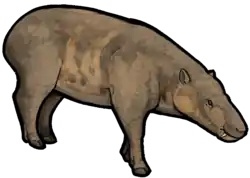
Fossil content
The Chitarwata Formation has provided a wealth of terrestrial mammal fossils of the late Paleogene and early Neogene, or Tabenbulakian; the last of the Asian land mammal ages (ALMA).
Among many others, the following fossils are reported from the formation:[1]
|
|
|
Color key
|
|
Notes
Uncertain or tentative taxa are in small text; crossed out taxa are discredited. |
Mammals
Artiodactyl
Ruminants
| Ruminants of the Chitarwata Formation |
| Genus |
Species |
Location |
Materials |
Notes |
Image |
| Bugtimeryx |
B. pilgrimi |
|
|
|
|
| Paalitherium |
P. gurki |
|
|
|
|
Creodonts
| Creodonts of the Chitarwata Formation |
| Genus |
Species |
Location |
Materials |
Notes |
Image |
| Hyainailouros |
H. bugtiensis |
|
|
A creodont. |
|
|
Perissodactyl
Paraceratheriidae
| Paraceratheriidaes of the Chitarwata Formation |
| Genus |
Species |
Location |
Materials |
Notes |
Image |
| "Buzdartherium" |
"B. gulkirao" |
|
|
|
|
| Paraceratherium |
P. bugtiense |
Chur J2, Bugti hill |
Left fragmentary maxilla with M2–M3 |
A giant hornless rhinoceros |
|
Marsupials
| Marsupials of the Chitarwata Formation |
| Genus |
Species |
Location |
Materials |
Notes |
Image |
| Asiadidelphis |
A. akbarbugtii |
|
|
|
|
Rodents
| Rodents of the Chitarwata Formation |
| Genus |
Species |
Location |
Materials |
Notes |
Image |
| Atavocricetodon |
A. paaliense |
|
|
|
|
| Baluchimys |
B. barryi |
|
|
|
|
| B. chaudryi, |
|
|
|
|
| B. ganeshapher |
|
|
|
|
| Bugtimys |
B. zafarullahi |
|
|
|
|
| Downsimys |
D. margolisi |
|
|
|
|
| Fallomus |
F. ginsburgi |
|
|
|
|
| F. quraishyi |
|
|
|
|
| F. razae |
|
|
|
|
| Hodsahibia |
H. azrae |
|
|
|
| H. beamshaiensis |
|
|
|
|
| H. gracilis |
|
|
|
|
| Lindsaya |
L.derabugtiensis |
|
|
|
|
| Primus |
P. cheemai |
|
|
|
|
| P. microps |
|
|
|
|
| Spanocricetodon |
S. sulaiman |
|
|
|
|
| Prokanisamys |
P. arifi |
|
|
|
|
| P. kowalskii |
|
|
|
|
| Pseudocricetodon |
P. nawabi |
|
|
|
|
| Welcommoides |
W. gurki |
|
|
|
|
| Zindapiria |
Z. quadricollis |
|
|
|
|
Primates
| Primates of the Chitarwata Formation |
| Genus |
Species |
Location |
Materials |
Notes |
Image |
| Bugtilemur |
B. mathesoni |
Paali Nala C2 |
A tooth (right M2), which is considered not a traceable fossil. |
An extinct relative of lemurs. |
|
| Bugtipithecus |
B. inexpectans |
Paali Nala DBC2 |
A dentition, right M. |
A Small-bodied amphipithecid. |
|
| Guangxilemur |
G. singsilai |
Paali Nala C2 |
A newly described upper and lower dentitions. |
An adapiform primate. |
|
| Phileosimias |
P. brahuiorum |
Paali Nala DBC2 |
Several dentition from upper molar |
An Eosimiidae primate. |
|
| P. kamali |
|
Further reading
- S. Adnet, P. -O. Antoine, S. R. Hassan Baqri, J. Crochet, L. Marivaux, J. Welcomme, and G. Métais. 2007. New tropical carcharhinids (chondrichthyes, Carcharhiniformes) from the late Eocene–early Oligocene of Balochistan, Pakistan: Paleoenvironmental and paleogeographic implications. Journal of Asian Earth Sciences 30(2):303-323
- G. Métais, P.-O. Antoine, S. R. H. Baqri, M. Benammi, J.-Y. Crochet, D. Franceschi, L. Marivaux and J.-L. Welcomme. 2006. New remains of the enigmatic cetartiodactyl Bugtitherium grandincisivum Pilgrim, 1908, from the upper Oligocene of the Bugti Hills (Balochistan, Pakistan). Naturwissenschaften 93(7):348-355
- E. H. Lindsay, L. J. Flynn, I. U. Cheema, J. C. Barry, K. Downing, A. R. Rajpar, and S. M. Raza. 2005. Will Downs and the Zinda Pir Dome. Palaeontologia Electronica 8(1):19A:1-18
- L. Marivaux, P.-O. Antoine, S. R. H. Baqri, M. Benammi, and Y. Chaimanee. 2005. Anthropoid primates from the Oligocene of Pakistan (Bugti Hills): Data on early anthropoid evolution and biogeography. Proceedings of the National Academy of Sciences 102(24):8436-8441
- P.-O. Antoine, J.-L. Welcomme, L. Marivaux, I. Baloch, M. Benammi and P. Tassy. 2003. First record of Paleogene Elephantoidea (Mammalia, Proboscidea) from the Bugti Hills of Pakistan. Journal of Vertebrate Paleontology 23(4):977-980
- J.-L. Welcomme and L. Ginsburg. 1997. Mise en évidence de l'Oligocène sur le territoire des Bugti (Balouchistan, Pakistan). Comptes Rendus de l'Académie des Sciences, Série IIA 325(12):999-1004
- L.J. Flynn, L.L. Jacobs, and I.U. Cheema. 1986. Baluchimyinae, A New Ctenodactyloid Rodent Subfamily from the Miocene of Baluchistan. American Museum Novitates 2841:1-58