Definition and properties
Let  be a natural number. Then the Kaprekar function for base
 and power

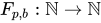 is defined to be the following:
 ,
where  and

It can also be expressed as:
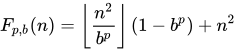
A natural number is a  -Kaprekar number if it is a fixed point for
 , which occurs if
 .
 and
 are trivial Kaprekar numbers for all
 and , all other Kaprekar numbers are nontrivial Kaprekar numbers.
The earlier example of 45 satisfies this definition with  and
 , because


A natural number is a sociable Kaprekar number if it is a periodic point for , where  for a positive integer
 (where
 is the th iterate of ), and forms a cycle of period . A Kaprekar number is a sociable Kaprekar number with
 , and a amicable Kaprekar number is a sociable Kaprekar number with
 .
The number of iterations  needed for
 to reach a fixed point is the Kaprekar function's persistence of , and undefined if it never reaches a fixed point.
There are only a finite number of -Kaprekar numbers and cycles for a given base , because if  , where
 then

and  ,
 , and
 . Only when
 do Kaprekar numbers and cycles exist.
If  is any divisor of , then is also a -Kaprekar number for base
 .
In base  , all even perfect numbers are Kaprekar numbers. More generally, any numbers of the form
 or
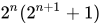 for natural number are Kaprekar numbers in base 2.
Set-theoretic definition and unitary divisors
The set  for a given integer
 can be defined as the set of integers
 for which there exist natural numbers
 and
 satisfying the Diophantine equation[1]
 , where


An -Kaprekar number for base is then one which lies in the set  .
It was shown in 2000[1] that there is a bijection between the unitary divisors of  and the set defined above. Let
 denote the multiplicative inverse of
 modulo
 , namely the least positive integer
 such that
 , and for each unitary divisor of let
 and
 . Then the function
 is a bijection from the set of unitary divisors of onto the set . In particular, a number is in the set if and only if
 for some unitary divisor of .
The numbers in occur in complementary pairs, and  . If is a unitary divisor of then so is , and if
 then
 .
Kaprekar numbers for
b = 4k + 3 and p = 2n + 1
Let and be natural numbers, the number base  , and
 . Then:
 is a Kaprekar number.
Proof
Let

Then,
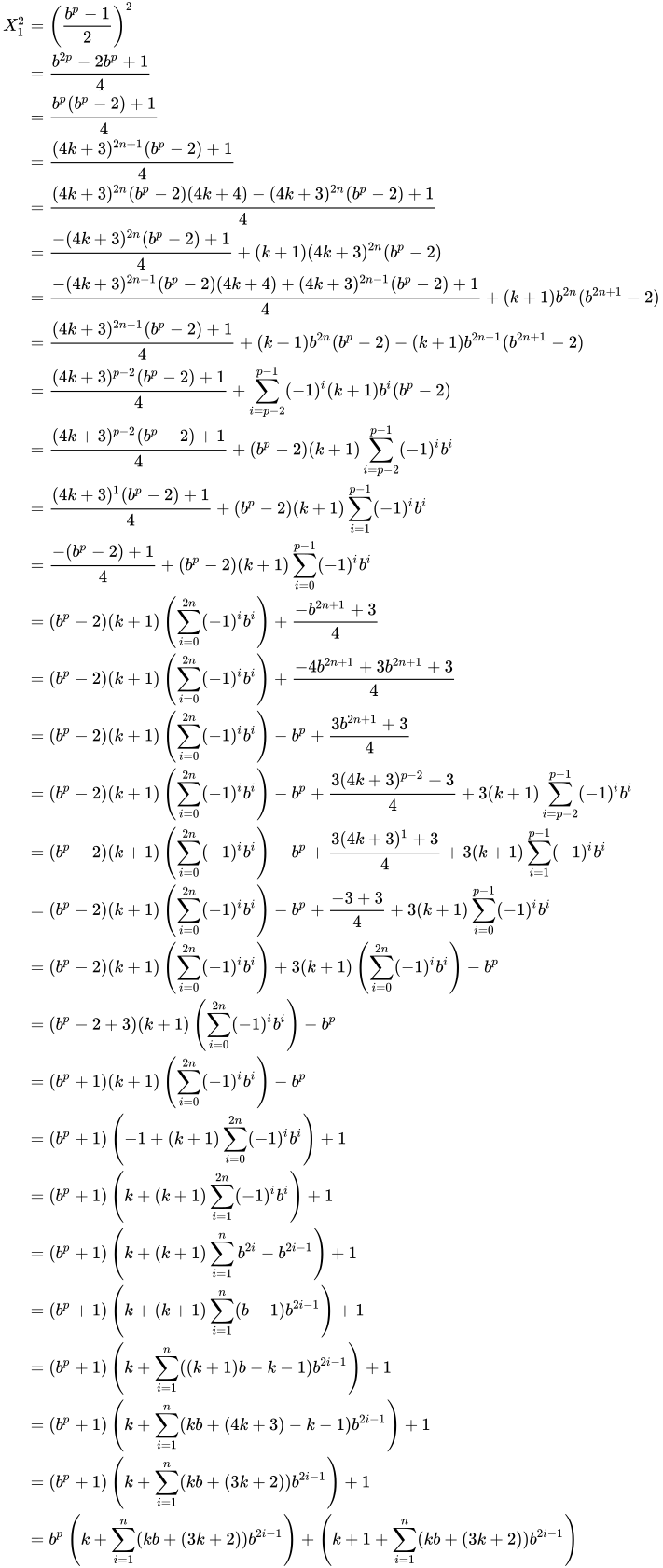
The two numbers  and
 are


and their sum is
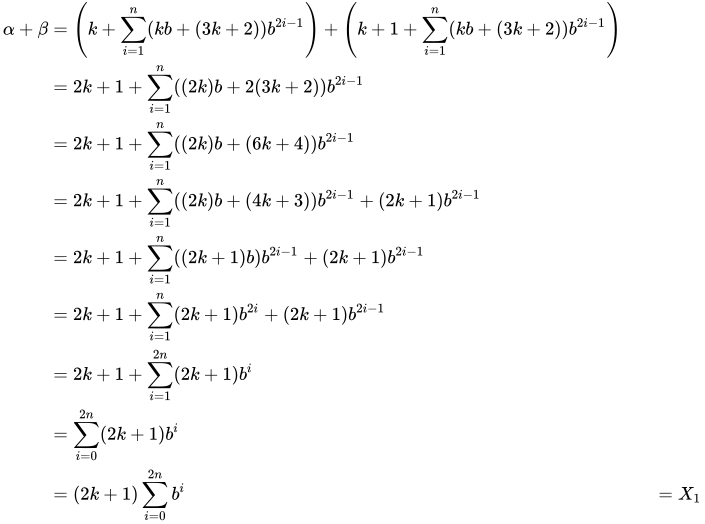
Thus,  is a Kaprekar number.
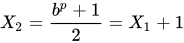 is a Kaprekar number for all natural numbers .
Proof
Let

Then,

The two numbers and are


and their sum is
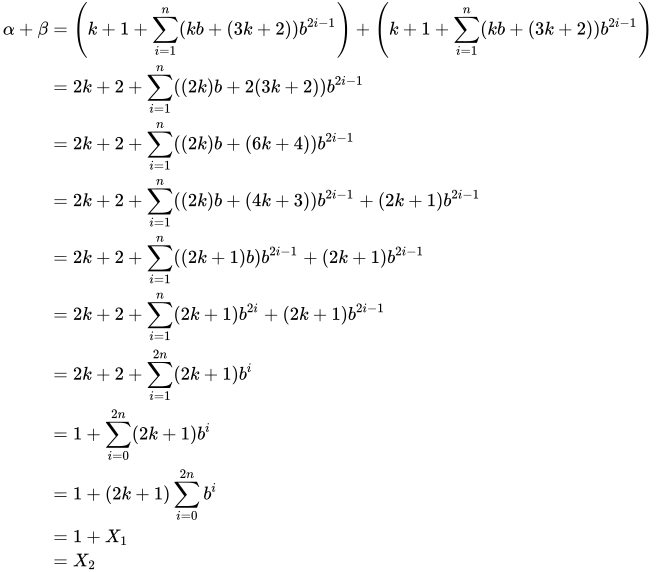
Thus,  is a Kaprekar number.






