In mathematics, a decagonal number is a figurate number that extends the concept of triangular and square numbers to the decagon (a ten-sided polygon).[1] However, unlike the triangular and square numbers, the patterns involved in the construction of decagonal numbers are not rotationally symmetrical. Specifically, the n-th decagonal numbers counts the dots in a pattern of n nested decagons, all sharing a common corner, where the ith decagon in the pattern has sides made of i dots spaced one unit apart from each other. The n-th decagonal number is given by the following formula
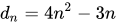 .[2]
The first few decagonal numbers are:
- 0, 1, 10, 27, 52, 85, 126, 175, 232, 297, 370, 451, 540, 637, 742, 855, 976, 1105, 1242, 1387, 1540, 1701, 1870, 2047, 2232, 2425, 2626, 2835, 3052, 3277, 3510, 3751, 4000, 4257, 4522, 4795, 5076, 5365, 5662, 5967, 6280, 6601, 6930, 7267, 7612, 7965, 8326 (sequence A001107 in the OEIS).
The nth decagonal number can also be calculated by adding the square of n to thrice the (n−1)th pronic number or, to put it algebraically, as
 .
Properties
- Decagonal numbers consistently alternate parity.
 is the sum of the first
 natural numbers congruent to 1 mod 8.
- is number of divisors of
 .
- The only decagonal numbers that are square numbers are 0 and 1.
- The decagonal numbers follow the following recurrence relations:



Sum of reciprocals
The sum of the reciprocals of the decagonal numbers admits a simple closed form:

Proof
This derivation rests upon the method of adding a "constructive zero":
 Rearranging and considering the individual sums:

References
|
|---|
|
|
|
|
Possessing a specific set of other numbers |
|---|
|
|
Expressible via specific sums |
|---|
|
|
|
|
|
|
|
|
|
|
|
|
|
|
|
