Jain Matha, Shravanabelgola
| Jain Matha, Shravanabelagola | |
|---|---|
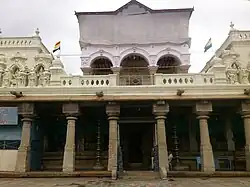 Jain Matha | |
| Religion | |
| Affiliation | Jainism |
| Sect | Digambara |
| Deity | Chandraprabha and Ambika |
| Leadership | Bhattaraka |
| Location | |
| Location | Shravanabelagola, Hassan |
| Architecture | |
| Style | Western Ganga |
| Creator | Chavundaraya |
| Established | 982 CE |
Jain Matha, Shravanabelagola is a Digambara Matha (Jain monastic institution) and Bhattaraka seat located at Shravanabelagola in Hassan district, Karnataka, India. The institution developed into an important centre of Jain pontifical authority and religious learning in southern India.[1]
The head of the matha traditionally bears the title Charukirti Bhattaraka. The institution has historically been associated with the Jain temples, religious establishments and manuscript tradition of Shravanabelagola.
History


Shravanabelagola developed as one of the principal centres of Digambara Jainism in Karnataka. Its numerous inscriptions document Jain monks, teachers, patrons and religious establishments over a period of several centuries.[2] An inscription records the existence of a Jain monastery at Shravanabelagola. According to R. B. P. Singh, the matha was founded in 982 CE by Chavundaraya, the general and minister of the Western Ganga ruler Marasimha II. Chavundaraya is also associated with the erection of the colossal Gommateshwara statue of Bahubali on Vindhyagiri Hill at Shravanabelagola.[3]
The matha subsequently developed into an important centre of Jain pontifical authority. Singh describes it as the principal centre of Jain pontificates claiming authority over Jain communities across southern India. Religious activities associated with the institution extended into different parts of Karnataka, and the Jain matha at Maleyur was subordinate to the Shravanabelagola establishment.[3] The importance of the institution continued into the later medieval and early modern periods, when the pontiffs of Shravanabelagola were involved in the administration of Jain temples and religious endowments at the pilgrimage center.
Bhattaraka tradition
The Jain Matha is a seat of the Bhattaraka tradition of Digambara Jainism. Unlike itinerant Digambara monks, Bhattarakas historically resided at permanent monastic institutions and were involved in religious instruction, temple administration, image consecration, manuscript preservation and the supervision of religious endowments. The pontiff of Shravanabelagola traditionally bears the title Charukirti. The existence of the matha and its resident Jain pontiff was independently documented in the 19th century. In his account of the inscriptions at Shravanabelagola, epigraphist Benjamin Lewis Rice referred to the Jain pontiff of the neighbouring matha and to scholars who assisted in the study of the inscriptions.[4] The institution formed part of a wider network of Digambara monastic establishments in Karnataka. The medieval Shravanabelagola matha exercised influence over affiliated Jain institutions, including the former matha at Maleyur.[3]
Religious and educational role


Jain mathas in medieval Karnataka served as centres of religious instruction and scholarship. Inscriptions from the region praise Jain teachers for learning in subjects including grammar, logic, Jain doctrine, literature, mathematics, medicine and other branches of knowledge.[5] Shravanabelagola itself developed into an important centre of Jain intellectual activity. The numerous inscriptions at the site record Jain ascetics and teachers belonging to different monastic lineages and provide evidence for the continuing importance of the settlement as a centre of Jain learning.[2] The matha's institutional functions included the preservation and transmission of Jain religious literature. A manuscript repository associated with the institution survives at Shravanabelagola.
Manuscript collection
The Jain Matha is associated with an important repository of Digambara Jain manuscripts. The Indira Gandhi National Centre for the Arts lists the Srimaccarukirti Panditacarya Jain Bhandar at Shravanabelagola among the Jain manuscript repositories of Karnataka. The existence of the collection reflects the traditional role of Jain mathas as centres for the preservation, copying and study of religious and philosophical literature. The manuscript tradition of Shravanabelagola forms part of a larger network of Digambara Jain grantha bhandaras in Karnataka, including important collections at Moodabidri, Karkala and other historic Jain centres.[6]
Relationship with Shravanabelagola
The history of the matha is closely connected with the development of Shravanabelagola as a Jain pilgrimage and monastic centre. The settlement contains two major sacred hills, Chandragiri and Vindhyagiri, together with numerous Jain temples, memorials and inscriptions. The establishment of the matha in the late 10th century coincided with an important phase in the development of Shravanabelagola under the Western Gangas. Chavundaraya, to whom the foundation of the matha is attributed, was also responsible for the monumental image of Bahubali on Vindhyagiri.[3] The large body of inscriptions at Shravanabelagola records the patronage of successive dynasties and officials, including the Western Gangas, Hoysalas, Vijayanagara rulers and the rulers of Mysore.[2]
Art

The Jain Matha contains paintings depicting subjects from Jain religious and cultural traditions. The paintings form part of the later artistic heritage of Shravanabelagola and include representations of religious figures, processions and narrative scenes. The presence of paintings in the Jain matha was noted in archaeological and bibliographical surveys of Jain monuments in Karnataka.[7]
Significance
The Shravanabelagola Jain Matha is significant in the institutional history of Digambara Jainism in Karnataka. From its medieval origins it developed as a centre of pontifical authority, religious education and administration.[3] Its importance is also connected with the position of Shravanabelagola as a major Jain pilgrimage centre. The concentration of inscriptions, temples, memorial monuments and manuscript collections at the site provides extensive evidence for the long history of Jain religious institutions in the region.[2]
The survival of the Bhattaraka institution and its manuscript repository represents the continuation of the monastic and scholastic traditions historically associated with Shravanabelagola.
Gallery
 Bahubali with Jain cosmology painting
 Sahastrakut Jinalaya
 Jain stories painting
 Vedi
 Jain stories painting
 Ambika
See also

References
Citations
Sources
- Narasimhachar, R. (1923). Inscriptions at Śravaṇa Beḷgoḷa: A Chief Seat of the Jains (PDF). Bangalore: Government Press.
- Singh, Ram Bhushan Prasad (1975). Jainism in Early Medieval Karnataka. Delhi: Motilal Banarsidass.
- Rice, Benjamin Lewis (1873). "Jain Inscriptions at Sravana Belgola". The Indian Antiquary. 2: 293–294.
- Indira Gandhi National Centre for the Arts. Jain Manuscripts and Grantha Bhandaras (PDF). New Delhi: Indira Gandhi National Centre for the Arts.
- Sangave, Vilas Adinath (1981), The Sacred ʹSravaṇa-Beḷagoḷa: A Socio-religious Study, Murtidevī granthamālā, vol. 8, Mumbai: Bhartiya Jnanpith, ISBN 9789326355599
- Jain, Chhote Lal (1945). Jaina Bibliography. Jaina Bibliography Series. Vol. 1. Calcutta: Bharati Jaina Parisat.
See also : Jain temples in North America and Jain temples in Pakistan | |
| Bihar | |
| Delhi | |
| Gujarat | |
| Jharkhand | |
| Karnataka | |
| Kerala | |
| Madhya Pradesh | |
| Maharashtra | |
| Nagaland | |
| Odisha | |
| Rajasthan | |
| Tamil Nadu | |
| Telangana | |
| Uttar Pradesh | |
| West Bengal | |


| Gods | |||||
|---|---|---|---|---|---|
| Philosophy | |||||
| Branches |
| ||||
| Practices | |||||
| Literature | |||||
| Symbols | |||||
| Ascetics | |||||
| Scholars | |||||
| Community |
| ||||
| Jainism in |
| ||||
| Jainism and | |||||
| Dynasties and empires | |||||
| Related | |||||
| Lists | |||||
| Navboxes |
| ||||