Iskandar Malaysia Bus Rapid Transit
| Johor Bahru Elevated Autonomous Rapid Transit (E-ART) | |||||||||||||||||||
|---|---|---|---|---|---|---|---|---|---|---|---|---|---|---|---|---|---|---|---|
 A CRRC Autonomous Rapid Transit (ART) smart-train vehicle on public demonstration in Malaysia. Similar rubber-tyred trackless rolling stock is planned for the Johor Bahru E-ART network. | |||||||||||||||||||
| Overview | |||||||||||||||||||
| Native name | Transit Aliran Autonomi Bertingkat | ||||||||||||||||||
| Owner | Government of Johor Federal Government of Malaysia | ||||||||||||||||||
| Locale | Iskandar Malaysia | ||||||||||||||||||
| Transit type | Autonomous Rapid Transit (Fully elevated, grade-separated) | ||||||||||||||||||
| Number of lines | 3 primary corridors (Skudai, Tebrau, Iskandar Puteri) | ||||||||||||||||||
| Number of stations | 32 elevated stations[1] | ||||||||||||||||||
| Operation | |||||||||||||||||||
| Operation will start | Proposed (Approved by Federal Cabinet May 2026;[1] under commercial evaluation by UKAS[2]) | ||||||||||||||||||
| Character | Fully elevated viaducts | ||||||||||||||||||
| Rolling stock | Rubber-tyred trackless smart trams (autonomous optical guidance) | ||||||||||||||||||
| Technical | |||||||||||||||||||
| System length | 50 km (trunk corridors)[2] | ||||||||||||||||||
| |||||||||||||||||||
| Iskandar Rapid Transit | |||||||||||||||||||||||||||||||||||||||||||||||||||||||||||||||||||||||||||||||||||||||||||||||||||||||||||||||||||||||||||||||||||||||||||||||||||||||||||||||||||||||||||||||||||||||||||||||||||||||||||||||||||||||||||||||||||||||||||||||||||||||||||||||||||||||||||||||||||||||||||||||||||
|---|---|---|---|---|---|---|---|---|---|---|---|---|---|---|---|---|---|---|---|---|---|---|---|---|---|---|---|---|---|---|---|---|---|---|---|---|---|---|---|---|---|---|---|---|---|---|---|---|---|---|---|---|---|---|---|---|---|---|---|---|---|---|---|---|---|---|---|---|---|---|---|---|---|---|---|---|---|---|---|---|---|---|---|---|---|---|---|---|---|---|---|---|---|---|---|---|---|---|---|---|---|---|---|---|---|---|---|---|---|---|---|---|---|---|---|---|---|---|---|---|---|---|---|---|---|---|---|---|---|---|---|---|---|---|---|---|---|---|---|---|---|---|---|---|---|---|---|---|---|---|---|---|---|---|---|---|---|---|---|---|---|---|---|---|---|---|---|---|---|---|---|---|---|---|---|---|---|---|---|---|---|---|---|---|---|---|---|---|---|---|---|---|---|---|---|---|---|---|---|---|---|---|---|---|---|---|---|---|---|---|---|---|---|---|---|---|---|---|---|---|---|---|---|---|---|---|---|---|---|---|---|---|---|---|---|---|---|---|---|---|---|---|---|---|---|---|---|---|---|---|---|---|---|---|---|---|---|---|---|---|---|---|---|---|---|---|---|---|---|---|---|---|---|---|---|---|---|---|---|---|---|---|---|---|---|---|---|---|---|---|---|
| BRT | |||||||||||||||||||||||||||||||||||||||||||||||||||||||||||||||||||||||||||||||||||||||||||||||||||||||||||||||||||||||||||||||||||||||||||||||||||||||||||||||||||||||||||||||||||||||||||||||||||||||||||||||||||||||||||||||||||||||||||||||||||||||||||||||||||||||||||||||||||||||||||||||||||
 | |||||||||||||||||||||||||||||||||||||||||||||||||||||||||||||||||||||||||||||||||||||||||||||||||||||||||||||||||||||||||||||||||||||||||||||||||||||||||||||||||||||||||||||||||||||||||||||||||||||||||||||||||||||||||||||||||||||||||||||||||||||||||||||||||||||||||||||||||||||||||||||||||||
| Overview | |||||||||||||||||||||||||||||||||||||||||||||||||||||||||||||||||||||||||||||||||||||||||||||||||||||||||||||||||||||||||||||||||||||||||||||||||||||||||||||||||||||||||||||||||||||||||||||||||||||||||||||||||||||||||||||||||||||||||||||||||||||||||||||||||||||||||||||||||||||||||||||||||||
| Native name | Transit Aliran Bas Iskandar Malaysia (Malay) | ||||||||||||||||||||||||||||||||||||||||||||||||||||||||||||||||||||||||||||||||||||||||||||||||||||||||||||||||||||||||||||||||||||||||||||||||||||||||||||||||||||||||||||||||||||||||||||||||||||||||||||||||||||||||||||||||||||||||||||||||||||||||||||||||||||||||||||||||||||||||||||||||||
| Locale | Iskandar Malaysia - Johor Bahru District, Kulai District, and Pontian District (South) | ||||||||||||||||||||||||||||||||||||||||||||||||||||||||||||||||||||||||||||||||||||||||||||||||||||||||||||||||||||||||||||||||||||||||||||||||||||||||||||||||||||||||||||||||||||||||||||||||||||||||||||||||||||||||||||||||||||||||||||||||||||||||||||||||||||||||||||||||||||||||||||||||||
| Transit type | Bus rapid transit | ||||||||||||||||||||||||||||||||||||||||||||||||||||||||||||||||||||||||||||||||||||||||||||||||||||||||||||||||||||||||||||||||||||||||||||||||||||||||||||||||||||||||||||||||||||||||||||||||||||||||||||||||||||||||||||||||||||||||||||||||||||||||||||||||||||||||||||||||||||||||||||||||||
| Number of lines | 72 (3 trunk, 26 direct, and 42 feeder BRT route) | ||||||||||||||||||||||||||||||||||||||||||||||||||||||||||||||||||||||||||||||||||||||||||||||||||||||||||||||||||||||||||||||||||||||||||||||||||||||||||||||||||||||||||||||||||||||||||||||||||||||||||||||||||||||||||||||||||||||||||||||||||||||||||||||||||||||||||||||||||||||||||||||||||
| Operation | |||||||||||||||||||||||||||||||||||||||||||||||||||||||||||||||||||||||||||||||||||||||||||||||||||||||||||||||||||||||||||||||||||||||||||||||||||||||||||||||||||||||||||||||||||||||||||||||||||||||||||||||||||||||||||||||||||||||||||||||||||||||||||||||||||||||||||||||||||||||||||||||||||
| Operation will start | Shelved | ||||||||||||||||||||||||||||||||||||||||||||||||||||||||||||||||||||||||||||||||||||||||||||||||||||||||||||||||||||||||||||||||||||||||||||||||||||||||||||||||||||||||||||||||||||||||||||||||||||||||||||||||||||||||||||||||||||||||||||||||||||||||||||||||||||||||||||||||||||||||||||||||||
| Operator(s) | 111 Handal Indah (Causeway Link) 227 Maju 007 S&S International 168 Transit Link (City Bus) | ||||||||||||||||||||||||||||||||||||||||||||||||||||||||||||||||||||||||||||||||||||||||||||||||||||||||||||||||||||||||||||||||||||||||||||||||||||||||||||||||||||||||||||||||||||||||||||||||||||||||||||||||||||||||||||||||||||||||||||||||||||||||||||||||||||||||||||||||||||||||||||||||||
| Number of vehicles | Articulated 18m ( Trunk route), 12m bus (Direct route) and 8m bus (Feeder route) | ||||||||||||||||||||||||||||||||||||||||||||||||||||||||||||||||||||||||||||||||||||||||||||||||||||||||||||||||||||||||||||||||||||||||||||||||||||||||||||||||||||||||||||||||||||||||||||||||||||||||||||||||||||||||||||||||||||||||||||||||||||||||||||||||||||||||||||||||||||||||||||||||||
| Technical | |||||||||||||||||||||||||||||||||||||||||||||||||||||||||||||||||||||||||||||||||||||||||||||||||||||||||||||||||||||||||||||||||||||||||||||||||||||||||||||||||||||||||||||||||||||||||||||||||||||||||||||||||||||||||||||||||||||||||||||||||||||||||||||||||||||||||||||||||||||||||||||||||||
| System length | 51 km (32 mi) First Phase | ||||||||||||||||||||||||||||||||||||||||||||||||||||||||||||||||||||||||||||||||||||||||||||||||||||||||||||||||||||||||||||||||||||||||||||||||||||||||||||||||||||||||||||||||||||||||||||||||||||||||||||||||||||||||||||||||||||||||||||||||||||||||||||||||||||||||||||||||||||||||||||||||||
| |||||||||||||||||||||||||||||||||||||||||||||||||||||||||||||||||||||||||||||||||||||||||||||||||||||||||||||||||||||||||||||||||||||||||||||||||||||||||||||||||||||||||||||||||||||||||||||||||||||||||||||||||||||||||||||||||||||||||||||||||||||||||||||||||||||||||||||||||||||||||||||||||||


The Iskandar Malaysia Bus Rapid Transit (IMBRT), later rebranded as the Iskandar Rapid Transit (IRT), was a planned mass transit network designed to serve Iskandar Malaysia, Johor, Malaysia.[3] Initially conceived as a ground-level bus rapid transit network consisting of trunk, direct, and feeder corridors,[3][4] the system's development model was originally influenced by Australia's Brisbane BRT.[5] The project framework was subsequently updated to integrate trackless, rubber-tyred Autonomous Rapid Transit (ART) smart trams to enhance operational capacity.[6][7]
The ground-level configuration was officially cancelled by the Johor state government in mid-2024 because traffic impact assessments indicated that dedicating existing road lanes to surface transit would worsen urban traffic congestion.[8][9] In May 2026, the Malaysian federal government approved a restructured RM10 billion Elevated Autonomous Rapid Transit (E-ART) system to succeed the original surface-level plan.[10] The elevated network is designed to isolate transit lines entirely from regular vehicular traffic and disperse cross-border passenger volumes arriving at the Bukit Chagar terminal of the Johor Bahru–Singapore Rapid Transit System (RTS Link).[11][12]
History
Conceptualization and early planning (2009–2016)
As the population of Iskandar Malaysia was expected to double to 3 million by 2025 from 1.5 million when it was established in 2006, a dedicated transit system was proposed to cater to the area's growing transportation needs.[13] This led to the first conceptualization of the Iskandar Malaysia Bus Rapid Transit (IMBRT) project in 2009, which aimed to combine the speed and reliability of light rail transit (LRT) with the affordability of a conventional bus system. Initiated under the Iskandar Malaysia Transportation Blueprint 2010–2030 by the Iskandar Regional Development Authority (IRDA), the concept targeted the use of high-capacity, air-conditioned, clean-energy buses operating along dedicated bus lanes. The system was designed to connect Johor Bahru to industrial and residential areas across three main corridors: Tebrau, Skudai, and Nusajaya (later renamed Iskandar Puteri).[14]
In late March 2016, the federal government officially approved the preliminary IMBRT blueprint. The development framework was divided into three construction phases, with an initial target to cover up to 90% of the Iskandar Malaysia metropolitan region upon completion, expanding significantly from the area's existing 39% public transit coverage.[14][15]
Project launch and pilot testing (2017–2023)
On 7 October 2017, Prime Minister Najib Razak officially launched the project at the Progressive Johor Expo in Kota Iskandar. The network infrastructure was budgeted at RM2.56 billion, financed via a RM1 billion direct allocation from the federal government, with the remaining capital to be raised through a public-private partnership (PPP) initiative.[3] The initial design spanned 51 km across trunk routes, encompassing 39 stations, and was intended to interface directly with the upcoming Johor Bahru–Singapore Rapid Transit System (RTS Link), the Kuala Lumpur–Singapore high-speed rail (HSR), and regional intercity bus terminals.[3]
A public inspection process commenced in November 2017 to gather commuter feedback, which continued into 2018 alongside updated routing metrics that expanded the total coverage framework to over 300 km, consisting of 50 km of trunk routes and an extensive network of feeder routes.[13] Following the 2018 general election, the incoming Pakatan Harapan state administration reaffirmed its commitment to the project, prioritizing the Johor Bahru–Kota Iskandar route.[16] However, logistical adjustments subsequently pushed the targeted construction phase to early 2022.[14]
In January 2021, the project's consortium partner, Mobilus Sdn Bhd, received its first trackless, bi-articulated automated rapid transit (ART) smart tram vehicles from CRRC Zhuzhou Locomotive in China.[17] Concurrently, the overall system was rebranded as the Iskandar Rapid Transit (IRT). From April to July 2021, a comprehensive three-month pilot testing program was executed along a 4 km loop on Lebuhraya Sultan Iskandar between Horizon Hills and Anjung in Medini, evaluating operational hardware and clean-energy fuel options from nine distinct international suppliers.[17] Detailed design planning and alignment structuring packages continued through 2023, with minor preliminary works scheduled across the late months of the year.[18]
Ground-level cancellation and transition to elevated ART (2024–present)
The regional transit framework underwent a major strategic shift in mid-2024, moving away from ground-level bus lanes. Comprehensive traffic impact and optimization studies revealed that because approximately 25% of the central 13.79 km alignment required a shared right-of-way with existing lanes, dedicating surface road space to at-grade transit would trigger severe traffic congestion across Johor Bahru's primary thoroughfares. Consequently, the Johor State Government formally shelved the ground-level strategy, resolving instead to shift the entire system onto an elevated alignment to isolate transit operations completely from street traffic.[19][20]
In early 2026, state authorities prioritized early rollouts on the high-traffic Tebrau corridor to alleviate worsening severe bottlenecks ahead of broader system deployment.[21] In May 2026, the Malaysian Federal Cabinet officially greenlit the restructured **Elevated Autonomous Rapid Transit (E-ART)** project, with an estimated valuation of RM10 billion.[22] The elevated design is developed under a public-private partnership (PPP) model overseen by the Public Private Partnership Unit (UKAS) of the Prime Minister's Department.[23]
The finalized layout spans three primary corridors—Skudai, Tebrau, and Iskandar Puteri—encompassing 32 elevated stations.[24] The network integrates directly into the Bukit Chagar RTS Link terminal to efficiently disperse high cross-border commuter volumes.[24][25] The final infrastructure and route alignments are scheduled for strategic submission by August 2026.[26]
As a summary of the project's historical timeline, the architectural and naming transitions of the network from inception to its current configuration are outlined below:
| Year | Abbreviation | Full term | Core transit technology | Key characteristics |
|---|---|---|---|---|
| 2017 | BRT | Bus Rapid Transit | Traditional dedicated bus lanes | Ground-level dedicated corridors using standard high-capacity buses. Inspired by Brisbane's busway model.[27] |
| 2019 | IMBRT | Iskandar Malaysia Bus Rapid Transit | Ground-level mass transit network | The localized comprehensive blueprint and structural planning framework covering trunk, direct, and feeder routes across the region.[28] |
| 2021 | IRT | Iskandar Rapid Transit | Unified regional transit identity | System-wide modernization and official rebranding from IMBRT to Iskandar Rapid Transit (IRT) to prepare for network-wide procurement.[29] |
| ART | Autonomous Rapid Transit | Trackless, rubber-tyred smart trams | Upgraded from standard buses to multi-carriage trackless trains guided by virtual tracks on existing roads.[30] | |
| 2026 | E-ART | Elevated Autonomous Rapid Transit | Multi-tiered elevated smart rail system | Fully elevated, grade-separated network designed to bypass road traffic and directly disperse RTS Link cross-border passengers.[31] |
IMBRT pilot testing programme
A three-month pilot testing program was launched on April 8, 2021, in Medini, Iskandar Puteri. As a pilot test, nine bus suppliers were involved in demonstrations of the use of the latest green bus technology that uses electricity or biodiesel. The buses tested ranged in size from 6 meters to 32 meters, and the actual test was held along the route in Iskandar Puteri corridor.[32]
Bi-articulated bus for trunk services

In January 2021, a LiDAR guided bi-articulated bus for IMBRT arrived in Johor from China.[33] The guided buses that will be used for this project are an Autonomous Rapid Transit (ART) type that was imported by Mobilus Sdn Bhd, a 51:49 joint venture company established between Eccaz Sdn. Bhd. and CRRC Urban Traffic Co Ltd, a member of CRRC Group. Malaysia will be the first country in the region to potentially adopt this technology.[17]
The ART is a multi-carriage vehicle equipped with sensors that read the painted track markings on the road, enabling it to automatically navigate its own route while travelling up to 70 km per hour and carrying more than 100 passengers per carriage. The capacity of an ART vehicle is expandable to up to five carriages. It is considered a medium-capacity transit system for urban passenger transport using leading-edge technology and allows for higher passenger capacity at a lower cost of implementation when compared to traditional light rail systems. During the pilot test, the guided bus used stored energy on electricity to operate. This is to find out the vehicle's sustainability to suit on the hot and humid conditions of Malaysian weather.[17]
Single-deck bus for direct and feeder services
A total of five single-deck buses have participated in this program, where four buses use electricity while only one Scania K250UB bus uses biodiesel. The electric bus models involved are Putra-NEDO EV, Edison Motors New e-FIBIRD, Skywell NJL6101EV and CRRC CSR6105GLEV1-1.[34]
Project restructuring
While the 2021 pilot testing yielded highly positive feedback from commuters and successful technical feedback from operators, subsequent scalability reviews highlighted long-term traffic bottlenecks. Feasibility studies indicated that roughly 25% or 13.79 km of the planned key trunk segments would be forced to share right-of-way lanes with private mixed traffic, threatening to worsen regional gridlock.[35]
Consequently, the original ground-level Bus Rapid Transit plan was officially shelved in mid-2024 because it was deemed unable to handle projected traffic volumes, a situation projected to worsen significantly upon the completion of the Johor Bahru–Singapore Rapid Transit System (RTS Link).[35] Following the cancellation, state planners shifted focus toward a fully elevated configuration, proposing an Elevated Autonomous Rapid Transit (E-ART) network to completely bypass ground-level road congestion.[35][36]
Route
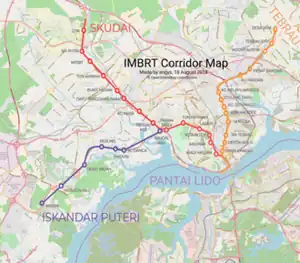
For the first phase of IMBRT, the Iskandar Regional Development Authority (IRDA) has allocated 22 solar-powered stations on the three BRT lines, comprising ten stations on the Tebrau line, eight stations on the Skudai line and four stations on the Iskandar Puteri line.
System characteristics and baseline design
The baseline data sets established during the planning phase continue to form the foundational corridor framework for the region's revised transit layouts:[37]
- Total network footprint: Originally mapped to cover 2,043 km across a unified network of trunk, direct, and local feeder routes.
- Primary trunk routes: Comprises three key corridors featuring 32 planned stations spanning a route network of more than 50 km:
- Skudai Corridor (~18 km): Planned to connect Johor Bahru City Centre to northern educational and industrial zones via 13 dedicated stations.
- Tebrau Corridor (~22 km): Aligned to serve the dense residential and commercial developments in the eastern sector across 19 planned stations.
- Iskandar Puteri Corridor (~15 km): Designed to link major administrative and growth nodes including Medini and Kota Iskandar.
- Feeder integration: Formulated to incorporate 55 localized feeder services operating within a 5 km service radius of primary trunk hubs, creating intermodal interchanges at the Larkin Bus Terminal and the upcoming RTS Bukit Chagar link.
Trunks service corridors
| Corridor | Origin–Destination[38] | Proposed halt | Current operational bus route |
|---|---|---|---|
| Tebrau | Larkin–JB Sentral–Tebrau City | Larkin, Kebun Teh, Saujana, Wadi Hasan, KOMTAR, JB Sentral, Sungai Segget, MBJB, Tun Sri Lanang, Wong Ah Fook Selatan, Wong Ah Fook Utara, Wadi Hana, Depot Polis, Sri Tebrau, Taman Abad, Sentosa, Taman Melodies, Taman Suria, Stulang Baru, Kampung Bendahara, Kampung Melayu Majidee, Taman Sri Pandan, Kampung Pandan, Taman Redang, Pusat Bandar Pandan & Tebrau City. | T10 T11 T13 |
| Skudai | JB Sentral–Sri Putri | JB Sentral, Sungai Segget, MBJB, Taman Istana, Lido Boulevard, Sri Gelam, Straits View South, Straits View, Bukit Serene, Danga Bay Park, Iskandar Malaysia, UDA, Skudai Kanan, Pengkalan Rinting, Kampung Pasir, Pekan Rabu, TD Penggawa Barat, Bukit Mewah, Danga Utama, Tun Aminah, Tun Aminah 2, MBJBT & Sri Putri. | T30 T31 T32 |
| Iskandar Puteri | JB Sentral–Medini | JB Sentral, Sungai Segget, MBJB, Taman Istana, Lido Boulevard, Sri Gelam, Strais View South, Straits View, Bukit Serene, Danga Bay Park, Iskandar Malaysia, Skudai Kiri, Sungai Danga, D'Utama, Baiduri, Perling, Bukit Indah, International Resort, Theme Park, Sungai Melayu, Kota Iskandar, Legoland, Medini & Ledang. | T33 T40 |
Direct service
| No. | Origin–Destination[38] | Length (km) |
|---|---|---|
| 1 | Bukit Indah–JB | 42.93 |
| 2 | Kota Iskandar–Perling–Bandar Baru UDA | 47.06 |
| 3 | Gelang Patah–Larkin–Permas Jaya Hub | 68.2 |
| 4 | Medini - Larkin–Permas Jaya | 51.77 |
| 5 | Taman Universiti–Mutiara Rini | 51.8 |
| 6 | UTM–Taman Universiti–Medini | 54.37 |
| 7 | UTM Station–Taman Ungku Tun Aminah–Medini | 37.95 |
| 8 | Taman Ungku Tun Aminah - Lima Kedai–Medini | 49.11 |
| 9 | Senai Airport–Bukit Indah–Medini | 70.4 |
| 10 | Kulai–Skudai–Larkin | 60.37 |
| 11 | Pulai–Kempas Sentral | 42.86 |
| 12 | Taman Ungku Tun Aminah–Tampoi–Johor Jaya | 63.79 |
| 13 | Kempas Baru–HAS–JB | 33.3 |
| 14 | Setia Indah–Kempas Baru–Larkin–JB | 41.83 |
| 15 | Kempas Sentral–Medini | 55.6 |
| 16 | Impian Jaya–Kempas Sentral–Larkin Sentral | 36.49 |
| 17 | Terminal Johor Jaya–Permas | 38.72 |
| 18 | Puteri Wangsa–Tebrau–Larkin–JB | 47.63 |
| 19 | Desa Cemerlang–Stulang | 47.14 |
| 20 | Setia Indah–Kebun Teh–Larkin Sentral | 34.89 |
| 21 | Ulu Tiram–Tebrau–Larkin Sentral | 40.53 |
| 22 | Tebrau City–Tampoi–Kempas Sentral | 37.24 |
| 23 | Masai–Seri Alam–Permas Jaya | 58.88 |
| 24 | Kota Masai–Pasir Gudang–JB | 68.45 |
| 25 | Pasir Gudang Terminal–Kempas Sentral | 53.96 |
| 26 | Seri Alam–Permas–Larkin Sentral | 36.37 |
Feeder service
| Origin–Destination[38] | Length (km) | |
|---|---|---|
| 1 | Danga Bay–Saujana–JB | 23.81 |
| 2 | Kg Pasir Station–Bandar Baru Uda–Larkin–Abad–Pelangi–JB | 34.08 |
| 3 | Larkin Sentral–Kg Amin–JB | 16.98 |
| 4 | Pulai Indah–Nusa Perintis–Medini | 76.21 |
| 5 | Pekan Nenas–Gelang Patah–Medini | 63.34 |
| 6 | Kg Maju Jaya–Desa Idaman–Econsave–Senai Airport | 27.02 |
| 7 | Taman Aman–Senai New Village | 8.72 |
| 8 | Ulu Tiram–Senai | 46.96 |
| 9 | Kg Kangkar–Sg Tiram–Ulu Tiram Terminal | 32.46 |
| 10 | Kong Kong–Taman Cendana–Pasir Gudang Terminal | 30.28 |
| 11 | KSAB CIQ–Medini South–Puteri Harbour | 42.81 |
| 12 | Pendas–Tanjung Pelepas–Medini | 57.31 |
| 13 | Pinewood–Medini–Gelang Patah | 29.38 |
| 14 | Medini South–Medini–Sg Melayu | 35.23 |
| 15 | Bukit Indah–Nusa Idaman–Horizon Hills–Medini | 26.84 |
| 16 | Perling Station–Taman Dato’ Penggawa Barat | 14.41 |
| 17 | Taman Universiti | 14.89 |
| 18 | Skudai Baru–Taman Ungku Tun Aminah–Taman Orkid | 15.72 |
| 19 | Penggawa Barat–Dahlia–Desa Rahmat–Kg Pasir Station | 11.95 |
| 20 | Danga Sutera–Selesa Jaya | 16.3 |
| 21 | Kempas–Impian Emas–UTM Terminal | 36.83 |
| 22 | Pulai Ria–Taman Teratai–Sri Pulai–Taman Universiti | 19.65 |
| 23 | Kempas–Taman Johor–Bukit Mewah Station | 18.26 |
| 24 | Taman Suria–Kg Melayu Majidee–Larkin | 15.78 |
| 25 | JPO–Bandar Putera | 19 |
| 26 | Kulai Jaya Terminal–Taman Putri Pulai | 11.46 |
| 27 | Taman Majidee–Taman Melodies–Taman Sentosa–Sri Tebrau–Pelangi Station | 21.84 |
| 28 | Setia Indah–Austin Height–Bandar Dato' Onn–Setia Indah | 17.36 |
| 29 | PPR Sri Stulang–Sentosa | 10.82 |
| 30 | KDSM–Majidee Baru–Kg Bendahara | 5.98 |
| 31 | Bestari Indah–Desa Cemerlang–Desa Jaya Hub | 18.79 |
| 32 | Johor Jaya–Taman Gaya–Desa Jaya Hub | 21.37 |
| 33 | Johor Jaya–Taman Molek–Pandan Station | 20.83 |
| 34 | UNIKL–UITM–Jalan Gunung–Seri Alam Terminal | 14.28 |
| 35 | Flora Height–Cendana–Kg Pasir Gudang Baru–Pasir Gudang Terminal | 22.04 |
| 36 | Permas–Senibong | 21.5 |
| 37 | Seri Alam–Nusa Damai–Pasir Gudang Terminal | 19.6 |
| 38 | PPR Desa Rakyat–Taman Scientex–Taman Cendana–Pasir Gudang–Masai | 22.86 |
| 39 | Kg Pasir Putih–Taman Air Biru–Pasir Gudang–Masai | 20.72 |
| 40 | Kota Masai–Taman Pasir Putih–Pasir Gudang | 26.6 |
| 41 | Pasir Gudang Terminal–Perigi Acheh–Tanjung Langsat | 32.75 |
| 42 | Seri Alam Terminal–Taman Rinting–Megah Ria | 14.44 |
See also
References
- 1 2 3 Benjamin, Nelson; Yee, Xiang Yun; Devi, Venesa (17 May 2026). "Cabinet approves RM10bil E-ART project to ease Johor Baru traffic". The Star. Retrieved 20 June 2026.
- 1 2 "E-ART Johor dilaksanakan di bawah UKAS melalui kaedah PPP". Astro Awani. Bernama. 16 June 2026. Retrieved 20 June 2026.
- 1 2 3 4 "Bus Rapid Transit to serve as Iskandar Malaysia public transportation backbone". www.nst.com.my. 2017-10-07. Retrieved 2026-06-21.
- ↑ "柔快捷巴士料2021年運行" (in Chinese). Oriental Daily News (Malaysia).
- ↑ "Iskandar bus rapid transit system modelled after Brisbane's BRT". The Star.
- ↑ "依斯干达快捷巴士系统汇报会.千辆巴士川行新山市区.BTS2021年投入运作" (in Simplified Chinese). Sin Chew Daily. 18 January 2018. Archived from the original on 20 January 2018. Retrieved 19 January 2018.
- ↑ "SunCon, WCT potential candidates in Johor RM2.6b bus rapid transit project". The Star.
- ↑ "Iskandar Malaysia transit bus can't tackle traffic, shelved". The Star.
- ↑ "From LRT to ART: Johor switches gear to autonomous rapid transit system to ease congestion, spur development". Channel NewsAsia. 29 April 2024.
- ↑ "Federal commitment powers Johor's RM10 billion ART transport leap". Scoop.my. Bernama. 18 May 2026. Retrieved 20 June 2026.
- ↑ "e‑ART to drive connectivity in JB". The Star. 9 June 2026. Retrieved 20 June 2026.
- ↑ "'Critical' with RTS Link launch: Johor's caretaker chief minister calls on Putrajaya to expedite ART rail plan". Channel NewsAsia. 16 June 2026. Retrieved 20 June 2026.
- 1 2 "First phase of Iskandar Malaysia BRT to be ready by 2021". The Star. 19 January 2018. Retrieved 21 January 2021.
- 1 2 3 "Johor's RM2.56 bil Bus Rapid Transit to take off in 2022". Free Malaysia Today. 19 May 2019. Retrieved 21 January 2021.
- ↑ "Iskandar Malaysia BRT system gets the green light". Paul Tan's Automotive News. 31 March 2016. Retrieved 21 January 2021.
- ↑ "Johor committed to continuing Iskandar Malaysia BRT project". The Edge Markets. 16 August 2018. Retrieved 21 January 2021.
- 1 2 3 4 "Mobilus welcomes arrival of first automated rapid transit system into Iskandar Malaysia". The Edge Markets. 20 January 2021. Retrieved 21 January 2021.
- ↑ Tamrin, Shahrim (15 September 2023). "Hot wheels: Johor Baru's BRT ready to go by 2025". The Vibes Malaysia.
- ↑ Onn Hafiz, Ghazi (16 June 2026). "Expedite ART project, Johor MB urges Putrajaya". Free Malaysia Today. Retrieved 20 June 2026.
- ↑ "From LRT to ART: Johor switches gear to autonomous rapid transit system to ease congestion, spur development". Channel NewsAsia. 29 April 2024.
- ↑ "Johor seeks early rollout of ART on high-traffic alignments". Malay Mail. 21 February 2026.
- ↑ "Federal commitment powers Johor's RM10 billion ART transport leap". Scoop.my. Bernama. 18 May 2026. Retrieved 20 June 2026.
- ↑ "E‑ART Johor dilaksanakan di bawah UKAS melalui kaedah PPP". Astro Awani. 16 June 2026.
- 1 2 "e‑ART to drive connectivity in JB". The Star. 9 June 2026.
- ↑ "'Critical' with RTS Link launch: Johor's caretaker chief minister calls on Putrajaya to expedite ART rail plan". Channel NewsAsia. 16 June 2026. Retrieved 20 June 2026.
- ↑ "Final E‑ART route proposal expected by August". Bernama.
- ↑ "SunCon, WCT potential candidates in Johor RM2.6b bus rapid transit project". The Star. 9 October 2017. Retrieved 20 June 2026.
- ↑ "IMBRT is now known as Iskandar Rapid Transit". Bernama. 9 November 2021. Retrieved 20 June 2026.
- ↑ "IMBRT is now known as Iskandar Rapid Transit". Bernama. 9 November 2021. Retrieved 20 June 2026.
- ↑ "依斯干达快捷巴士系统汇报会.千辆巴士川行新山市区.BTS2021年投入运作" (in Simplified Chinese). Sin Chew Daily. 18 January 2018.
{{cite news}}: CS1 maint: url-status (link) - ↑ "'e-ART to drive connectivity in JB'". The Star. 9 June 2026. Retrieved 20 June 2026.
- ↑ https://themalaysianreserve.com/2021/04/09/johor-commences-brt-pilot-testing/ Johor commences BRT pilot testing
- ↑ https://iskandarputeri.com/autonomous-rapid-transit-art-the-first-art-system-in-asean-is-now-arrived-in-iskandar-malaysia/ Archived 2021-04-17 at the Wayback Machine Autonomous Rapid Transit (ART)–The First ART System in ASEAN is Now Arrived in Iskandar Malaysia!
- ↑ https://landtransportguru.net/imbrt-pilot-testing-programme/ IMBRT Pilot Testing Programme
- 1 2 3 Yee, Xiang Yun (17 May 2024). "Iskandar Malaysia transit bus can't tackle traffic, shelved". The Star. Retrieved 20 June 2026.
- ↑ Chan, Mick (16 June 2026). "E-ART crucial for preventing severe traffic when Johor Bahru-Singapore RTS Link starts next year: Johor MB". Paul Tan's Automotive News. Retrieved 20 June 2026.
- ↑ "Federal commitment powers Johor's RM10 billion ART transport leap". Scoop.my. Bernama. 18 May 2026. Retrieved 20 June 2026.
- 1 2 3 "Feeder & Direct Routes - IMBRT". 24 January 2018.
External links
- Iskandar Malaysia Bus Rapid Transit Official Website
- Iskandar Regional Development Authority Official Website
- Perbadanan Pengangkutan Awam Johor Official Website
| Bus service |
| ||||||||||||||||||
|---|---|---|---|---|---|---|---|---|---|---|---|---|---|---|---|---|---|---|---|
| Major bus hubs |
| ||||||||||||||||||
| Companies |
| ||||||||||||||||||
| Depots |
| ||||||||||||||||||
| Related topics | |||||||||||||||||||
| Automated fare collection |
| ||||||||||||||||||
| Commissions |
| ||||||||||||||||||
| |||||||||||||||||||


