Portal:India


Introduction


India, officially the Republic of India, is a country in South Asia. It is the world's seventh-largest country by area and the largest by population. Bounded by the Indian Ocean on the south, the Arabian Sea on the southwest, and the Bay of Bengal on the southeast, it shares land borders with Pakistan to the west; China, Nepal, and Bhutan to the north; and Bangladesh and Myanmar to the east. In the Indian Ocean, India is near Sri Lanka and the Maldives. (Full article...)
 Featured article –

Kareena Kapoor Khan (pronounced [kəˈriːna kəˈpuːr xɑːn]; née Kapoor; born 21 September 1980) is an Indian actress. She has been known for her leading roles in Hindi cinema since 2000. Kapoor is the recipient of several awards, including six Filmfare Awards, and as of 2024, is one of Hindi cinema's highest-paid actresses.
Born into the Kapoor family, she is the daughter of actors Babita and Randhir Kapoor, and the younger sister of actress Karisma Kapoor. After making her acting debut in 2000 in Refugee, Kapoor established herself the following year with several roles, including in the top-grossing drama Kabhi Khushi Kabhie Gham. This was followed by a series of commercial failures and negative reviews for her repetitive roles. An against-type performance as a sex worker in the 2004 drama Chameli marked a turning point in her career. She earned critical recognition for her portrayal of a riot victim in the 2004 drama Dev and a character based on Desdemona in the 2006 crime film Omkara. Her performance as a loquacious woman in the romantic comedy Jab We Met (2007) earned her the Filmfare Award for Best Actress. (Full article...)
Virupaksha temple at Hampi, the sacred centre at Vijayanagara, the royal capital
Vijayanagara literature in Kannada is the body of literature composed in the Kannada language of South India during the ascendancy of the Vijayanagara Empire which lasted from the 14th through the 16th century. The Vijayanagara empire was established in 1336 by Harihara I and his brother Bukka Raya I. Although it lasted until 1664, its power declined after a major military defeat by the Shahi Sultanates in the battle of Talikota in 1565. The empire is named after its capital city Vijayanagara, whose ruins surround modern Hampi, now a World Heritage Site in Karnataka.
Kannada literature during this period consisted of writings relating to the socio-religious developments of the Veerashaiva and Vaishnava faiths, and to a lesser extent to that of Jainism. Writing on secular topics was popular throughout this period. Authorship of these writings was not limited to poets and scholars alone. Significant literary contributions were made by members of the royal family, their ministers, army commanders of rank, nobility and the various subordinate rulers. In addition, a vast body of devotional folk literature was written by musical bards, mystics and saint-poets, influencing society in the empire. Writers of this period popularised use of the native metres: shatpadi (six-line verse), sangatya (compositions meant to be sung to the accompaniment of a musical instrument), and tripadi (three-line verse). (Full article...)
The Chalukya dynasty (Kannada: [tʃaːlukjɐ]) was a Classical Indian dynasty that ruled large parts of southern and central India between the 6th and the 12th centuries. During this period, they ruled as three related yet individual dynasties. The earliest dynasty, known as the "Badami Chalukyas", ruled from Vatapi (modern Badami) from the middle of the 6th century. The Badami Chalukyas began to assert their independence at the decline of the Kadamba kingdom of Banavasi and rapidly rose to prominence during the reign of Pulakeshin II. After the death of Pulakeshin II, the Eastern Chalukyas became an independent kingdom in the eastern Deccan. They ruled from Vengi until about the 11th century. In the western Deccan, the rise of the Rashtrakutas in the middle of the 8th century eclipsed the Chalukyas of Badami before being revived by their descendants, the Western Chalukyas, in the late 10th century. These Western Chalukyas ruled from Kalyani (modern Basavakalyan) until the end of the 12th century.
The rule of the Chalukyas marks an important milestone in the history of South India and a golden age in the history of Karnataka. The political atmosphere in South India shifted from smaller kingdoms to large empires with the ascendancy of Badami Chalukyas. A Southern India-based kingdom took control and consolidated the entire region between the Kaveri and the Narmada rivers. The rise of this empire saw the birth of efficient administration, overseas trade and commerce and the development of new style of architecture called "Chalukyan architecture". Kannada literature, which had enjoyed royal support in the 9th century Rashtrakuta court found eager patronage from the Western Chalukyas in the Jain and Brahminical traditions. The 11th century saw the patronage of Telugu literature under the Eastern Chalukyas. (Full article...)
The Marwari, also known as the Malani is a rare breed of horse from the Marwar region of Rajasthan, in north-west India. It is closely related to the Kathiawari breed of the Kathiawar peninsula of Gujarat, with which it shares the distinctive inward-curving ears. Marwari horses are found in all equine colours, including piebald and skewbald. It is a hardy riding horse and may exhibit a natural ambling gait.
The Rathores, traditional rulers of the Marwar region of western India, were the first to breed the Marwari. Beginning in the 12th century, they espoused strict breeding that promoted purity and hardiness. Used throughout history as a cavalry horse by the people of the Marwar region, the Marwari was noted for its loyalty and bravery in battle. The breed deteriorated in the 1930s, when poor management practices resulted in a reduction of the breeding stock, but today has regained some of its popularity. The Marwari is used for light draught and agricultural work, as well as riding and packing. In 1995, a breed society was formed for the Marwari horse in India. The exportation of Marwari horses was banned for decades, but between 2000 and 2006, a small number of exports were allowed. Since 2008, visas allowing temporary travel of Marwari horses outside India have been available in small numbers. Though they are rare they are becoming more popular outside of India due to their unique looks. (Full article...)- Dilwale Dulhania Le Jayenge (transl. The Brave-Hearted Will Take the Bride), also known by the initialism DDLJ, is a 1995 Indian Hindi-language romantic musical film written and directed by Aditya Chopra in his directorial debut and produced by his father Yash Chopra. The film stars Shah Rukh Khan and Kajol as Raj and Simran, two young non-resident Indians, who fall in love during a vacation through Europe with their friends. Raj tries to win over Simran's family so the couple can marry, but Simran's father has long since promised her hand to his friend's son.
The film was shot in India, London, and Switzerland, from September 1994 to August 1995. (Full article...)
Sonam Kapoor Ahuja (pronounced [soːnəm kəˈpuːr]; born 9 June 1985) is an Indian former actress who worked in Hindi films. Known for portraying the lives of ordinary Indian women, she is also cited in the media as a fashion icon. She has received several awards, including a National Film Award and a Filmfare Award. Kapoor appeared in Forbes India's Celebrity 100 list from 2012 to 2016.
The daughter of actor Anil Kapoor, Sonam began her career as an assistant director on filmmaker Sanjay Leela Bhansali's 2005 film Black. She made her acting debut in Bhansali's romantic drama Saawariya (2007), a box office flop, and had her first commercial success with the romantic comedy I Hate Luv Storys (2010). This was followed by a series of commercial failures and repetitive roles, which garnered her negative reviews. The 2013 box office hit Raanjhanaa marked a turning point in Kapoor's career, garnering her praise and Best Actress nominations at several award ceremonies. (Full article...)
The black stork (Ciconia nigra) is a large bird in the stork family Ciconiidae. It was first described by Carl Linnaeus in the 10th edition of his Systema Naturae. Measuring on average 95 to 100 cm (37 to 39 in) from beak tip to end of tail with a 145-to-155 cm (57-to-61 in) wingspan, the adult black stork has mainly black plumage, with white underparts, long red legs and a long pointed red beak. A widespread but uncommon species, it breeds in scattered locations across Europe (predominantly in Portugal and Spain, and central and eastern parts), and east across the Palearctic to the Pacific Ocean. It is a long-distance migrant, with European populations wintering in tropical Sub-Saharan Africa, and Asian populations in the Indian subcontinent. When migrating between Europe and Africa, it avoids crossing broad expanses of the Mediterranean Sea and detours via the Levant in the east, the Strait of Sicily in the center, or the Strait of Gibraltar in the west. An isolated non-migratory population lives in Southern Africa.
Unlike the closely related white stork, the black stork is a shy and wary species. It is seen singly or in pairs, usually in marshy areas, rivers or inland waters. It feeds on amphibians, small fish and insects, generally wading slowly in shallow water stalking its prey. Breeding pairs usually build nests in large forest trees—most commonly deciduous but also coniferous—which can be seen from long distances, as well as on large boulders, or under overhanging ledges in mountainous areas. The female lays two to five greyish-white eggs, which become soiled over time in the nest. Incubation takes 32 to 38 days, with both sexes sharing duties, and fledging takes 60 to 71 days. (Full article...)- Andha Naal (pronounced [an̪da naːɭ] transl. That Day) is a 1954 Indian Tamil-language mystery and thriller film, produced by A. V. Meiyappan and directed by S. Balachander. It is the first film noir in Tamil cinema, and the first Tamil film to be made without songs, dance, or stunt sequences. Set in the milieu of World War II, the story is about the killing of a radio engineer Rajan (Sivaji Ganesan). The suspects are Rajan's wife Usha (Pandari Bai), the neighbour Chinnaiya Pillai (P. D. Sambandam), Rajan's brother Pattabi (T. K. Balachandran), Rajan's sister-in-law Hema (Menaka), and Rajan's mistress Ambujam (K. Sooryakala). Each one's account of the incident points to a new suspect.
Balachander watched Akira Kurosawa's Rashomon (1950) at a film festival, was inspired by it and wrote a play in the same narrative style, but the script was rejected by All India Radio; Meiyappan later agreed to produce it as the film that would later be titled Andha Naal under AVM Productions. The screenplay was written by Javar Seetharaman, who also played a prominent role as an investigative officer in the film. The cinematography was handled by S. Maruti Rao, and the background score was composed by AVM's own music troupe, Saraswathy Stores Orchestra. The film was shorter than most contemporaneous Tamil films. It was the only film directed by Balachander for AVM. (Full article...)
Shah Rukh Khan (pronounced [ˈʃaːɦɾʊx xäːn] ⓘ; born as Shahrukh Khan on 2 November 1965), popularly known by the initials SRK, is an Indian actor and film producer renowned for his work in Hindi cinema. Referred to in the media as the "Baadshah of Bollywood" and "King Khan", he has appeared in more than 90 films and earned numerous accolades, including a National Film Award and 15 Filmfare Awards. He has been awarded the Padma Shri by the Government of India, as well as the Order of Arts and Letters and Legion of Honour by the Government of France. Khan has a significant following in Asia and among the Indian diaspora worldwide. In terms of audience size and income, several media outlets have described him as one of the most successful film stars in the world. Many of his films thematise Indian national identity and connections with diaspora communities, or gender, racial, social and religious differences and grievances.
Khan began his career with appearances in several television series in the late 1980s and made his Hindi film debut in 1992 with the musical romance Deewana. He was initially recognised for playing villainous roles in the films Baazigar (1993), Darr (1993), and Anjaam (1994). Khan established himself as a leading actor by starring in a series of top-grossing romantic films, reaching international audiences with hits such as Dilwale Dulhania Le Jayenge (1995), Yes Boss, Pardes, Dil To Pagal Hai (all 1997), Kuch Kuch Hota Hai (1998), Mohabbatein (2000), Kabhi Khushi Kabhie Gham (2001), Kal Ho Naa Ho (2003), Veer-Zaara (2004), and Kabhi Alvida Naa Kehna (2006). He earned critical acclaim for his portrayal of an alcoholic in the period romantic drama Devdas (2002), a NASA scientist in the social drama Swades (2004), a hockey coach in the sports drama Chak De! India (2007), and a man with Asperger syndrome in the drama My Name Is Khan (2010). Further commercial successes came with the romances Om Shanti Om (2007) and Rab Ne Bana Di Jodi (2008), and with his expansion to comedies in Chennai Express (2013) and Happy New Year (2014). Following a brief setback and hiatus, Khan made a career comeback with the 2023 action thrillers Pathaan and Jawan, both of which rank among the highest-grossing Indian films. For Jawan, he received the National Film Award for Best Actor in a Leading Role. (Full article...)- Waiting is a 2015 Indian Hindi-language drama film directed by Anu Menon. Produced by Priti Gupta and Manish Mundra under the banner of Ishka Films and Drishyam Films respectively, the film was co-written by Menon and James Ruzicka, and stars Naseeruddin Shah and Kalki Koechlin. Waiting focuses on the relationship between two people from different walks of life who befriend each other in a hospital, while nursing their respective comatose spouses. Rajat Kapoor, Suhasini Maniratnam, Arjun Mathur, Ratnabali Bhattacharjee and Rajeev Ravindranathan play supporting roles in the film.
The development of the film began in June 2014, when Menon signed Koechlin and Shah for an untitled project. Principal photography started in November 2014 in the South Indian coastal city of Kochi; Neha Parti served as the cinematographer for the film. New Zealand-based singer-songwriter Mikey McCleary composed the film's score. Nitin Baid and Apurva Asrani edited the film, and Atika Chohan wrote the dialogue. Waiting also marked the Hindi film debut of the prominent South Indian actress-director Suhasini Maniratnam. Koechlin also made her debut as a lyricist with the film's soundtrack, writing the song "Waiting for You". (Full article...) - Nil Battey Sannata (lit. 'Zero Divided by Zero Equals Nothing'; slang for "Good for Nothing"), released internationally as The New Classmate, is a 2015 Indian Hindi-language comedy drama film directed by Ashwiny Iyer Tiwari in her feature debut. Produced by Aanand L. Rai, Ajay Rai, and Alan McAlex under the banners of Colour Yellow Productions and JAR Pictures, the film was co-written by Iyer, Neeraj Singh, Pranjal Choudhary, and Nitesh Tiwari. Swara Bhaskar starred as Chanda Sahay, a high-school drop-out household maid and single mother of a sullen young girl named Apeksha, played by Riya Shukla. The film's theme is a person's right to dream and change their lives, irrespective of social status.
Released in India on 22 April 2016, Nil Battey Sannata was distributed by Eros International and garnered critical and audience acclaim. Reviewers praised most aspects of the production, especially its narrative and realism, and the performances of the cast, Bhaskar's in particular. At the 62nd Filmfare Awards, Iyer won the Filmfare Award for Best Debut Director, while Bhaskar and Shukla won the Screen Awards for Best Actress (Critics) and Best Child Artist respectively. The film did well at the box-office, collecting a total of around ₹69 million (US$720,000) during its entire theatrical run. The same year, the film was remade in Tamil as Amma Kanakku, with Iyer returning to direct. The following year, it was remade in Malayalam as Udaharanam Sujatha. (Full article...) 
Darjeeling (/dɑːr.ˈdʒiː.lɪŋ/, Nepali: [ˈdard͡ziliŋ], Bengali: [ˈdarˌdʒiliŋ]) is a city in the northernmost region of the Indian state of West Bengal. Located in the Eastern Himalayas, it has an average elevation of 2,045 metres (6,709 ft). To the west of Darjeeling lies the easternmost province of Nepal, to the east the Kingdom of Bhutan, to the north the Indian state of Sikkim, and farther north the Tibet Autonomous Region of China. Bangladesh lies to the south and southeast, and most of the state of West Bengal lies to the south and southwest, connected to the Darjeeling region by a narrow tract. Kangchenjunga, the world's third-highest mountain, rises to the north and is prominently visible on clear days.
In the early 19th century, during East India Company rule in India, Darjeeling was identified as a potential summer retreat for British officials, soldiers, and their families. The narrow mountain ridge was leased from the Kingdom of Sikkim, and eventually annexed to British India. Experimentation with growing tea on the slopes below Darjeeling was highly successful. Thousands of labourers were recruited chiefly from Nepal to clear the forests, build European-style cottages and work in the tea plantations. The widespread deforestation displaced the indigenous peoples. Residential schools were established in and around Darjeeling for the education of children of the domiciled British in India. By the late-19th century, a novel narrow-gauge mountain railway, the Darjeeling Himalayan Railway, was bringing summer residents into the town and carrying a freight of tea out for export to the world. After India's independence in 1947, as the British left Darjeeling, its cottages were purchased by wealthy Indians from the plains and its tea plantations by out-of-town Indian business owners and conglomerates. (Full article...)
Victoria (Alexandrina Victoria; 24 May 1819 – 22 January 1901) was Queen of the United Kingdom of Great Britain and Ireland from 20 June 1837 until her death in 1901. Her reign of 63 years and 216 days, which was longer than those of any of her predecessors, constituted the Victorian era, a period of industrial, political, scientific, and military change within the United Kingdom marked by a great expansion of the British Empire. In 1876, the British parliament voted to grant her the additional title of Empress of India.
Victoria was the daughter of Prince Edward, Duke of Kent and Strathearn, who was the fourth son of King George III. After the deaths of her father and grandfather in 1820, she was raised under close supervision by her mother, Princess Victoria of Saxe-Coburg-Saalfeld, and her comptroller, John Conroy. She inherited the throne aged 18 after her father's three elder brothers died without surviving legitimate issue. Victoria attempted privately to influence government policy and ministerial appointments; publicly, she became a national icon who was identified with strict standards of personal morality. (Full article...)
The Bengali language movement was a political movement in East Bengal in 1952, advocating the recognition of the Bengali language as a co-lingua franca of the Dominion of Pakistan. The movement wanted to allow its use in government affairs, the continuation of its use as a medium of education, its use in media, currency and stamps, and to maintain its writing in the Bengali alphabet and Bengali script.
When the Dominion of Pakistan was formed after the separation of the Indian subcontinent in 1947, when the British left, it was composed of various ethnic and linguistic groups, with the geographically non-contiguous East Bengal province having a mainly ethnic Bengali population. In 1948, the Government of the Dominion of Pakistan ordained as part of Islamization of East Pakistan or East Bengal that Urdu will be the sole federal language, alternately Bengali writing in the Perso-Arabic script or Roman script (Romanisation of Bengali) or Arabic as the state language of the whole of Pakistan was also proposed, sparking extensive protests among the Bengali-speaking majority of East Bengal. Facing rising sectarian tensions and mass discontent with the new law, the government outlawed public meetings and rallies. The students of the University of Dhaka and other political activists defied the law and organised a protest on 21 February 1952. The movement reached its climax when police killed student demonstrators on that day. The deaths provoked widespread civil unrest. After years of conflict, the central government relented and granted official status to the Bengali language in 1956. (Full article...)
Prince Sadruddin Aga Khan (17 January 1933 – 12 May 2003) was a French-born statesman and activist who served as United Nations High Commissioner for Refugees from 1966 to 1977. During his tenure, the agency expanded its operational focus to include refugee situations outside Europe.
He married twice, but had no children of his own. Sadruddin died of cancer at the age of 70, and was buried in Switzerland. (Full article...)
Vithoba (IAST: Viṭhobā), also known as Vitthala (IAST: Viṭṭhala), and Panduranga (IAST: Pāṇḍuraṅga), is a Hindu deity predominantly worshipped in the Indian states of Maharashtra and Karnataka. He is a form of the Hindu deity Vishnu in his avatar of Krishna. Vithoba is often depicted as a dark young boy, standing arms akimbo on a brick, sometimes accompanied by his consort Rakhumai.
Vithoba is the focus of an essentially monotheistic, non-ritualistic bhakti-driven Varkari faith in Maharashtra and the Haridasa sect established in Dvaita Vedanta in Karnataka. Vithoba Temple, Pandharpur is his main temple. Vithoba legends revolve around his devotee Pundalik who is credited for bringing the deity to Pandharpur, and around Vithoba's role as a saviour to the poet-saints of the Varkari faith. The Varkari poet-saints are known for their unique genre of devotional lyric, the abhang, dedicated to Vithoba and composed in Marathi. Other devotional literature dedicated to Vithoba includes the Kannada hymns of the Haridasa and the Marathi versions of the generic aarti songs associated with rituals of offering light to the deity. The most important festivals of Vithoba are held on Shayani Ekadashi in the month of Ashadha, and Prabodhini Ekadashi in the month of Kartika. (Full article...)
Elephants are the largest living land animals. Three living species are currently recognised: the African bush elephant (Loxodonta africana), the African forest elephant (L. cyclotis), and the Asian elephant (Elephas maximus). They are the only surviving members of the family Elephantidae and the order Proboscidea; extinct relatives include mammoths and mastodons. Distinctive features of elephants include a long proboscis called a trunk, tusks, large ear flaps, pillar-like legs, and tough but sensitive grey skin. The trunk is prehensile, bringing food and water to the mouth and grasping objects. Tusks, which are derived from the incisor teeth, serve both as weapons and as tools for moving objects and digging. The large ear flaps assist in maintaining a constant body temperature as well as in communication. African elephants have larger ears and concave backs, whereas Asian elephants have smaller ears and convex or level backs.
Elephants are scattered throughout sub-Saharan Africa, South Asia, and Southeast Asia. They live in different habitats, including savannahs, forests, deserts, and marshes. They are herbivorous, and they stay near water when it is accessible. They are considered to be keystone species, due to their impact on their environments. Elephants have a fission–fusion society, in which multiple family groups come together to socialise. Females (cows) tend to live in family groups, which can consist of one female with its calves or several related females with offspring. The leader of a female group, usually the oldest cow, is known as the matriarch. (Full article...)- Mayabazar (transl. Market of Illusions) is a 1957 Indian Hindu mythological film directed by K. V. Reddy. The epic was produced by Nagi Reddi and Chakrapani under their banner, Vijaya Productions. Produced by Telugu cinema, it was shot simultaneously in Telugu and Tamil, with a few differences in the cast. The story is an adaptation of the folk tale Sasirekha Parinayam, which is based on the characters of the Sanskrit epic Mahabharata. It revolves around the roles of Krishna (N. T. Rama Rao) and Ghatotkacha (S. V. Ranga Rao), as they try to reunite Arjuna's son Abhimanyu (Telugu: Akkineni Nageswara Rao, Tamil: Gemini Ganesan) with his love, Balarama's daughter Sasirekha (Savitri). The Telugu version features Gummadi, Mukkamala, Ramana Reddy, and Relangi in supporting roles, with D. Balasubramaniam, R. Balasubramaniam, V. M. Ezhumalai, and K. A. Thangavelu playing those respective parts in the Tamil version.
The first mythological film produced by their studio, Mayabazar marked a milestone for Nagi Reddi and Chakrapani. In addition to the technical crew, 400 studio workers – including light men, carpenters, and painters – participated in the development of the film. Director Reddy was meticulous with the pre-production and casting phases, which took nearly a year to complete. Though Rama Rao was initially reluctant to play the lead role, his portrayal of Krishna received acclaim and yielded more offers to reprise the same role in several unrelated films. The soundtrack features twelve songs, with most of the musical score composed by Ghantasala. Telugu lyrics were written by Pingali Nagendrarao and Tamil lyrics were written by Thanjai N. Ramaiah Dass. One of those songs, Lahiri Lahiri, was accompanied by the first illusion of moonlight in Indian cinema, shot by cinematographer Marcus Bartley. (Full article...)
Katrina Kaif (pronounced [kəˈʈriːna kɛːf]; born Katrina Rosemary Turcotte, 16 July 1983) is a British actress and businesswoman who works in Hindi-language films. One of India's highest-paid actresses, her accolades include four Screen Awards and four Zee Cine Awards, alongside three Filmfare Awards nominations. Although critical reception to her acting has varied, she is noted for her roles in action films and her dancing ability.
Born in British Hong Kong, Kaif lived in several countries before moving to London, where she spent three years. She received her first modelling assignment as a teenager and later pursued a career in fashion modelling. At a fashion show in London, Indian filmmaker Kaizad Gustad cast her in Boom (2003), which was a critical and commercial failure. While Kaif established a successful modelling career in India, she initially faced difficulty securing film roles due to her limited command of Hindi. After appearing in the Telugu film Malliswari (2004), Kaif achieved commercial success in Bollywood with the romantic comedies Maine Pyaar Kyun Kiya? (2005) and Namastey London (2007). Further success followed with a series of box-office hits, though she was criticised for her acting, repetitive roles, and preference for male-dominated films. (Full article...)
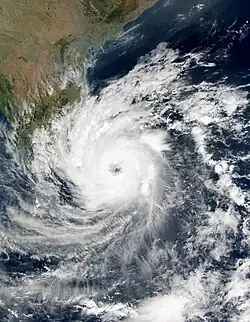
The 2000 Sri Lanka cyclone (IMD designation: BOB 06 JTWC designation: 04B) was the strongest tropical cyclone to strike Sri Lanka since 1978. The fourth tropical storm and the second severe cyclonic storm of the 2000 North Indian Ocean cyclone season, it developed from an area of disturbed weather on December 25, 2000. It moved westward, and quickly strengthened under favorable conditions to reach top wind speeds of 75 mph (121 km/h). The cyclone hit eastern Sri Lanka at peak strength, then weakened slightly while crossing the island before making landfall over southern India on December 28. The storm degenerated into a remnant low later that day, before merging with another trough on the next day.
The storm was the first cyclone over Sri Lanka with winds of at least hurricane strength since a cyclone of 1978 hit the island in the 1978 season, as well as the first tropical storm to hit the island since 1992. The storm was also the first December tropical cyclone of hurricane intensity in the Bay of Bengal since 1996. It produced heavy rainfall and strong winds, damaging or destroying tens of thousands of houses and leaving up to 500,000 homeless. At least nine people died as a result of the cyclone. (Full article...)
Nyctibatrachus major, the Malabar night frog, large wrinkled frog, or Boulenger's narrow-eyed frog, is a species of frog in the family Nyctibatrachidae, commonly known as the robust frogs. It was described in 1882 by the zoologist George Albert Boulenger, and is the type species of the genus Nyctibatrachus. It is a large frog for its genus, with an adult snout–vent length of 31.5–52.0 mm (1.24–2.05 in) for males and 43.7–54.2 mm (1.72–2.13 in) for females. It is mainly brownish to greyish in colour, with a dark greyish-brown upperside, a greyish-white underside, and light grey sides. It also has a variety of grey or brown markings. When preserved in ethanol, it is mostly greyish-brown to grey, with whitish sides. Sexes can be told apart by the presence of the femoral glands (bulbous glands near the inner thigh) in males.
The species is endemic to the Western Ghats mountain range of India, where it is found in Kerala, Tamil Nadu, and Karnataka. Adults inhabit fast-moving forest streams at elevations of up to 900 m (3,000 ft) and have highly specific habitat requirements. Adults are mostly found in or near water and are nocturnal; subadults can be found during both the night and day. Its diet mainly consists of other frogs and insect larvae. Over a period of several days or weeks, females lay multiple small clutches of eggs on leaves and rocks overhanging water; tadpoles drop into the water below on hatching. The species is currently classified as being endangered on the IUCN Red List owing to its small and severely fragmented range and ongoing habitat degradation. Threats to the species include habitat loss, increased human presence near the streams it inhabits, and possibly nitrate pollution caused by fertiliser overuse. (Full article...)
Vidya Balan (pronounced [ʋɪd̪ːja baːlən]; born 1 January 1979) is an Indian actress. Known for pioneering a change in the portrayal of women in Hindi cinema with her roles in female-led films, she is the recipient of several awards, including a National Film Award and seven Filmfare Awards. She was awarded the Padma Shri by the Government of India in 2014. She was invited by the Academy of Motion Picture Arts and Sciences to join the Actors Branch in 2021.
Vidya aspired to a career in film from a young age and had her first acting role in the 1995 sitcom Hum Paanch. While pursuing a master's degree in sociology from the University of Mumbai, she made several unsuccessful attempts to start a career in film, and featured in television commercials and music videos. She made her film debut by starring in the Bengali film Bhalo Theko (2003) and received praise for her first Hindi film, the drama Parineeta (2005). This was followed by several commercial successes including Lage Raho Munna Bhai (2006) and Bhool Bhulaiyaa (2007), but her subsequent roles were met with negative reviews. (Full article...)
Thuggee was a phenomenon of highway robbery in the Indian subcontinent that saw gangs of Thugs murder and rob travellers, often by strangling. During the British colonial era, thuggee was represented and popularised as a secret pan-Indian fraternity of ritual stranglers with ancient origins, motivated by fanaticism and bloodlust. This portrayal has come under intense scholarly criticism beginning in the 1950s, with historical reinterpretations generally contesting the significance of religion to thuggee and viewing the Thugs as more or less ordinary criminals, or thuggee as a type of banditry. There is a general consensus among contemporary historians against the colonial-era representation.
The thuggee phenomenon came to prominence in the early 19th century, during the expansion of Company rule in India. In the 1830s, colonial administrator William Henry Sleeman led a policing campaign against thuggee, supported by legal developments that facilitated convictions. In 1835, the Thuggee Department was formally established to apprehend and prosecute the gangs. Sleeman authored works on thuggee and, together with his colleagues, recorded interviews with approvers which underpinned the colonial-era representation and constitute the vast majority of sources on the phenomenon. Thuggee was portrayed by the colonial authorities as "hereditary criminality" and the campaign served as a precedent for the 1871 Criminal Tribes Act that criminalised itinerant communities. (Full article...)- The 44th Chess Olympiad (28 July – 10 August 2022) was a FIDE-organised international team chess event held in Chennai, the capital of Tamil Nadu, India. It consisted of two main tournaments—an Open event, enabling participation of players from all genders, and a Women's event, enabling participation of female players only—as well as several events to promote chess. The Olympiad was initially supposed to take place in Khanty-Mansiysk, Russia, the host of the Chess World Cup 2019, in August 2020, but it was later moved to Moscow. However, it was postponed due to the COVID-19 pandemic and then relocated to Chennai following Russia's invasion of Ukraine. This was the first Chess Olympiad to take place in India.
The total number of participants was 1,737: 937 in the Open and 800 in the Women's event. The number of registered teams was 188 from 186 nations in the Open section and 162 from 160 nations in the Women's section; being the host nation, India had three teams participating in each section. Both sections set team participation records. The main venue of the Chess Olympiad was the convention centre at the Four Points by Sheraton, while the opening and closing ceremonies were held at the Jawaharlal Nehru Stadium. The Chief Arbiter of the event was France's Laurent Freyd. (Full article...)
Dimple Kapadia (born 8 June 1957) is an Indian actress predominantly appearing in Hindi films. Born and raised in Mumbai by wealthy parents, she aspired to become an actress from a young age and received her first opportunity through her father's efforts to launch her in the film industry. She was discovered at age 14 by the filmmaker Raj Kapoor, who cast her in the title role of his teen romance Bobby (1973), which opened to major commercial success and gained her wide public recognition. Shortly before the film's release in 1973, she married the actor Rajesh Khanna and quit acting. Their daughters, Twinkle and Rinke Khanna, both briefly worked as actresses in their youth. Kapadia returned to films in 1984, two years after her separation from Khanna. Her comeback film Saagar, which was released a year later, revived her career. Both Bobby and Saagar won her Filmfare Awards for Best Actress. Through her work over the next decade, she established herself as one of Hindi cinema's leading actresses.
While her initial roles often relied on her perceived beauty and sex appeal, Kapadia was keen to challenge herself and expand her range. She was among the first actresses who starred in women-centred Hindi action films but found greater favour with critics when she took on more dramatic roles in both mainstream and neorealist parallel cinema. Appearing in films ranging from marital dramas to literary adaptations, she played troubled women sometimes deemed reflective of her personal experience, and received acclaim for her performances in Kaash (1987), Drishti (1990), Lekin... (1991), and Rudaali (1993). For her role as a professional mourner in Rudaali, she won the National Film Award for Best Actress and a Filmfare Critics Award. She also had supporting roles in the crime dramas Prahaar (1991), Angaar (1992), Gardish (1993) and Krantiveer (1994), the latter securing her another Filmfare Award. (Full article...)




Selected pictures
 Al-Ameen College of PharmacyPhoto: Muhammad Mahdi KarimAl-Ameen College of Pharmacy is a pharmacy college in Bangalore, India. Established in 1983, it is under the purview of the Al-Ameen Educational Society.
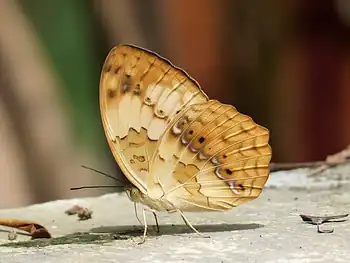 Photograph: JkadavoorCupha erymanthis is a species of brush-footed butterfly found in forested areas of tropical South and Southeast Asia which may feed on liquids from carrion. This specimen was photographed in Kadavoor, Kerala, India.
 Photograph credit: AjoyDutta1997; edited by AristeasDiwali is a five-day Hindu festival of lights which symbolises the spiritual victory of light over darkness and good over evil. It commemorates the day when Hindu god Rama, along with his wife-consort Sita and brother Lakshmana, returned to his kingdom of Ayodhya after defeating demon-king Ravana and following 14 years of exile. Celebrations peak on the night of the third day of the festival—the main day of Diwali, which is today—marking the darkest night of the Hindu lunisolar calendar. People celebrate on this day by lighting traditional lamps (diyas) and candles. Pictured here is a woman lighting candles on Diwali.
 A statue of the Hindu god Shiva as Nataraja, the Lord of Dance. In this form, Shiva performs his divine dance to destroy a weary universe and make preparations for the god Brahma to start the process of creation. A Telugu and Tamil concept, Shiva was first depicted as Nataraja in the famous Chola bronzes and sculptures of Chidambaram. The form is present in most Shiva temples in South India, and is the main deity in Chidambaram Temple, the foremost Shaivist temple.

 Coin design credit: East India Company and the Calcutta Mint; photographed by Andrew ShivaThe mohur is a gold coin that was formerly minted by several governments, including those of British India. It was usually equivalent in value to fifteen silver rupees. Gold mohurs issued by the British East India Company or the Crown are valuable collectors' items, and sell in auctions for high prices. The double mohur (minted between 1835 and 1918), with a value of thirty rupees, is the highest-denomination circulating coin ever issued in India. The 1835 two-mohur coin above was minted in the reign of King William IV, while the 1862 one-mohur coin below was minted in the reign of Queen Victoria; both are now part of the National Numismatic Collection at the National Museum of American History.
 Image credit: Vaikunda RajaThe Lotus-Namam is the symbol of Ayyavazhi, a Dharmic belief system that originated in South India in the 19th century. The lotus represents the 1,008-petalled Sahasrara and the flame-shaped white Namam represents the Aanma Jyothi or ātman, sometimes translated as 'soul' or 'self'. The number of practitioners is estimated to be between 700,000 and 8,000,000, although the exact number is unknown, since Ayyavazhis are reported as Hindus during censuses.
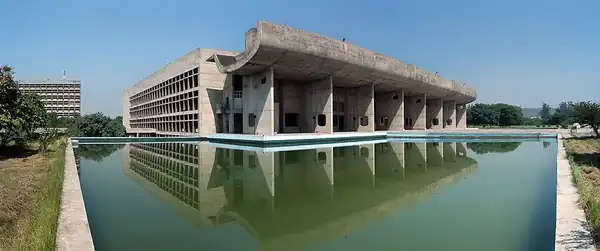 Photograph credit: duncid, retouched by UnpetitproleX and AristeasThe Palace of Assembly in Chandigarh, India, is a legislative assembly building designed by modernist architect Le Corbusier forming part of the Chandigarh Capitol Complex – a larger government compound including several other buildings such as the Secretariat Building and the Palace of Justice. Constructed to serve as the administrative capital for the eastern half of the historic British Indian Punjab province that remained in India after the 1947 partition of India, the compound, along with sixteen other globally scattered buildings designed by Le Corbusier, was designated a World Heritage Site by UNESCO in 2016. The Palace of Assembly houses the legislatures of the present-day northern Indian states of Punjab and Haryana.
 Photograph credit: Charles James SharpThe pied bush chat (Saxicola caprata) is a small passerine bird widely distributed in Asia. The males are black with white shoulder and vent patches, while the females are predominantly brownish. This species is insectivorous, and like other chats hunts from a prominent low perch. This female pied bush chat was photographed in Pench National Park, India.
 Photograph: Muhammad Mahdi KarimMysore Palace, the official residence and seat of the Wodeyars — the rulers of the Kingdom of Mysore. Located in southern India, the kingdom is traditionally believed to have been founded in 1399 as a vassal state to the Vijayanagara Empire before becoming independent in the 16th century.
 Painting: Raja Ravi Varma
 Photograph: Arthur Chapman; edit: Papa Lima Whiskey and Ryan KaldariBrahmaea wallichii, also known as the owl moth, is a moth from the family Brahmaeidae. With a wingspan of about 90–160 mm (3.5–6.3 in), it is one of the largest species of Brahmin moth. This nocturnal species is found in India, Bhutan, Myanmar, China, Taiwan and Japan.
 Photograph credit: Narender9Holi is a popular Indian festival of love and spring. The festival celebrates the eternal and divine love of Radha Krishna, and signifies the triumph of good over evil, as it celebrates the victory of Vishnu over Hiranyakashipu. This photograph depicts the celebration of Lathmar Holi at Radha Rani Temple in Barsana, India, with devotees throwing gulal (coloured powder) at each other as a celebration of love and equality.
 Photograph credit: Charles J. SharpThe Bengal tiger is a population of the tiger subspecies Panthera tigris tigris found in the Indian subcontinent. Ranking among the largest wild cats alive today, it is considered to be one of the world's charismatic megafauna. The tiger is estimated to have been present in the Indian subcontinent since the Late Pleistocene, for about 12,000 to 16,500 years. Today it is threatened by poaching, and habitat loss and fragmentation, and was estimated to comprise fewer than 2,500 wild individuals by 2011. The tiger is the national animal of India. This female Bengal tiger was photographed in Kanha Tiger Reserve, in the Indian state of Madhya Pradesh.
 Photograph credit: Vikramjit KakatiNohkalikai Falls is a 340-foot-tall (100 m) plunge waterfall located in the northeast Indian state of Meghalaya. It is the tallest plunge waterfall in India and is situated near Cherrapunji, one of the wettest places on Earth. Nohkalikai Falls are fed by the rainwater collected on the summit of a relatively small plateau. Below the falls is a plunge pool with water of an unusual shade of green.
 Photograph: Jorge RoyanAn Indian merchant holding green chickpeas (Cicer arietinum). One of the earliest cultivated legumes, chickpeas are ingredients in a number of dishes around the world. India is the largest producer of this nutrient-dense food, accounting for 64% of global production in 2016.
Featured list –

Haasan in 2014
Shruti Haasan is an Indian actress and singer who works in Telugu, Tamil and Hindi films. She started her career as a playback singer at the age of six in the 1992 Tamil film Thevar Magan. She had a brief role in her father, Kamal Haasan's Tamil-Hindi directorial Hey Ram (2000) as a child artist. Haasan's first major appearance was in the Hindi film Luck (2009), in which she played a dual role of a woman avenging her twin sister's death. She played the female lead in the films Anaganaga O Dheerudu and 7 Aum Arivu; both were released in 2011 and together earned her the Best Female Debut – South at the 59th Filmfare Awards South ceremony.
Haasan's subsequent releases Oh My Friend (2011) and 3 (2012) were commercially unsuccessful. The latter earned her a nomination for the Best Actress – Tamil at the 60th Filmfare Awards South ceremony. A turning point came in Haasan's career with Harish Shankar's commercially successful Telugu film Gabbar Singh (2012). The release was followed by a series of successful films such as Balupu (2013) and Yevadu (2014). She received her first Filmfare Award for Best Actress – Telugu for her performance in Race Gurram (2014). (Full article...)
Ajith in 2010
Ajith Kumar is an Indian actor who works mainly in Tamil cinema. Apart from a small role in the 1990 Tamil film En Veedu En Kanavar, his professional career began three years later with his debut as a lead actor in Tamil cinema with Amaravathi (1993). Despite being a moderate success, the film helped him obtain more modelling assignments. He followed it up the same year with Prema Pusthakam, his only Telugu film to date. After Amaravathy's release, Ajith opted against acting, and instead tried pursuing a career in auto racing. While training for an amateur race, he injured his back and underwent three major surgeries, leaving him bed-ridden for a year and a half. After recovering from the injury, he played supporting roles in Paasamalargal (1994) and Pavithra (1994). After this, he co-starred with Vijay in Rajavin Parvaiyile (1995). That same year, he had his breakthrough with the romantic thriller Aasai. His performance earned him critical acclaim and established him as an up-and-coming actor in Tamil cinema.
He was next seen as the main lead in Agathiyan's epistolary Kadhal Kottai (1996), a critical and commercial success. In 1997, he had five releases, all of which were commercial failures. Ajith's dual portrayal of twin brothers—where one is deaf-mute—in S. J. Suryah's Vaalee (1999) won him his first Filmfare Award for Best Tamil Actor. Impressed with his performance in that film, Rajiv Menon cast Ajith in the ensemble drama Kandukondain Kandukondain (2000) which was also commercial and critical success. The following year, he collaborated with debutant director AR Murugadoss on the action film Dheena. The film was successful in establishing his reputation as an action hero and earning him the nickname "Thala" ("leader"). He earned critical acclaim for his dual role performance in the vigilante film Citizen (2001), and the film was commercial success. and a Best Actor nomination at Filmfare for the drama Poovellam Un Vasam (2001). His last release of the year was Santosh Sivan's Hindi film Aśoka, where he played a brief antagonistic role opposite Shah Rukh Khan. His -role performance as twin brothers in K. S. Ravikumar's film Villain (2002) won him a second Filmfare Award for Best Tamil Actor. (Full article...)- Mani Ratnam is an Indian filmmaker who works predominantly in Tamil cinema. Regarded as one of the greatest Indian filmmakers, he is credited with redefining the "range and depth of Tamil cinema". As of 2025, he has directed 29 films, and produced over 15 under his production company Madras Talkies.
Mani Ratnam made his directorial debut, without formal training or education in filmmaking, with the Kannada film Pallavi Anu Pallavi (1983). The critically acclaimed film, which he also wrote, won him the Karnataka State Film Award for Best Screenplay. Then he entered Malayalam film industry with Unaroo, which was based on then prevailing trade union politics. His first Tamil film Pagal Nilavu (1985) was a commercial failure, but immediately followed Idaya Kovil (1985) found theatrical success. The following year, he made the romantic drama Mouna Ragam, which narrated the story of a young woman who is forced into an arranged marriage by her family. The critical and commercial success of the film established him as a leading filmmaker in Tamil cinema. His next release Nayakan, starring Kamal Haasan, was inspired by the life of the Bombay-based gangster Varadarajan Mudaliar. The film was submitted by India as its official entry for the 60th Academy Awards. Later in 2005, Nayakan was included in Time's "All-Time 100 Movies" list. Mani Ratnam followed this with the tragic romance Geethanjali (1989), which marked his Telugu cinema debut; the tragedy Anjali (1990), which narrated the story of an intellectually disabled child; and the crime drama Thalapathi (1991), loosely adapted from the Indian epic Mahabharata. In 1992, he made the romantic thriller Roja for Kavithalayaa Productions. The film was dubbed into many Indian languages, including Hindi, and its widespread success brought national recognition to Mani Ratnam. Three years later, he made Bombay (1995), which was based on the 1992–93 Bombay riots. Although controversial for its depiction of religious riots, the film met with wide critical acclaim and became commercially successful in India. (Full article...)
Ajay Devgn is an Indian actor, director and producer who works in Hindi films. He debuted as an actor in Phool Aur Kaante (1991), which won him the Filmfare Award for Best Male Debut. Devgn then played a kickboxer in the martial arts film Jigar (1992) and a blind in Vijaypath (1994) and starred in Suhaag (1994), Dilwale (1994), Diljale (1996), Jaan (1996), Ishq (1997), Pyaar To Hona Hi Tha (1998), and Hum Dil De Chuke Sanam (1999). He garnered Filmfare Best Actor nominations for Naajayaz and Hum Dil De Chuke Sanam and also won his first National Film Award for Best Actor for his performance in Zakhm (1998). In 2000, Devgn started Ajay Devgn FFilms, producing and headlining the commercially unsuccessful Raju Chacha. He received a Filmfare Best Supporting Actor nomination for enacting a dacoit in the ensemble film Lajja (2001).
2002 proved to be a banner year for Devgn as he received universal acclaim for his performances in Company, The Legend of Bhagat Singh and Deewangee. He won his second National Award for portraying revolutionary Bhagat Singh in The Legend of Bhagat Singh and the Filmfare Critics Award for Best Actor for it and Company, along with a Filmfare Best Villain Award for Deewangee. In 2003, he acted in the Bhoot, a sleeper hit, and played a police officer in Gangaajal, which earned him another Filmfare Best Actor nomination. He was next featured in Yuva (2004), Kaal (2005), and Omkara (2006). Rohit Shetty's Golmaal series established Devgn in comic roles, producing Golmaal (2006), Golmaal Returns (2008) and Golmaal 3 (2010). However Devgn was highly panned for Aag (2007), based on the 1975 cult classic Sholay. Today, it is considered one of the worst films. In 2008, he made his directorial debut with his own production U Me Aur Hum. 2010 proved to be a milestone year for him as he delivered his first 100 Crore Club film with Golmaal 3 and received positive feedback for the top-grossing films Raajneeti and Once Upon a Time in Mumbaai. The latter fetched him a Filmfare Best Actor nomination, as like his next Singham (2011), the first part of Shetty's Cop Universe, which was later reprised in Singham Returns (2014) and briefly in other standalone films of the universe, culminating in Singham Again (2024). (Full article...)
Sourav Ganguly scored 16 centuries in Test matches and 22 in ODIs.
Sourav Ganguly is a former Indian cricketer and captain of the India national cricket team. From his international debut in 1992 to his retirement in 2008, he scored centuries (100 or more runs) on 16 occasions in Test cricket and in 22 One Day International (ODI) matches.
Ganguly scored a century on Test debut, against England in Lord's in June 1996. He became the 10th Indian player to perform the feat, and the third player to score a century on debut at the ground. In the next match at Trent Bridge, he made 136 and became the third batsman to make a century in each of his first two innings. He is eighth in the list of leading Test century makers for India. His highest score of 239—his only double century—was made against Pakistan in 2007 at the M. Chinnaswamy Stadium, Bangalore. He made centuries against all Test-cricket playing nations except South Africa and West Indies. His centuries have been scored in fourteen cricket grounds, including eight outside India. He ended up in the nineties on four occasions—including two scores of 99. (Full article...)
The chief minister of Tamil Nadu is the head of government of the Indian state of Tamil Nadu. In accordance with the Constitution of India, the governor is a state's de jure head, while the de facto authority rests with the chief minister. Following elections to the Tamil Nadu Legislative Assembly, the state's governor usually invites the party (or coalition) with the majority of seats in the assembly to form the government. The governor appoints the chief minister, whose council of ministers are collectively responsible to the assembly. Given that the chief minister has the confidence of the assembly, the chief minister's term is for five years and is subject to no term limits.
Since 1950, Tamil Nadu has had 14 chief ministers. The first four chief ministers belonged to the Indian National Congress, of which K. Kamaraj held the post for the longest, for more than nine years. With the rise of Dravidian parties in the state, C. N. Annadurai of the Dravida Munnetra Kazhagam (DMK) became the first non-Congress chief minister in 1969. Annadurai was from the Tamil film industry, and since his tenure, a significant number of the state's chief ministers have hailed from the industry. (Full article...)
The Kerala State Film Award for Best Actress is an award presented annually at the Kerala State Film Awards of India since 1969 to an actress for the best performance within the Malayalam film industry. Until 1997, the awards were managed directly by the Department of Cultural Affairs, Government of Kerala. Since 1998, the Kerala State Chalachitra Academy, an autonomous non-profit organisation functioning under the Department of Cultural Affairs, has been exercising control over the awards. The awardees, decided by a jury formed by the academy, are declared by the Minister for Cultural Affairs and are presented by the Chief Minister.
The 1st Kerala State Film Awards ceremony was held in 1970 with Sheela receiving the Best Actress award for her role in Kallichellamma (1969). The following year, Sharada was recognised for her performances in two films—Thriveni and Thara. Since then, several actresses have been awarded for more than one film during a year. (Full article...)- The prime minister of India is the chief executive of the Government of India and chair of the Union Council of Ministers. Although the president of India is the constitutional, nominal, and ceremonial head of state, in practice and ordinarily, the executive authority is vested in the prime minister and their chosen Council of Ministers. The prime minister is the leader elected by the party with a majority in the lower house of the Indian parliament, the Lok Sabha, which is the main legislative body in the Republic of India. The prime minister and their cabinet are at all times responsible to the Lok Sabha. The prime minister can be a member of the Lok Sabha or of the Rajya Sabha, the upper house of the parliament. The prime minister ranks third in the order of precedence.
The prime minister is appointed by the president of India; however, the prime minister has to enjoy the confidence of the majority of Lok Sabha members, who are directly elected every five years, unless a prime minister resigns. The prime minister is the presiding member of the Council of Ministers of the Union government. The prime minister unilaterally controls the selection and dismissal of members of the council; and allocation of posts to members within the government. This council, which is collectively responsible to the Lok Sabha as per Article 75(3), assists the president regarding the operations under the latter's powers; however, by the virtue of Article 74 of the Constitution, such 'aid and advice' tendered by the council is binding. (Full article...) 
Rabindranath Tagore was the first Indian and also the first non-European and the first Asian to be awarded with the Nobel Prize. He received the prize for Literature in 1913.
The Nobel Prize is a set of annual international awards bestowed on "those who conferred the greatest benefit on humankind" in the fields of Physics, Chemistry, Physiology or Medicine, Literature, Peace and Economic Sciences, instituted by Alfred Nobel's last will, which specified that a part of his fortune be used to create the prizes. Each laureate (recipient) receives a gold medal, a diploma and a sum of money, which is decided annually by the Nobel Foundation. The Royal Swedish Academy of Sciences awards the Nobel Prize in Physics, the Nobel Prize in Chemistry and the Sveriges Riksbank Prize in Economic Sciences in Memory of Alfred Nobel; the Nobel Assembly at the Karolinska Institute awards the Nobel Prize in Physiology or Medicine; the Swedish Academy awards the Nobel Prize in Literature; and the Norwegian Nobel Committee awards the Nobel Peace Prize. They are widely recognised as one of the most prestigious honours awarded in the aforementioned fields.
First instituted in 1901, the Nobel Prize has been awarded to a total of 989 individuals (930 men and 59 women) and 30 organisations as of 2022. Among the recipients, 12 are Indians of which 5 are Indian citizens and 7 are of Indian ancestry or residency. Rabindranath Tagore was the first Indian citizen to be awarded and also the first non-European and the first Asian to be awarded in 1913. Mother Teresa is the only woman among the list of recipients. Sri Aurobindo, the Indian poet, philosopher, nationalist and developer of Integral yoga, was nominated unsuccessfully for the Nobel Prize in Literature in 1943 and for the Nobel Peace Prize in 1950. (Full article...)
Mersal (transl. Zapped) is a 2017 Indian vigilante action film directed by Atlee Kumar, who co-wrote the screenplay with V. Vijayendra Prasad and S. Ramana Girivasan. Produced by N. Ramasamy and Hema Rukmani under the banner of Thenandal Studio Limited, Mersal features Vijay in triple roles for the first time in his career. Nithya Menen, S. J. Surya, Kajal Aggarwal and Samantha Akkineni play the other lead roles while Vadivelu, Kovai Sarala and Sathyaraj feature as supporting characters. A. R. Rahman composed the film's soundtrack, while also handling the background score along with Qutub-E-Kripa. Ruben and G. K. Vishnu were in charge of the editing and cinematography respectively. The film follows two brothers, Vetri (Vijay), a renowned magician, and Maaran (Vijay), a doctor who charges meagre amounts for his patients, who try to expose the corrupt dealings and medical crimes of another doctor, Daniel Arockiaraj (Surya), who also happens to be the same person that killed their parents, Vetrimaaran (Vijay) and Aishwarya (Menen).
Produced on a budget of ₹1.2 billion (about US$17.5 million in 2017), Mersal was released on 18 October 2017 and received positive reviews. It was also a commercial success, grossing ₹2.6 billion (about US$39.3 million in 2017) worldwide. The film won 35 awards from 57 nominations; its direction, screenplay, music and Vijay's performances received the most attention from award groups. (Full article...)
Karan Johar, the son of founder Yash Johar, has directed seven films for Dharma Productions, as of 2023
Dharma Productions is an Indian production company established by Yash Johar in 1976. As of 2024, the company has produced 63 Hindi films, including three that have yet to be released. A large number of the films were co-produced with companies such as Red Chillies Entertainment, Star Studios, Zee Studios and Viacom18 Studios. In addition, Dharma Productions has presented ten other-Indian language films from other companies. The most frequent collaborations of the company have been with the actors Alia Bhatt, Shah Rukh Khan, Sidharth Malhotra, Kareena Kapoor Khan, Amitabh Bachchan, Ranbir Kapoor, Kajol, Varun Dhawan and Sanjay Dutt.
Dharma Productions' first release came in 1980 with the Raj Khosla–directed Dostana, starring Amitabh Bachchan, Shatrughan Sinha and Zeenat Aman, which was a commercial success. However, their subsequent releases, Duniya (1984) and Muqaddar Ka Faisla (1987) performed poorly at the box office. Their first release of the 1990s, the Bachchan-starring thriller Agneepath (1990) garnered critical acclaim but was a commercial failure. The company's next releases were the thriller Gumrah (1993) and the comedy Duplicate (1998), both directed by Mahesh Bhatt. In 1998, Yash Johar's son, Karan Johar made his directorial debut with the romantic drama Kuch Kuch Hota Hai, starring Shah Rukh Khan, Kajol, Rani Mukerji and Salman Khan. The film was the highest-grossing Bollywood film of 1998, and established Dharma Productions as a leading production company in India. Their subsequent releases, the ensemble family drama Kabhi Khushi Kabhie Gham (2001), and the romantic comedy-drama Kal Ho Naa Ho (2003) and the musical romantic drama Kabhi Alvida Naa Kehna (2006), all starring Shah Rukh Khan, were top-grossing Hindi films in domestic and overseas markets. (Full article...)
The Padma Vibhushan is the second highest civilian award of the Republic of India. Instituted on 2 January 1954, the award is given for the "exceptional and distinguished service", without distinction of race, occupation, position, or sex. The Padma Vibhushan award recipients are announced every year on Republic Day and registered in The Gazette of India—a publication released weekly by the Department of Publication, Ministry of Urban Development used for official government notices. The conferral of the award is not considered official without its publication in the Gazette. Recipients whose awards have been revoked or restored, both of which require the authority of the President, are also registered in the Gazette and are required to surrender their medals when their names are struck from the register. As of 2020, none of the conferments of Padma Vibhushan have been revoked or restored. The recommendations are received from all the state and the union territory governments, the Ministries of the Government, the Bharat Ratna and previous Padma Vibhushan award recipients, the Institutes of Excellence, the Ministers, the Chief Ministers and the Governors of State, and the Members of Parliament including private individuals. The recommendations received during 1 May and 15 September of every year are submitted to the Padma Awards Committee, constituted by the Prime Minister. The committee recommendations are later submitted to the Prime Minister and the President for the further approval.
When instituted in 1954, the Padma Vibhushan was classified as "Pahla Varg" (Class I) under the three-tier Padma Vibhushan awards; preceded by the Bharat Ratna, the highest civilian award, and followed by "Dusra Varg" (Class II), and "Tisra Varg" (Class III). On 15 January 1955, the Padma Vibhushan was reclassified into three different awards; the Padma Vibhushan, the highest of the three, followed by the Padma Bhushan and the Padma Shri. The criteria includes "exceptional and distinguished service in any field including service rendered by Government servants" but excluding those working with the Public sector undertakings with the exception of doctors and scientists. The 1954 statutes did not allow posthumous awards but this was subsequently modified in the January 1955 statute. The award, along with other personal civil honours, was briefly suspended twice in its history; for the first time in July 1977 when Morarji Desai was sworn in as the fourth Prime Minister. The suspension was rescinded on 25 January 1980, after Indira Gandhi became the Prime Minister. The civilian awards were suspended again in mid-1992, when two Public-Interest Litigations were filed in the High Courts questioning the civilian awards being "Titles" per an interpretation of Article 18 (1) of the Constitution. The awards were reintroduced by the Supreme Court in December 1995, following the conclusion of the litigation. (Full article...)
Virat Kohli is one of only two players to score 4 IPL centuries in a single season. He is also one of four players to score IPL centuries in back-to-back innings, and has the most IPL centuries with 9.
In cricket, a batter reaches a century when he scores 100 runs or more in a single innings. A century is regarded as a landmark score for a batter, and his number of centuries is generally recorded in his career statistics. The Indian Premier League (IPL) is a professional league for Twenty20 cricket in India, which has been held annually since its first edition in 2008. Till date, 124 centuries have been scored by 63 different batsmen, out of which 32 are Indian players and 31 are overseas players. Players from 12 of the 15 franchises have scored centuries, with the three franchises that have not had a player score a century for them being Pune Warriors India, Kochi Tuskers Kerala and Gujarat Lions.
The first century in the league's history was scored in the inaugural match itself on 18 April 2008 at M. Chinnaswamy Stadium, Bangalore by Brendon McCullum for Kolkata Knight Riders against Royal Challengers Bangalore, scoring 158*, which is also one of the only three 150+ scores by individual batsmen in the league's history till date. The highest score in the competition was made by Chris Gayle, who scored 175* for Royal Challengers Bangalore against Pune Warriors India. In the same game, he scored the fastest century in terms of number of balls faced, scoring 100 runs in 30 deliveries. The slowest century was jointly scored by Manish Pandey and Virat Kohli, both for Royal Challengers Bengaluru, reaching the milestone in 67 deliveries. (Full article...)
Districts of West Bengal
The West Bengal is an Indian state located in eastern portion of the country. As of year 2026, the state is divided into 27 districts and 5 administrative divisions.
The Himalayas lies in the north of West Bengal and the Bay of Bengal is at the south. Between them, the river Ganga flows eastwards and its main distributary, the Hooghly River, flows south to reach the Bay of Bengal. The Siliguri Corridor, which connects North-East India with rest of the India, lies in the North Bengal region of the state. Geographically, West Bengal is divided into a variety of regions—Darjeeling Himalayan hill region, Terai and Dooars region, North Bengal plains, Rarh region, Western plateau and high lands, coastal plains, Sundarbans and the Ganga Delta. (Full article...)- Aadukalam (transl. Arena) is a 2011 Indian Tamil-language drama film written and directed by Vetrimaaran and produced by S. Kathiresan. Vetrimaaran co-wrote the dialogues with Vikram Sugumaran. The film stars Dhanush and Taapsee Pannu with Kishore, V. I. S. Jayapalan, Naren, and Murugadoss playing supporting roles. The musical score was composed by G. V. Prakash Kumar while the cinematography and editing were respectively handled by Velraj and Kishore Te. The film's story revolves around Karuppu who is the understudy of an experienced cockfighter, Pettaikaran. When Karuppu wins in a cockfight against Pettaikaran's rival Rathnasamy, Pettaikaran, who is initially happy, becomes jealous of Karuppu's newfound popularity and plots his downfall.
Produced on a budget of ₹150-200 million, Aadukalam was released on 14 January 2011 and grossed ₹300 million according to a February 2011 report by The Economic Times. The film garnered awards and nominations in several categories, with particular praise for its direction, screenplay, Dhanush's performance, music, cinematography, and editing. The film has won 33 awards from 52 nominations. (Full article...) - In cricket, a batsman reaches a triple century if they score 300 or more runs in a single innings. The Ranji Trophy is the premier first-class cricket championship played in India. Conducted by the Board of Control for Cricket in India, it was founded in 1934 as "The Cricket Championship of India". As of January 2020, a triple century has been scored on 46 occasions by 41 different batsmen in the Ranji Trophy.
The first triple century in the Ranji Trophy was scored by Maharashtra's Vijay Hazare against Baroda in the 1939–40 season. As of November January 2023, the most recent triple century in the tournament was scored by Prithvi Shaw from Mumbai, who made 379 against Assam in the 2022–23 season. The highest score in the competition was made by B. B. Nimbalkar, who scored 443 runs not out for Maharashtra against Kathiawar in the 1948–49 season. It is the only instance of a quadruple century in the tournament. The highest number of triple centuries are scored by Ravindra Jadeja, who has reached the milestone three times while playing for Saurashtra. Jadeja is followed by V. V. S. Laxman, Cheteshwar Pujara, and Wasim Jaffer, with two triple centuries each. Tamil Nadu's Woorkeri Raman and Arjan Kripal Singh are the only two batsmen to score triple centuries in the same innings. As of December 2016, five batsmen have scored 290–299 runs in an innings, and three of them were not out. (Full article...) 
Map showing the Indian Princely states during the rebellion of 1857
The Victoria Cross (VC) was introduced in Great Britain on 29 January 1856 by Queen Victoria to reward acts of valour during the Crimean War. For the Indian Mutiny (also known as India's First War of Independence, Revolt of 1857, or the Sepoy Mutiny) the VC was awarded to 182 members of the British Armed Forces, the Honourable East Indies Company (HEIC) and civilians under its command. The VC is the highest British honour and is awarded for valour "in the face of the enemy". Created in 1856 for the British Army and Royal Navy, eligibility was extended in 1857 to members of the HEIC and in 1858 to non-military personnel bearing arms as volunteers.
Queen Victoria created the tradition of the British monarch presenting the VC to the recipient, personally presenting 74 of the 111 awards for the Crimean War. Many VCs for the Indian Mutiny were sent to India for presentation and while there is documentation for 42 presentations, the information on 51 presentations which were likely presented in India is vague and it not known if the medal was personally presented or received by post. There were 18 Indian Mutiny VCs sent to next of kin where the award was posthumous, or the recipient died before presentation. The Queen personally presented 63 Indian Mutiny awards after the recipients returned to the UK. (Full article...)- The J. C. Daniel Award is the highest award in Malayalam cinema, established by the Government of Kerala, India. It is presented annually by the Kerala State Chalachitra Academy, a non-profit autonomous institution operating under the Department of Cultural Affairs, Kerala. Instituted in 1992, the award recognizes individuals for their "outstanding contributions to Malayalam cinema". Recipients are selected by a jury suggested by the Kerala State Chalachitra Academy and appointed by the Department of Cultural Affairs. As of 2021, the honourees receive a statuette, a citation, and a cash prize of ₹500,000 (US$5,200). They are honoured at the Kerala State Film Awards ceremony.
The Government of Kerala created the award to commemorate the contribution of Indian filmmaker J. C. Daniel, who is often regarded as the "father of Malayalam cinema". The J. C. Daniel Award was managed by the Department of Cultural Affairs until 1997. In 1998, the Government of Kerala constituted the Kerala State Chalachitra Academy, and since that year, the Academy has hosted the award. A cash prize of ₹50,000 (US$520) was granted with the award until 2002. In 2003, the prize money was doubled and, as part of a technical correction to update it, no award was presented that year. Actor Madhu was the first recipient of the award with the increased monetary prize of ₹100,000 (US$1,000) in 2004. Since 2016, the cash prize is ₹500,000 (US$5,200). (Full article...) - The Kerala State Film Award for Best Director is an honour presented annually at the Kerala State Film Awards of India since 1969. It is given to a film director who has exhibited outstanding direction while working in the Malayalam film industry. Until 1997, the awards were managed directly by the Department of Cultural Affairs of the Government of Kerala. Since 1998, the Kerala State Chalachitra Academy, an autonomous non-profit organisation functioning under the Department of Cultural Affairs, has been exercising control over the awards. The recipients are decided by an independent jury formed by the academy. They are declared by the Minister for Cultural Affairs and are presented by the Chief Minister.
The first Kerala State Film Awards ceremony was held in 1970 with cinematographer-director A. Vincent receiving the Best Director award for his work in Nadhi (1969). Throughout the years, accounting for ties and repeat winners, the Government of Kerala has presented a total of 50 best director awards to 25 different filmmakers. The recipients receive a figurine, a certificate, and a cash prize of ₹2 lakh (US$2,100). (Full article...) 
The Victoria Cross
The Victoria Cross (VC) was awarded to 153 members of the British Indian Army and civilians under its command, from 1857 until independence in 1947. The Victoria Cross is a military decoration awarded for valour "in the face of the enemy" to members of armed forces of some Commonwealth countries and previous British Empire territories. It takes precedence over all other Orders, decorations and medals. It may be awarded to a person of any rank in any service and to civilians under military command. The VC is traditionally presented to the recipient by the British monarch during an investiture at Buckingham Palace, though in a large number of cases this was not possible and it was presented in the field by a prominent civil or military official. The VC was introduced in Great Britain on 29 January 1856 by Queen Victoria to reward acts of valour during the Crimean War.
Indian troops were not originally eligible for the VC, because since 1837 they had been eligible for the Indian Order of Merit—the oldest British gallantry award for general issue. When the VC was created, Indian troops were still controlled by the British East India Company, and did not come under Crown control until 1860. European officers and men serving with the East India Company were not eligible for the Indian Order of Merit; the VC was extended to cover them in October 1857. It was only at the end of the 19th century that calls for Indian troops to be awarded the VC intensified. Indian troops became eligible for the award in 1911. The first awards to Indian troops appeared in The London Gazette on 7 December 1914 to Darwan Singh Negi and Khudadad Khan, whose gallantry on 31 October 1914 was nearly a month earlier than Negi's gallantry on 24/25 November. Negi was presented with the VC by King George V two days earlier, on 5 December 1914, during a visit to troops in France. He is one of a small number of soldiers presented with his award before it appeared in the London Gazette. (Full article...)- Thondimuthalum Driksakshiyum is a 2017 Indian Malayalam-language thriller-drama film directed by Dileesh Pothan. The film stars Fahadh Faasil, Suraj Venjaramoodu, Nimisha Sajayan, Alencier Ley Lopez, Vettukili Prakash, and Sibi Thomas. It was written by Sajeev Pazhoor along with Syam Pushkaran who was also creative director. Bijibal composed the music while Rajeev Ravi handled the cinematography.
Produced on a budget of ₹65 million, Thondimuthalum Driksakshiyum was released on 30 June 2017 and grossed ₹175 million in Kerala. The film was cited as one of the "Top 5 Malayalam movies in 2017" and "The 25 best Malayalam films of the decade" by The Hindu. The film garnered awards and nominations in several categories, with particular praise for its direction, screenplay and Fahadh's performance. The film won 36 awards from 45 nominations. (Full article...) - The National Film Award for Best Actress in a Supporting Role is an honour presented annually at India's National Film Awards ceremony by the National Film Development Corporation of India (NFDC), an organisation set up by the Indian Ministry of Information and Broadcasting. Since 1984, the award is given by a national panel appointed annually by the NFDC to an actress for the best performance in a supporting role within Indian cinema. It is presented by the President of India at a ceremony held in New Delhi. Since the 70th National Film Awards, the name was changed to "Best Actress in a Supporting Role".
The winner is given a "Rajat Kamal" (Silver Lotus) certificate and a cash prize of ₹2,00,000. Including ties and repeat winners, the NFDC has presented a total of 41 Best Supporting Actress awards to 35 different actresses. Although Indian cinema produces films in more than 20 languages, the performances of films that have won awards are of 11 languages: Hindi (20 awards), Malayalam (8 awards), Bengali (4 awards), Tamil (4 awards), English (2 awards), Gujarati (1 award), Haryanvi (1 award), Marathi (1 award), Meitei (1 award), Odia (1 award) and Urdu (1 award). (Full article...) 
Population Estimates of India (2024)
India is a union consisting of 28 states and 8 union territories. As of 2026, with an estimated population of 1.47 billion, India is the world's most populous country. India occupies 2.4% of the world's area and is home to 17.5% of the world's population. The Indo-Gangetic Plain has one of the world's biggest stretches of fertile not-deep alluvium and are among the most densely populated areas of the world. The eastern and western coastal regions of Deccan Plateau are also densely populated regions of India. The Thar Desert in western Rajasthan is one of the most densely populated deserts in the world. The northern and north-eastern states along the Himalayas contain cold arid deserts with fertile valleys. These states have relatively low population density due to indomitable physical barriers. (Full article...)
Kumar in 2012
Akshay Kumar is an Indian actor, television presenter, and film producer who works in Hindi-language films. He had a minor role in the 1987 Indian film Aaj. He debuted in a leading role with the film Saugandh (1991) before his breakthrough with Khiladi (1992), first film of the Khiladi series. In 1994, Kumar featured in the successful releases Elaan, Mohra, Main Khiladi Tu Anari, Suhaag and the romantic drama Yeh Dillagi, which earned him a Filmfare Award for Best Actor nomination. He also found success with Khiladiyon Ka Khiladi (1996) and Dil To Pagal Hai (1997), which earned him a Filmfare Award for Best Supporting Actor nomination. However, several other of his 1990s releases performed poorly at the box office, leading to a brief setback in his film career.
The 1999 psychological thriller Sangharsh (1999) and crime drama Jaanwar (1999) marked Kumar's comeback. His next films Hera Pheri (2000), Dhadkan (2000) and Ajnabee (2001) were well received. He played a negative role in the latter, winning the Filmfare Best Villain Award and then appeared in Andaaz (2003), Aitraaz (2004), Khakee (2004) and Aan: Men at Work (2004) and Waqt (2005). In this period, Kumar also proved himself as a great comic actor when he featured in financially successful comedies like Mujhse Shaadi Karogi (2004), Garam Masala (2005), Bhagam Bhag (2006), Phir Hera Pheri (2006), Namastey London (2007), Heyy Babyy (2007), Welcome (2007), Bhool Bhulaiyaa (2007), Singh Is Kinng (2008), Housefull (2010) and Tees Maar Khan (2010). He won the Filmfare Best Comedian Award for Garam Masala. In 2004, he presented the television series Seven Deadly Arts with Akshay Kumar. In 2008, he founded the Hari Om Entertainment production company, and hosted the reality shows Fear Factor: Khatron Ke Khiladi and MasterChef India in 2010. In 2011 he founded another production company Grazing Goat Pictures, and produced the Indo-Canadian hockey-based film Breakaway, which became the highest grossing cross-cultural film at the Canadian box office. (Full article...)- The state president of the Indian National Congress is the state-level highest command of the Indian National Congress (INC), responsible for leading in political campaigns at state level. State presidents shoulder a diverse array of roles and responsibilities integral to the effective functioning of the party at the state-level. Also known as the leader of the state and union territory party, a state president is appointed by the national president of the party.
Being the higher decision-making body, state presidents actively contribute to the formulation of state-level policies, representing the party's stance on relevant issues and engaging in the development and implementation of election strategies during state elections. In addition, a state president is tasked with overseeing the organizational structure of the Pradesh Congress Committee, including the appointment and coordination of leaders at various levels, such as the district committee, block committee, and each panchayat development block or panchayat samiti. Serving as a spokesperson for the party in the state, they communicate the party's positions to the media and keep party members informed about policies and decisions. State presidents also play a pivotal role in building and maintaining the party's membership, reaching out to diverse sections of society and addressing their concerns to advance the party's agenda. (Full article...)


 Good article –

Russell's viper (Daboia russelii) is a species of highly venomous snake in the family Viperidae. The species is native to South Asia. It was described in 1797 by George Shaw and Frederick Polydore Nodder. It is named after Patrick Russell. Known for its extremely painful bite, it is considered one of the "Big Four" venomous snake species in the region. (Full article...)
Vicky Kaushal (pronounced [ˈʋɪkːi ˈkɔːʃəl]; born 16 May 1988) is an Indian actor who works in Hindi films. He is the recipient of several accolades, including a National Film Award and three Filmfare Awards, and has appeared in Forbes India's Celebrity 100 list of 2019.
After graduating with an engineering degree from Rajiv Gandhi Institute of Technology, Kaushal began his career by assisting Anurag Kashyap in the crime drama Gangs of Wasseypur (2012) and played minor roles in films. His first leading role was in the independent drama Masaan (2015), following which he starred in Kashyap's psychological thriller Raman Raghav 2.0 (2016). Kaushal gained wider recognition in 2018 with supporting roles in the top-grossing dramas Raazi and Sanju, winning the Filmfare Award for Best Supporting Actor for the latter. (Full article...)
Boroline is an over-the-counter antiseptic cream sold in India by G. D. Pharmaceuticals. The cream is marketed as a natural and ayurvedic solution for various skin issues such as cuts, cracked lips, rough skin, and infections.
The product traces its origins to the Swadeshi movement prevalent in India in the 1920s. First produced in 1929 by Gour Mohan Dutta, the product gained popularity since it was one of the first antiseptic creams to be made in India. Dutta strategically marketed Boroline as a reflection of Bengali culture, tapping into nationalistic sentiments. The packaging of the cream in green tubes featuring an elephant logo allowed it to be easily identified by consumers, especially those in rural areas. Post-independence, the company faced competition but adapted through branding and marketing efforts, including event sponsorship. Despite challenges such as production halts, Boroline is still in circulation as of 2024, and the brand accounted for over 60% of the parent company's revenue in 2016. It maintains a significant presence in Bengali culture and is known to evoke a sense of nostalgia amongst members of the community. (Full article...)
The Western Ghats, also known as the Sahyadri, is a mountain range that stretches 1,600 km (1,000 mi) along the west coast of India. Covering an area of 160,000 km2 (62,000 mi2), it traverses the Indian states of Gujarat, Maharashtra, Goa, Karnataka, Kerala, and Tamil Nadu. The range forms an almost continuous chain of mountains along the western edge of the Deccan Plateau, from the Tapti River to Swamithoppe in Kanyakumari district at the southern tip of the Indian peninsula. The Western Ghats meet with the Eastern Ghats at Nilgiris before continuing south.
Geologic evidence indicates that the mountains were formed during the break-up of the supercontinent of Gondwana. The mountains arose along the west coast of India somewhere in the late Jurassic and early Cretaceous periods when India separated from the African continent. The mountains can be roughly divided into three parts: the northern section with an elevation ranging from 900–1,500 m (3,000–4,900 ft), the middle section starting south of Goa with a lower elevation of less than 900 m (3,000 ft), and the southern section where the altitude rises again. The Western Ghats have several peaks that rise above 2,000 m (6,600 ft), with Anamudi (2,695 m (8,842 ft)) being the highest peak. The average elevation is around 1,200 m (3,900 ft). (Full article...)- The Jungle Book is a 1967 American animated musical adventure film produced by Walt Disney Productions and released by Buena Vista Distribution. Based on the "Mowgli" stories from Rudyard Kipling's 1894 book of the same name, it is the final animated feature film to be produced by Walt Disney, who died during its production. It was directed by Wolfgang Reitherman and written by Larry Clemmons, Ralph Wright, Ken Anderson, and Vance Gerry. Featuring the voices of Phil Harris, Sebastian Cabot, Louis Prima, George Sanders, and Sterling Holloway, the film's plot follows Mowgli, a feral child raised in the Indian jungle by wolves, as his friends, Bagheera the panther and Baloo the bear, try to convince him to leave the jungle before the ruthless tiger Shere Khan arrives.
The early versions of both the screenplay and the soundtrack followed Kipling's work more closely, with a dramatic, dark, and sinister tone, which Disney did not want in his family film, leading to writer Bill Peet and songwriter Terry Gilkyson being replaced. (Full article...)
Rohit Gurunath Sharma (born 30 April 1987) is an Indian international cricketer and the former captain of the India national cricket team in all formats of the game. He is a right-handed top-order batter. He represents Mumbai in domestic cricket and Mumbai Indians in the Indian Premier League. Sharma was a member of the teams that won the 2007 T20 World Cup, the 2013 ICC Champions Trophy and was the winning captain of the 2024 T20 World Cup and the 2025 ICC Champions Trophy. Sharma is acknowledged as one of the greatest opening batsmen of India in ODI format.
Sharma holds several batting records which include most runs in T20 Internationals, most sixes in international cricket, most double centuries in ODI cricket (3), most centuries at Cricket World Cups (7) and joint most hundreds in Twenty20 Internationals (5). He also holds the world record for the highest individual score (264) in a One Day International (ODI) and also holds the record for scoring most hundreds (five) in a single Cricket World Cup, for which he won the ICC Men's ODI Cricketer of the Year award in 2019. He is the first and only captain to lead a team in all ICC tournament finals. (Full article...)- Nayak: The Real Hero (/nɑːjək/ transl. Hero) is a 2001 Indian Hindi-language political thriller film co-written and directed by Shankar (in his Bollywood debut) and produced by A. M. Rathnam under the Sri Surya Movies banner. The film stars Anil Kapoor, with Rani Mukerji, Amrish Puri, Paresh Rawal, and Johnny Lever playing supporting roles. A remake of Shankar's 1999 Tamil-language film Mudhalvan, it focuses on Shivaji Rao (Kapoor), a television cameraman and, later, television presenter, who accidentally hears and records a conversation between the police and the Chief Minister of Maharashtra Balraj Chauhan. While interviewing Chauhan about the issues, Shivaji is challenged to take over the chief minister's job for a day.
Nayak was announced in June 2000 and marked the first Hindi-language directorial venture of Shankar. The soundtrack was composed by A. R. Rahman, with lyrics that were written by Anand Bakshi. Filming was done by K. V. Anand, taking place in more than 100 locations across India. (Full article...) 
Idries Shah (/ˈɪdrɪs ˈʃɑː/; Hindi: इदरीस शाह, Urdu: ادریس شاه; 16 June 1924 – 23 November 1996), also known as Idris Shah, Indries Shah, né Sayed Idries el-Hashimi (Arabic: سيد إدريس هاشمي) and by the pen name Arkon Daraul, was an Afghan author, thinker and teacher in the Sufi tradition. Shah wrote over three dozen books on topics ranging from psychology and spirituality to travelogues and culture studies.
Born in British India, the descendant of a family of Afghan nobles on his father's side and a Scottish mother, Shah grew up mainly in England. His early writings centred on magic and witchcraft. In 1960 he established a publishing house, Octagon Press, producing translations of Sufi classics as well as titles of his own. His seminal work was The Sufis, which appeared in 1964 and was well received internationally. In 1965, Shah founded the Institute for Cultural Research, a London-based educational charity devoted to the study of human behaviour and culture. A similar organisation, the Institute for the Study of Human Knowledge (ISHK), was established in the United States under the directorship of Stanford University psychology professor Robert Ornstein, whom Shah appointed as his deputy in the U.S. (Full article...)- Full Circle: Carnegie Hall 2000 is a live album by Indian musician and composer Ravi Shankar, released in 2001 through the record label Angel Records. Recorded at Carnegie Hall in October 2000 as part of a tour with Shankar's daughter Anoushka, the album contains five tracks and presents two ragas. The concert occurred sixty-two years after Shankar's first performance at Carnegie Hall and commemorated his eightieth birthday; the album was his first live recording in nearly twenty years. Full Circle was produced by Hans Wendl, mastered by Scott Hull, and mixed and engineered by Tom Lazarus. Featured are performances by Tanmoy Bose and Bickram Ghosh on tabla, and Anoushka and Ravi on sitar.
In 2001, the album peaked at ninth position on Billboard's Top World Music Albums chart and earned Shankar the Grammy Award for Best World Music Album. (Full article...) - Mozaffar-Hosayn Mirza (Persian: مظفر حسین میرزا; 1563–1600) was an Iranian nobleman from the Safavid dynasty that held the governorship of Qandahar from 1578 until his defection to India in 1595. His rule was characterized by his constant conflict with his younger brother, Rustam Mirza, and his regent, Kur Hamza Beg. In 1593, he killed Hamza Beg and captured Rustam's lands. He was then faced with raids from the Uzbek of Bukhara and the Mughal emperor Akbar wanting to conquer Qandahar. Unable to drive the Uzbeks away, he surrendered Qandahar to Akbar and defected to India. He was honoured greatly by Akbar and his daughter, Kandahari Begum, was married to Akbar's grandson, the future Shah Jahan. His son and grandson became high-ranking officials in the Mughal bureaucracy. (Full article...)
- Maheshinte Prathikaaram (transl. Mahesh's Revenge) is a 2016 Indian Malayalam-language comedy drama film directed by Dileesh Pothan, in his directorial debut, and produced by Aashiq Abu. The film stars Fahadh Faasil in the title role alongside a supporting cast including Aparna Balamurali, Anusree, Alencier Ley Lopez and Soubin Shahir. Written by Syam Pushkaran, the story is based on an incident in the life of Thampan Purushan from Thuravoor, Cherthala. Shyju Khalid was the film's cinematographer, and Bijibal composed the music.
Maheshinte Prathikaaram's development began in 2013 when Pothan was working as an associate director for Abu on Idukki Gold, co-written by Syam. Syam suggested a story idea to Pothan based on an incident in his native village. At Pothan's insistence, Syam wrote the screenplay that year and Abu later became interested in producing the film. Production was scheduled to commence from December 2014 after completing the casting process but, scheduling conflicts led to its postponement to August 2015. Principal photography began in early August in Idukki at nearby locations, where it was predominantly filmed. Shooting was completed in late October. (Full article...)
Mysore Airport (IATA: MYQ, ICAO: VOMY), also known as Mandakalli Airport, is a domestic airport serving Mysore in Karnataka, India. It is located eight kilometres (5 mi) south of the city in the village of Mandakalli and is owned and operated by the Airports Authority of India. The Princely State of Mysore constructed it in 1940. The airport was later refurbished and inaugurated in May 2010. (Full article...)- King of Bollywood is a biography by the film critic and journalist Anupama Chopra, chronicling the life and career of Shah Rukh Khan. The book describes his personal life such as his birth in 1965 in New Delhi and his marriage to Gauri Chibber in 1991. The book also outlines his career as an actor, film producer, and television presenter. It was published by Grand Central Publishing on 9 August 2007 and became a commercial success. Its critical reception was positive, with Chopra's writing garnering appreciation.
Chopra came up the idea of the book while writing for Dilwale Dulhania Le Jayenge (2002), about the 1995 film of the same name. In the summer of 2003, she told him about the project; although his initial reaction was reluctant, Chopra tried to persuade him for around six months and Khan eventually changed his mind. The book took three years to complete, with Chopra meeting Khan's close friends, school teachers, and collaborators in her writing process. (Full article...) 
Indian captain Talimeren Ao (right) and French captain Gaby Robert (left) shaking hands before Swedish referee Gunnar Dahlner prior to the commencement of India's first Olympic match on 31 July 1948 against France.
Football was first introduced as an Olympic sports at the Summer Olympic Games held in France in 1900. It was played by only three club teams from three nations as an exhibition sport and played again at the 1904 Games. National sides played for the first time at the 1908 Summer Olympics. India did not send a football side to the Olympics until the 1948 Games; it participated in the next three Games. An Indian team last participated in the 1960 Games. India's best appearance was at the 1956 Summer Olympics where its team reached the semi-finals. Beginning with the 1992 Summer Olympics, the rules were changed so that only under-23 national teams are allowed to compete in the Games. India's U-23 national team has yet to qualify for the Olympic football competition. (Full article...)
Junagarh Fort is a fort in the city of Bikaner, Rajasthan, India. The fort was originally called Chintamani and was renamed Junagarh or "Old Fort" in the early 20th century when the ruling family moved to Lalgarh Palace outside the fort limits. Members of the cadet branch of the royal family continued to reside in the fort. It is one of the few major forts in Rajasthan which is not built on a hilltop. The modern city of Bikaner has developed around the fort.
The fort complex was built under the supervision of Karan Chand, the Prime Minister of Raja Rai Singh, the sixth ruler of Bikaner, who ruled from 1571 to 1611 AD. Construction of the walls and the associated moat commenced in 1589 and was completed in 1594. It was built outside the original fort of the city (the first fort built by Rao Bikaji), about 1.5 kilometres (0.93 mi) from the city centre. Some remnants of the old fort are preserved near the Lakshmi Narayan temple. (Full article...)- Sridevi: The Eternal Screen Goddess is a biography by author and screenwriter Satyarth Nayak that chronicles the life and career of Indian actress Sridevi. Consisting of ten chapters, it describes her birth in 1963 in Egmore, her acting career in both the North and South Indian film industries, her marriage in 1996 to the film producer Boney Kapoor, with whom she has two daughters, and her death by accidental drowning in 2018. Published by Random House on 16 December 2019, the book was a success both commercially and critically, and reviewers commended it for the writing and comprehensiveness.
After authoring the mystery novel The Emperor's Riddles (2014) and scripting the historical television series Porus (2017–2018), Nayak wanted to experiment in writing a biography. 2017 was the year of Sridevi's 300th film, Mom; the news of the milestone aroused him to choose the actress as his next subject. Discussion of the book was started the same year, but writing started in mid-2018—following her death in February 2018—and was finished in around 1+1⁄2 years. In research, Nayak used his personal collection of film magazines and interviewed approximately 70 people, including her family members, her contemporaries and her friends. (Full article...) - Maine Pyar Kiya (transl. 'I've loved'), also known by the initialism MPK, is a 1989 Indian Hindi-language romantic action drama film directed by Sooraj Barjatya in his directorial debut. Produced by Tarachand Barjatya, the film was co-written by S. M. Ahale, and Sooraj Barjatya, and distributed by Rajshri Productions. The film stars Salman Khan in his first lead role alongside Bhagyashree in her Big screen debut. It also features Alok Nath, Mohnish Bahl, Reema Lagoo, Rajeev Verma, Ajit Vachani, and Laxmikant Berde in supporting roles. Maine Pyar Kiya tells the story of two individuals whose journey from friendship to love is complicated by family differences, ultimately challenging them to fight for their relationship.
Principal photography took place in Mumbai and various locations in Ooty. The film features a score and soundtrack composed by Raamlaxman, while Asad Bhopali wrote the lyrics. Maine Pyar Kiya is considered to be one of Khan's most iconic and loved films, and it became a cult favorite because of its songs, dialogues, and chemistry between Khan and Bhagyashree. The film also established the careers of the supporting cast including Mohnish Bahl and Laxmikant Berde. (Full article...)
Hyderabadi haleem (/ˈhaɪdərəbɑːdiː həˈliːm/) is a type of haleem popular in the Indian city of Hyderabad. Haleem is a stew composed of meat, lentils, and pounded wheat cooked into a thick paste. It is originally an Arabic dish and was introduced to the Hyderabad State by the Chaush people during the rule of the Nizams (the former rulers of Hyderabad State). Local traditional spices helped a unique Hyderabadi haleem evolve, that became popular among the native Hyderabadis by the 20th century.
The preparation of haleem has been compared to that of Hyderabadi biryani. Though Hyderabadi haleem is the traditional hors d'oeuvre at weddings, celebrations and other social occasions, it is particularly consumed in the Islamic month of Ramadan during Iftar (the evening meal that breaks the day-long fast) as it is high in calories. In recognition of its cultural significance and popularity, in 2010 it was granted Geographical Indication status (GIS) by the Indian GIS registry office, making it the first non-vegetarian dish in India to receive this status. In October 2022, Hyderabadi haleem won 'Most Popular GI' award in the food category, that was chosen through a voting system that was conducted by the Department for Promotion of Industry & Internal Trade (under the Ministry of Commerce and Industry). (Full article...)- Missamma is the soundtrack of the 1955 Indian Telugu-language film of the same name directed by L. V. Prasad. Composed by S. Rajeswara Rao, the soundtrack contains 11 songs with lyrics by Pingali. The film was written by Chakrapani, who co-produced it with B. Nagi Reddi for Vijaya Productions. N. T. Rama Rao and Savitri played the lead roles in the Telugu version, with Akkineni Nageswara Rao, Jamuna, S. V. Ranga Rao, Rushyendramani, Relangi and Ramana Reddy in supporting roles.
Until Bhanumathi was replaced by Savitri as the female lead, she was planned to provide vocals for her character in the film. After Bhanumathi left, P. Leela was chosen as Savitri's playback singer. Unlike their previous films, Vijaya Productions preferred A. M. Rajah over Ghantasala to sing for Rama Rao in the Telugu version. Chakrapani chose P. Susheela to sing the remaining two songs featuring Jamuna, and Venkata Ramaiah sang two uncredited songs. (Full article...) - Mullum Malarum (transl. 'The Thorn and the Flower' or 'Even a Thorn Will Bloom'; pronounced [muɭɭum maɭaɾum]) is a 1978 Indian Tamil-language drama film written and directed by Mahendran. Produced by Venu Chettiar and V. Mohan, the film stars Rajinikanth, Sarath Babu, Jayalaxmi and Shoba. It marks Mahendran's directorial debut and is partly based on Uma Chandran's novel of the same name, which was serialised in the Tamil magazine Kalki in 1966. Mullum Malarum tells the story of Kali (Rajinikanth), a winch operator of a cable trolley who dotes on his sister Valli (Shoba) since they were orphaned, and clashes with his boss Kumaran (Sarath Babu).
Mahendran read only part of the novel, and developed the screenplay as he wanted, making a visually focused film without formulaic Tamil cinema conventions he disliked such as melodrama, overacting, excessive dialogue and duets. Since Mahendran had no previous directing experience, cinematographer Balu Mahendra, who was already an established director, assisted him with the screenplay, dialogue, camera angles, casting and editing. Principal photography lasted for about 30 days, taking place primarily in Sringeri, Karnataka, though some scenes were also filmed in Ooty, Tamil Nadu. The film was edited by D. Vasu, and the soundtrack was composed by Ilaiyaraaja. (Full article...) - Shiva (also spelt Siva) is a 1989 Indian Telugu-language crime action film directed by Ram Gopal Varma in his directoral debut and the film is produced by Akkineni Venkat and Yarlagadda Surendra under Annapurna Studios and SS Creations. The film, which marks the directorial debut of Ram Gopal Varma, explores the concepts of student exploitation by anti-social elements and the impact of crowd psychology.
Varma's script was based on his experiences as a student at Siddhartha Engineering College in Vijayawada. Tanikella Bharani wrote the dialogues. Ilaiyaraaja composed the soundtrack and score, while S. Gopala Reddy was its cinematographer. Thota Tharani and Sattibabu were the art director and editor respectively. The principal photography began on 16 February 1989, and was completed in 55 working days. Except for three days of shooting in Madras (now Chennai), Shiva was filmed in Telangana and Andhra Pradesh. (Full article...) - Nirmala is a Hindi novel written by Indian writer Munshi Premchand. The melodramatic novel is centered on Nirmala, a young girl who was forced to marry a widower of her father's age. The plot unfolds to reveal her husband's suspicion of a relationship between her and his eldest son, a suspicion that leads to the son's death.
A poignant novel first published between 1925 and 1926, Nirmala's reformist agenda is transparent in its theme which deals with the question of dowry, and consequently mismatched marriages and related issues. The story uses fiction to highlight an era of much needed social reform in 1920s Indian society. Nirmala was serialised in Chand, a women's magazine in which the novel's feminist character was represented. Nirmala is somewhat like Godaan (published in 1936) in that it deals with the exploitation of the village poor, and Nandita (2016) in similarities of being shackled by society's narrow expectations of how a woman should be. Nirmala was translated by multiple scholarly translators. It was first translated in 1988 as The Second Wife by David Rubin, and in 1999 as Nirmala by Alok Rai, Premchand's grandson. (Full article...)
The Indian Antiquary: A journal of oriental research in archaeology, history, literature, language, philosophy, religion, folklore, &c, &c (subtitle varies) was a journal of original research relating to India, published between 1872 and 1933. It was founded by the archaeologist James Burgess to enable the sharing of knowledge between scholars based in Europe and in India and was notable for the high quality of its epigraphic illustrations which enabled scholars to make accurate translations of texts that in many cases remain the definitive versions to this day. It was also pioneering in its recording of Indian folklore. It was succeeded by The New Indian Antiquary (1938–47) and the Indian Antiquary (1964–71). (Full article...)
Nandanar (also spelt as Nantanar), also known as Thirunaallaippovaar (transl. The one who will go tomorrow) and Tirunallaipovar Nayanar, was a Nayanar saint, who is venerated in the Hindu sect of Shaivism. He is generally counted as the eighteenth in the list of 63 Nayanars. Like the other Nayanars, he was a devout devotee of the god Shiva.
The tale of Nandanar is retold numerous times in folk tales, folk music, plays, films and literature in Tamil society. While Nandanar is included in Nayanar list since the 8th century CE, the 12th century CE Periya Puranam gives a full biographical account of his life. The tale focuses on two miracles attributed to him. In Sivalokanathar Temple, Tirupunkur; his prayers are said to have moved a giant stone bull, which still appears in the moved position in the temple. Nandanar is said to have ritually purified himself by fire at Thillai Nataraja Temple, Chidambaram. Nandar's tale features in temple lore and religious literature related to both these temples. Gopalakrishna Bharati's 19th-century retelling of the saint's life remains the basis of many later retellings. It expands the original narrative adding elements of oppression of the Dalit saint by higher castes. While the original account of the Periya Puranam focuses on the saint's observance of caste norms, Dalit retellings emphasize his exploitation and superior religiosity. (Full article...)
The clouded leopard (Neofelis nebulosa), also called mainland clouded leopard, is a wild cat that has large dusky-grey blotches and irregular spots and stripes reminiscent of clouds. Its head-and-body length ranges from 68.6 to 108 cm (27.0 to 42.5 in) with a 61 to 91 cm (24 to 36 in) long tail, which it uses for balancing when moving in trees.
The clouded leopard was first described in 1821 on the basis of a skin of an individual from China. It is the sister taxon to other pantherine cats, having genetically diverged 9.32 to 4.47 million years ago. It inhabits dense forests from the foothills of the Himalayas through Northeast India and Bhutan to mainland Southeast Asia into South China. It can climb down vertical tree trunks head first, rests in trees during the day and hunts by night on the forest floor. (Full article...)


News
- 23 August 2026 –
- The Indian Coast Guard and Navy's Eastern Naval Command reports that two crew members from the Panama-flagged MV Ocean Winner have been rescued after it sank off the coast of Bay of Bengal in eastern India. (Times of India) (New Indian Express)
- 22 August 2026 –
- The Indian Coast Guard launches a rescue operation after a Panama–flagged cargo bulk carrier sunk off the coast of eastern India. (Reuters)
- 21 August 2026 – Project Elephant
- India's Supreme Court orders states to protect elephant corridors, identify and remove obstructions, and prohibit groups from using fire to drive wild elephants away amid increasing habitat loss and human-elephant conflict. (AFP via France 24)
- 19 August 2026 –
- Nine people, including eight Bangladeshi nationals, are killed and six others are injured in a hotel fire in Kolkata, West Bengal, India. (AP) (The Independent)
- 18 August 2026 –
- At least eight people are killed and more than 20 others are injured after a vehicle rams into a truck in Madhya Pradesh, India. (Xinhua)
Did you know...
- ... that in its 1962 election campaign, the Socialist Party of India demanded that twice-yearly inter-caste dining be made a mandatory criterion for government employment?
- ... that before becoming a commissioner of Indian affairs, William P. Dole was only known to have encountered Native Americans once in his life?
- ... that Indian historian R. Champakalakshmi was a script consultant for Bharat Ek Khoj, a television series based on Jawaharlal Nehru's The Discovery of India?
- ... that optical physicist Franklin Dollar grew up on a Native American reservation without electricity or running water?
- ... that in 1884 Motibai Kapadia's father allowed her to study alongside men in India?
- ... that Indian activist V. V. Dravid moved to Indore to build a textile workers' union, spent one and a half years in jail there, and later represented the city at the state's legislative assembly?
Topics related to India
Timeline of Indian history, Indus Valley Civilisation, Dholavira, Science and technology in ancient India, Meluhha, Aryan invasion theory, Out of India theory, Greek conquests in India, Indian maritime history, Maurya Empire, Ashoka, Shunga Empire, Hoysala Empire, Vijayanagara, Satavahana dynasty, Indo-Greek Kingdom, Indo-Scythians, Indo-Parthian Kingdom, Kushan Empire, Western Satraps, Gupta Empire, Chola dynasty, Pala Empire, Islamic incursions in India, Mughal Empire, Maratha Empire, British Raj, East India Company, Governor-General, Viceroy, War of Independence, 1857, Indian independence movement, Indian National Army, Azad Hind, Quit India Movement, Partition of India, History of Republic of India, Non-Aligned Movement, Sino-Indian War, Indo-Pakistani War of 1947–1948, Indo-Pakistani War of 1965, Indo-Pakistani War of 1971, Kargil War, 2001–02 India–Pakistan standoff, Military, Demographic
Law, Hindu law, Constitution, Political parties (Indian National Congress, Bharatiya Janata Party), Foreign relations, Elections, Political divisions, Reservation in India
Government agencies, Legislative branch (Lok Sabha, Rajya Sabha) Executive branch (President & Vice President, Prime Minister & Deputy Prime Minister, Cabinet Ministers, Cabinet Secretary, Election Commission, Foreign Minister; Law enforcement: CBI, CID, Intelligence: IB, RAW), Directorate General of Income Tax Investigation Judicial branch (Supreme Court), Armed Forces (Army, Navy, Air Force, Border Security Force, Coast Guard)
Himalayas, Western Ghats, Eastern Ghats, Indo-Gangetic Plain, Deccan Plateau, Thar Desert, Ganges, Rann of Kutch, Brahmaputra River, Northeast India; Mountains, Valleys, Islands, Rivers; States and union territories, Cities, Districts, Regions, Fauna, Flora
Rupee, Bombay Stock Exchange, National Stock Exchange, Standard of living, Companies, Reserve Bank of India, Energy policy (Solar, Wind, Nuclear), Tourism, Transport (Expressways, Rail transport, Auto rickshaw),
Languages, Standard of living, Religion
Music (Carnatic, Hindustani, Indi-pop), Dance, Languages, Literature, Architecture, Film & TV, Cuisine, Holidays, Folklore, Education, Media, Indian martial arts
Indian Council of Agricultural Research (ICAR), Indian Institute of Astrophysics, National Centre for Software Technology, AIIMS, IISc, IIT, NIT, BITS-Pilani, INRegistry, Indian numbering system, Indian Space Research Organisation, National Internet Exchange of India, ICRISAT, International Institute of Information Technology, Hyderabad
Indian English, Indian nationality law, Numbering system, Indian Space Research Organisation, Telecommunications, National Highways Development Project, Flag, Vehicle registration plates, Indian nationalism, Metrication in India
Categories

Related portals
Religions in India
Regions
Cities
Other topics
Indian Subcontinent
Other countries
Wikipedias in Indian languages
- অসমীয়া (Assamese)
- বাংলা (Bengali)
- भोजपुरी (Bhojpuri)
- বিষ্ণুপ্রিয়া মণিপুরী (Bishnupriya Manipuri)
- गोंयची कोंकणी / Gõychi Konknni (Konkani)
- ગુજરાતી (Gujarati)
- हिन्दी (Hindi)
- ಕನ್ನಡ (Kannada)
- कॉशुर/كشميري (Kashmiri)
- मैथिली (Maithili)
- മലയാളം (Malayalam)
- मराठी (Marathi)
- नेपाली (Nepali)
- नेपाल भाषा
- (Newari)
- ଓଡ଼ିଆ (Odiya)
- ਪੰਜਾਬੀ (Punjabi)
- पालि (Pali)
- संस्कृत (Sanskrit)
- ᱥᱟᱱᱛᱟᱲᱤ (Santali)
- سنڌي (Sindhi)
- தமிழ் (Tamil)
- తెలుగు (Telugu)
- ತುಳು (Tulu)
- اردو (Urdu)
Associated Wikimedia
The following Wikimedia Foundation sister projects provide more on this subject:
-
 Commons
Free media repository -
 Wikidata
Free knowledge base -
 Wikiquote
Collection of quotations -
 Wikisource
Free-content library -
 Wikiversity
Free learning tools -
 Wikivoyage
Free travel guide -
 Wiktionary
Dictionary and thesaurus
-
 List of all portals
-

-

-

-

-

-

-

-

-

-
 Random portal
-
 WikiProject Portals